
Gas Turbine Market Report Scope and Overview:
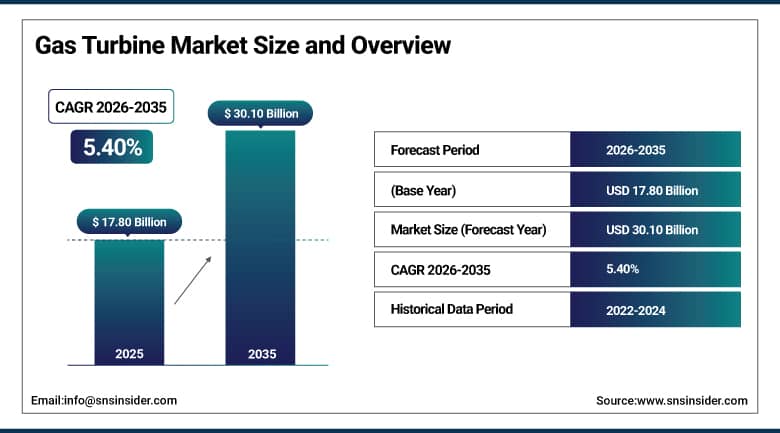
The Gas Turbine Market was valued at USD 17.80 Billion in 2025 and is projected to reach USD 30.10 Billion by 2035, registering a CAGR of 5.40% from 2026 to 2035.
The Gas Turbine Market growth is propelled by rapid replacement of outdated coal generation capacity, rising electricity consumption in connection with data centers running on AI technologies and electrification of industry, increasing investment in hydrogen-ready and ammonia-capable combustion technologies, and usage in utility-scale, oil and gas operations, manufacturing, and aviation sectors globally. Gas Turbines play a critical role in power generation around the world by offering fast-ramping, flexible generation capacity that enables higher shares of renewable energy sources on modern electric grids. The turbine converts energy released from the burning of natural gas or liquid fuels into mechanical and electrical energy via a rotating compressor, combustor, and turbine combination. Gas turbines are widely used in combined cycle installations for achieving efficiencies above 60%.
Long-term service agreements, collaboration between turbine suppliers and hyperscale data center companies, and development of digital twin and AI technologies for predictive maintenance have come after considerable investments in flexible, low-emission generation capacity made by utilities, independent power producers, and industrial companies.
To Get More Information On Gas Turbine Market - Request Free Sample Report
Gas Turbine Market Trends
-
Rising AI-driven data center power demand continues accelerating gas turbine order volumes worldwide.
-
Growing investment in hydrogen and ammonia-ready combustion systems continues expanding low-carbon turbine adoption.
-
Expanding coal-to-gas power plant conversions is broadening demand for combined-cycle turbine installations.
-
Increasing use of AI-based predictive maintenance and digital twins continues extending turbine service intervals.
-
Growing turbine leasing and mobile aeroderivative deployment continues supporting rapid disaster-recovery and peak-demand response.
U.S. Gas Turbine Market Size Outlook
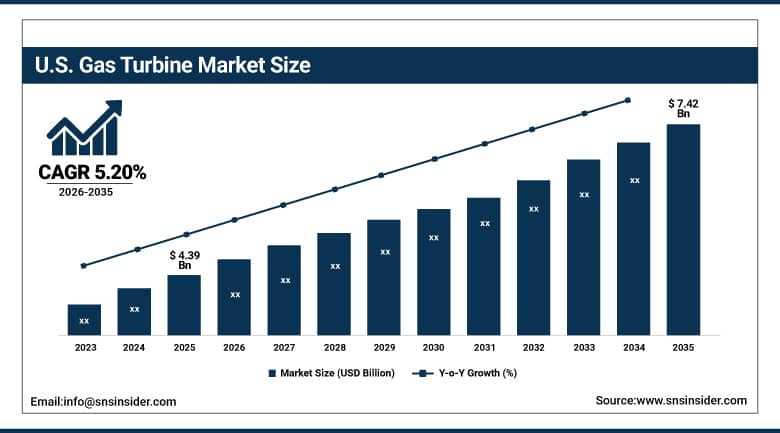
The U.S. Gas Turbine Market was valued at approximately USD 4.39 Billion in 2025 and is projected to reach approximately USD 7.42 Billion by 2035, registering a CAGR of approximately 5.20% from 2026 to 2035.
The demand in the U.S. has been fueled by rapid changes in coal-to-gas power generation, old infrastructure modernization, and rising electricity consumption by data centers and industries due to the development of AI technologies. The abundance of cheap shale gas and favorable federal policies have helped speed up the investments of utilities and independent producers in rapidly ramping gas turbine capacity that would help integrate renewable power into the grid.
The employment of long-term service agreements and AI-powered predictive maintenance software played a crucial role in strengthening the position of the U.S. gas turbine market. Moreover, the increased popularity of mobile aeroderivative turbines installed at hyperscale data center campuses boosted the demand for the product in the country.
Gas Turbine Market Segment Analysis
-
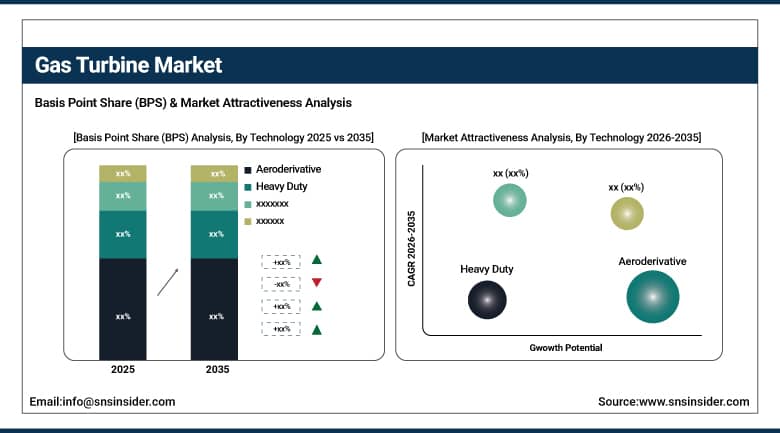
By Technology, Aeroderivative segment dominated the Market in 2025 with 41.50% share; Light Industrial segment is the fastest growing segment, registering a CAGR of approximately 7.80%.
-
By Cycle, Combined Cycle segment dominated the market in 2025 with 68.50% share; Combined Cycle segment is also the fastest growing segment, registering a CAGR of approximately 7.90%.
-
By Capacity, 100-300 MW segment dominated the market in 2025 with 29.60% share; Below 30 MW segment is the fastest growing segment, registering a CAGR of approximately 10.20%.
-
By Sector, Power Utilities segment dominated the market in 2025 with 45.80% share; Data Centers segment is the fastest growing segment, registering a CAGR of approximately 11.20%.
By Technology, Aeroderivative Dominates While Light Industrial Accelerates Fastest
The Aeroderivative Turbines had the highest market share of the Gas Turbine Market in 2025 at about 41.50% due to their ability to provide quick startup times and flexibility to be used in power generation and industrial applications. The deployment of GE Vernova's aeroderivative units LM2500XPRESS for providing almost 1 GW of flexible electricity to power AI data center campuses demonstrates the reason behind the utilities' and hyperscalers' tendency to prefer aeroderivative turbines over heavy-duty types for fast-deployed power plants.
The Light Industrial turbines are estimated to grow at a CAGR of about 7.80%, being the fastest-growing among all other segments of the Technology division, because of the increasing demand for such solutions in manufacturing processes, oil and gas industry, and distributed generation facilities. The growing trend to use compact units capable of running on two fuel types, suitable for CHP applications, supports the aforementioned growing trend.
By Cycle, Combined Cycle Leads and Grows Fastest
The Combined Cycle segment has the largest market share in 2025, which will be around 68.50% because of efficient use of waste heat, high efficiency, and closeness to the environmental compliance goals. It is also common that most power plants are established in stages such that initially simple cycle systems are established and then changed to combined cycle over time due to the availability of money, which makes the segment dominant.
Furthermore, the Combined Cycle is also expected to be the most rapidly growing cycle type with CAGR of around 7.90%, since utilities prefer ultra-high-efficiency cycle systems having more than 60% efficiency for reducing fuel usage and cost of operations. Companies keep enhancing heat recovery steam generators as well as combustion technologies.
By Capacity, 100-300 MW Dominates While Below 30 MW Grows Fastest
The 100-300 MW capacity segment held the largest share in 2025 at approximately 29.60%, owing to the fact that the turbines with such capacity range continue to be the workhorse for utility power production, especially in the current times, when the industry is trying to reduce hazardous emissions due to the environmental safety issues. The combination of the turbine output and its combined cycle efficiency makes this capacity range ideal for large power plant construction.
Below 30 MW turbines are projected to expand at a CAGR of approximately 10.20%, the fastest pace among capacity categories, driven by the ready availability of gas and rising demand for modular, dual-fuel-capable units suited to combined heat and power and cogeneration applications. Their compact footprint and rapid deployment timelines make them increasingly attractive for distributed generation, industrial, and remote-site power projects.
By Sector, Power Utilities Lead While Data Centers Gain Fastest Traction
Power Utilities became the dominant industry in 2025, contributing around 45.80% of the total revenue due to increasing efforts toward the replacement of existing steam and coal-based turbines with gas-based turbines in the power generation units. These turbines have significantly greater efficiency of power generation than the conventional ones, making utilities the structural support of the entire gas turbine market.
Data Centers are set to witness the fastest growth, with a CAGR of about 11.20%. The demand is expected to arise due to the increasing demand for AI-based computing applications and the requirement for rapid deployment of power generating systems due to backlogs of grid connection. Increasing investments of hyperscale operators in aeroderivative and heavy-duty turbine fleets make this industry the most dynamic emerging one.
Regional Analysis:
|
Region |
Major Country |
Share within Region, 2025 (%) |
|---|---|---|
|
North America |
United States |
83.50% |
|
Europe |
Germany |
10.50% |
|
Asia Pacific |
China |
23.00% |
|
Middle East and Africa |
Saudi Arabia |
30.00% |
|
Latin America |
Brazil |
60.00% |
North America Gas Turbine Market Insights
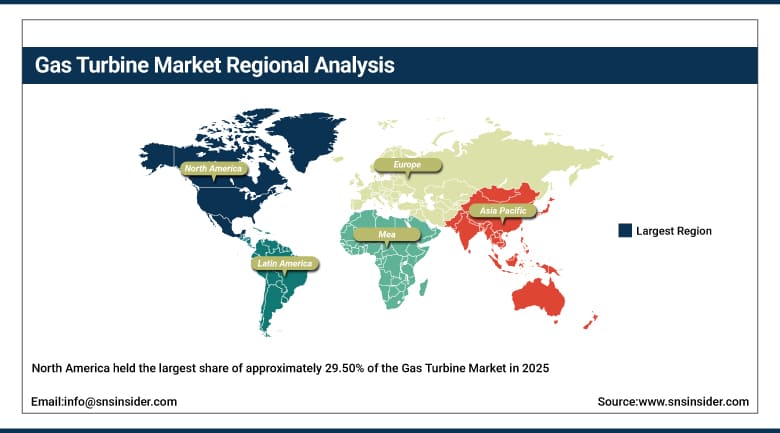
North America held the largest share of approximately 29.50% of the Gas Turbine Market in 2025, due to the quick transition from coal to gas-fired power generation, the need to replace outdated power infrastructure, and flexibility required for renewables integration. The abundant availability of low-cost shale gas, supportive government policies, and increased power demand from AI-based data centers have all contributed to North America's dominance over the forecast period.
The U.S. contributed approximately 83.50% of the total North American revenue share, mostly attributed to increased pressure on the grid connection queue leading to installation of gas turbine power generation at hyperscale facilities, the government incentive programs for local power infrastructure development, and higher service agreements from independent power producers with combined-cycle plants operating at multiple locations.
Get Customized Report as Per Your Business Requirement - Enquiry Now
Europe Gas Turbine Market Insights
The share of the Gas Turbine Market was large within Europe due to the requirement for grid flexibility because of renewable energy, the replacement of outdated power infrastructure, and decarbonization activities being carried out by the member countries of the region. With the help of standardized emission regulations and hydrogen blending programs, European utility companies are making an effort to acquire hydrogen-ready turbine systems to aid in energy transitions.
The country leading in terms of revenue in the European region was Germany as there was a need for balancing the grid due to the renewable energy generation mix of the country and the need for fast ramping capacity due to intermittent generation from wind and solar power sources. The United Kingdom and other Western European countries were contributing to the region's demand.
Asia Pacific Gas Turbine Market Insights
Asia Pacific is expected to register the highest growth at an estimated CAGR of 8.30% between 2026 and 2035. This region has seen growth due to rising electricity demands, urbanization, and a conscious effort by countries to transition from coal-powered plants to natural gas plants in China, India, Japan, and Southeast Asia.
China held the largest share of revenue generated in Asia Pacific at about 23.00% owing to industrialization, rapid urbanization, and stringent policies by the government for reducing the use of coal before 2060. This is because China aims to achieve carbon neutrality by 2060. Rapid growth of infrastructure in India and Southeast Asia, coupled with the increasing number of LNG terminal projects in the region, also contributed to the growth of Asia Pacific.
MEA and Latin America Gas Turbine Market Insights
Middle East & Africa and Latin America experienced consistent growth due to the development of extensive infrastructure, the incorporation of high-efficiency, hydrogen-ready combined-cycle gas turbines and industrialization necessitating dependable power production. The development of petrochemical cogeneration infrastructure in the Gulf and the renewal of power infrastructure that is aged in Latin America have made the two regions significant markets for gas turbines in the next ten years.
Saudi Arabia was leading in the region as it invested in extensive greenfield gas-fired power plants through Vision 2030 diversification and fuel switching program to replace the use of crude oil to generate power. The region also witnessed cogeneration projects in Qatar and the UAE that aided in increasing its share. On the other hand, Brazil accounted for the largest share in Latin America due to increasing industrialization and the need to update power infrastructure to natural gas-fired generation.
Market Dynamics:
Growth Drivers: Rising Electricity Demand and Grid Flexibility Needs
The market is expected to grow due to rising demand for electricity globally due to urbanization and industrialization, increasing requirement for fast-ramping flexible power generation capacity to integrate renewable energy, and surging AI-powered data centers’ power requirements that force hyperscale players to use rapidly deployable power generation capacity on-site. Taking into account the rising number of orders for gas turbines in connection with data center and grid modernization projects, demand for gas turbines will remain high during the forecast period.
Other evidence includes deepening of long-term service agreements between gas turbine manufacturers and utility customers, and government-supported coal-to-gas switching and grid flexibility programs in different regions. The continued interest of the global market in replacement of old thermal infrastructure without affecting grid stability is yet another factor supporting demand and growth dynamics throughout the forecast period.
Restraints: Natural Gas Price Volatility and Green Finance Barriers
Price fluctuation in natural gas as a result of geopolitical conflict and supply disruptions is an impediment to consistent project economics, especially in areas where there is no access to cheap domestic gas sources. In addition to that, the stringent sustainable finance requirements in some jurisdictions are posing financing hurdles to gas-fired power plants projects due to the stringent emissions intensity levels which rule out traditional gas plants from the green bond finance options.
Another issue is the high cost of construction and maintenance of modern combined-cycle turbines which might act as a hurdle to investments in emerging markets that are sensitive to prices. The lengthy process of project development and licensing also acts as a deterrent to project adoption especially in large utility projects.
Opportunities: Hydrogen-Ready Technology and Turbine Leasing Models
The increasing focus on hydrogen and ammonia compatible combustion technologies provides a clear opportunity for companies that can provide turbines which facilitate decarbonization but without removing any existing infrastructure. For instance, platform products provided by companies, such as GE Vernova and Siemens Energy, including advanced combustion testing with high percentage of hydrogen and ammonia firing, is one way how vendors can take advantage of this expanding process.
In addition to this, the increased need for turbine leasing and mobile aeroderivative turbines in climate fragile and capacity constrained areas provides an opportunity for vendors to prove their worth through rapid power deployment. Vendors who can add value to their products through lease-based financing and turbine pools in different regions will definitely benefit from the investments made by utilities and industrial customers.
Recent Developments:
-
2025: GE Vernova completed its Jafurah Cogeneration Independent Steam and Power Plant in Saudi Arabia, deploying its 7HA.01 gas turbine as the first H-Class unit completed locally in the Kingdom.
-
2025: Mitsubishi Power and Mitsubishi Electric completed functional testing of a next-generation gas turbine control system integrating high-speed data processing and multi-fuel compatibility, including hydrogen.
-
2026: Russia's Rostec launched the domestically produced GTD-110M gas turbine at the Udarnaya power station, boosting plant capacity to 560 MW amid import restrictions.
-
2026: Siemens Energy announced a US$1 billion investment to expand gas turbine and grid equipment manufacturing capacity across multiple U.S. states.
-
2026: Mitsubishi Power secured a contract to supply hydrogen-ready M701JAC gas turbines for a major independent water and power project near Doha, Qatar.
Gas Turbine Companies are:
-
GE Vernova Inc.
-
Mitsubishi Power, Ltd.
-
Ansaldo Energia S.p.A.
-
Solar Turbines Incorporated
-
Kawasaki Heavy Industries, Ltd.
-
Bharat Heavy Electricals Limited
-
OPRA Turbines B.V.
-
Rolls-Royce Holdings plc
-
Vericor Power Systems LLC
-
Wärtsilä Corporation
-
Harbin Electric International Company Limited
-
MAN Energy Solutions SE
-
United Engine Corporation (NPO Saturn)
-
Capstone Green Energy Corporation
-
Cryostar SAS
-
Zorya-Mashproekt
-
IHI Corporation
-
Baker Hughes Company
Gas Turbine Market Report Scope:
| Report Attributes | Details |
|---|---|
| Market Size in 2025 | USD 17.80 Billion |
| Market Size by 2035 | USD 30.10 Billion |
| CAGR | 5.40% from 2026 to 2035 |
| Base Year | 2025 |
| Forecast Period | 2026-2035 |
| Historical Data | 2022-2024 |
| Report Scope & Coverage | Market Size, Segments Analysis, Competitive Landscape, Regional Analysis, DROC & SWOT Analysis, Forecast Outlook |
| Key Segments | •By Technology, Aeroderivative segment dominated the Market in 2025 with 41.50% share; Light Industrial segment is the fastest growing segment, registering a CAGR of approximately 7.80%. •By Cycle, Combined Cycle segment dominated the market in 2025 with 68.50% share; Combined Cycle segment is also the fastest growing segment, registering a CAGR of approximately 7.90%. •By Capacity, 100-300 MW segment dominated the market in 2025 with 29.60% share; Below 30 MW segment is the fastest growing segment, registering a CAGR of approximately 10.20%. •By Sector, Power Utilities segment dominated the market in 2025 with 45.80% share; Data Centers segment is the fastest growing segment, registering a CAGR of approximately 11.20%. |
| Regional Analysis/Coverage | North America (US, Canada), Europe (Germany, UK, France, Italy, Spain, Russia, Poland, Rest of Europe), Asia Pacific (China, India, Japan, South Korea, Australia, ASEAN Countries, Rest of Asia Pacific), Middle East & Africa (UAE, Saudi Arabia, Qatar, South Africa, Rest of Middle East & Africa), Latin America (Brazil, Argentina, Mexico, Colombia, Rest of Latin America). |
| Company Profiles | GE Vernova Inc., Siemens Energy AG, Mitsubishi Power, Ltd., Ansaldo Energia S.p.A., Solar Turbines Incorporated, Kawasaki Heavy Industries, Ltd., Doosan Enerbility Co., Ltd., Bharat Heavy Electricals Limited, OPRA Turbines B.V., Rolls-Royce Holdings plc, Vericor Power Systems LLC, Wärtsilä Corporation, Harbin Electric International Company Limited, MAN Energy Solutions SE, United Engine Corporation (NPO Saturn), Capstone Green Energy Corporation, Cryostar SAS, Zorya-Mashproekt, IHI Corporation, Baker Hughes Company. |

Frequently Asked Questions
Key players in the Gas Turbine Market include GE Vernova Inc., Siemens Energy AG, Mitsubishi Power, Ltd., Ansaldo Energia S.p.A., and Solar Turbines Incorporated, among others.
Key opportunities in the Gas Turbine Market include expansion of hydrogen and ammonia-ready combustion technology, alongside growing demand for turbine leasing and mobile deployment models in climate-vulnerable and capacity-constrained regions.
The market is driven by rising electricity demand across the world, growing need for fast-ramping, flexible capacity to support renewable energy integration, and surging AI-driven data center power consumption.
The Aeroderivative segment dominated the Gas Turbine Market, accounting for approximately 41.50% market share.
The North America region dominated the Gas Turbine Market in 2025 with a 29.50% share, driven by rapid coal-to-gas power generation shifts and surging data center electricity demand.
