
Veterinary Clinical Trials Market Report Scope & Overview:
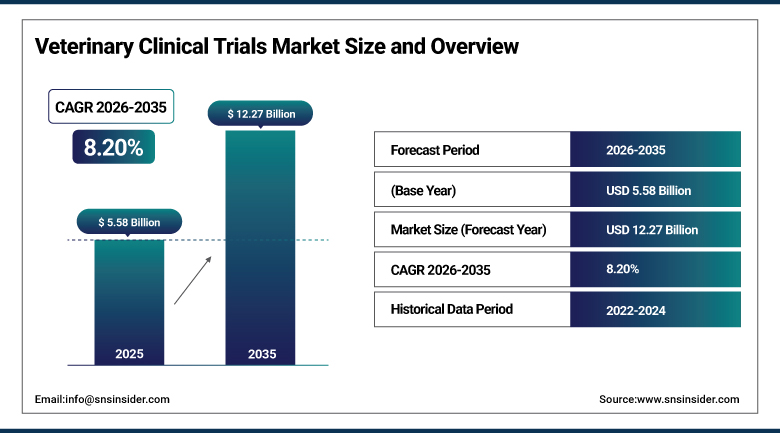
The Veterinary Clinical Trials Market was valued at USD 5.58 Billion in 2025 and is expected to reach USD 12.27 Billion by 2035, growing at a CAGR of 8.20% from 2026-2035.
The Veterinary Clinical Trials Market covers the design, conduct and management of studies that test the safety and efficacy of medicines, vaccines and medical devices in companion animals and livestock before regulatory approval. Studies are run by veterinary contract research organizations, academic hospitals and the research teams of animal health companies. Growth is supported by rising pet ownership, spending on companion animal care, demand for new therapies in oncology, pain and dermatology, and regulatory expectations for evidence, while patient recruitment, owner consent and study costs shape activity.
⮞In May, 2026, Clinglobal Group had completed its acquisition of the French research organizations OcciLife and Bio2M, which now operate together under the Clinvet name as Clinvet France. The deal followed 18 months of collaboration and brings the Clinvet brand to Europe after more than 26 years of operations in Africa and North America.
To Get more information Veterinary Clinical Trials Market - Request Free Sample Report
Veterinary Clinical Trials Market Trends
- Growth of pivotal field studies for monoclonal antibodies in canine pain and dermatology
- Rising use of veterinary patients in comparative oncology studies that inform human cancer research
- Expansion of veterinary contract research organizations through acquisitions and new sites
- Adoption of organ-on-chip and other models that reduce animal use in early research
- Use of electronic case report forms and decentralized visit models in client-owned animal studies
- Increase in livestock trials for vaccines and antimicrobial alternatives
U.S. Veterinary Clinical Trials Market Outlook
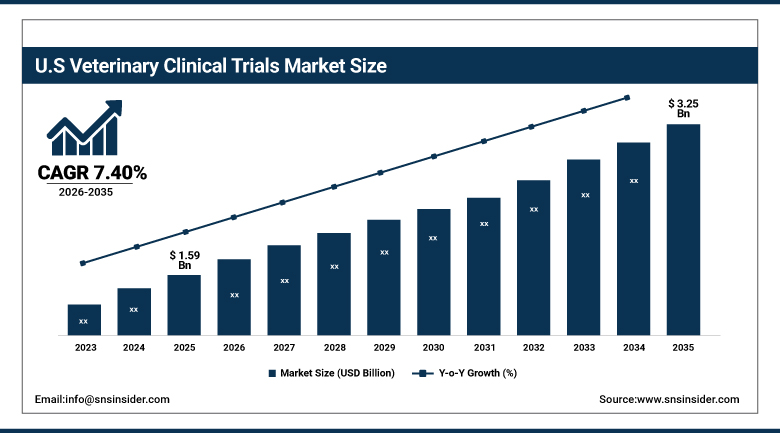
The U.S. Veterinary Clinical Trials Market was valued at USD 1.59 Billion in 2025 and is expected to reach USD 3.25 Billion by 2035, growing at a CAGR of 7.40% from 2026-2035.
The U.S. Veterinary Clinical Trials Market is the largest national market, supported by a large pet-owning population, a deep base of animal health companies, veterinary schools with specialty hospitals and an established regulatory pathway through the Food and Drug Administration and the Department of Agriculture. Companion animal studies in dermatology, pain, oncology and parasite control dominate activity, while livestock work focuses on vaccines and production animal health. Growth is moderated by study costs, owner recruitment and competition for specialist investigators.
⮞In December, 2025, Elanco Animal Health announced U.S. Department of Agriculture approval of Befrena, an anti-IL31 monoclonal antibody injection for canine allergic and atopic dermatitis, its second dermatology approval in under 18 months. Elanco expects to launch the product in the first half of 2026 and estimates the U.S. canine dermatology market at USD 1.30 billion.
Veterinary Clinical Trials Market Segment Analysis
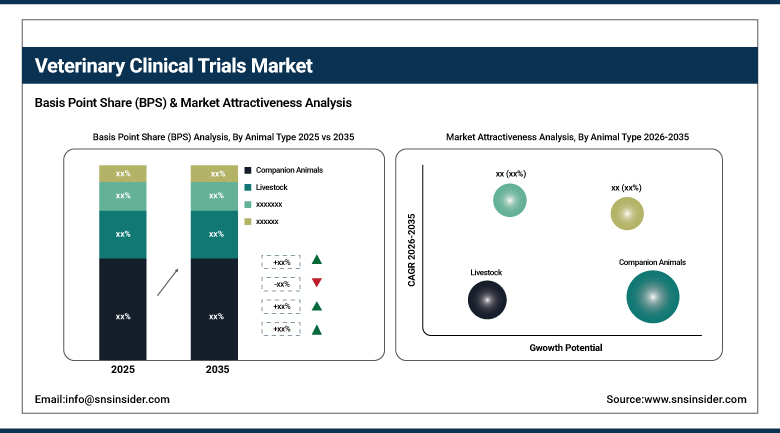
- By Animal Type, companion animals segment dominated the Veterinary Clinical Trials Market in 2025 with an estimated 60.50% share; livestock segment is the fastest-growing segment, with an estimated CAGR of 9.40% during 2026–2035.
- By Indication, oncology segment dominated the Veterinary Clinical Trials Market in 2025 with an estimated 28.00% share; internal medicine segment is the fastest-growing segment, with an estimated CAGR of 9.60% during 2026–2035.
- By Intervention, medicines segment dominated the Veterinary Clinical Trials Market in 2025 with an estimated 53.00% share; medical devices segment is the fastest-growing segment, with an estimated CAGR of 10.00% during 2026–2035.
- By Sponsor, veterinary pharmaceutical and biopharmaceutical companies segment dominated the Veterinary Clinical Trials Market in 2025 with an estimated 54.00% share; academic and research centers segment is the fastest-growing segment, with an estimated CAGR of 10.10% during 2026–2035.
By Animal Type, Companion Animals Dominates Veterinary Clinical Trials Market; Livestock to Register Fastest Growth.
Companion animals dominate the Veterinary Clinical Trials Market because dogs and cats are the focus of the highest-value animal health products, and owners are willing to pay for new therapies in pain, dermatology, oncology, cardiology and parasite control. Client-owned pets are enrolled in field studies at veterinary clinics and specialty hospitals, where owner engagement and a large patient base support recruitment. Sponsors prioritize companion animal programs because of larger commercial returns and strong regulatory pathways in major markets. Pet insurance growth also supports willingness to pay for treatment.
Livestock is projected to register the fastest growth because producers and governments are investing in vaccines, antimicrobial alternatives and production health tools for cattle, swine and poultry. Trials in food animals require controlled housing, large animal numbers and strict biosecurity, so specialist research organizations and farms play a central role. Disease outbreaks, pressure to reduce antibiotic use and food security programs in Asia, Latin America and Africa add demand for livestock studies. Regulators in these regions also expect robust field data on vaccine performance.
By Indication, Oncology Dominates Veterinary Clinical Trials Market; Internal Medicine to Register Fastest Growth.
Oncology dominates the Veterinary Clinical Trials Market because cancer is common in older dogs and cats, and companion animal tumors share biological features with human cancers. Veterinary oncology centers run studies of chemotherapy, targeted therapy, immunotherapy and radiation, and comparative oncology programs let researchers test agents in pets with naturally occurring tumors. Owners seek new options for their animals, which supports recruitment, and results can inform human drug development. Referral oncology practices also provide steady patient access for sponsors planning multicenter studies.
Internal medicine is projected to register the fastest growth because chronic conditions such as kidney disease, diabetes, endocrine disorders and gastrointestinal disease are rising as pets live longer. Sponsors are developing drugs and diets for these conditions and need field studies to show benefit over months or years. Orthopedics, cardiology, neurology, ophthalmology and dermatology also contribute, with osteoarthritis pain and itch control producing some of the largest pivotal programs in the market. Dietary and nutrition studies add further activity in these conditions.
⮞Zoetis shows the scale of these programs. On October 15, 2025, Health Canada approved Zoetis's Lenivia, a monoclonal antibody given once every three months to relieve osteoarthritis pain in dogs, and the company cited a nine-month field study in which treated dogs showed increased mobility and decreased pain.
By Intervention, Medicines Dominates Veterinary Clinical Trials Market; Medical Devices to Register Fastest Growth.
Medicines dominate the Veterinary Clinical Trials Market because most studies test drugs, biologics and vaccines, which require demonstrated safety and efficacy for approval. Small molecules, monoclonal antibodies, vaccines, anti-parasitics and antimicrobials move through dose confirmation, laboratory studies and pivotal field trials, and the number of products in development continues to rise. Large animal health companies and biotechnology start-ups maintain steady pipelines that keep medicine trials at the center of the market. Reliable manufacturing and regulatory precedent also reduce risk for sponsors planning new programs.
Medical devices are projected to register the fastest growth as veterinary hospitals adopt implants, monitoring systems, surgical tools, imaging aids and digital health products that need evidence of benefit. Device studies are often shorter and smaller than drug studies, which attracts start-ups and academic groups. Regenerative therapies, wearable monitors for pets and orthopedic implants are examples, and regulators in several countries are clarifying how such products should be evaluated before they reach clinics. Pilot studies in single clinics often precede larger multicenter programs.
By Sponsor, Veterinary Pharmaceutical and Biopharmaceutical Companies Dominates Veterinary Clinical Trials Market; Academic and Research Centers to Register Fastest Growth.
Veterinary pharmaceutical and biopharmaceutical companies dominate the Veterinary Clinical Trials Market because they fund the large pivotal programs required for product approval. Global animal health companies run extensive portfolios across parasiticides, pain, dermatology and vaccines, and they outsource a large share of studies to contract research organizations. Their budgets, regulatory experience and commercial plans make them the main source of demand for trial sites, investigators and monitoring services. Established sponsor relationships also give these companies strong influence over study design and timelines across regions.
Academic and research centers are projected to register the fastest growth because veterinary schools are expanding specialty hospitals, research funding and partnerships with industry. Universities offer access to specialist investigators, large patient populations and shared facilities, and they lead comparative oncology and translational studies. Philanthropic funding is helping, as seen in the large gift to the University of California, Davis, in January 2026, and governments are supporting alternative models that reduce animal use. Public research grants and philanthropic funds often support these studies.
Regional Analysis
|
Region |
Major Country |
Share within Region, 2025 (%) |
|
North America |
United States |
84.00 |
|
Europe |
Germany |
26.00 |
|
Asia Pacific |
China |
44.00 |
|
Latin America |
Brazil |
56.00 |
|
Middle East & Africa |
Saudi Arabia |
27.00 |
North America Veterinary Clinical Trials Market Insights
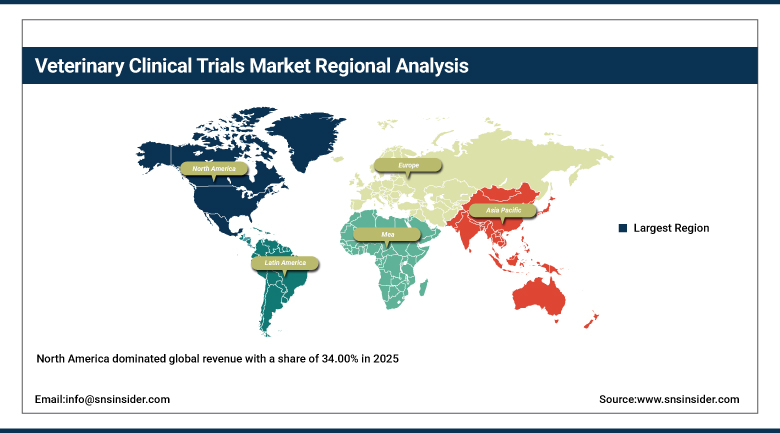
North America dominated global revenue with a share of 34.00% in 2025. The United States accounts for majority of regional demand, with Canada adding volume through approvals and field studies. The region has large animal health companies, contract research organizations such as Charles River Laboratories and Inotiv, veterinary schools with specialty hospitals and a high rate of pet ownership. Canada adds a smaller but growing research base through its veterinary colleges.
Companion animal studies in pain, dermatology, oncology and parasite control are the main activity, and sponsors value access to experienced investigators and large patient pools. Livestock studies concentrate in the Midwest and the Plains, where research organizations run infectious disease models in swine, poultry and cattle. High study costs, difficulty recruiting owners and competition for specialists restrain growth, although strong funding keeps the region at the top. Established networks of referral hospitals also allow sponsors to enroll specific diagnoses quickly, which shortens timelines for multicenter field studies.
⮞On January 29, 2026, philanthropists Joan and Sanford Weill gave USD 120 million to the University of California, Davis School of Veterinary Medicine, which was renamed the UC Davis Weill School of Veterinary Medicine. About USD 80 million will fund a new small animal teaching hospital and USD 40 million will support cross-species research on cancer, neurological and cardiovascular disease.
Get Customized Report as per Your Business Requirement - Enquiry Now
Europe Veterinary Clinical Trials Market Insights
Germany leads regional demand, followed by the United Kingdom, France, Spain, Italy and the Netherlands, supported by strong animal health companies, veterinary schools and contract research organizations. Argenta, Cebiphar, Klifovet, Knoell, Scantox and Löhlein & Wolf Vet Research are among the providers serving sponsors in the region. Veterinary hospitals and university clinics in these countries also take part in multicenter studies for global sponsors, and specialist referral centers provide reliable access to cases.
European rules under the Veterinary Medicinal Products Regulation shape study design and approvals, and animal welfare principles encourage use of alternative methods that reduce animal numbers. Academic centers such as the Royal Veterinary College are building new models, and companion animal and livestock studies both contribute. Fragmented national requirements and high costs temper growth, but a large pet population and an established research base support steady demand. Brexit has also added separate regulatory steps in the United Kingdom, although cooperation between research groups continues across borders.
⮞On September 9, 2025, the Royal Veterinary College signed a memorandum of understanding with Emulate, Inc. to develop organ-on-a-chip models of veterinary species. Emulate described the collaboration as establishing the first veterinary-focused Organ-Chip service offering, and the college said the approach could reduce the number of animals needed for research.
Asia Pacific Veterinary Clinical Trials Market Insights
Asia Pacific is projected to be the fastest-growing region, at a CAGR of 10.20% during 2026-2035. China leads regional demand, followed by Japan, South Korea, India and Australia, supported by rising pet ownership, growth in livestock production and local animal health companies that are moving into innovative drugs. Providers include Daewoong Pet, Scantox, Biotest Lab and Shokukanken, and global sponsors are widening studies in the region. Australia and New Zealand add strong livestock and companion animal research capability, with experienced contract research organizations serving international sponsors.
Governments are updating veterinary drug registration rules, and local sponsors are filing clinical trial applications for pet therapies in diabetes, kidney disease and pain. Lower study costs and large patient populations draw contract research work, although differences in regulations, limited numbers of qualified sites and quality standards remain challenges. Livestock studies for vaccines and antimicrobial alternatives add demand in China, India and Southeast Asia. Pet food and nutrition companies are also funding studies in the region, adding to demand for qualified veterinary investigators and sites.
⮞On October 1, 2024, Daewoong Pet, a subsidiary of Daewoong Pharmaceutical, entered the contract research sector in South Korea to support the full clinical trial process for veterinary drugs. The company noted that over 70% of drugs used in veterinary clinics are human medications and that pet-owning households in Korea rose to about 6.30 million in 2023.
MEA & Latin America Veterinary Clinical Trials Market Insights
In Latin America, Brazil leads on the strength of its livestock industry and growing pet population, followed by Mexico, Argentina and Colombia. Regional demand grows, with studies concentrated on vaccines, parasite control and production animal health. Multinational sponsors work with local research groups, and companies in Argentina and Brazil are expanding vaccine capacity. Chile and Peru add livestock-related demand, and universities in Brazil and Argentina provide investigators and laboratories that help sponsors run field studies with local partners.
In the Middle East and Africa, the United Arab Emirates, Saudi Arabia and South Africa lead demand, supported by livestock health programs, food security goals and investment in veterinary services. South Africa hosts large-animal research facilities, while Gulf countries are building laboratories and veterinary businesses. Limited numbers of trained investigators and fragmented regulation restrain activity. Egypt and Kenya add smaller volumes through livestock disease programs, and universities in the region are partnering with international sponsors and research organizations.
⮞On July 4, 2024, Biogénesis Bagó opened a USD 30 million vaccine plant in Campo Largo, Brazil, with capacity of over 10 million doses per year. In 2026, Al Khayyat Investments of the United Arab Emirates committed USD 100 million to launch VetHealth, a veterinary division with pharmaceuticals, biologicals, biosecurity, nutrition and diagnostics units serving the Middle East and Africa.
Market Dynamics
Growth Drivers: Pet Ownership, Pipeline Growth and Outsourcing
Rising pet ownership and spending on animal health are central drivers of the Veterinary Clinical Trials Market. Owners increasingly treat pets as family members and seek advanced therapies for pain, skin disease, cancer and chronic illness, which gives sponsors commercial reasons to fund pivotal programs. Monoclonal antibodies and other biologics for dogs and cats have created a new generation of products that require large field studies.
Outsourcing is adding to demand. Animal health companies use contract research organizations to run studies across several countries, and providers are expanding sites and services through acquisitions and partnerships. Greater regulatory attention to data quality, as well as the growth of livestock programs on vaccines and antimicrobial alternatives, adds to the pipeline of studies that need qualified sites.
Restraints: Recruitment, Cost and Regulatory Differences
Recruiting client-owned animals is harder than recruiting human patients in some respects, because owners must agree to visits, sampling and sometimes extended follow-up, and veterinary clinics have limited research capacity. Studies in chronic disease can last many months, which raises cost and the risk of dropouts.
Regulatory requirements differ among countries, so multinational programs must adapt protocols and documentation. A limited number of qualified investigators and sites, concerns about animal welfare and pressure to reduce animal use also affect study planning and budgets, particularly for large animal and laboratory work.
Opportunities: New Models, Emerging Markets and Translational Research
New research models such as organ-on-chip systems, digital endpoints and decentralized visits can reduce animal numbers, speed enrollment and lower cost. Providers that adopt these tools can offer sponsors faster and more efficient studies, and academic partnerships help validate them.
Emerging markets in Asia, Latin America and the Middle East offer growing pet and livestock populations and sponsors looking for local data. Translational work, including comparative oncology, can also create value because pets with naturally occurring disease provide evidence that is useful for both animal and human medicine.
⮞On February 4, 2026, INNOGEN-B announced that China's Ministry of Agriculture and Rural Affairs had accepted its veterinary drug clinical trial application for Esupaglutide α, a candidate for diabetes in companion animals, with Phase I trials expected to begin in the first quarter of 2026.
Recent Developments:
- In July 2026, Zoetis launched Lenivia, a long-acting monoclonal antibody for canine osteoarthritis pain, in Canada and European Union member states. The launch follows a nine-month European pivotal field study that showed pain reduction as early as day 7.
- In May 2026, Clinglobal Group completed the acquisition of French research organizations OcciLife and Bio2M, which now operate as Clinvet France. The deal extends the group's preclinical and clinical research capabilities into Europe.
- In February 2026, INNOGEN-B had its veterinary drug clinical trial application for Esupaglutide α accepted by China's Ministry of Agriculture and Rural Affairs. The candidate targets diabetes in companion animals.
- In December 2025, Elanco Animal Health received U.S. Department of Agriculture approval for Befrena, an anti-IL31 monoclonal antibody for canine allergic and atopic dermatitis. The approval adds to the company's dermatology portfolio.
- In September 2025, the Royal Veterinary College signed a memorandum of understanding with Emulate to develop organ-on-a-chip models for veterinary species. The agreement supports research that can reduce animal use.
Veterinary Clinical Trials Market Key Players are:
-
Charles River Laboratories International, Inc.
-
IDEXX Laboratories, Inc.
-
Boehringer Ingelheim International GmbH
-
Argenta Limited
-
Veterinary Research Management
-
Clinvet (Clinglobal Group)
-
Labcorp Drug Development
-
Inotiv, Inc.
-
KLIFOVET GmbH
-
Cebiphar
-
Oncovet Clinical Research (OCR)
-
Knoell
-
Scantox
-
Löhlein & Wolf Vet Research
-
Zoetis Inc.
-
Elanco Animal Health Incorporated
-
Merck Animal Health
-
Premier Research
-
STATKING Clinical Services
-
Daewoong Pet
Veterinary Clinical Trials Market Report Scope:
| Report Attributes | Details |
|---|---|
| Market Size in 2025 | USD 5.58 Billion |
| Market Size by 2035 | USD 12.27 Billion |
| CAGR | CAGR of 8.20% From 2026 to 2035 |
| Base Year | 2025 |
| Forecast Period | 2026-2035 |
| Historical Data | 2022-2024 |
| Report Coverage | Market Size, Segments Analysis, Competitive Landscape, Regional Analysis, DROC & SWOT Analysis, Forecast Outlook |
| Key Segments | • By Animal Type (Companion Animals, Livestock, and Others) • By Indication (Oncology, Internal Medicine, Orthopedics, Cardiology, Neurology, Ophthalmology, Dermatology, and Others) • By Intervention (Medicines, Medical Devices, and Others) • By Sponsor (Veterinary Pharmaceutical and Biopharmaceutical Companies, Academic and Research Centers, and Others) |
| Regional Analysis/Coverage | North America (US, Canada), Europe (Germany, UK, France, Italy, Spain, Russia, Poland, Rest of Europe), Asia Pacific (China, India, Japan, South Korea, Australia, ASEAN Countries, Rest of Asia Pacific), Middle East & Africa (UAE, Saudi Arabia, Qatar, South Africa, Rest of Middle East & Africa), Latin America (Brazil, Argentina, Mexico, Colombia, Rest of Latin America). |
| Company Profiles | Charles River Laboratories International, Inc.; IDEXX Laboratories, Inc.; Boehringer Ingelheim International GmbH; Argenta Limited; Veterinary Research Management; Clinvet (Clinglobal Group); Labcorp Drug Development; Inotiv, Inc.; KLIFOVET GmbH; Cebiphar; Oncovet Clinical Research (OCR); Knoell; Scantox; Löhlein & Wolf Vet Research; Zoetis Inc.; Elanco Animal Health Incorporated; Merck Animal Health; Premier Research; STATKING Clinical Services; Daewoong Pet |

Frequently Asked Questions
Key players include Charles River Laboratories International, Inc., IDEXX Laboratories, Inc., Boehringer Ingelheim International GmbH, Argenta Limited, Veterinary Research Management, Clinvet, Labcorp Drug Development and Inotiv, Inc.
Key opportunities include new research models such as organ-on-chip systems, trials in emerging markets in Asia, Latin America and the Middle East, and translational oncology studies.
The major growth factor is rising pet ownership and spending on animal health, which supports pipelines of biologics and other therapies requiring field studies.
By Animal Type, the Companion Animals segment dominated the market in 2025 with an estimated 60.50% share, supported by demand for pain, dermatology and oncology therapies.
North America dominated the market with a share of 34.00% in 2025, driven by a large pet population, major animal health companies and veterinary schools.
