
Health and Wellness Market Report Scope & Overview:
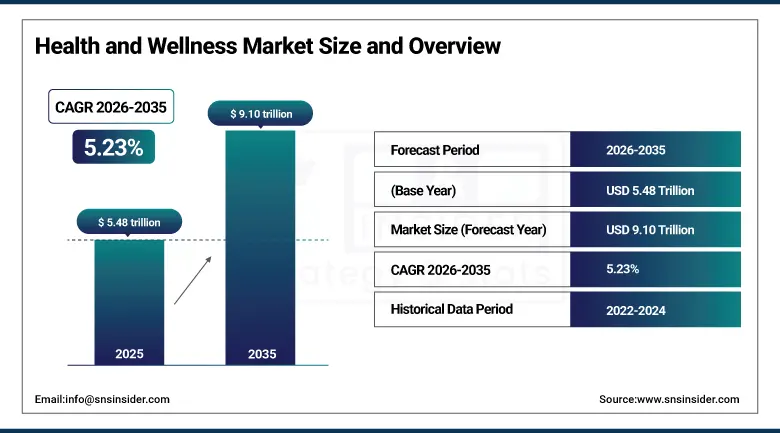
The Health and Wellness Market was valued at USD 5.48 Trillion in 2025. and is expected to reach USD 9.10 Trillion by 2035, growing at a CAGR of 5.23% from 2026 to 2035.
Growth in the Health & Wellness Market can be attributed to consumers placing more importance on preventive healthcare, healthy living, and wellbeing. Consumer consciousness about issues of nutrition, physical fitness, boosting immunity, and psychological wellbeing is contributing towards rising demand for wellness solutions on a global scale. Consumers are turning to functional foods, dietary supplements, wearable health gadgets, and wellness platforms to monitor their health status and improve it. Escalating medical expenses are making it necessary to opt for preventive healthcare measures. Moreover, developments in areas such as personal nutrition, telemedicine, fitness technologies, and wellness software will further contribute towards market growth..
Herbalife and Amway have diversified their personalized nutrition and wellness product offerings due to increasing demand for preventive healthcare and fitness products by consumers across the globe.Investments in digital wellness and preventive healthcare surpassed USD 420 billion during 2025, with more consumers embracing holistic wellness products that promote physical fitness, mental wellness, and lifestyle improvement.
To Get more information on Health and Wellness Market - Request Free Sample Report
Health and Wellness Market Trends
-
Consumers are becoming more health conscious and focusing on preventive care, which is increasing demand for functional foods, nutritional supplements, and wellness-oriented products worldwide.
-
Fitness wearables and AI-powered health monitoring apps are gaining popularity as people increasingly prefer real-time health tracking and personalised wellness recommendations.
-
Rising awareness about mental wellbeing, stress management, and better sleep habits is encouraging adoption of mindfulness programmes, wellness applications, and holistic healthcare solutions globally.
-
Consumers are showing stronger preference for clean-label, organic, and plant-based nutrition products to improve immunity, fitness, and overall lifestyle health.
-
Growing investments in personalised nutrition, connected fitness platforms, and digital wellness technologies are supporting long-term expansion of the global health and wellness industry.
U.S. Health and Wellness Market Outlook
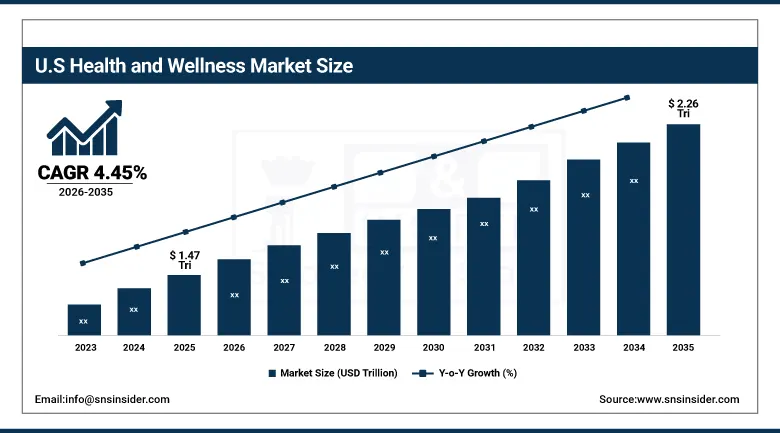
The U.S. Health and Wellness Market was valued at approximately USD 1.47 Trillion in 2025 and is expected to reach approximately USD 2.26 Trillion by 2035, growing at a CAGR of approximately 4.45% from 2026 to 2035.
Health and wellness market in the U.S. will witness an upward trend because of the growing interest of consumers towards preventive care, physical fitness, healthy food, and wellness. Increasing healthcare expenditures are leading consumers to lead healthier lifestyles and spend more money on health and wellness products and services. People are buying more supplements, healthy food products, exercise equipment, and wearables as a means of ensuring good health in the future. The rising cases of obesity, lifestyle diseases, and psychological problems are another major factor responsible for the growth of the health and wellness market.
In February 2025, Life Time Group extended its wellness and digital fitness membership platforms in view of consumer demand for holistic wellness products and services. WHOOP improved its use of wearable health monitors and AI technology that could help recover better after workouts. In 2025, the country recorded over USD 185 Billion investments in digital health and wellness technology products and applications. The increasing number of users for fitness trackers and wellness applications remained an important factor for the commercialization of the health and wellness ecosystem in the country.
Health and Wellness Market Segment Analysis
-
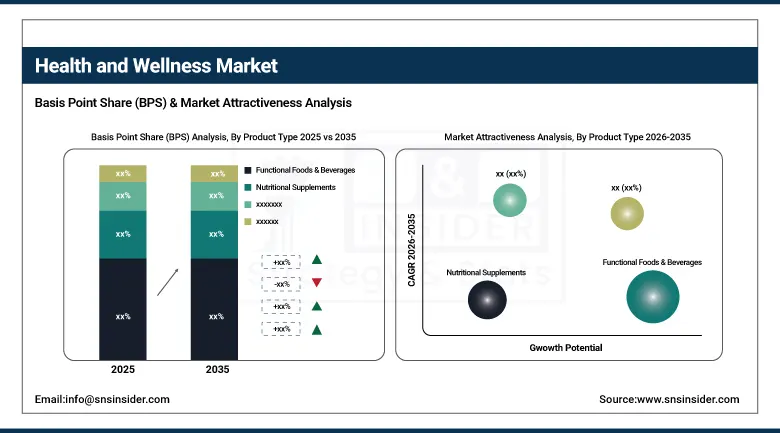
By Product Type, functional foods & beverages dominated the health and wellness market with 34.00% share in 2025, while nutritional supplements are the fastest growing product type with the highest CAGR from 2026 to 2035.
-
By Distribution Channel, supermarkets & hypermarkets dominated the health and wellness market with 39.00% share in 2025, while online retail is the fastest growing distribution channel with the highest CAGR from 2026 to 2035.
-
By End User, adults dominated the health and wellness market with 46.00% share in 2025, while millennials & Gen Z are the fastest growing consumer group with the highest CAGR from 2026 to 2035.
-
By Application, preventive healthcare dominated the health and wellness market with 37.00% share in 2025, while mental wellness is the fastest growing application with the highest CAGR from 2026 to 2035.
By Product Type, functional foods & beverages dominate, nutritional supplements grow fastest
Functional foods & beverages dominated the health and wellness market in 2025, accounting for approximately 34% of the total revenue share owing to increasing consumer demand for immunity-boosting, protein-rich and preventive healthcare nutrition products across the globe. Consumers increasingly adopted fortified beverages, probiotic foods, energy drinks and functional snacks to improve their long-term health, digestive wellness and lifestyle management. Growing awareness about preventive healthcare and healthy dietary habits has further accelerated commercialisation of wellness-focused food products worldwide. Global spending on functional food & beverage products is expected to exceed USD 890 billion by 2025, with the growing appetite for clean-label and plant-based nutrition products strengthened long term market expansion globally.
Nutritional supplements are expected to register the fastest CAGR during the forecast period, due to the increasing consumer awareness for personalised nutrition, immunity support, and fitness management solutions across the globe. The increasing acceptance of vitamins, minerals, protein supplements and herbal wellness products by millennials and ageing populations continued to accelerate commercialisation opportunities for advanced nutritional supplement ecosystems worldwide.
By Distribution Channel, supermarkets & hypermarkets dominate, online retail grows fastest
Supermarkets & hypermarkets were the leading segments in the health and wellness market in 2025, accounting for about 39% revenue share, driven by the strong preference of consumers for convenient access to functional foods, nutritional supplements, personal wellness products, and preventive healthcare solutions from organised retail channels across the globe. Increasingly, large retail chains expanded dedicated health and wellness product sections supporting broader consumer accessibility and product visibility across urban markets worldwide. The increasing penetration of premium organic products and wellness-focused retail ecosystems further expedited commercialisation opportunities for health and wellness brands across the globe
The online retail is expected to register the fastest CAGR owing to the rising adoption of digital commerce and increasing consumer preference for personalised wellness shopping experiences across the globe. The growing consumer purchases of nutritional supplements, fitness products, and wellness solutions on e-commerce platforms due to convenience, subscription models and wider product accessibility are supporting the long-term expansion of the global digital wellness ecosystem.
By End User, adults dominate, millennials & Gen Z grow fastest
The adults segment dominates the health and wellness market in 2025 contributing around 46% of the total revenue share owing to increasing focus on preventive healthcare, fitness management, nutritional balance, and lifestyle disease prevention globally. Adult consumers were increasingly investing in functional foods, wellness supplements, fitness equipment and digital health monitoring technologies that supported long-term physical and mental wellbeing. Rising prevalence of obesity, cardiovascular diseases and stress related health conditions further increased the demand for wellness focused consumer products across the globe. Global spending on adult wellness and preventive healthcare surpassed USD 2.1 Trillion in 2025, opening up opportunities for the growth of personalised health management ecosystems globally.
Millennials & Gen Z are expected to witness the fastest CAGR during the forecast period due to increasing adoption of digital wellness platforms, wearable fitness technologies, plant-based nutrition products and mental wellness applications globally. Younger consumers are focusing more on managing their overall lifestyle and on preventive wellness solutions that foster the long-term growth of connected wellness ecosystems worldwide.
By Application, preventive healthcare dominates, mental wellness grows fastest
Preventive healthcare held the largest share of the health and wellness market in 2025 and accounted for around 37% revenue share due to increasing consumer awareness about chronic disease prevention, immunity management, and long-term health optimisation worldwide. Consumers increasingly adopted wellness supplements, functional nutrition products, wearable health monitoring technologies and fitness solutions to reduce long-term healthcare risks and enhance quality of life. The global demand for preventive wellness ecosystems has been further accelerated by rising healthcare costs and lifestyle-related disorders. In 2025, global spending on preventive healthcare and wellness surpassed USD 2.4 trillion, driving the commercialisation of advanced health-focused consumer products and digital wellness technologies worldwide
Mental wellness is likely to witness the fastest CAGR growth, driven by the rising awareness on stress management, emotional wellbeing, sleep quality, and holistic mental healthcare. The increasing adoption of mindfulness applications, wellness coaching platforms, meditation programs, and digital therapy solutions further boosted commercialisation opportunities for advanced mental wellness ecosystems worldwide
Regional Analysis
|
Region |
Major Country |
Share within Region, 2025 (%) |
|---|---|---|
|
North America |
United States |
82.44% |
|
Europe |
Germany |
27.36% |
|
Asia Pacific |
China |
36.18% |
|
Middle East & Africa |
UAE |
23.84% |
|
Latin America |
Brazil |
41.27% |
North America Health and Wellness Market Insights
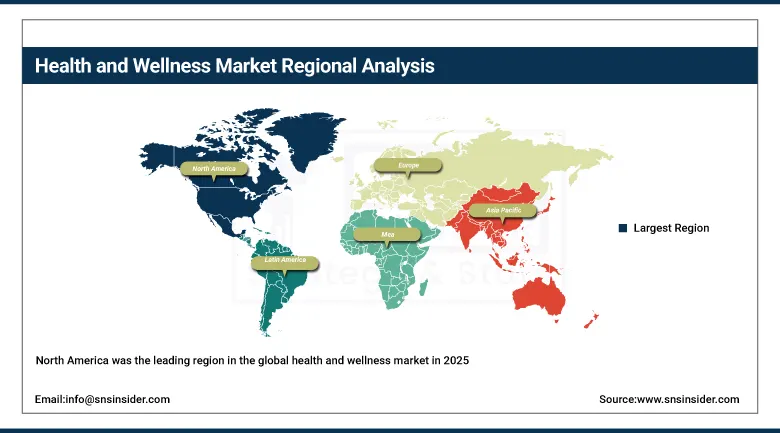
North America was the leading region in the global health and wellness market in 2025, contributing close to 32.45% to the revenue pool, propelled by high spending capacity on preventive care services, technological solutions for fitness, health and nutrition supplements in the United States and Canada.
The awareness about preventive healthcare along with growing adoption of Artificial Intelligence based technologies in health monitoring systems is expected to contribute positively towards market growth over the coming years in North America. The US continued to lead in investments in digital wellness, while Canada rapidly pushed forward with the development of wellness ecosystems.
Get Customized Report as per Your Business Requirement - Enquiry Now
Europe Health and Wellness Market Insights
Contribution from Europe was at about 30.56%, attributable to the focus of the consumers on healthy living, preventative medicine, and organic food and wellness products such as those used in Germany, France, Italy and the United Kingdom. The European consumers were spending on fitness programs, vitamins and other nutrients, wellness tourism and applications in the digital health ecosystem to sustain their physical and mental wellbeing.
The growth opportunities in Europe will be propelled by growing demand for organic food products and mental wellness services. Wellness product consumption remained high in Germany while there was improved focus in digital fitness and preventative medicine in the United Kingdom.
Asia Pacific Health and Wellness Market Insights
The Asia Pacific region accounted for a significant share of around 29.67% of the overall revenues generated by the health and wellness market in 2025, thanks to factors such as higher disposable incomes, preventive healthcare consciousness, and the adoption of functional nutrition and fitness solutions in countries like China, Japan, India, and South Korea. There has been an increased consumer trend towards herbal wellness products, as well as the use of wearable fitness and holistic healthcare products to enhance lifestyle.
The trend toward urbanization along with the need for preventive healthcare solutions will positively contribute to long-term market growth within the Asia Pacific region. The leading demand for functional nutrition and wellness products was from China in 2025, while India made progress in digital wellness and fitness ecosystems.
MEA & Latin America Health and Wellness Market Insights
Middle East & Africa and Latin America collectively accounted for nearly 7.33% of total revenue generated by the global health and wellness market in 2025. Rising health consciousness, adoption of wellness and fitness products, and investments made towards preventive health care have been driving the regional market. People started embracing wellness supplements, fitness subscriptions, digital wellness applications, and organic nutrition to manage their lifestyles in the long run.
In 2025, Brazil remained at the forefront of fitness and nutritional supplements consumption within the region, whereas UAE made more efforts towards wellness tourism and preventive health care. Growth witnessed in the regional health and wellness markets throughout the world can be attributed to the rising importance of healthy living amongst consumers.
Market Dynamics
Growth Drivers: Rising preventive healthcare awareness and personalized wellness adoption
The global health and wellness market is positively impacted by increasing consumer knowledge of preventive healthcare and rising acceptance of personalised wellness offerings. Consumers are increasingly spending on functional foods, nutritional supplements, wearable fitness technology, wellness apps and preventive healthcare products to improve their long-term physical and mental wellbeing. Growing incidence of obesity, diabetes, cardiovascular diseases and stress related health conditions are further driving the demand for fitness management and holistic wellness ecosystems globally. Global preventive healthcare and wellness spending exceeded USD 2.4 Trillion in 2025, and investments in digital wellness and connected health technology continued to grow in global North America, Europe and Asia Pacific consumer markets.
Restraints: High wellness product costs and regulatory compliance challenges
High costs of premium wellness products and increasing regulatory compliance requirements are creating operational challenges across the global health and wellness market. Personalised nutrition products, wearable fitness devices, organic food products and digital wellness solutions are often associated with higher pricing structures that restrict access to them among price sensitive consumer groups around the world. Regulatory standards relating to nutritional labelling, health claims, consumer safety and supplement quality verification are also increasing operational complexity for wellness product manufacturers worldwide. Increased raw material and logistics costs continued to create pricing pressures across wellness ecosystems globally. Global wellness product manufacturing and distribution costs increased more than 10% in 2025.
Opportunities: Expansion of digital wellness and AI-enabled health ecosystems
Increasing use of AI-enabled health monitoring systems and development of connected wellness ecosystems present lucrative business potential in the international health and wellness industry. The growing inclination of consumers towards wearable health devices, wellness apps, virtual fitness programs, and artificial intelligence-based nutrition tracking systems for real-time health management and lifestyle optimization is evident. Increasing focus on telemedicine, digital therapies, and preventive care technologies is adding to the growth potential in the international connected wellness market. Over 420 Billion USD has been invested in digital health and wellness in 2025, whereas rising consumer demand for personalized wellness solutions led to increased commercialization in the health and wellness industry.
Recent Developments:
-
In March 2025, Nestlé Health Science expanded personalized nutrition and wellness product portfolios supporting rising global demand for preventive healthcare and functional nutrition solutions.
-
In February 2025, Fitbit strengthened AI-powered health tracking and connected wellness technologies targeting digital fitness and lifestyle management ecosystems globally.
-
In January 2025, GNC Holdings expanded immunity-focused nutritional supplement and wellness product offerings supporting growing consumer focus on holistic health management worldwide.
-
In January 2025, Technogym accelerated deployment of connected fitness and digital wellness platforms supporting integrated home and commercial fitness ecosystems globally.
-
In January 2025, Life Time Group strengthened holistic wellness and mental wellbeing programs supporting expansion of integrated health management ecosystems across North America.
The Health and Wellness Market Key Players are:
-
Nestlé Health Science
-
Herbalife Ltd.
-
Amway Corporation
-
GNC Holdings LLC
-
Nature’s Bounty
-
Glanbia PLC, Danone S.A.
-
Abbott Laboratories
-
PepsiCo Inc.
-
The Coca-Cola Company
-
Unilever PLC
-
Procter & Gamble Co.
-
Technogym S.p.A.
-
Fitbit Inc.
-
WHOOP Inc.
-
Peloton Interactive Inc.
-
Life Time Group Holdings Inc.
-
Bayer AG
-
Haleon plc
-
DSM-Firmenich AG
Health and Wellness Market Report Scope:
| Report Attributes | Details |
|---|---|
| Market Size in 2025 | USD 5.48 Trillion |
| Market Size by 2035 | USD 9.10 Trillion |
| CAGR | CAGR of 5.23% From 2026 to 2035 |
| Base Year | 2025 |
| Forecast Period | 2026-2035 |
| Historical Data | 2022-2024 |
| Report Scope & Coverage | Market Size, Segments Analysis, Competitive Landscape, Regional Analysis, DROC & SWOT Analysis, Forecast Outlook |
| Key Segments | • By Product Type (Functional Foods & Beverages, Nutritional Supplements, Personal Care & Beauty Products, Fitness Equipment, Wellness Tourism) • By Distribution Channel (Online Retail, Supermarkets & Hypermarkets, Specialty Stores, Pharmacies) • By End User (Adults, Geriatric Population, Millennials & Gen Z) • By Application (Weight Management, Preventive Healthcare, Fitness & Nutrition, Mental Wellness) |
| Regional Analysis/Coverage | North America (US, Canada, Mexico), Europe (Eastern Europe [Poland, Romania, Hungary, Turkey, Rest of Eastern Europe] Western Europe] Germany, France, UK, Italy, Spain, Netherlands, Switzerland, Austria, Rest of Western Europe]), Asia Pacific (China, India, Japan, South Korea, Vietnam, Singapore, Australia, Rest of Asia Pacific), Middle East & Africa (Middle East [UAE, Egypt, Saudi Arabia, Qatar, Rest of Middle East], Africa [Nigeria, South Africa, Rest of Africa], Latin America (Brazil, Argentina, Colombia, Rest of Latin America) |
| Company Profiles | Nestlé Health Science, Herbalife Ltd., Amway Corporation, GNC Holdings LLC, Nature’s Bounty, Glanbia PLC, Danone S.A., Abbott Laboratories, PepsiCo Inc., The Coca-Cola Company, Unilever PLC, Procter & Gamble Co., Technogym S.p.A., Fitbit Inc., WHOOP Inc., Peloton Interactive Inc., Life Time Group Holdings Inc., Bayer AG, Haleon plc, DSM-Firmenich AG |
Frequently Asked Questions
The Health and Wellness Market is expected to grow at a CAGR of 5.23% during the forecast period.
The Health and Wellness Market was valued at approximately USD 5.48 Trillion in 2025.
Rising consumer focus on preventive healthcare, fitness management, personalized nutrition, and holistic wellbeing is the major factor driving market growth globally.
Functional foods & beverages dominated the market in 2025 due to rising consumer demand for immunity-boosting, protein-rich, and wellness-focused nutrition products globally.
North America dominated the Health and Wellness Market in 2025 due to high consumer spending on preventive healthcare, connected fitness technologies, nutritional supplements, and digital wellness solutions.
