
Process Intensification Market Report Scope & Overview:
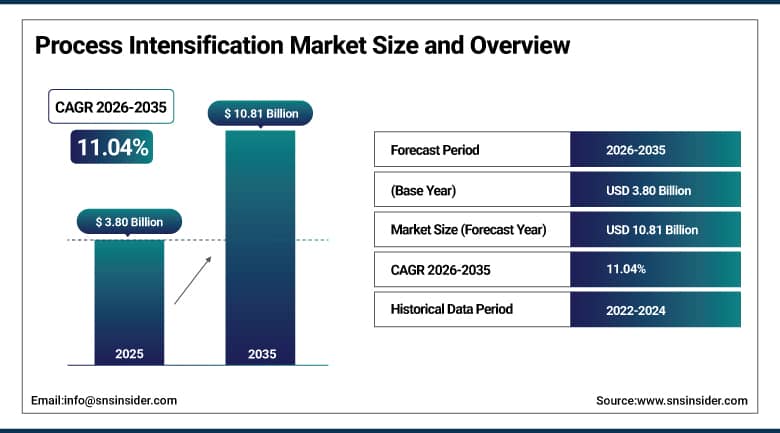
Process Intensification Market was valued at USD 3.80 Billion in 2025 and is expected to reach USD 10.81 Billion by 2035, growing at a CAGR of 11.04% from 2026–2035.
Some of the key factors driving the growth of the global Process Intensification Market include the rising demand for energy efficient and sustainable production processes, the presence of stringent environmental regulations, and the increasing use of advanced and compact process technologies in the chemical, petrochemical, pharmaceutical, and food processing sectors. Companies are now making investments in advanced reactors, process optimization software, and modular production facilities in order to increase efficiency and cut down costs and carbon emissions..
On May 22, 2025, Honeywell announced its agreement to acquire Johnson Matthey's Catalyst Technologies business for £1.8 billion. The acquisition strengthens Honeywell's portfolio of catalyst and process technologies, expands its capabilities across refining, petrochemicals, renewable fuels, and sustainable chemical production, and enhances its ability to deliver integrated process intensification solutions that improve efficiency, reduce emissions, and support the energy transition.
Market Size and Forecast
-
Market Size 2026E: USD 4.21 Billion
-
Market Size 2035: USD 10.81 Billion
-
CAGR: 11.04% from 2026 to 2035
-
Fastest Growing Region: Asia-Pacific
-
Largest Region: North America
To Get More Information On Process Intensification Market - Request Free Sample Report
Process Intensification Market Trends
-
Rising demand for energy-efficient, sustainable, and compact manufacturing processes is driving the adoption of process intensification technologies across the chemical and process industries.
-
Increasing focus on reducing energy consumption, operational costs, and carbon emissions is accelerating investments in advanced reactors, compact heat exchangers, and process intensification equipment.
-
Process intensification technologies improve production efficiency, enhance product yields, reduce equipment footprint, and optimize resource utilization across industrial operations.
-
Advancements in micro reaction technology, reactive distillation, membrane separation, digital process optimization, and AI-enabled process control are fostering innovation in process intensification solutions.
-
Growing adoption across chemicals, petrochemicals, pharmaceuticals, food processing, and energy industries is supporting sustained growth of the process intensification market.
The U.S. Process Intensification Market Outlook
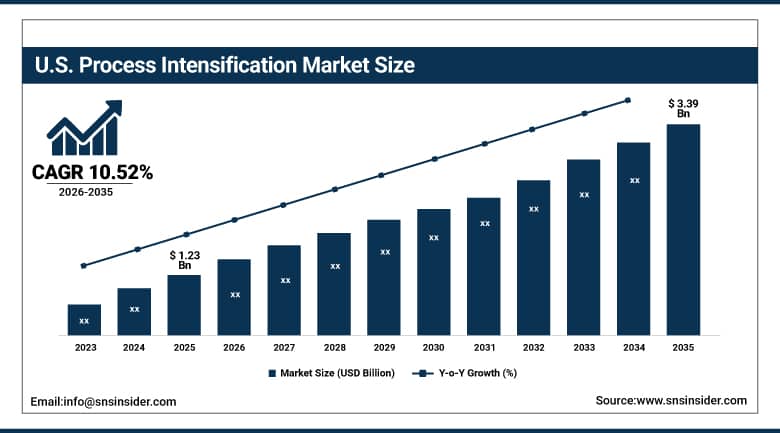
The U.S. Process Intensification Market was valued at USD 1.23 Billion in 2025 and is expected to reach around USD 3.39 Billion by 2035, growing at a CAGR of 10.52% from 2026–2035.
There have been many efforts that have been put in place in order to ensure that there is an increased adoption of process intensification technologies within the US. This is due to the increase in the demand for energy-efficient production processes, strict environmental legislation and the need for improving the process efficiency while minimizing the cost and carbon footprints of the processes. The industries such as chemical, petrochemicals, pharmaceuticals, and food processing have increasingly resorted to process intensification technologies such as microreactors, efficient heat exchange systems and distillation technology in order to enhance their process efficiency and minimize equipment sizes.
On June 20, 2025, thyssenkrupp nucera signed an agreement to acquire key technology assets from Green Hydrogen Systems. The acquisition expands thyssenkrupp nucera's green hydrogen technology portfolio with modular high-pressure alkaline electrolysis technology, strengthening its capabilities in efficient, scalable industrial process solutions and accelerating innovation in energy-efficient process technologies that support process intensification across industrial applications.
Process Intensification Market Segmentation Analysis
-
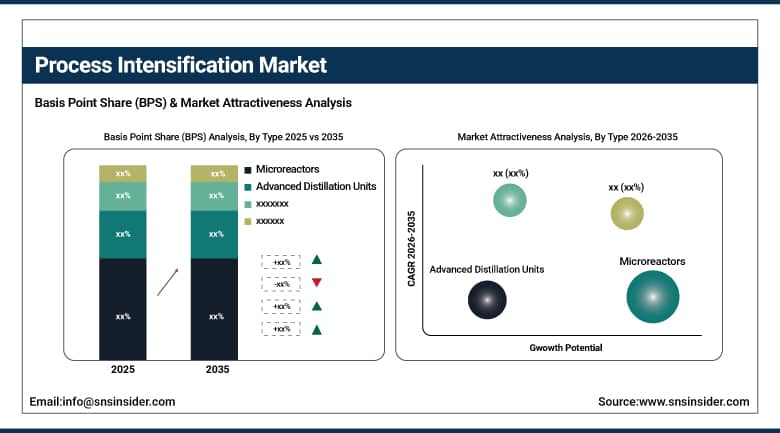
By Type, microreactors dominated the process intensification market with a 34.20% share in 2025, while advanced distillation units are projected to be the fastest-growing segment, registering a CAGR of 11.36% during 2026–2035.
-
By Application, chemicals dominated the process intensification market with a 38.50% share in 2025, while pharmaceuticals are projected to be the fastest-growing segment, registering a CAGR of 11.78% during 2026–2035.
-
By Technology, microreaction technology dominated the process intensification market with a 33.60% share in 2025, while membrane technology is projected to be the fastest-growing segment, registering a CAGR of 12.16% during 2026–2035.
-
By End-use Industry, chemicals dominated the process intensification market with a 39.40% share in 2025, while pharmaceuticals are projected to be the fastest-growing segment, registering a CAGR of 12.73% during 2026–2035.
By type, microreactors dominated the process intensification market, while advanced distillation units are expected to grow fastest.
Over 2025, the microreactors segment held the highest share in the global process intensification market on account of their capability to increase reaction efficiency, improved heat and mass transfer, energy savings, and increased safety and compactness in processing. The growing use of microreactors in the chemicals, pharmaceuticals, and specialty chemicals segments to improve production efficiencies drove the market share of this segment.
Advanced distillation units are anticipated to witness the fastest CAGR over the forecast period on account of the increasing need for energy-efficient separation technology with lower operating cost and carbon emissions. Increased investments in sustainable process technology along with modernization of production facilities will drive the adoption of advanced distillation systems.
By application, chemicals dominated the process intensification market, while pharmaceuticals are expected to grow fastest.
On the basis of application, the chemicals segment represented the highest market share in the process intensification market, while the pharmaceuticals segment is estimated to have the highest growth rate during the forecast period. The chemicals segment dominated the market in 2025 because of the growing adoption of process intensification technology in order to increase production efficiency, lower energy use, reduce waste production, and ensure safety of processes in chemical manufacturing.
The pharmaceuticals segment is estimated to experience the highest CAGR during the forecast period because of the growing adoption of continuous manufacturing, microreactor technology, and process intensification techniques for the production of pharmaceuticals.
By end-use industry, chemicals dominated the process intensification market, while pharmaceuticals are expected to grow fastest.
In terms of end-use industries, the chemicals sector held the largest market share in the process intensification market, whereas the pharmaceutical sector is estimated to grow at the fastest pace over the forecast period. The chemicals industry was the dominant segment of the market in 2025 due to rising investments in energy-efficient production techniques, increasing focus on cost and emission reduction, and growing use of efficient process equipment in manufacturing processes.
The pharmaceutical industry is estimated to register the highest CAGR over the forecast period owing to increasing continuous processing, rise in biologics and specialty drug manufacturing, and increasing investments in advanced manufacturing technologies. Process intensification solutions aid pharmaceutical manufacturers to achieve product quality improvement, increase process flexibility, decrease manufacturing footprints, and enhance manufacturing efficiency.
Regional Analysis
|
Region |
Major Country |
Share within Region, 2025(%) |
|---|---|---|
|
North America |
United States |
87.30% |
|
Europe |
Germany |
22.80% |
|
Asia Pacific |
China |
39.20% |
|
Middle East & Africa |
Saudi Arabia |
31.40% |
|
Latin America |
Brazil |
45.80% |
North America process intensification market insights
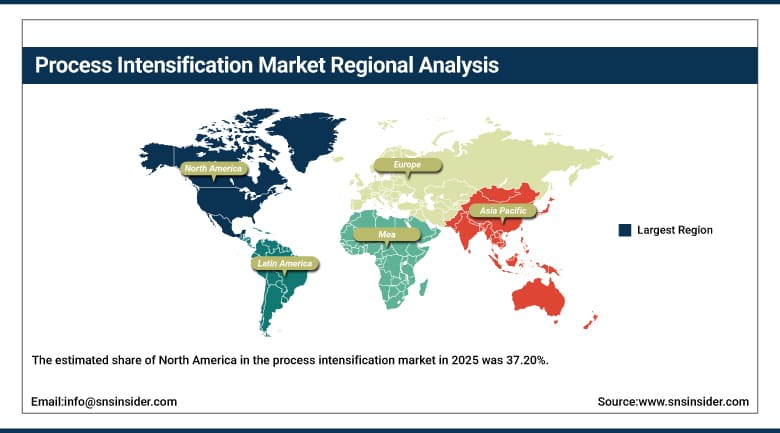
The estimated share of North America in the process intensification market in 2025 was 37.20%. This was because of the well-established chemical, petrochemical, pharmaceutical, and food processing industries in addition to the increasing investments in the development of efficient and sustainable manufacturing process technology. Process intensification has been widely adopted in North America through microreactors, compact heat exchangers, catalytic reactors, and advanced distillation systems that enhance the efficiency of production processes. The share of the US in the process intensification market in North America was 87.30% due to its industrial infrastructure, process innovation investment, and technology providers.
Increasing focus on energy efficiency, reduction in carbon emissions, process optimization, and digital manufacturing is boosting the adoption of process intensification technologies in North America. The increasing adoption of modular process systems, advanced catalysts, digital twins, and AI-based process optimization is expected to further propel the process intensification market growth in the region.
Get Customized Report as Per Your Business Requirement - Enquiry Now
Europe process intensification market insights
Europe remains a significant region in the process intensification market owing to stringent environmental regulations, strong focus on sustainable manufacturing, and increasing investments in energy-efficient chemical processing technologies. Germany accounted for 22.80% of the Europe process intensification market in 2025, supported by its well-established chemical and pharmaceutical industries, advanced manufacturing capabilities, and continuous investment in industrial process innovation.
The growth of the process intensification market in Europe is driven by rising demand for low-carbon production technologies, increasing adoption of compact processing equipment, and growing implementation of advanced separation and reaction technologies. Additionally, government initiatives promoting industrial decarbonization, circular economy practices, and energy efficiency are expected to support long-term market growth.
Asia Pacific process intensification market insights
The Asia-Pacific process intensification market is expected to register the highest CAGR during the forecast period, driven by rapid industrialization, expanding chemical manufacturing capacity, increasing investments in pharmaceutical production, and rising demand for energy-efficient processing technologies. China accounted for 39.20% of the Asia-Pacific process intensification market in 2025, supported by its large chemical manufacturing base, expanding industrial infrastructure, and increasing investments in advanced manufacturing technologies.
Growing demand for sustainable production processes, increasing adoption of modular plants, expansion of specialty chemical production, and rising investments in process automation are creating significant growth opportunities across the region. Furthermore, supportive government policies, increasing industrial modernization, and growing adoption of digital process optimization technologies are expected to accelerate the growth of the process intensification market throughout the forecast period.
Middle East & Africa and Latin America insights
The Middle East & Africa process intensification market is growing steadily due to increasing investments in petrochemical production, oil & gas processing, specialty chemicals, and industrial modernization initiatives. Saudi Arabia accounted for 31.40% of the regional market in 2025, supported by expanding petrochemical capacity, investments in sustainable industrial technologies, and government initiatives aimed at improving manufacturing efficiency and reducing energy consumption.
The Latin America process intensification market is expanding due to increasing investments in chemical processing, food processing, pharmaceuticals, and energy industries. Brazil dominated the regional market in 2025, accounting for 45.80% of the regional market, owing to its large industrial base, growing manufacturing sector, and increasing adoption of energy-efficient process technologies. Rising industrial automation, modernization of production facilities, and growing focus on operational efficiency and environmental sustainability are expected to support continued market growth across the region during the forecast period.
Market Dynamics
Growth Driver: Increasing demand for energy-efficient and sustainable manufacturing accelerating the process intensification market growth
Increasing demand for energy-efficient, compact, and sustainable manufacturing processes is one of the key factors driving the global process intensification market. Industries such as chemicals, petrochemicals, pharmaceuticals, food processing, and energy are increasingly adopting process intensification technologies to improve production efficiency, reduce energy consumption, minimize waste generation, and lower operating costs. Technologies including microreactors, compact heat exchangers, catalytic reactors, and advanced distillation systems enable higher process performance while reducing equipment size and environmental impact.
Growing investments in industrial modernization, stricter environmental regulations, increasing adoption of modular production systems, advances in process simulation and digital twins, and rising demand for low-carbon manufacturing are expected to further accelerate the growth of the process intensification market during the forecast period.
Restraints: High capital investment and technical complexity may restrain process intensification market growth
High initial capital investment and the technical complexity associated with implementing process intensification technologies remain key challenges for the process intensification market. The adoption of advanced reactors, separation systems, and integrated processing equipment often requires significant modifications to existing production facilities, increasing installation costs and project complexity. In addition, process design, scale-up, and integration require specialized engineering expertise, which can limit adoption among small and medium-sized manufacturers.
Furthermore, concerns related to operational reliability, process validation, maintenance requirements, and the limited availability of skilled professionals are expected to restrain the growth of the process intensification market during the forecast period.
Opportunities: Growing adoption of modular manufacturing and digital process optimization
The increasing adoption of modular manufacturing, smart factories, and Industry 4.0 technologies presents significant growth opportunities for the process intensification market. Manufacturers are increasingly integrating artificial intelligence, digital twins, advanced process simulation, and real-time process monitoring to optimize production efficiency, reduce energy consumption, and improve operational performance.
Moreover, expanding investments in specialty chemicals, pharmaceuticals, sustainable energy production, and advanced manufacturing technologies, along with increasing demand for environmentally friendly processing solutions and compact production systems, are expected to create substantial growth opportunities for the process intensification market over the coming years.
Recent Developments
-
2025: Honeywell announced advancements in its modular process technologies, enabling chemical manufacturers to improve energy efficiency, reduce emissions, and optimize plant performance through compact process solutions.
-
2025: Sulzer expanded its process intensification portfolio with advanced separation and mixing technologies designed to improve productivity, reduce energy consumption, and support sustainable chemical processing.
-
2024: Koch-Glitsch introduced next-generation mass transfer and process intensification solutions that enhance separation efficiency while lowering energy usage and operational costs in refining and petrochemical applications.
-
2024: GEA launched new high-performance process intensification technologies for the food and pharmaceutical industries, helping manufacturers improve production efficiency, reduce equipment footprint, and support sustainable manufacturing practices.
Process Intensification Market key players are:
-
Sulzer Ltd.
-
Koch-Glitsch LP
-
Corning Incorporated
-
Ehrfeld Mikrotechnik BTS GmbH
-
Vahterus Oy
-
Chart Industries, Inc.
-
Buss ChemTech AG
-
AM Technology
-
Microinnova Engineering GmbH
-
SPX FLOW, Inc.
-
Pall Corporation
-
HRS Heat Exchangers Ltd.
-
PROSIM SA
-
SGL Carbon SE
-
GMM Pfaudler Ltd.
-
PDC Machines Inc.
-
Linde plc.
Process Intensification Market Report Scope:
| Report Attributes | Details |
|---|---|
| Market Size in 2025 | USD 3.80 Billion |
| Market Size by 2035 | USD 10.81 Billion |
| CAGR | CAGR of 11.04% From 2026 to 2035 |
| Base Year | 2025 |
| Forecast Period | 2026-2035 |
| Historical Data | 2022-2024 |
| Report Scope & Coverage | Market Size, Segments Analysis, Competitive Landscape, Regional Analysis, DROC & SWOT Analysis, Forecast Outlook |
| Key Segments | • By Type (Microreactors, Compact Heat Exchangers, Process Intensification Equipment, Catalytic Reactors, Advanced Distillation Units) • By Application (Chemicals, Petrochemicals, Pharmaceuticals, Food Processing, Energy) • By Technology (Microreaction Technology, Reactive Distillation, Membrane Technology, Static Mixers, Rotating Packed Beds) • By End-use Industry (Chemicals, Pharmaceuticals, Food & Beverage, Oil & Gas, Energy) |
| Regional Analysis/Coverage | North America (US, Canada, Mexico), Europe (Eastern Europe [Poland, Romania, Hungary, Turkey, Rest of Eastern Europe] Western Europe] Germany, France, UK, Italy, Spain, Netherlands, Switzerland, Austria, Rest of Western Europe]), Asia Pacific (China, India, Japan, South Korea, Vietnam, Singapore, Australia, Rest of Asia Pacific), Middle East & Africa (Middle East [UAE, Egypt, Saudi Arabia, Qatar, Rest of Middle East], Africa [Nigeria, South Africa, Rest of Africa], Latin America (Brazil, Argentina, Colombia, Rest of Latin America) |
| Company Profiles | Honeywell International Inc., Sulzer Ltd., Koch-Glitsch LP, GEA Group AG, Alfa Laval AB, Corning Incorporated, Ehrfeld Mikrotechnik BTS GmbH, Vahterus Oy, Chart Industries, Inc., Buss ChemTech AG, AM Technology, Microinnova Engineering GmbH, SPX FLOW, Inc., Pall Corporation, HRS Heat Exchangers Ltd., PROSIM SA, SGL Carbon SE, GMM Pfaudler Ltd., PDC Machines Inc., Linde plc |
Frequently Asked Questions
The process intensification market was valued at USD 3.80 billion in 2025.
The market is driven by energy-efficient manufacturing and sustainable processing technologies.
The microreactors segment dominated the process intensification market in 2025 with a 34.20% share.
North America dominated the process intensification market in 2025 with a 37.20% share.
