
Dental Ceramic Biomaterials Market Report Scope & Overview:
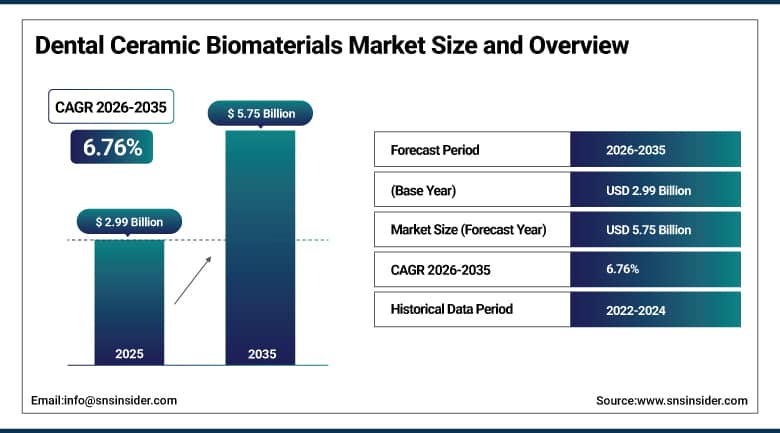
The Dental Ceramic Biomaterials Market was valued at USD 2.99 Billion in 2025 and is projected to reach USD 5.75 Billion by 2035, expanding at a CAGR of 6.76% during the forecast period 2026–2035.
Growth is evident in the market for dental ceramic biomaterials as more people embrace aesthetic dentistry, implant supported restorations, and minimally invasive dentistry globally. Ceramic biomaterials such as zirconium, lithium disilicate, feldspathic ceramics and hybrid ceramics are known for their biocompatibility, strong mechanical properties, durability, and very natural appearance. This makes them the best option when making crowns, bridges, veneers, implant restorations and digital dentistry. Awareness about oral health issues, rising disposable incomes, increase in cosmetic dentistry and adoption of CAD/CAM dentistry are some of the factors driving commercial growth of the market.
In addition, the market is growing due to technological advancements that include innovations in digital dentistry. Innovations such as chairside CAD/CAM milling technology, ceramic processing techniques, prosthetic design using AI, and additive manufacturing technologies for customized dental restoration are making more people invest in automation technologies. Such innovations will help in achieving precise dental restorations in less time, lower costs and better patient results. Investments in dental infrastructures, rise in implantology procedures, favorable reimbursement policy in some countries and constant product innovation from major manufacturers are some of the factors that will drive market growth.
Market Size and Forecast
-
Market Size 2026E: USD 3.19 Billion
-
Market Size 2035: USD 5.75 Billion
-
CAGR: 6.76% from 2026 to 2035
-
Fastest Growing Region: Asia Pacific
-
Largest Region: North America
To Get More Information On Dental Ceramic Biomaterials Market - Request Free Sample Report
Dental Ceramic Biomaterials Market Trends
-
Rising adoption of digital CAD/CAM ceramic restorative workflows worldwide.
-
Increasing demand for highly aesthetic metal-free dental restorations.
-
Growing utilization of zirconia ceramics for implant-supported prosthetics.
-
Expansion of chairside dentistry using advanced ceramic milling systems.
-
AI-enabled digital smile design improving restorative treatment planning.
The U.S. Dental Ceramic Biomaterials Market Size Outlook
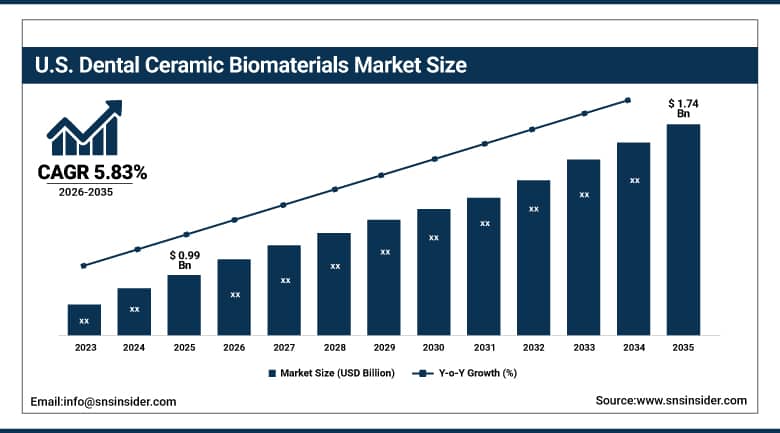
The U.S. Dental Ceramic Biomaterials Market was valued at USD 0.99 billion in 2025 and is expected to reach approximately USD 1.74 billion by 2035, expanding at a CAGR of 5.83% during 2026–2035.
The dominance of the United States in the dental ceramic biomaterials market in North America is evident from the advanced dental healthcare facilities available in the country, high level of patient awareness about cosmetic dentistry, use of implant-supported restorations, and swift adoption of digital dentistry solutions. There has been an upsurge in investments being made by dental practices and laboratories in the country in CAD/CAM solutions, intraoral scanners, digital impressions technology, and advanced zirconia and lithium disilicate ceramic materials for providing highly customized restorations. The aging population, prevalence of tooth loss, and rising demand for aesthetic restorative treatments are driving the growth of the market in the coming years.
Besides, constant innovations in the area of ceramic processing, AI-enabled prosthetic planning software, and chairside milling systems are increasing the clinical efficiency and patient satisfaction rate in the U.S. market. Manufacturers of dental products have been concentrating on providing next-generation multilayered zirconia, highly translucent ceramic materials, and hybrid ceramic materials. Rising investments in digital dental labs, increasing use of minimally invasive restorative treatments, and collaboration between manufacturers and dental service organizations are going to strengthen the leadership of the country in the market through 2027.
Dental Ceramic Biomaterials Market Segmentation Analysis
-
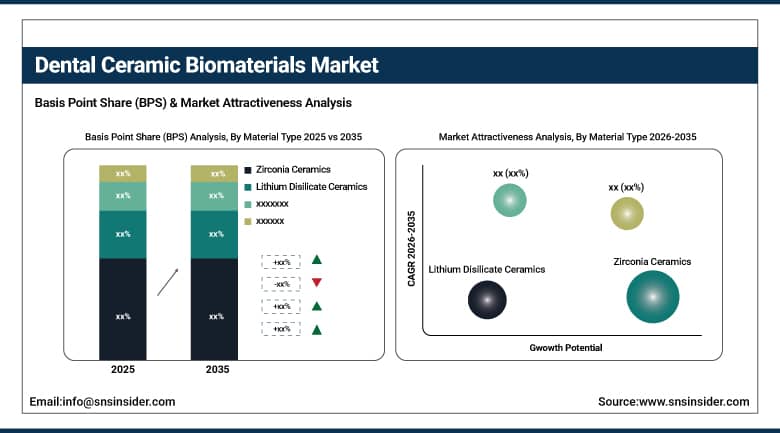
By Material Type, zirconia ceramics dominated the market with 44.00% share in 2025, while lithium disilicate are projected to witness the fastest growth with 8.01% CAGR during the forecast period.
-
By Manufacturing Technology, CAD/CAM milling dominated the market with 58.00% share in 2025, while 3D printed ceramics are projected to witness the fastest growth with 8.48% CAGR during the forecast period.
-
By Application, crowns & bridges dominated the market with 42.00% share in 2025, while dental implants & abutments are projected to witness the fastest growth with 8.96% CAGR during the forecast period.
-
By End User, dental clinics dominated the market with 54.00% share in 2025, while dental laboratories are projected to witness the fastest growth with 8.96% CAGR during the forecast period.
By Material Type, zirconia ceramics dominated, while lithium disilicate fastest growth.
Zirconia ceramics held a share of 44.00% in the market of dental ceramic biomaterials market in 2025. The high fracture toughness, superior flexural strength, excellent biocompatibility, and reliability in clinical use have made this material popular in the field. Zirconia has emerged as the most suitable biomaterial in making crowns, bridges, implant restorations, and full arch prosthetics since it offers great resistance against occlusal forces along with aesthetically pleasing results. The continuous development of multilayer translucent zirconia and digitally designed restorations has enhanced its business appeal for dental laboratories and clinics across the globe.
Lithium disilicate ceramics will witness the highest CAGR of 8.01% between 2026 and 2035. This is due to the excellent translucency, natural look like the enamel, lesser tooth preparation requirement, and compatibility with computer aided design and manufacturing (CAD/CAM) systems. This material has been preferred by dentists for making veneers, anterior crowns, and other minimally invasive procedures where aesthetics are the main consideration. Further improvements in glass ceramic technology and digital restorative techniques will accelerate the adoption of this material in the future.
By Manufacturing Technology, CAD/CAM milling dominated, while 3D printed ceramics fastest growth.
CAD/CAM milling is expected to lead in terms of revenue contribution at 58.00%, owing to the fast digitalization process occurring in restorative dentistry and dental labs. The use of CAD/CAM allows for highly precise production of ceramic restorations with consistency in terms of quality, fast processing times, and reduced chances of errors. The increase in investments in chairside dentistry, intraoral scanning, digital impressions, and milling systems has made procedures efficient and improved the patients' experiences. CAD/CAM has become the technology of choice for producing zirconia, lithium disilicate, and hybrid ceramic restorations.
3D printed ceramics is anticipated to be the fastest-growing segment with a CAGR of 8.48% over the forecast period. This new advancement in additive manufacturing provides personalization options for producing ceramics with greater design freedom, better material efficiency, and less waste during manufacturing. Research on the fabrication of strong ceramic products and use of computer aided design software based on artificial intelligence technology is aiding in rapid commercialization of this technology. As increasing numbers of dental laboratories adopt automation manufacturing technology, ceramic 3D printing is expected to be one of the important growth factors in digital dentistry.
By Application, crowns & bridges dominated, while dental implants & abutments fastest growth.
In terms of value share, crowns & bridges held 42.00% of the dental ceramic biomaterials market in 2025 because of the increase in cases of dental caries, dental fractures, and aging tooth loss, which needs restorative treatment. Ceramic crowns and bridges provide better aesthetics, biocompatibility, durability, and clinical effectiveness than other traditional biomaterials. The use of CAD/CAM technology, better ceramic transparency, and the use of metal-free biomaterials have further contributed to the dominance of the segment in dental clinics and laboratories around the world.
The dental implants & abutments segment is estimated to register the highest CAGR of 8.96% in the coming years (2026-2035). An increase in the number of people opting for permanent tooth replacement, the rising need for implants among older populations, and increased awareness about oral rehabilitation are driving the growth in the market. The developments in zirconium implants, customized digital abutments, and innovations in implant prosthetics are helping improve the clinical results of the procedure.
Regional Analysis:
|
Region |
Major Country |
Share within Region, 2025 (%) |
|---|---|---|
|
North America |
United States |
92.00% |
|
Europe |
Germany |
31.00% |
|
Asia Pacific |
China |
25.00% |
|
Middle East & Africa |
UAE |
4.00% |
|
Latin America |
Brazil |
4.00% |
North America Dental Ceramic Biomaterials Market Insights
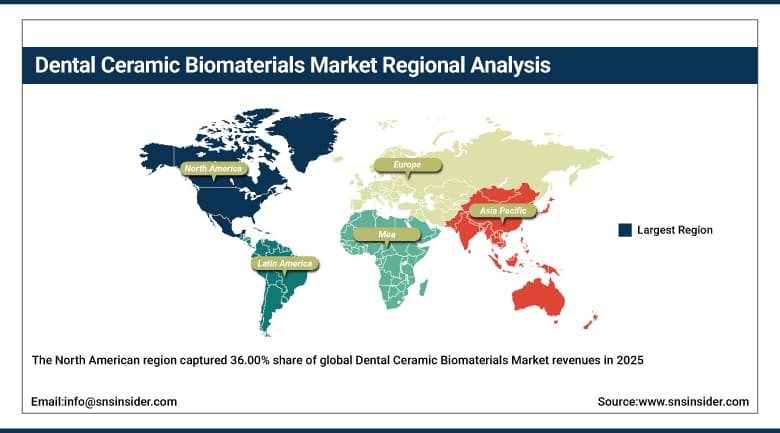
The North American region captured 36.00% share of global Dental Ceramic Biomaterials Market revenues in 2025, retaining its dominant market standing due to advanced dental healthcare facilities, adoption of digital dentistry practices, and rising demand for cosmetic and restorative dental procedures. There have been significant investments made by the region in the areas of CAD/CAM technology, intraoral scanners, digital laboratories, and advanced ceramic restorative products, contributing towards speedy treatment and better clinical results. Increasing number of dental implants, positive reimbursement policies for some dental procedures, and rising preference among patients for metal-free restorations further fuel the market growth in the region.
Furthermore, advancements in dental product development by leading dental product manufacturing companies, increased utilization of artificial intelligence for dental prosthetics design, and growth in chairside milling capacities are expected to drive regional market growth. In recent years, there have been rising investments in digital workflows that help to enhance operational efficiencies as well as reduce the time taken to complete restorations. Dentsply Sirona launched an advanced digital restorative workflows in February 2026 that integrates AI-based dental treatments with CAD/CAM ceramic restorations.
Get Customized Report as Per Your Business Requirement - Enquiry Now
Europe Dental Ceramic Biomaterials Market Insights
The European market is still considered to be one of the major markets for dental ceramics. It is fueled by developed dental care systems in this part of the world, high demand for aesthetic dentistry, and increasing use of innovative restorative methods. Such countries as Germany, France, Italy, United Kingdom and Spain are still considered the main countries because of a large number of procedures carried out, good networks of dental laboratories and widespread application of zirconia and lithium disilicate ceramics. Continuous investment in the development of digital dentistry, precise prosthetics, and minimally invasive restorative approaches makes ceramic biomaterials more popular among public and private dental clinics.
Asia Pacific Dental Ceramic Biomaterials Market Insights
The market for Asia Pacific Dental Ceramic Biomaterials Market is expected to record the highest growth rate by registering CAGR of 9.42% during the forecast period. The rapid rate of urbanization, rise in disposable income, growth in dental tourism, and rising awareness about oral healthcare in China, Japan, South Korea, India, and Southeast Asia are major factors leading to high demand for premium quality biomaterials in the region. There is constant investment being made in dental infrastructure and digital dentistry by governments and private health care service providers.
CAD/CAM technology availability, increase in number of implant dentistry procedures and the growth of indigenous manufacture of ceramic biomaterials is providing significant future opportunities for players operating in the region. Rising demand for smile restoration treatments among younger population is also contributing to the market growth. In 2025, Aidite Technology Co., Ltd. introduced its range of Multilayer Zirconia Biomaterials and Digital Dental Care Solutions in the Asia-Pacific region.
Middle East & Africa and Latin America Dental Ceramic Biomaterials Market Insights
Expansion of The Middle East & Africa is being driven by improvements in healthcare infrastructure, more investments into private dental clinics, and the introduction of digital restorative technology. There is an increasing number of people from countries such as the UAE, Saudi Arabia, and South Africa, who are becoming interested in cosmetic dentistry, implants restoration, and high-end ceramics prosthetics. The further expansion of specialty dental clinics and digital labs is projected to fuel the growth of the market in the future. In 2025, Straumann Group extended its digital dentistry and implant education program in the region by working together with dental professionals.
Latin America fueled by increasing dental tourism, improved access to restorative treatment, and more investments into modern dental laboratories in Brazil, Mexico, Argentina, and Chile. Increasing awareness of aesthetic dentistry and usage of CAD/CAM ceramic restorations drive the growth of the demand in the region. In 2025, VITA Zahnfabrik extended international distribution of their innovative ceramic restorative materials through regional distributor.
Growth Drivers: Increasing usage of digital dentistry and CAD/CAM ceramic restorations.
Increasing shift towards digital dentistry is one of the major driving factors fueling the Dental Ceramic Biomaterials Market. CAD/CAM technologies, intra-oral scanning, digital impressions, and software that uses AI assistance in restoration design are gaining popularity among dental practices and laboratories due to their benefits in terms of enhancing accuracy, saving production time, and customer satisfaction. The use of advanced ceramic biomaterials, like zirconia and lithium disilicate, is easy in the digital production process and provides customized high-quality restorations.
With an increased focus of dental practices on the manufacturing of restorations within the dental clinic or automated laboratory production, there will be a rise in demand for advanced ceramic biomaterials in the forecasted period. Dentsply Sirona reinforced its digital dentistry offerings through bettering the CAD/CAM restorative process and ceramic materials.
Restraints: High costs of treatment and digital manufacturing infrastructure.
Although the industry presents excellent prospects for the future, there are still some barriers due to high costs associated with ceramics restorations and technology. High-end equipment such as CAD/CAM milling unit, ceramic furnace, intraoral scanner, and high-end ceramic blocks are quite expensive, which hinders smaller dental offices and labs from using advanced equipment. Furthermore, the necessity of special training and maintenance together with higher cost of procedures when compared to traditional restorations may impede wider adoption of new technology, especially in developing countries where affordability is an important factor. Ivoclar continued growing its educational and training programs for dentists to promote new ceramics restorative technology.
Opportunities: Increase in demand for aesthetic implant dentistry and advanced ceramic biomaterials.
Patient preference for tooth restorations without metals, minimally invasive techniques, and aesthetically pleasing outcomes presents numerous opportunities for ceramic biomaterial producers. Constant development in terms of multilayer zirconia, bioactive ceramics, ceramic hybrids, and printable ceramic composites results in increased mechanical properties, translucency, and durability of the material. At the same time, use of ceramic implants, customized prosthesis, and artificial intelligence treatment planning is creating additional opportunities for commercial success in cosmetic dentistry and implantology. Growing investments from emerging markets in dental digital technology infrastructure are likely to contribute to market growth in the coming decade. Kuraray Noritake Dental presented an advanced range of multilayer zirconia materials offering improved aesthetic and mechanical properties.
Recent Developments
-
2026: Dentsply Sirona introduced enhanced AI-enabled digital restorative workflow solutions supporting improved CAD/CAM ceramic restoration planning and chairside efficiency.
-
2025: Ivoclar expanded its IPS e.max and zirconia restorative portfolio with improved digital workflow compatibility and advanced ceramic processing technologies.
-
2025: Aidite Technology Co., Ltd. launched new multilayer zirconia ceramic materials designed for highly aesthetic implant-supported and prosthetic restorations.
-
2026: Kuraray Noritake Dental introduced next-generation multilayer zirconia solutions featuring enhanced translucency and improved mechanical performance for digital dentistry applications.
Dental Ceramic Biomaterials Market Key Players are:
-
VITA Zahnfabrik H. Rauter GmbH & Co. KG
-
GC Corporation
-
Straumann Holding AG
-
Solventum Corporation
-
Zirkonzahn GmbH
-
Shofu Inc.
-
COLTENE Holding AG
-
VOCO GmbH
-
Kulzer GmbH
-
Henry Schein, Inc.
-
Aidite Technology Co., Ltd.
-
Amann Girrbach AG
-
BEGO GmbH
-
Ultradent Products Inc.
-
Keystone Industries
-
BISCO, Inc.
-
DMG Chemisch-Pharmazeutische Fabrik GmbH
Dental Ceramic Biomaterials Market Report Scope:
| Report Attributes | Details |
|---|---|
| Market Size in 2025 | USD 2.99 Billion |
| Market Size by 2035 | USD 5.75 Billion |
| CAGR | CAGR of 6.76% From 2026 to 2035 |
| Base Year | 2025 |
| Forecast Period | 2026-2035 |
| Historical Data | 2022-2024 |
| Report Scope & Coverage | Market Size, Segments Analysis, Competitive Landscape, Regional Analysis, DROC & SWOT Analysis, Forecast Outlook |
| Key Segments | • By Material Type (Zirconia Ceramics, Lithium Disilicate Ceramics, Feldspathic Ceramics, Alumina Ceramics, Others) • By Manufacturing Technology (CAD/CAM Milling, Pressable Ceramics, Conventional Laboratory Fabrication, 3D Printed Ceramics) • By Application (Crowns & Bridges, Dental Implants & Abutments, Veneers, Inlays & Onlays, Others) • By End User (Dental Clinics, Dental Laboratories, Hospitals, Academic & Research Institutes, Others) |
| Regional Analysis/Coverage | North America (US, Canada), Europe (Germany, UK, France, Italy, Spain, Russia, Poland, Rest of Europe), Asia Pacific (China, India, Japan, South Korea, Australia, ASEAN Countries, Rest of Asia Pacific), Middle East & Africa (UAE, Saudi Arabia, Qatar, South Africa, Rest of Middle East & Africa), Latin America (Brazil, Argentina, Mexico, Colombia, Rest of Latin America). |
| Company Profiles | Dentsply Sirona Inc., Ivoclar AG, Kuraray Noritake Dental Inc., VITA Zahnfabrik H. Rauter GmbH & Co. KG, GC Corporation, Straumann Holding AG, Solventum Corporation, Zirkonzahn GmbH, Shofu Inc., COLTENE Holding AG, VOCO GmbH, Kulzer GmbH, Henry Schein, Inc., Aidite Technology Co., Ltd., Amann Girrbach AG, BEGO GmbH, Ultradent Products Inc., Keystone Industries, BISCO, Inc., DMG Chemisch-Pharmazeutische Fabrik GmbH |
Frequently Asked Questions
Zirconia Ceramics accounted for the largest revenue share of 44.00% in 2025.
North America dominated the global Dental Ceramic Biomaterials Market in 2025.
The market is anticipated to expand at a CAGR of 6.76% during the forecast period.
The Dental Ceramic Biomaterials Market was valued at USD 2.99 Billion in 2025.
The market is projected to reach USD 5.75 Billion by 2035.
