
Embedded Non-Volatile Memory Market Report Scope & Overview:
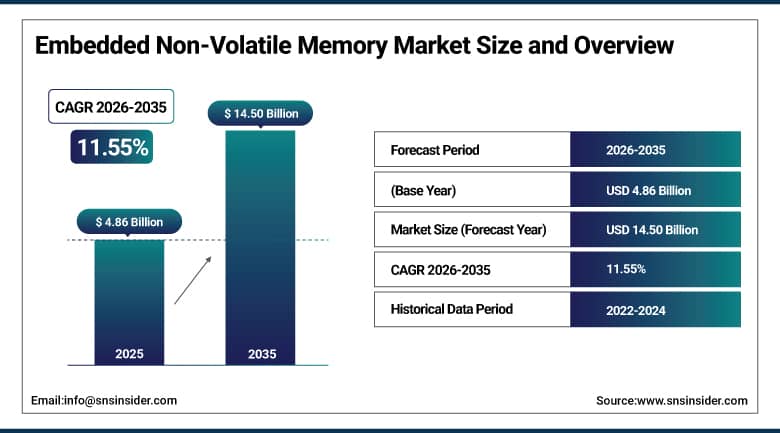
The Embedded Non-Volatile Memory Market was valued at USD 4.86 Billion in 2025 and is expected to reach USD 14.50 Billion by 2035, growing at a CAGR of 11.55% from 2026-2035.
The Embedded Non-Volatile Memory Market is expanding rapidly as microcontrollers, secure elements and system-on-chip devices integrate code, configuration data and security keys directly on the processor die. Automotive electrification, connected industrial equipment, payment cards and wearable devices all require memory that retains data without power and updates reliably in the field. Embedded flash continues to anchor volumes, while magnetoresistive, resistive and phase-change memories are entering advanced process nodes where flash scaling becomes difficult. Foundries, memory intellectual property vendors and chipmakers are therefore investing in new platforms. These shifts support double-digit growth through 2035. Qualification cycles are lengthy, so platforms that reach production tend to hold design positions for many years.
⮞The International Organization of Motor Vehicle Manufacturers reported on 23 April 2026 that global vehicle production reached 96.40 million units in 2025, up 3.9%. Each vehicle contains dozens of microcontrollers that depend on embedded memory.
To Get More Information On Embedded Non-Volatile Memory Market - Request Free Sample Report
Embedded Non-Volatile Memory Market Trends
-
Embedded MRAM is moving into automotive and industrial microcontrollers at 28 nm, 22 nm and 16 nm as embedded flash scaling slows.
-
Resistive RAM and phase-change memory are being qualified on advanced foundry platforms for edge AI and low-power devices.
-
Automotive Grade 1 qualification and functional safety features are becoming a standard requirement for embedded memory platforms.
-
Secure one-time programmable and physically unclonable function memory is expanding in AI, data center and IoT chips.
-
Memory intellectual property licensing models are spreading as chip designers seek portable memory across several foundries.
U.S. Embedded Non-Volatile Memory Market Outlook
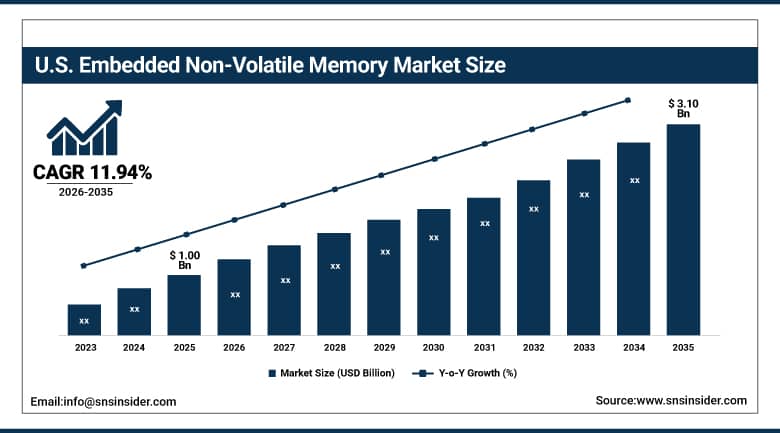
The U.S. Embedded Non-Volatile Memory Market was valued at USD 1.00 Billion in 2025 and is expected to reach USD 3.10 Billion by 2035, growing at a CAGR of 11.94% from 2026-2035.
The U.S. Embedded Non-Volatile Memory Market is the largest national market in North America, supported by leading microcontroller designers, fabless chip companies, aerospace and defense programs, and a growing base of secure payment and identity applications. Federal semiconductor incentives are bringing new fabrication capacity to the country, which improves access to specialty memory process platforms. Automotive and industrial customers increasingly request embedded memory with long retention and high endurance. Licensing of memory intellectual property from U.S. companies also supports demand. These factors sustain strong growth in the U.S. through 2035. Tier-one automotive suppliers headquartered in the country also specify embedded memory for next-generation domain controllers.
⮞The Congressional Research Service reported on 14 July 2026 that, as of January 2025, 19 companies had been awarded up to USD 30.70 billion in federal incentives for 40 semiconductor manufacturing projects.
Embedded Non-Volatile Memory Market Segment Analysis
-
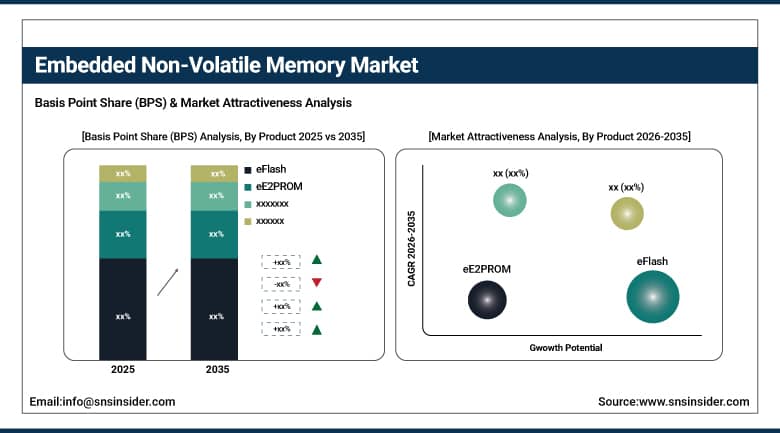
By Product, the eFlash segment dominated the Embedded Non-Volatile Memory Market with approximately 40.12% share in 2025, while the eE2PROM segment is the fastest growing with a CAGR of approximately 12.03%.
-
By Wafer Size, the More than 100 mm segment dominated the Embedded Non-Volatile Memory Market with approximately 56.37% share in 2025, while the Less than 100 mm segment is the fastest growing with a CAGR of approximately 12.46%.
-
By Application, the BFSI segment dominated the Embedded Non-Volatile Memory Market with approximately 25.37% share in 2025, while the Telecommunications segment is the fastest growing with a CAGR of approximately 12.88%.
-
By End-Use Industry, the Consumer Electronics segment dominated the Embedded Non-Volatile Memory Market with approximately 38.74% share in 2025, while the Automotive segment is the fastest growing with a CAGR of approximately 14.26%.
By Product, eFlash Dominates the Embedded Non-Volatile Memory Market and eE2PROM Grows Fastest
Embedded flash retains the largest position because it is a proven technology with decades of qualification history in microcontrollers, smart cards and automotive controllers. Foundries offer eFlash on mature nodes from 180 nm down to 28 nm, and designers value its high endurance, wide temperature tolerance and cost per bit. SuperFlash and split-gate variants support code storage in appliances, meters and industrial controls. Scaling beyond 28 nm is difficult, which has opened a path for newer memories, but the large installed design base keeps eFlash dominant. Smart meters, building controllers and industrial drives also keep demand for mature eFlash nodes high, since redesign costs and qualification time make migration unattractive for long-lifecycle products.
Embedded EEPROM is growing fastest because sensors, wearables, power management chips and display drivers need small, byte-erasable memory for calibration and trimming data. These devices rarely justify full flash blocks, and EEPROM macros integrate easily on analog and mixed-signal processes. FRAM and other emerging options serve applications requiring ultra-low write energy and instant writes, such as data loggers, metering and medical monitors, though higher cost limits their share. Automotive body electronics, battery management units and sensor modules add further volumes for small EEPROM blocks, and suppliers are offering compact macros that meet Grade 0 temperature requirements.
⮞Infineon agreed on 17 September 2026 to sell its NOR Flash and F-RAM business to Winbond, with closing targeted for the second half of 2027.
By Wafer Size, More than 100 mm Dominates the Embedded Non-Volatile Memory Market and Less than 100 mm Grows Fastest
Wafers larger than 100 mm account for most production because nearly all embedded memory is built on 200 mm and 300 mm lines at major foundries. Automotive microcontrollers, smart card controllers and consumer system-on-chip devices benefit from the cost efficiency and process maturity of these lines. Large wafers also provide access to advanced analog, high-voltage and embedded memory modules within a single platform, which simplifies design for chip companies. Foundries operating 200 mm lines continue to add embedded memory options for analog and power products, which keeps older wafer sizes economically relevant for automotive and industrial customers.
Smaller wafer formats are growing faster from a limited base as specialty fabs expand production of sensors, power devices and compound semiconductor products that need compact embedded memory for calibration and identification. Research institutes and specialty foundries also use smaller wafers to prototype resistive and ferroelectric memories before transferring them to larger lines. Government support for specialty production in Asia and Europe is helping these facilities add capacity. Transitions of some products to 300 mm lines are under way, but the cost of requalification means many designs stay on existing formats for the life of the program, and equipment makers still sell refurbished tools to support this demand.
⮞The global semiconductor equipment industry recorded billings of USD 135.10 billion in 2025, up 15%, according to SEMI data published on 7 April 2026.
By Application, BFSI Dominates the Embedded Non-Volatile Memory Market and Telecommunications Grows Fastest
Banking, financial services and insurance applications lead because payment cards, secure elements, point-of-sale terminals and authentication tokens rely on embedded memory for credentials and transaction data. Card issuers are migrating to chip-based, contactless and biometric cards, which raises memory content per unit. Strict security certification requirements favor established suppliers of tamper-resistant memory, and replacement cycles for cards and terminals provide stable demand. Insurers, banks and public authorities are also rolling out chip-based identity and digital wallet programs that depend on certified secure memory in handsets and cards, reinforcing the segment's lead.
Telecommunications is the fastest-growing application as fifth-generation networks, small cells, routers and cellular IoT modules require reliable on-chip memory for firmware, configuration and security keys. Network equipment needs rapid, secure firmware updates, and billions of connected devices use SIM and embedded SIM components with non-volatile storage. Information technology and government uses, including identity documents and secure boot, add further demand. Satellite connectivity, private wireless networks and open radio access architectures create additional memory needs, as base station and edge computing hardware stores configuration and firmware locally.
⮞The Ericsson Mobility Report, released in June 2026, estimated about 4.5 billion cellular IoT connections at the end of 2025.
By End-Use Industry, Consumer Electronics Dominates the Embedded Non-Volatile Memory Market and Automotive Grows Fastest
Consumer electronics remains the largest end-use industry because smartphones, wearables, televisions, appliances and gaming accessories all include microcontrollers and system-on-chip devices with embedded memory. High unit volumes and frequent product refresh cycles generate consistent demand. Manufacturers emphasize low power consumption and compact area, which favors embedded options over external memory chips in cost-sensitive designs. Smart home gadgets, true wireless earbuds and fitness trackers are especially memory-intensive on a per-chip basis because they combine wireless stacks, sensor calibration tables and firmware updates.
Automotive is the fastest-growing end-use industry as electrified powertrains, advanced driver assistance and software-defined vehicle architectures sharply increase memory content in each car. Over-the-air updates require large, reliable code storage, and safety regulations demand data retention across wide temperature ranges. Industrial and robotics customers add demand for controllers with long life, while information and communication equipment makes up the remaining volume. Electric vehicle platforms from Chinese, European and American makers now use several hundred microcontrollers and memory-rich domain controllers, and suppliers state that memory content per vehicle will keep rising as autonomy features expand.
⮞The European Automobile Manufacturers' Association reported on 27 January 2026 that battery electric cars made up 17.40% of new European Union registrations in 2025, or 1,880,370 units.
Regional Analysis
|
Region |
Major Country |
Share within Region, 2025 (%) |
|---|---|---|
|
Asia Pacific |
China |
41.38% |
|
North America |
United States |
86.43% |
|
Europe |
Germany |
31.64% |
|
Latin America |
Brazil |
36.27% |
|
Middle East & Africa |
Saudi Arabia |
28.91% |
Asia Pacific Embedded Non-Volatile Memory Market Insights
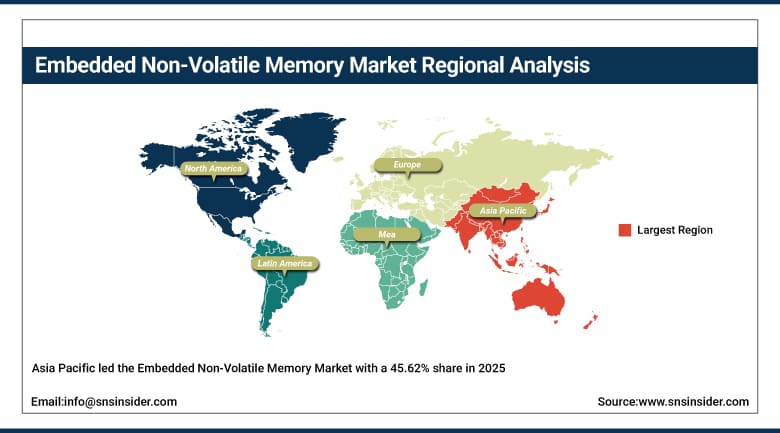
Asia Pacific led the Embedded Non-Volatile Memory Market with a 45.62% share in 2025, reflecting the concentration of foundries, assembly plants and consumer device makers in Taiwan, China, South Korea and Japan. TSMC, UMC, Samsung Foundry, SMIC and Hua Hong operate the main embedded memory platforms, and Japan contributes automotive microcontroller design through Renesas. India is building a design and packaging base under its semiconductor mission, adding a new source of demand. Singapore and Malaysia contribute through back-end packaging and test, and Vietnam is attracting electronics assembly that increases demand for microcontrollers carrying embedded memory.
China is the largest national market, driven by the world's biggest electric vehicle and appliance output. Local chip designers are adopting locally developed flash and emerging memory options to reduce import dependence, and regional smart card and SIM makers consume large volumes. South Korea is advancing MRAM on advanced nodes, and Taiwan leads in foundry capability. Growth is sustained by electronics manufacturing scale and the pace of vehicle electrification. Australia and Southeast Asian economies add smaller volumes through smart card, metering and automotive aftermarket programs, and regional governments are funding design centers to build local memory expertise.
⮞The China Association of Automobile Manufacturers reported in January 2026 that China produced 34.53 million vehicles in 2025, a record, with exports above 7 million units.
Get Customized Report as Per Your Business Requirement - Enquiry Now
North America Embedded Non-Volatile Memory Market Insights
North America is the fastest-growing region, with a CAGR of 12.04% projected for 2026-2035, supported by the United States and Canada. Fabless chip designers, aerospace and defense contractors, and automotive suppliers are adopting embedded MRAM, secure OTP memory and advanced flash for artificial intelligence and edge devices. Memory intellectual property companies and specialty microcontroller vendors in the region license technology to foundries worldwide, which captures value beyond local production. The region also hosts a strong venture-backed ecosystem in emerging memory design, and several startups license resistive and magnetic memory blocks to foundries and chip companies worldwide.
Federal incentives for chip manufacturing and advanced packaging are encouraging local fabrication, and Canadian and U.S. research centers are advancing resistive and ferroelectric memory. Data center and communications equipment makers require secure boot and configuration memory in custom silicon. Medical device and industrial automation customers prefer long-retention memory with strong security features. These dynamics support above-average growth despite a smaller manufacturing base than Asia Pacific. Mexico is often linked to the North American supply chain, but in this report it is covered under Latin America, so regional figures here reflect the United States and Canada only.
⮞Microchip announced on 15 January 2026 that its 28 nm ESF4 SuperFlash Gen 4 platform, qualified to AEC-Q100 Grade 1 at UMC, had entered production.
Europe Embedded Non-Volatile Memory Market Insights
Europe holds a significant share, shaped by automotive, industrial automation and secure identity sectors in Germany, France, Italy and the Netherlands. Infineon, STMicroelectronics and NXP design microcontrollers and secure controllers that integrate flash, phase-change memory and MRAM, and the GlobalFoundries site in Dresden is preparing automotive embedded MRAM production. Passport, driver license and payment card programs add steady demand for secure memory. Eastern European countries such as Poland and Czechia are expanding automotive electronics assembly, which raises purchases of microcontrollers from the main European suppliers.
European buyers prioritize functional safety, long product lifetimes and cybersecurity compliance, which favors qualified embedded memory platforms. The European Union's push to expand local chip production is supporting new fabs and design centers. Growth is moderate because the vehicle market is mature, but the shift to electric and software-defined cars, together with industrial digitalization, continues to raise memory content per device. The United Kingdom contributes through chip design firms and intellectual property licensors, while Spain and Italy add demand through industrial machinery and smart meter rollouts.
⮞The European Commission adopted a Chips Act 2.0 proposal on 3 June 2026 that sets a 12-month maximum permitting period for chip facilities and proposes an open foundry for 3 nm and below.
MEA & Latin America Embedded Non-Volatile Memory Market Insights
Latin America is a smaller market where demand comes from imported electronics, automotive assembly in Mexico and Brazil, and payment card programs. Brazil is promoting local semiconductor design and packaging through tax incentives, which may increase consumption of embedded memory over time. Mexico's electronics and vehicle plants import microcontrollers, while Argentina and Colombia show growth in smart card and identity projects. Import-dependent supply chains and currency volatility affect pricing, but nearshoring trends are improving the outlook. Public identity programs in Colombia and Argentina remain steady buyers of secure memory.
The Middle East and Africa are emerging markets for embedded memory, led by Gulf countries investing in smart city, identity and payment infrastructure. Saudi Arabia and the United Arab Emirates are exploring semiconductor design hubs and advanced manufacturing partnerships. Israel hosts specialty foundry and design activity, and South Africa has demand for smart meters and cards. Most embedded memory content is imported through finished devices. Local distributors and system integrators play a central role in specifying secure memory for national identity and utility projects.
⮞Brazil published Decree 13.065 on 15 July 2026 to regulate its PADIS and Brasil Semicon programs, granting a 100% income tax reduction on qualifying semiconductor device profits through 2029.
Market Dynamics
Growth Drivers: Artificial Intelligence and Secure Chip Design Drive Growth in the Embedded Non-Volatile Memory Market
Artificial intelligence processing at the edge and in data centers is increasing the amount of firmware, model parameters and security data that chips must store on-die. Designers require fast, power-efficient memory that preserves data without power and supports secure boot and key storage. Embedded MRAM and resistive options are being added to microcontrollers that run machine learning at low power. Hyperscale operators and automotive makers are also demanding hardware-rooted trust, which places non-volatile storage at the center of chip security architecture.
Connected devices and regulations on product security further expand demand. Cyber resilience rules in Europe and the United States require secure update mechanisms, which depend on reliable non-volatile storage. One-time programmable memory is widely used for unique identifiers and hardware roots of trust, and its licensing on leading nodes is rising with every new generation of accelerators. Foundry roadmaps now list embedded memory modules next to logic nodes, signaling long-term commitment from the largest manufacturers. Chip companies serving data centers are therefore adding secure memory to management controllers.
⮞eMemory announced on 26 June 2025 that its NeoFuse one-time programmable memory had been qualified on the TSMC N3P process for AI, high-performance computing and automotive chips.
Restraints: Process Complexity and Automotive Demand Uncertainty Restrain Growth in the Embedded Non-Volatile Memory Market
Adding embedded memory to advanced nodes requires extra masks, process steps and qualification, which raises cost and development time. Embedded flash does not scale well below 28 nm, and alternative memories still face challenges in yield, endurance and write variability at volume. Smaller design teams may avoid new memory types because of the engineering risk involved. Capital intensity is a further burden, since specialty memory lines at leading foundries need dedicated tools and process engineers that smaller suppliers cannot afford.
Demand from the automotive sector, the largest growth contributor, is exposed to policy changes and cyclical swings in vehicle sales. Qualification cycles lasting several years delay revenue from new platforms. Supplier consolidation, including exits from discrete memory lines, can also disrupt long-term sourcing plans, and geopolitical restrictions on equipment and technology complicate global supply chains for foundries. Intellectual property fragmentation and licensing disputes can slow adoption, and customers sometimes delay migration until second sources become available. Pricing pressure from mature-node competitors in China adds a further constraint on margins.
⮞The International Energy Agency reported on 20 May 2026 that global electric car sales fell 8% year on year in the first quarter of 2026, mainly because of policy changes in China and the United States.
Opportunities: Magnetoresistive Memory Microcontrollers and Edge Devices Create Opportunities in the Embedded Non-Volatile Memory Market
Microcontrollers with embedded MRAM provide a path to higher performance and endurance than flash at advanced nodes, and several chipmakers have launched products for automotive, industrial and artificial intelligence workloads. Fast write speeds and strong retention support over-the-air updates and frequent data logging, giving suppliers a basis to differentiate and command higher prices. Reference designs and software development kits from suppliers shorten time to market for customers moving from flash to MRAM, lowering the barrier to adoption. Customers also gain flexibility to scale memory size without changing external components.
Edge devices, wearables and smart sensors offer a second opportunity, since they need compact, low-power memory with instant wake-up. Foundry partnerships and licensing models allow chip designers to adopt MRAM, resistive RAM and phase-change memory without developing the technology themselves. Replacement of external flash with on-chip memory also reduces board space and improves security. Defense, space and medical electronics also value radiation tolerance and endurance, which opens higher-margin segments for suppliers of magnetic and ferroelectric memory. These advantages are especially valuable in battery-powered products.
⮞Renesas introduced its RA8P1 microcontroller on 1 July 2025, built on TSMC 22 nm ultra-low-leakage technology with 1 MB of on-chip MRAM.
Recent Developments:
- 2025: NXP Semiconductors introduced the S32K5 family of automotive microcontrollers, described as the first 16 nm FinFET devices with embedded MRAM. The family supports Arm cores running up to 800 MHz, and NXP states that MRAM writes are more than 15 times faster than embedded flash, which supports faster software updates.
- 2026: Weebit Nano announced a ReRAM licensing agreement with Texas Instruments and reported qualification of its embedded ReRAM to JEDEC standards at DB HiTek. The agreements broaden the adoption of ReRAM as an embedded option on mature and specialty nodes.
- 2026: STMicroelectronics unveiled the Stellar P3E automotive microcontroller with xMemory phase-change memory offering up to 19.5 MB of on-chip storage. The company states that the memory provides about twice the density of flash and supports A/B firmware swaps for over-the-air updates.
- 2026: GlobalFoundries announced availability of FDX+AutoPro150, an Auto Grade 1 embedded MRAM technology on its enhanced FDX platform. The technology delivers 500,000 write cycles and sub-10 nanosecond read times at 150 degrees Celsius, with volume production planned for the second half of 2026 in Dresden, Germany.
Embedded Non-Volatile Memory Market Key Players are:
-
Taiwan Semiconductor Manufacturing Company (TSMC)
-
GlobalFoundries Inc.
-
Samsung Foundry
-
United Microelectronics Corporation (UMC)
-
Hua Hong Semiconductor Limited
-
Tower Semiconductor Ltd.
-
STMicroelectronics N.V.
-
Infineon Technologies AG
-
NXP Semiconductors N.V.
-
Renesas Electronics Corporation
-
Microchip Technology Inc. (Silicon Storage Technology)
-
eMemory Technology Inc.
-
Synopsys, Inc.
-
Weebit Nano Ltd.
-
RAMXEED Limited
Embedded Non-Volatile Memory Market Report Scope:
| Report Attributes | Details |
|---|---|
| Market Size in 2025 | USD 4.86 Billion |
| Market Size by 2035 | USD 14.50 Billion |
| CAGR | CAGR of 11.55% From 2026 to 2035 |
| Base Year | 2025 |
| Forecast Period | 2026-2035 |
| Historical Data | 2022-2024 |
| Report Scope & Coverage | Market Size, Segments Analysis, Competitive Landscape, Regional Analysis, DROC & SWOT Analysis, Forecast Outlook |
| Key Segments | • By Product (eFlash, eE2PROM, FRAM, and Others) • By Wafer Size (Less than 100 mm and More than 100 mm) • By Application (BFSI, Consumer Electronics, Government, Telecommunications, Information Technology, and Others) • By End-Use Industry (Automotive, Consumer Electronics, Industrial and Robotics, Information and Communication, and Others) |
| Regional Analysis/Coverage | North America (US, Canada), Europe (Germany, UK, France, Italy, Spain, Russia, Poland, Rest of Europe), Asia Pacific (China, India, Japan, South Korea, Australia, ASEAN Countries, Rest of Asia Pacific), Middle East & Africa (UAE, Saudi Arabia, Qatar, South Africa, Rest of Middle East & Africa), Latin America (Brazil, Argentina, Mexico, Colombia, Rest of Latin America). |
| Company Profiles | Taiwan Semiconductor Manufacturing Company (TSMC), GlobalFoundries Inc., Samsung Foundry, United Microelectronics Corporation (UMC), Hua Hong Semiconductor Limited, Tower Semiconductor Ltd., STMicroelectronics N.V., Infineon Technologies AG, NXP Semiconductors N.V., Renesas Electronics Corporation, Microchip Technology Inc. (Silicon Storage Technology), eMemory Technology Inc., Synopsys, Inc., Weebit Nano Ltd., RAMXEED Limited |

Frequently Asked Questions
The key players in the Embedded Non-Volatile Memory Market include Taiwan Semiconductor Manufacturing Company, GlobalFoundries Inc., Samsung Foundry, United Microelectronics Corporation, STMicroelectronics N.V., among others.
Key opportunities include embedded MRAM microcontrollers for automotive and artificial intelligence workloads, edge and wearable devices that need low-power on-chip memory, and memory intellectual property licensing across several foundries.
The major growth factor is the rising memory content of automotive, industrial and edge artificial intelligence chips, supported by secure update and boot requirements.
The eFlash segment dominated the Embedded Non-Volatile Memory Market with approximately 40.12% share in 2025, supported by proven reliability and wide foundry availability.
Asia Pacific dominated the Embedded Non-Volatile Memory Market with a 45.62% share in 2025, driven by concentrated foundry capacity and electronics manufacturing in Taiwan, China, South Korea and Japan.
