
Network Bandwidth Management Software Market Report Scope & Overview:
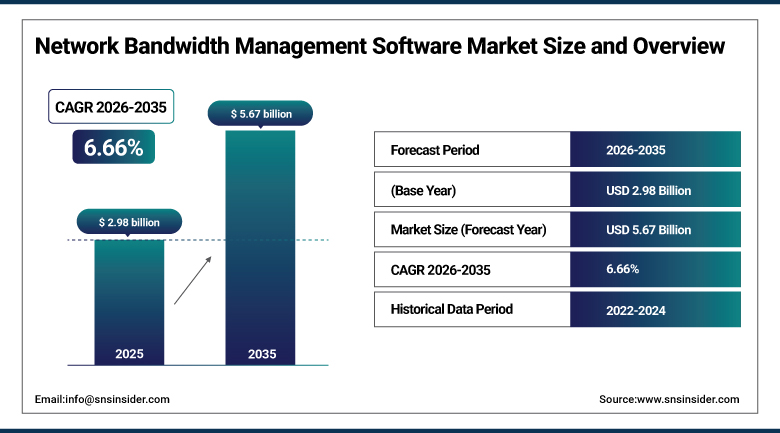
The Network Bandwidth Management Software Market was valued at USD 2.98 Billion in 2025 and is expected to reach USD 5.67 Billion by 2035, growing at a CAGR of 6.66% from 2026–2035.
The global network bandwidth management software market is witnessing steady growth owing to the increasing volume of enterprise network traffic, rapid adoption of cloud-based applications, expansion of distributed and hybrid work environments, and growing demand for efficient network resource utilization. Rising deployment of SD-WAN, IoT devices, AI workloads, video collaboration platforms, and data-intensive applications is increasing the need for real-time bandwidth monitoring, traffic prioritization, quality-of-service control, and network optimization.
Growing reliance on cloud-native applications, multi-site enterprise networks, remote connectivity, and digital business platforms is creating greater pressure on organizations to maintain application performance while controlling network infrastructure costs. Enterprises across telecommunications and IT, BFSI, healthcare, retail and e-commerce, education, manufacturing, and government sectors are increasingly adopting bandwidth management software to identify congestion, allocate network capacity according to business priorities, and improve service reliability. The increasing integration of SD-WAN, AI-driven network analytics, application-aware traffic management, and cloud-based management platforms is further expanding the capabilities and adoption of bandwidth management solutions.
In July 2026, AI-powered network management gained momentum as enterprises sought automated solutions for managing growing network traffic and infrastructure complexity. AI-driven analytics support real-time monitoring, anomaly detection, and automated network optimization. For the Network Bandwidth Management Software Market, this trend highlights rising demand for intelligent traffic management, proactive congestion control, and efficient bandwidth allocation.
To Get more information Network Bandwidth Management Software Market - Request Free Sample Report
Network Bandwidth Management Software Market Trends
-
AI-powered network analytics has improved real-time decision-making and efficiency in enterprise bandwidth management.
-
The expansion of cloud infrastructure and distributed enterprise networks has increased demand for centralized bandwidth monitoring, traffic control, and network optimization.
-
Growing network traffic from cloud applications, video collaboration, IoT devices, and AI workloads is increasing demand for intelligent bandwidth management solutions.
-
Integration with AI-driven analytics and edge computing enables faster traffic analysis, congestion detection, and automated bandwidth allocation.
-
Predictive network analytics and automated performance monitoring are helping enterprises identify potential network bottlenecks and optimize bandwidth utilization before service disruptions occur.
-
Network infrastructure providers, software vendors, and cloud technology companies are increasingly developing intelligent bandwidth management capabilities to support automated traffic optimization, application prioritization, and efficient network resource utilization across distributed enterprise environments.
The U.S. Network Bandwidth Management Software Market Outlook
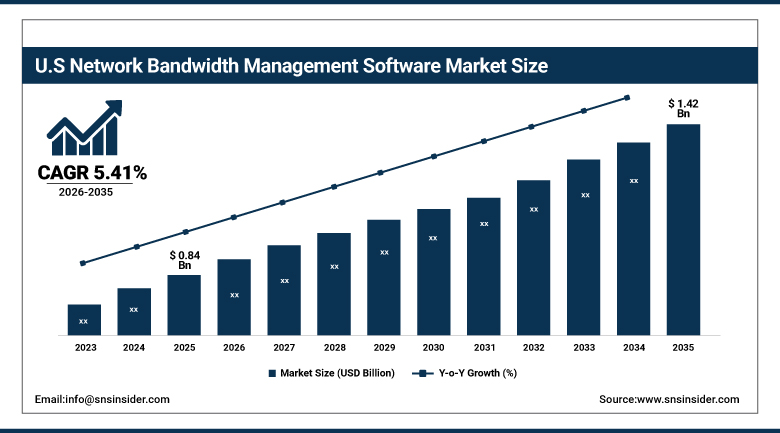
The U.S. Network Bandwidth Management Software Market was valued at USD 0.84 Billion in 2025 and is expected to reach around USD 1.42 Billion by 2035, growing at a CAGR of 5.41% from 2026–2035.
The U.S. network bandwidth management software market is expanding owing to the increasing volume of enterprise network traffic, rapid adoption of cloud computing, and growing demand for efficient network resource utilization. Rising deployment of hybrid and multi-cloud environments, SD-WAN, remote work platforms, IoT devices, and bandwidth-intensive applications is increasing the need for real-time traffic monitoring, application prioritization, and network optimization. Increasing investments in digital infrastructure and enterprise networking technologies are further supporting market growth across the country. Organizations are increasingly adopting bandwidth management software to reduce network congestion, improve application performance, optimize available bandwidth, and control infrastructure costs. The growing use of AI-driven network analytics, automated traffic management, and centralized network monitoring is further enhancing the capabilities of bandwidth management solutions. Increasing adoption across telecommunications and IT, BFSI, healthcare, retail and e-commerce, manufacturing, education, and government organizations is strengthening long-term demand for network bandwidth management software in the U.S. market.
In July 2026, Cisco reported strong demand for AI-focused networking infrastructure in the U.S., with AI infrastructure product orders reaching $9.3 billion and fiscal 2026 revenue increasing 18%. The development highlights rising enterprise demand for high-performance networks to support AI workloads and growing data traffic. For the Network Bandwidth Management Software Market, this trend supports increasing demand for traffic monitoring, bandwidth optimization, application prioritization, and efficient network resource allocation.
Network Bandwidth Management Software Market Segment Analysis
-
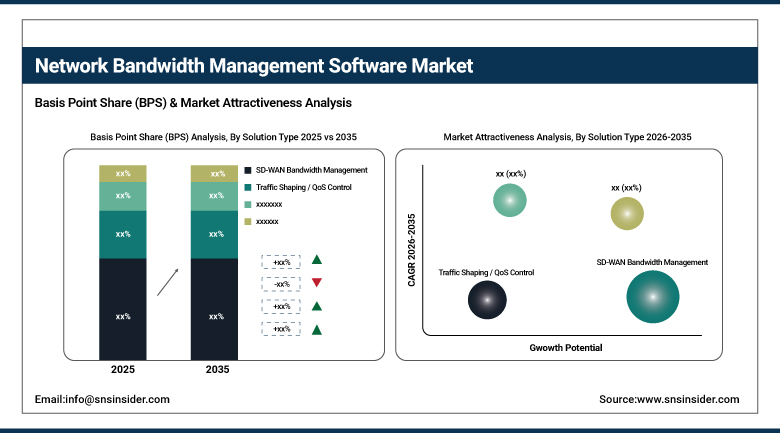
By Solution Type, Sd-Wan bandwidth management dominated the market with a 26.42% share in 2025 and is also the fastest-growing segment, registering a CAGR of 9.70% during 2026 to 2035.
-
By Deployment Model, cloud-based solutions dominated the market with a 51.35% share in 2025 and are the fastest-growing segment, registering a CAGR of 8.46% during 2026 to 2035.
-
By Network Type, wired networks dominated the market with a 64.85% share in 2025, while wireless networks are the fastest-growing segment with a CAGR of 8.68%% during 2026 to 2035.
-
By Organization Size, large enterprises dominated the market with a 63.05% share in 2025, while small & medium-sized enterprises (SMEs) are the fastest-growing segment with a CAGR of 8.12% during 2026 to 2035.
-
By End-User Vertical, telecommunications & IT dominated the market with a 25.08% share in 2025, while healthcare is the fastest-growing segment with a CAGR of 8.48% during 2026 to 2035.
By Solution Type, Sd-Wan bandwidth management dominated the network bandwidth management software market, while it is also the fastest-growing segment.
The Sd-wan bandwidth management segment held the leading position in the network bandwidth management software market in 2025. Its dominance is supported by the growing adoption of software-defined wide area networking across distributed enterprises, branch offices, and cloud-connected environments. Organizations are increasingly using sd-wan bandwidth management to prioritize business-critical applications, optimize traffic flows, improve link utilization, and maintain network performance across multiple connectivity types. Increasing deployment of hybrid cloud environments and geographically distributed enterprise networks is further strengthening demand for centralized bandwidth control and policy-based traffic optimization.
The Sd-wan bandwidth management segment is projected to register the fastest growth during 2026–2035. Rising adoption of Sd-Wan, multi-cloud connectivity, and distributed enterprise architectures is creating greater demand for intelligent bandwidth allocation and application-aware traffic management. Increasing integration of automation, network analytics, and centralized policy controls is expected to further accelerate segment growth.
By Deployment Model, cloud-based dominated the network bandwidth management software market, while cloud-based is also the fastest-growing segment.
The cloud-based segment dominated the network bandwidth management software market in 2025. Its leading position is attributed to increasing enterprise migration toward cloud infrastructure, distributed applications, and software-as-a-service platforms. Cloud-based bandwidth management enables centralized monitoring, traffic control, and resource optimization across geographically dispersed networks without requiring extensive on-premises infrastructure. Growing demand for scalability, flexible deployment, and reduced network management costs is further supporting adoption.
The cloud-based segment is expected to experience the fastest growth during 2026–2035. Increasing adoption of hybrid and multi-cloud architectures, remote work environments, and cloud-native applications is driving enterprises toward scalable network management platforms. The growing integration of centralized analytics, automated traffic policies, and real-time network monitoring is expected to strengthen the segment's growth.
By Network Type, wired networks dominated the network bandwidth management software market, while wireless networks are the fastest-growing segment.
The wired networks segment accounted for the leading share of the network bandwidth management software market in 2025. Its dominance is supported by the extensive deployment of wired enterprise networks across data centers, corporate offices, industrial facilities, telecommunications infrastructure, and large-scale IT environments. Organizations continue to rely on wired connectivity for high bandwidth capacity, stability, security, and predictable network performance, increasing demand for traffic monitoring, bandwidth allocation, and congestion management.
The wireless networks segment is projected to register the fastest growth during 2026–2035. The increasing adoption of Wi-Fi, mobile devices, IoT endpoints, wireless enterprise applications, and distributed connectivity is creating greater requirements for efficient wireless bandwidth utilization. Growing deployment of advanced wireless technologies and increasing network traffic from connected devices are expected to accelerate adoption of bandwidth management solutions.
By End-User Vertical, telecommunications & IT dominated the network bandwidth management software market, while healthcare is the fastest-growing segment.
The telecommunications & IT segment dominated the network bandwidth management software market in 2025. Its leadership is driven by the high volume of network traffic generated by telecommunications infrastructure, cloud services, data centers, enterprise applications, and digital platforms. Service providers and IT organizations require continuous bandwidth monitoring, traffic optimization, quality-of-service controls, and network performance management to maintain reliable connectivity and application availability
The healthcare segment is projected to register the fastest growth during 2026–2035. Increasing adoption of electronic health records, telemedicine, connected medical devices, cloud-based healthcare applications, and high-volume medical data is placing greater demands on healthcare networks. The growing need for reliable connectivity, low-latency applications, and secure transmission of sensitive information is encouraging healthcare organizations to adopt advanced bandwidth monitoring and traffic management solutions.
Regional Analysis
|
Region |
Major Country |
Share within Region, 2025(%) |
|---|---|---|
|
North America |
United States |
82.78% |
|
Europe |
Germany |
27.38% |
|
Asia Pacific |
China |
45.72% |
|
Middle East & Africa |
Saudi Arabia |
22.84% |
|
Latin America |
Brazil |
21.63% |
North America Network Bandwidth Management Software Market Insights
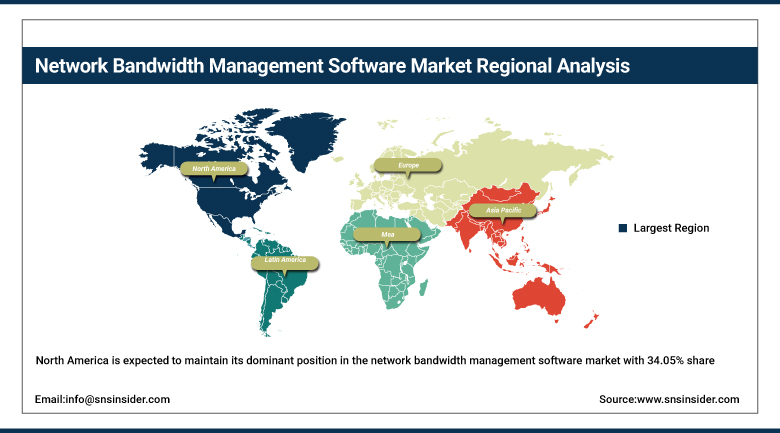
The North America region is expected to maintain its dominant position in the network bandwidth management software market throughout the forecast period, accounting for a 34.05% share of the global market in 2025. The region benefits from widespread adoption of cloud computing, advanced enterprise networking infrastructure, high volumes of data traffic, and strong demand for network performance optimization. The presence of major technology companies, telecommunications providers, financial institutions, healthcare organizations, and large enterprises further supports regional demand for bandwidth monitoring, traffic management, application prioritization, and network optimization solutions.
The U.S. represents the largest country market in North America, supported by extensive deployment of cloud and hybrid network environments, SD-WAN, remote connectivity, AI workloads, IoT applications, and data-intensive enterprise platforms. Growing investments in digital transformation and the need to improve network efficiency, reduce congestion, and optimize bandwidth utilization are strengthening adoption across enterprises and service providers.
Get Customized Report as per Your Business Requirement - Enquiry Now
Europe Network Bandwidth Management Software Market Insights
The demand for network bandwidth management software in Europe is supported by increasing cloud adoption, digital transformation, distributed enterprise networks, and growing requirements for reliable network performance. Germany represents a major country market, supported by its strong manufacturing, automotive, industrial, financial services, and technology sectors, which increasingly depend on connected applications and high-performance enterprise networks.
Organizations across the region are adopting bandwidth management solutions to improve traffic visibility, prioritize business-critical applications, optimize network capacity, and support cloud-based workloads. The UK, France, Italy, and other European markets are also contributing to regional growth through investments in cloud infrastructure, cybersecurity, digital services, SD-WAN, and enterprise networking technologies.
Asia Pacific Network Bandwidth Management Software Market Insights
Asia Pacific is projected to be the fastest-growing regional market, registering a CAGR of 8.68% during 2026–2035. Regional growth is driven by rapid digital transformation, expanding cloud infrastructure, increasing data center capacity, growing enterprise connectivity, and rising adoption of AI, IoT, cloud-native applications, and distributed computing environments. China represents the largest country market in the region, supported by its expanding technology sector, digital economy, telecommunications infrastructure, data centers, and enterprise cloud adoption.
Japan and South Korea remain important markets due to their advanced technology, electronics, automotive, telecommunications, manufacturing, and enterprise IT sectors. India is also expected to experience strong demand as businesses increasingly adopt cloud computing, AI workloads, digital applications, and distributed enterprise networks.
Middle East & Africa and Latin America Network Bandwidth Management Software Market Insights
The Middle East & Africa and Latin America markets are expected to experience continued growth through 2035, supported by digital transformation, expanding cloud infrastructure, increasing enterprise connectivity, and investments in modern networking technologies. In the Middle East & Africa, Saudi Arabia represents a significant country market due to investments in digital infrastructure, data centers, smart city initiatives, cloud services, and national digital transformation programs.
In Latin America, Brazil represents an important country market, supported by increasing cloud adoption across financial services, telecommunications, retail, manufacturing, healthcare, and public-sector organizations. Mexico and other regional markets are also contributing to growth as enterprises expand digital operations and modernize their network infrastructure.
Market Dynamics
Growth Driver: Increasing network traffic and demand for bandwidth optimization are driving market growth
The rapid growth of enterprise network traffic is a major factor driving demand for the network bandwidth management software market. Organizations are increasingly relying on cloud applications, video conferencing, SaaS platforms, AI workloads, IoT devices, and data-intensive digital services, creating greater pressure on network capacity and performance. Bandwidth management software enables enterprises to monitor traffic, prioritize critical applications, control congestion, and optimize available network resources across distributed environments.
The growing adoption of hybrid cloud, multi-cloud, SD-WAN, remote connectivity, and distributed enterprise architectures is further increasing the need for centralized network visibility and automated traffic management. Advancements in network analytics, application-aware policies, quality-of-service controls, and automated bandwidth allocation are enabling organizations to improve network efficiency while maintaining reliable application performance. These developments are supporting wider adoption across telecommunications, IT, BFSI, healthcare, retail, manufacturing, government, and other sectors.
Restraint: Integration complexity, infrastructure costs, and network management challenges can limit market adoption
Integration with existing network infrastructure and legacy systems can create challenges for organizations implementing network bandwidth management software. Enterprises operating complex environments may need to integrate bandwidth management platforms with routers, switches, firewalls, SD-WAN systems, cloud platforms, and network monitoring tools, increasing deployment complexity and implementation time. Compatibility issues across different vendors and network architectures can further complicate adoption.
The costs associated with software licensing, infrastructure upgrades, integration, customization, and skilled network professionals can also limit adoption, particularly among small and medium-sized enterprises. In addition, organizations may face concerns related to data security, network visibility, access controls, and compliance when deploying centralized monitoring and traffic management solutions across distributed network environments.
Opportunity: Growing adoption of SD-WAN, cloud networking, and AI-driven network optimization creates new market opportunities
The increasing adoption of SD-WAN, hybrid cloud, multi-cloud networking, and distributed enterprise infrastructure is creating significant opportunities for network bandwidth management software providers. Organizations require intelligent solutions capable of dynamically allocating bandwidth, prioritizing applications, optimizing traffic routes, and maintaining network performance across multiple connectivity environments.
The growing integration of artificial intelligence, machine learning, predictive analytics, and automation is creating opportunities for advanced bandwidth management platforms. AI-driven traffic analysis can help identify congestion patterns, predict network demand, automate resource allocation, and optimize application performance. The expansion of edge computing, IoT, remote work, and data-intensive applications is expected to further increase demand for intelligent network optimization and centralized bandwidth management solutions across telecommunications, BFSI, healthcare, manufacturing, retail, government, and other industries.
Recent Developments
-
May 2026: Cisco introduced Intelligent Packet Flow enhancements for AI networking, integrating telemetry, adaptive routing, and congestion management to improve network performance for bandwidth-intensive AI workloads.
-
June 2026: Cisco introduced Multicloud Fabric through Cisco Cloud Control, providing unified site-to-cloud and cloud-to-cloud connectivity to improve visibility, scalability, and network management across distributed environments.
-
June 2026: Riverbed was recognized as a Leader and Fast Mover in the 2026 GigaOm Radar for Network Observability, highlighting its AI-driven insights and unified approach to network performance management.
-
2026: SolarWinds expanded its bandwidth management capabilities through NetFlow Traffic Analyzer and Observability Self-Hosted, enabling organizations to analyze traffic patterns, identify high-bandwidth users and applications, and improve bandwidth allocation.
Network Bandwidth Management Software Market key players are:
-
Cisco Systems, Inc.
-
Broadcom Inc.
-
SolarWinds Corporation
-
Progress Software Corporation
-
NetScout Systems, Inc.
-
Riverbed Technology
-
Nokia Corporation
-
Huawei Technologies Co., Ltd.
-
Juniper Networks, Inc.
-
Fortinet, Inc.
-
VMware, Inc.
-
IBM Corporation
-
Hewlett Packard Enterprise
-
A10 Networks, Inc.
-
Allot Ltd.
-
Kentik Technologies, Inc.
-
ManageEngine
-
Paessler AG
-
GFI Software
-
Exinda Networks
Network Bandwidth Management Software Market Report Scope:
| Report Attributes | Details |
|---|---|
| Market Size in 2025 | USD 2.98 Billion |
| Market Size by 2035 | USD 5.67 Billion |
| CAGR | CAGR of 6.66% From 2026 to 2035 |
| Base Year | 2025 |
| Forecast Period | 2026-2035 |
| Historical Data | 2022-2024 |
| Report Scope & Coverage | Market Size, Segments Analysis, Competitive Landscape, Regional Analysis, DROC & SWOT Analysis, Forecast Outlook |
| Key Segments | • By Solution Type (Bandwidth Monitoring & Reporting, Traffic Shaping / QoS Control, WAN / Internet Link Optimization, SD-WAN Bandwidth Management, Others) • By Deployment Model (On-Premises, Cloud-Based, Hybrid) • By Network Type (Wired Networks, Wireless Networks) • By Organization Size (Large Enterprises, Small & Medium-Sized Enterprises (SMEs)) • By End-User Vertical (Telecommunications & IT, BFSI, Healthcare, Retail & E-Commerce, Education, Government & Defense, Manufacturing, Others) |
| Regional Analysis/Coverage | North America (US, Canada), Europe (Germany, UK, France, Italy, Spain, Russia, Poland, Rest of Europe), Asia Pacific (China, India, Japan, South Korea, Australia, ASEAN Countries, Rest of Asia Pacific), Middle East & Africa (UAE, Saudi Arabia, Qatar, South Africa, Rest of Middle East & Africa), Latin America (Brazil, Argentina, Mexico, Colombia, Rest of Latin America) |
| Company Profiles | Cisco Systems, Inc., Broadcom Inc., SolarWinds Corporation, Progress Software Corporation, NetScout Systems, Inc., Riverbed Technology, Nokia Corporation, Huawei Technologies Co., Ltd., Juniper Networks, Inc., Fortinet, Inc., VMware, Inc., IBM Corporation, Hewlett Packard Enterprise, A10 Networks, Inc., Allot Ltd., Kentik Technologies, Inc., ManageEngine, Paessler AG, GFI Software, Exinda Networks |

Frequently Asked Questions
The Network Bandwidth Management Software Market is expected to grow at a CAGR of 6.66% from 2026 to 2035.
The Network Bandwidth Management Software Market was valued at approximately USD 2.88 billion in 2025.
The market is primarily driven by increasing network traffic, growing adoption of cloud and hybrid network environments, rising demand for bandwidth optimization, and the need to improve network performance, application availability, and resource utilization.
SD-WAN Bandwidth Management dominated the Network Bandwidth Management Software Market in 2025, accounting for a 26.42% share.
North America dominated the Network Bandwidth Management Software Market in 2025, accounting for a 34.05% share.
