
High-Performance Polymers Market Report Scope & Overview:
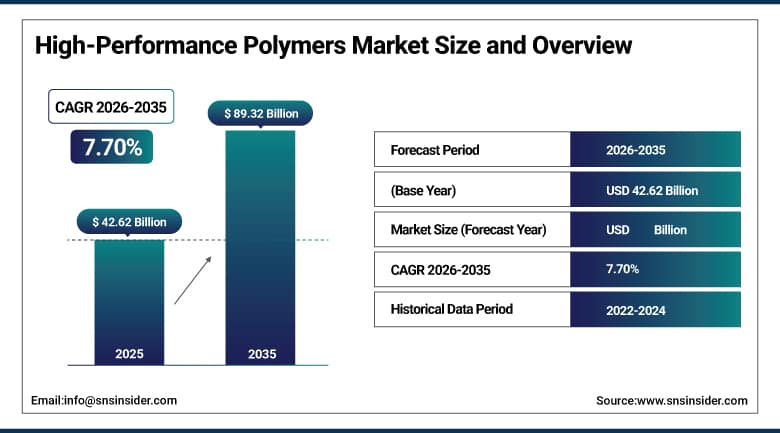
The High-Performance Polymers Market was valued at USD 42.62 Billion in 2025 and is expected to reach USD 89.32 Billion by 2035, growing at a CAGR of 7.70% from 2026–2035.
The global high-performance polymers market is witnessing steady growth in the global market owing to increasing demand for lightweight, durable, and high-temperature resistant materials. Rising adoption across automotive, electronics & electrical, aerospace & defense, medical & healthcare, and industrial applications is accelerating market expansion. Manufacturers are focusing on advanced polymer formulations, precision processing technologies, recyclable material development, and high-performance composite integration. Growing investments in additive manufacturing, AI-based material design, digital simulation platforms, and sustainable polymer production are supporting technology advancement. Increasing demand for fuel-efficient vehicles, miniaturized electronic components, medical-grade materials, and high-strength industrial solutions is further driving market adoption.
As per the report on “OECD Regional Plastics Outlook” that was published in 2025, the number of plastics consumed in the region of East and Southeast Asia stood at 152 million tonnes, which represents a 9-times increase from what it was in the year 1990. In addition, the production of engineered polymers and synthetic fibres in the world industry sector is anticipated to consume 18.4 million barrels of crude oil feedstock per day till 2030.
Market Size and Forecast
-
Market Size 2026E: USD 45.82 Billion
-
Market Size 2035: USD 89.32 Billion
-
CAGR: 7.70% from 2026 to 2035
-
Fastest Growing Region: Asia Pacific
-
Largest Region: North America
To Get More Information On High-Performance Polymers Market - Request Free Sample Report
High-Performance Polymers Market Trends
-
Rising adoption of recyclable High-Performance Polymers supports sustainable manufacturing and circular economy initiatives across multiple industries globally.
-
Artificial intelligence accelerates polymer formulation, material discovery, and performance optimization for advanced engineering applications and manufacturing.
-
Lightweight High-Performance Polymers are increasingly replacing metals in automotive and aerospace components to improve efficiency and durability.
-
Expanding electric vehicle production continues driving demand for thermally stable, lightweight, and high-strength polymer materials worldwide.
-
Electronics manufacturers increasingly utilize High-Performance Polymers for compact, heat-resistant, and reliable next-generation electronic component production.
-
Continuous investments in advanced processing technologies enhance polymer performance, manufacturing efficiency, and commercial application opportunities globally.
U.S. High-Performance Polymers Market Outlook
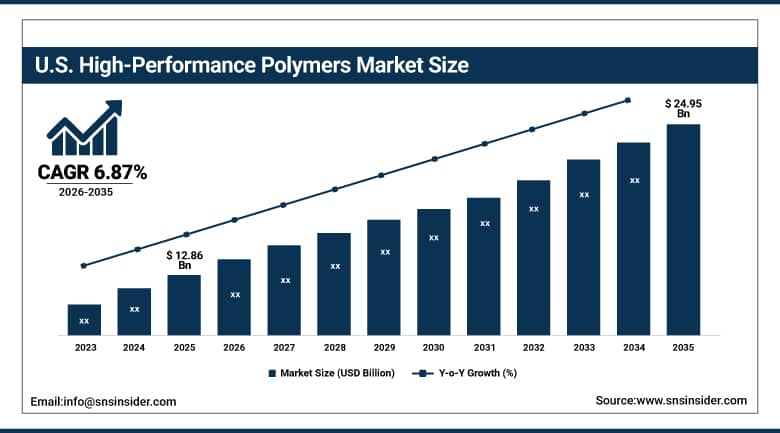
The U.S. High-Performance Polymers Market was valued at USD 12.86 Billion in 2025 and is expected to reach around USD 24.95 Billion by 2035, growing at a CAGR of 6.87% from 2026–2035.
The U.S. high-performance polymers market is expanding steadily owing to rising demand for advanced lightweight materials across high-value manufacturing industries. Increasing adoption by automotive, aerospace & defense, electronics & electrical, healthcare, and industrial manufacturers is supporting market growth nationwide. Rising investments in high-temperature polymer development, precision processing technologies, advanced composites, and sustainable material innovations are driving manufacturing efficiency and product performance. Growth in electric vehicle production and semiconductor manufacturing is further accelerating high-performance polymer consumption across industries. Manufacturers are focusing on recyclable polymer solutions, AI-based material design, and digital simulation technologies across diverse application segments. Increasing demand for durable components, medical-grade polymers, and high-performance electrical insulation materials is strengthening long-term market penetration.
According to the U.S. Department of Energy, manufacturing of fluoropolymer used in batteries has helped the synthesis plants increase their production capacity in order to encourage the development of electric vehicles by 2025. Likewise, environmental databases from government sectors have confirmed that high molecular weight polymers stay non-soluble and test respirable particles over 10000 daltons. The federal energy policy has been based on heat-resistant polymers in which the efficiency of material processing has increased from 4% to 13%.
High-Performance Polymers Market Segment Analysis
-
By Product Type, polyether ether ketone (PEEK) dominated the market with 29.95% share in 2025; while liquid crystal polymers (LCP) are the fastest growing segment with CAGR of 12.11% during 2026 to 2035.
-
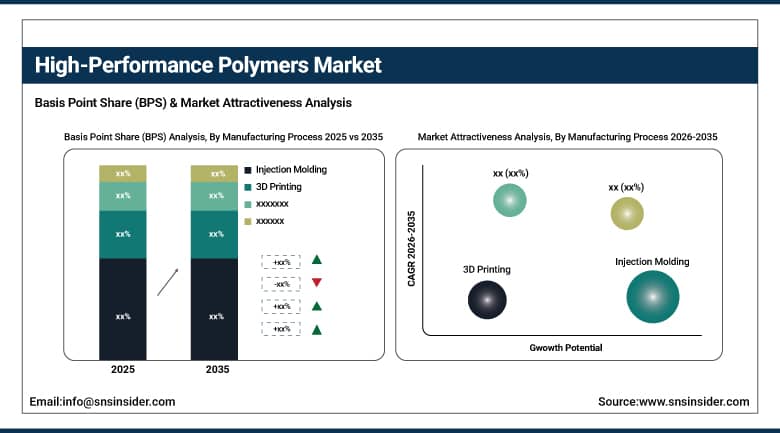
By Manufacturing process, injection molding dominated the market with 46.95% share in 2025; while 3D printing are the fastest growing segment with CAGR of 15.18% during 2026 to 2035.
-
By Application, electronics & electrical dominated the market with 35.79% share in 2025; while medical is the fastest growing segment with CAGR of 11.09% during 2026 to 2035.
-
By End Use, industrial dominated the market with 44.95% share in 2025; while healthcare is the fastest growing segment with CAGR of 11.55% during 2026 to 2035.
By Manufacturing Process, injection molding dominated the high-performance polymers market, while 3D printing is the fastest growing segment.
The injection molding segment captured the dominated revenue share in the high-performance polymers market in 2025. This segment is known for allowing mass production with high precision and high consistency in product quality through different industrial applications. Manufacturers usually choose injection molding as an effective method for producing complex parts of high-performance polymers without wasting raw materials and reducing production time. The increasing demand from various industrial verticals such as automotive, electronics & electrical, medical, and other sectors added momentum to the market domination of the segment.
3D printing is likely to experience the fastest CAGR during 2026-2035. The adoption of additive manufacturing facilitates rapid prototyping and customization of production through advanced high-performance polymers. 3D printing technology allows lightweight production of components by saving raw materials and minimizing production time through important industries. Increasing investment in industries including aerospace & defense, healthcare, electronics, and other industries are driving the adoption of 3D Printing solutions.
By Product Type, polyether ether ketone (PEEK) dominated the high-performance polymers market, while liquid crystal polymers (LCP) are the fastest growing segment.
High-performance polymers market held PEEK segment as leader with the dominated share in 2025 owing to its outstanding mechanical strength, excellent thermal stability, and superior chemical resistance. It was widely used in aerospace, automotive, electronics, and medical segments, and hence increased the overall consumption of the product. Rising preference for lightweight and durable materials boosted its market leadership in advanced manufacturing sectors.
LCP segment is expected to witness fastest CAGR during 2026-2035 owing to rising demand for miniature electronic parts and high-frequency electronic devices. Low dielectric constant and high-temperature resistance make LCPs suitable for future generation products. Rising manufacturing of electric vehicles, 5G network, and precision electronic products have significantly accelerated the use of LCPs in various markets.
By Application, electronics & electrical dominated the high-performance polymers market, while medical is the fastest growing segment.
The electronics & electrical segment took the top spot in the high-performance polymers market by generating the dominated revenue share in 2025. High demand for electronic gadgets that are compact as well as semiconductor packaging has resulted in high usage of high-performance polymers around the globe. These polymers offer great thermal stability, electric insulation, flame retardancy, and dimensional accuracy. The quick advancement in 5G infrastructure, consumer electronics, electric vehicles, and industrial automation has contributed toward their adoption in electronics manufacturing plants all over the world.
Medical segment is projected to register the fastest CAGR during the forecast period. Growing need for biocompatibility, sterilization capability, and light weight of the polymer material is propelling its adoption in advanced healthcare applications all over the world. High-performance polymers are used for surgical instruments, orthopedic implants, diagnostic devices, and other minimally invasive devices. Innovative medical technologies, increasing healthcare infrastructure, aging population, and stringent regulations are making advanced investments in polymer material in healthcare industry.
By End Use, industrial dominated the high-performance polymers market, while healthcare is the fastest growing segment.
The industrial segment occupied the top position in terms of the dominated revenue share in the high-performance polymers market during 2025. The high demand for tough materials by the manufacturing, machinery, oil and gas, and chemical processing industries was behind this segment's popularity. High-performance polymers can withstand very high temperatures and have excellent thermal stability, chemical resistance, wear resistance, and mechanical strength. Their use as replacements for metals in many industries has helped enhance the performance of the equipment due to their light weight.
The healthcare segment is estimated to register the fastest CAGR over the forecast period of 2026-2035. The rising demand for biocompatible materials in the medical sector such as medical devices, surgical tools, diagnostic equipment, and implants has increased their adoption. The high sterilization and chemical compatibility resistance along with light weight of these polymers makes them fit for healthcare applications.
Regional Analysis
|
Region |
Major Country |
Share within Region, 2025(%) |
|---|---|---|
|
North America |
United States |
83.95% |
|
Europe |
Germany |
24.68% |
|
Asia Pacific |
China |
39.52% |
|
Middle East & Africa |
UAE |
14.36% |
|
Latin America |
Brazil |
42.81% |
North America High-Performance Polymers Market Insights
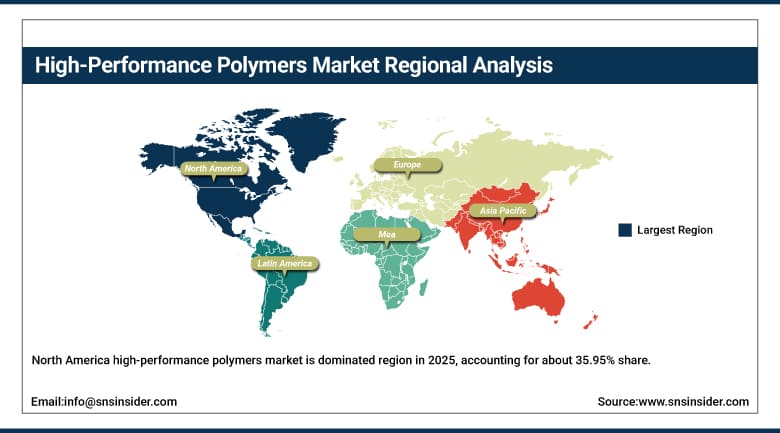
North America high-performance polymers market is dominated region in 2025, accounting for about 35.95% share, driven by increasing demand for lightweight, high-strength materials across aerospace, automotive, electronics, and healthcare industries. The region benefits from advanced manufacturing infrastructure, strong research investments, and established polymer technology companies. Increasing adoption of high-temperature engineering plastics, precision processing technologies, and sustainable material innovations is strengthening market growth. Expansion of electric vehicle production and semiconductor manufacturing further reinforces the region’s dominant position in the market.
As mentioned by the U.S. Department of Energy, using the new composite materials and lightweight materials in the production process of North American automobiles seeks to attain a 25% decrease in weight of the automobile glider. Program data shows that the substitution of the conventional metal by the high-performance polymer matrix composite results in a 10% to 60% decrease in weight per component, thus improving the efficiency in the fuel consumption rate by 6% to 8%.
Get Customized Report as Per Your Business Requirement - Enquiry Now
Europe High-Performance Polymers Market Insights
Europe high-performance polymers market is characterized by stable growth in 2025 owing to increasing investments in sustainable material development and advanced polymer manufacturing technologies. Key countries include Germany, France, United Kingdom, Italy, and Spain. Rising adoption of engineering thermoplastics, recyclable polymers, and lightweight composite materials is supporting market expansion. Increasing focus on electric mobility, industrial automation, and circular economy initiatives is strengthening long-term industry development. Technological advancements continue encouraging high-performance material innovation and manufacturing efficiency across the region.
As highlighted by Plastics Europe in Plastics the Fast Facts 2025, there was a constant level of production of plastic within Europe at 54.6 million tonnes; however, the regional share of the global plastics produced fell to 12%. The circular plastics accounted for 15.4% of the total European production volume amounting to 8.4 million tonnes. Fossil-based materials constituted 79.2%, recycling made up 13.9%, and the Europe region had a trade deficit of 1.6 million tonnes.
Asia Pacific High-Performance Polymers Market Insights
Asia Pacific is the fastest growing region in the high-performance polymers market, registering a CAGR of about 8.95% during 2026–2035. Rapid industrialization and increasing manufacturing investments are driving strong market demand across China, Japan, India, South Korea, and Southeast Asia. Rising production of electronics, electric vehicles, industrial machinery, and medical devices is accelerating regional market growth. Growing investments in advanced polymer processing technologies and high-performance material innovation continue supporting widespread market expansion across manufacturing industries.
As highlighted in the 2025 Regional Plastics Outlook in Southeast and East Asia by the Organisation for Economic Cooperation and Development, ASEAN Plus Three countries account for over 33% of global plastic leakage despite producing almost 33% of global gross domestic product. Regional-level policies aimed at tackling primary polymer lifecycle phases are expected to reduce the total consumption of plastic by 28%, plastic waste generation by 23%, and plastic leakage to zero percent.
Middle East & Africa and Latin America High-Performance Polymers Market Insights
The Middle East & Africa along with Latin America regions are witnessing steady growth due to expanding industrial manufacturing capacity and increasing investments in advanced material technologies. Key contributing countries include Saudi Arabia, UAE, South Africa, Brazil, Mexico, and Argentina. Growing adoption of engineering polymers across automotive, oil and gas, electrical, and industrial applications is supporting market expansion. Continued investments in manufacturing modernization and infrastructure development are strengthening long-term regional opportunities.
In accordance with the statistical measures for global industries in 2025 by the United Nations Industrial Development Organization, medium-high and high-technology manufacturing indices increased by 47.6%, whereas the high-technology manufacturing production remained at 51.2% of total manufacturing value added. Moreover, regional industrial benchmarking suggests that global manufacturing production experienced an annual growth rate of 2.8% due to the implementation of advanced industrial policies that facilitated high-technology manufacturing processes in developing regions.
Market Dynamics
Growth Drivers: Increasing demand for lightweight high-performance materials accelerates automotive, aerospace, electronics, and industrial growth.
The increasing application of lightweight and durable materials in the automotive and aerospace industry is considerably aiding market expansion around the world. The use of metals in automobiles and aerospace is now being substituted by the High-Performance Polymers, which help improve fuel efficiency and performance along with durability. Increasing demand for the electric vehicles and aircrafts is contributing towards rising the consumption of the materials in their construction. The electronics manufacturers are now using these materials for producing miniaturized components. Constant investments in technology advancements have been improving the performance of products.
As per the DOE Materials Technologies Roadmap 2025 Report, the application of advanced lightweight materials like polymers will result in a weight reduction of up to 50% of the vehicle body and chassis. In addition to this, there is an increase in fuel efficiency by 6% to 8% as a consequence of 10% weight reduction from the total weight of the vehicle. The target for DOE is a 25% reduction in weight for the entire vehicle body, chassis, and interior by 2030.
Restraints: Complex processing and limited expertise reduce advanced polymer manufacturing efficiency globally.
Sophisticated fabrication processes needed for High Performance Polymers pose significant operating difficulties for industries in various economic segments. The fabrication of such sophisticated polymers requires special machinery and skilled technicians. Higher process temperatures and careful molding complicate operations and raise the cost of production. Moreover, the lack of processing expertise poses hurdles in commercializing such products in certain developing economies. There is a constant need for training the labor force and installing processing technology to keep up the standard of the product.
Opportunities: Recyclable polymers and AI-based material development accelerate sustainable manufacturing innovation globally.
The increasing focus on sustainability and digital material innovation is creating new growth prospects for High-Performance Polymers in the international marketplace. Companies are working on developing engineering polymers that are recyclable, biodegradable and production processes with reduced carbon footprints to achieve sustainability goals. The artificial intelligence is speeding up the development process of new materials and formulations. There is reduction in development time with improved product quality through digital simulation methods. Growing support from regulators in favor of sustainable materials is motivating companies to develop sustainable polymer materials.
As per the European Commission, the regulations in EU concerning sustainability of material innovation have a target of 77% collection rate of plastic bottles and 25% of recycled content of PET bottles by 2025. At the same time, it is evident from industry market surveillance that mechanical recycling accounts for 63.5% of circular polymers and that the generation of plastic waste in the world has exceeded 350 million metric tons.
Recent Developments
-
2026: Syensqo broke ground on a multi-million-dollar expansion in Maryland, increasing aerospace composite materials capacity by over 30%.
-
2025: Evonik expanded its high-performance polymer solutions for additive manufacturing through an enhanced PA12 3D-printing partnership with HP.
-
2025: BASF expanded its Cellasto high-performance polyurethane component production capacity across its key manufacturing sites in Shanghai and Dahej.
-
2024: Victrex commenced commercial operations at its China manufacturing facility, ramping production up to 150 tonnes of PEEK annually.
High-Performance Polymers Market Key Players are:
-
Syensqo S.A.
-
BASF SE
-
Evonik Industries AG
-
Arkema S.A.
-
Celanese Corporation
-
DuPont de Nemours, Inc.
-
Victrex plc
-
Saudi Basic Industries Corporation (SABIC)
-
Toray Industries, Inc.
-
Kuraray Co., Ltd.
-
Sumitomo Chemical Co., Ltd.
-
Mitsubishi Chemical Group Corporation
-
Daikin Industries, Ltd.
-
EMS-CHEMIE HOLDING AG
-
RTP Company
-
Ensinger GmbH
-
LANXESS AG
-
Mitsui Chemicals, Inc.
-
DIC Corporation
-
Asahi Kasei Corporation
High-Performance Polymers Market Report Scope:
| Report Attributes | Details |
|---|---|
| Market Size in 2025 | USD 42.62 Billion |
| Market Size by 2035 | USD 89.32 Billion |
| CAGR | CAGR of 7.70% From 2026 to 2035 |
| Base Year | 2025 |
| Forecast Period | 2026-2035 |
| Historical Data | 2022-2024 |
| Report Scope & Coverage | Market Size, Segments Analysis, Competitive Landscape, Regional Analysis, DROC & SWOT Analysis, Forecast Outlook |
| Key Segments | • By Product Type (Polyphenylene Sulfide (PPS), Polyether Ether Ketone (PEEK), Polytetrafluoroethylene (PTFE), Liquid Crystal Polymers (LCP), Polyimides (PI), Polyamide-imide (PAI), Others) • By Manufacturing Process (Injection Molding, Extrusion, 3D Printing, Compression Molding, Other Fabrication Techniques) • By Application (Automotive, Electronics & Electrical, Aerospace & Defense, Medical, Other Sectors) • By End Use (Industrial, Consumer Goods, Healthcare, Energy, Others) |
| Regional Analysis/Coverage | North America (US, Canada), Europe (Germany, UK, France, Italy, Spain, Russia, Poland, Rest of Europe), Asia Pacific (China, India, Japan, South Korea, Australia, ASEAN Countries, Rest of Asia Pacific), Middle East & Africa (UAE, Saudi Arabia, Qatar, South Africa, Rest of Middle East & Africa), Latin America (Brazil, Argentina, Mexico, Colombia, Rest of Latin America). |
| Company Profiles | Syensqo S.A., BASF SE, Evonik Industries AG, Arkema S.A., Celanese Corporation, DuPont de Nemours, Inc., Victrex plc, Saudi Basic Industries Corporation (SABIC), Toray Industries, Inc., Kuraray Co., Ltd., Sumitomo Chemical Co., Ltd., Mitsubishi Chemical Group Corporation, Daikin Industries, Ltd., EMS-CHEMIE HOLDING AG, RTP Company, Ensinger GmbH, LANXESS AG, Mitsui Chemicals, Inc., DIC Corporation, Asahi Kasei Corporation |

Frequently Asked Questions
The high-performance polymers market was valued at USD 42.62 billion in 2025.
The polyether ether ketone (PEEK) dominated in 2025 due to superior strength, thermal stability, chemical resistance, and broad industrial adoption.
The major growth factors include rising demand for lightweight materials, expanding electric vehicle production, additive manufacturing advancements, AI-based material design, and sustainable recyclable polymer solutions.
North America dominated the high-performance polymers market in 2025.
