
Industrial Solvents Market Report Scope & Overview
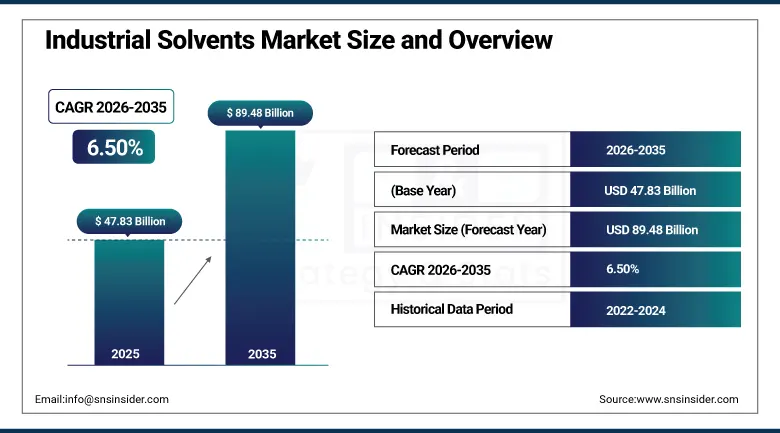
The Industrial Solvents Market was valued at USD 47.83 Billion in 2025 and is expected to reach USD 89.48 Billion by 2035, growing at a CAGR of 6.50% from 2026 to 2035.
The Industrial Solvents Market is driven by the growth of production activities in the automotive, construction, pharmaceutical and packaging industries and the rising demand for high-performance chemical formulations. Industrial solvents are the main components for dissolution, extraction, cleaning and formulation processes in many manufacturing applications. Globally, there is an increasing consumption of solvents, thanks to increasing investments in infrastructure projects, increasing vehicle production and increasing pharmaceutical manufacturing capacities. Furthermore, the move to bio-based and low-VOC solvents is being driven by more stringent environmental regulations and sustainability initiatives, opening up new opportunities for innovation and long-term market growth in both developed and emerging economies.
BASF SE has invested more in sustainable solvents and bio-chemicals in the year 2025 owing to the increase in global demand for products having low VOC emissions. It is anticipated that there will be an investment exceeding USD 120 billion in the global specialty and industrial chemicals sector by 2025.
To Get more information On Industrial Solvents Market - Request Free Sample Report
Market Trends:
-
Growing demand from paints, coatings, adhesives, and chemical manufacturing industries is driving higher consumption of industrial solvents across industrial applications.
-
Rapid industrialization and infrastructure expansion are increasing solvent usage in formulation, cleaning, and processing operations globally.
-
Strong shift toward bio-based and low-VOC solvents is accelerating due to tightening environmental regulations and sustainability goals.
-
Increasing focus on green chemistry and eco-friendly formulations is driving innovation in sustainable industrial solvent alternatives.
U.S. Industrial Solvents Market Outlook:
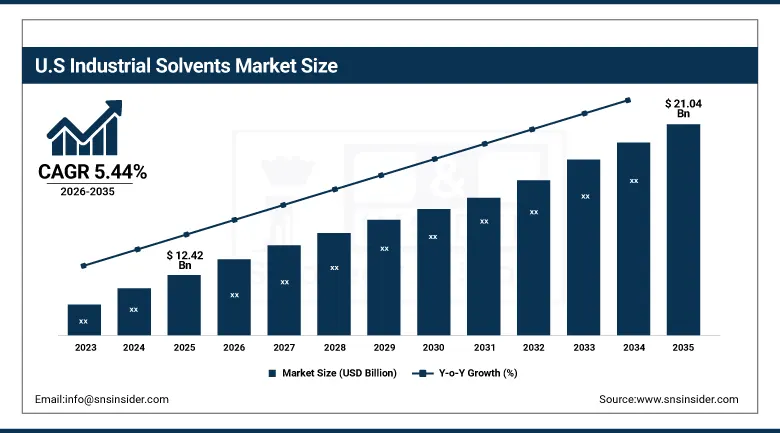
The U.S. Industrial Solvents Market was valued at approximately USD 12.42 Billion in 2025 and is expected to reach approximately USD 21.04 Billion by 2035, growing at a CAGR of approximately 5.44% from 2026 to 2035.
The U.S. Industrial Solvents Market is growing at a very fast pace. Industrial solvents are used in paints & coatings, automotive manufacturing, pharmaceuticals and industrial cleaning applications. The demand for solvents is anticipated to be driven by a variety of end-use industries with increasing industrial production, infrastructure development and chemical processing activities. The market is also being driven by the adoption of advanced manufacturing techniques and specialty chemical formulations. Increasing demand for high performance solvents used in precision cleaning, surface treatment and formulation processes in various industrial sectors is also aiding growth.
Dow Chemical Company in the year 2025 increased its efforts in producing chemicals with low carbon footprint and sustainable solvent technology in order to enhance domestic production capacity and respond to rising demand from the industries for sustainable formulation products. The US is still a major investment hub for specialized chemicals, semiconductors, and advanced material production. This increases demand for industrial solvents.
Industrial Solvents Market Segment Analysis:
-
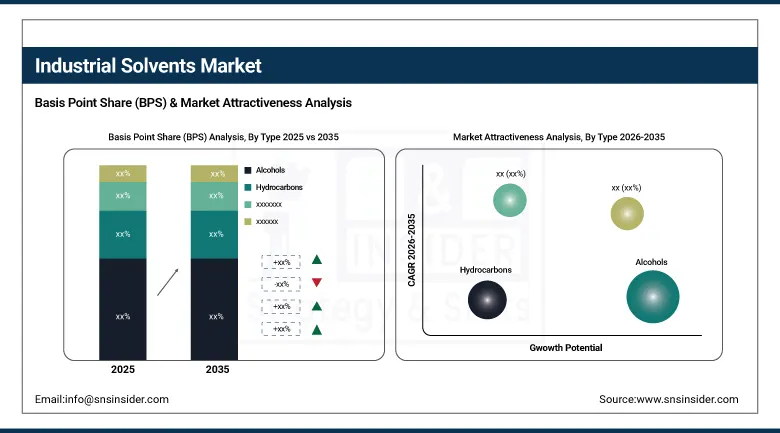
By Type, Alcohols dominated the Industrial Solvents Market with approximately 34.00% share in 2025, while Bio-based Solvents are the fastest-growing segment from 2026 to 2035.
-
By Source, Petrochemical-based Solvents dominated the Industrial Solvents Market with approximately 71.00% share in 2025, while Bio-based Solvents are the fastest-growing source segment from 2026 to 2035.
-
By Application, Paints & Coatings dominated the Industrial Solvents Market with approximately 29.00% share in 2025, while Pharmaceuticals are the fastest-growing application segment from 2026 to 2035.
-
By End-use Industry, Chemical Manufacturing dominated the Industrial Solvents Market with approximately 31.00% share in 2025, while Electronics & Semiconductor Manufacturing is the fastest-growing end-use industry segment from 2026 to 2035
By Type, alcohols dominate, bio-based solvents grow fastest
Alcohols dominated the industrial solvents market in 2025 and accounted for approximately 34% revenue share. This increase is mainly attributed to increasing demand for paints and coatings, pharmaceuticals, cosmetic products, and industrial cleaners. Due to their good solvating power, cheap price, and good industrial compatibility, they are the most commonly used class of solvents in the world today.
Bio-based solvents are expected to witness the fastest CAGR during the forecast period of 2026–2035. Growth is driven by stricter environmental regulations and increasing corporate commitments to sustainability across a variety of industries. They are derived from renewable feedstocks such as biomass, sugars and vegetable oils, have lower toxicity and lower VOC emissions than petrochemical-based solvents. The commercialization of bio-based solvents is expected to pick up speed, fueled by rising investments in green chemistry, expanding applications in coatings, adhesives, cleaning products and pharmaceuticals, and the worldwide shift towards sustainable chemical manufacturing
By Source, petrochemical-based solvents dominate, bio-based solvents grow fastest
Petrochemical-based solvents dominated the industrial solvents market in 2025 and accounted for approximately 71% revenue share. This is due to their large availability, advanced manufacturing plants and wide applicability in paints, coatings, adhesives and industrial processes. The low cost of these compounds and their stable performance under industrial conditions have allowed them to occupy a dominant position on the world market.
Bio-based solvents are expected to witness the fastest CAGR during the forecast period of 2026–2035.This growth is attributed to stringent environmental policies and the growing sustainability goals among companies. The bio-based products are made from renewable raw materials and offer less impact on the environment and low volatile organic compound (VOC) emissions. A strong shift towards the use of bio-based solvents is anticipated to take place, owing to technological progress in renewable chemicals, environmental regulation of petrochemical solvents, and high usage in pharmaceuticals and coatings.
By Application, paints & coatings dominate, pharmaceuticals grow fastest
Paints & coatings dominated the industrial solvents market in 2025 and accounted for approximately 29% revenue share. The growth is driven by strong demand from construction, automotive refinishing and industrial surface protection applications. This application segment accounts for the largest share of the global market due to its critical role in formulation, viscosity control and performance enhancement.
Pharmaceuticals are expected to witness the fastest CAGR during the forecast period of 2026–2035. The growth is due to increased production of drugs, API manufacturing and demand for high-purity solvents in formulation and synthesis processes. The increasing healthcare infrastructure worldwide and growing pharmaceutical manufacturing capacity also boost the segment growth. The pharmaceutical segment is expected to witness a significant growth owing to the rising demand for precision drug formulation, increasing biologics production, and rising investments in advanced pharmaceutical manufacturing technologies.
By End-use Industry, chemical manufacturing dominates, electronics & semiconductor grows fastest
Chemical manufacturing dominated the industrial solvents market in 2025 and accounted for approximately 31% revenue share. Large solvent consumption in synthesis, formulation and processing operations in bulk and specialty chemical manufacturing is driving the growth. Backed by a dominant position, continuous industrial output and strong global chemical demand.
Electronics & semiconductor manufacturing is expected to witness the fastest CAGR during the forecast period of 2026–2035. The growth is attributed to increasing demand for ultrahigh purity solvents for wafer cleaning, microelectronics fabrication and precision cleaning processes. Growth is also supported by expansion of semiconductor investments and advanced electronics production. The segment is anticipated to grow at a fast rate, owing to increasing semiconductor fabrication capacity, growing demand for miniaturized electronics, and rising adoption of ultra-pure chemical processes in advanced manufacturing ecosystems.
Regional Analysis:
|
Region |
Major Country |
Share within Region, 2025 (%) |
|---|---|---|
|
North America |
United States |
84.12% |
|
Europe |
Germany |
24.1% |
|
Asia Pacific |
China |
46.3% |
|
Latin America |
Brazil |
44.6% |
|
Middle East |
Saudi Arabia |
26.2% |
North America Industrial Solvents Market Insights
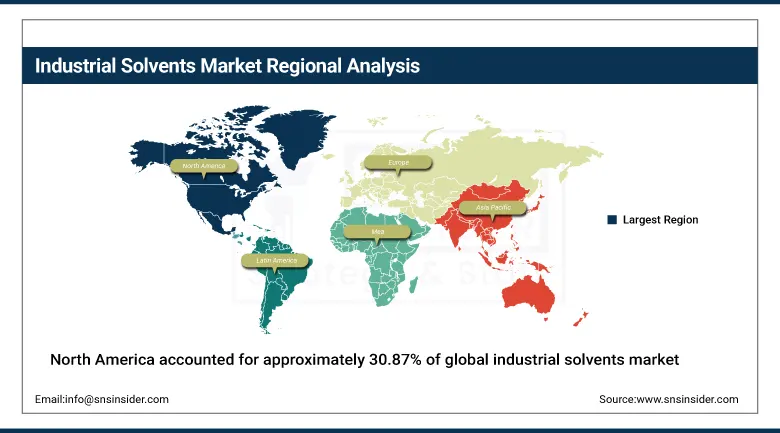
North America accounted for approximately 30.87% of global industrial solvents market revenues in 2025. The area has a strong chemical manufacturing base supported by strong demand from paints and coatings, the pharmaceuticals sector and industrial cleaning. North America is the largest region in terms of revenue generation, due to the substantial share contributed by the U.S. The U.S. contributed 83.4% of total revenue generated in North America owing to its developed petrochemical and manufacturing capacity.
This is driven by the growing specialty chemical and pharmaceutical sectors in Canada while solvent consumption is helped by the growing automotive and manufacturing industry in Mexico.
Get Customized Report as per Your Business Requirement - Enquiry Now
Europe Industrial Solvents Market Insights
Europe accounted for approximately 29.05% of global industrial solvents market revenues in 2025.The market is driven by the strong chemical manufacturing capacities, the strict environmental regulations and the increasing adoption of sustainable solvent technologies. Germany contributed about 24.1% to European revenues, supported by its leadership in chemical production, automotive manufacturing and industrial processing industries.
France, Italy and the United Kingdom are increasingly adopting bio-based and specialty solvents in response to environmental regulations and sustainability targets. The region’s solvent demand continues to be driven by growing investments in green chemistry and low emission industrial processes.
Asia Pacific Industrial Solvents Market Insights
Asia Pacific accounted for approximately 27.79% of global industrial solvents market revenues in 2025.The demand in the region is driven by increasing investments in chemicals, electronics and pharmaceuticals coupled with rapid industrialization and growing manufacturing activities. China, with its large chemical manufacturing industry, wide industrial base, and large-scale production of paints, coatings & consumer goods, contributed around 46.3% of Asia Pacific revenues.
India, Japan and South Korea are also making major contributions through expanding pharmaceutical manufacturing, electronics production and infrastructure development activities. The rising demand for specialty chemicals and the increasing investments in sustainable manufacturing technologies are driving the regional market growth.
Middle East & Africa & Latin America Industrial Solvents Market Insights
The Middle East and Latin America collectively accounted for approximately 12.29% of global industrial solvents market revenues in 2025. Growing petrochemical investments, increasing industrial diversification and expanding manufacturing activities are driving solvent demand in both regions. Furthermore, the market is driven by growing adoption of industrial coatings, adhesives and cleaning chemicals.
Brazil’s large manufacturing and chemical processing sectors helped it to account for around 44.6% of Latin American revenues. Saudi Arabia accounted for most revenues in the Middle East, with about 26.2% of the region’s revenues, driven by significant investments in petrochemicals and downstream chemical industries and industrial diversification efforts under Vision 2030. Demand for industrial solvents is increasing in both regions as industrial development picks up.
Market Dynamics:
Growth Drivers: Expanding paints, coatings, and industrial manufacturing activities driving solvent consumption
The industrial solvents market is experiencing growth driven by the increasing demand from paints & coatings, adhesives, pharmaceuticals and industrial cleaning applications. The consumption of solvents is increasing due to rapid infrastructure development, urbanization and expansion of manufacturing activities in the construction, automotive and chemical industries. The market is also buoyed by higher output of specialty chemicals and value-added industrial materials.
The continuous demand for high-performance solvents is attributed to the rising investment in automotive manufacturing and industrial processing facilities. Growth in pharmaceutical production and electronics manufacturing is also driving specialty solvents used in formulation, precision cleaning and advanced processing applications around the world.
Restraints: Stringent environmental regulations and volatility in petrochemical feedstock prices
There are constraints that arise owing to tighter environmental restrictions on the emissions of volatile organic compounds and handling of dangerous chemicals. There is an increase in operational costs and complexities in the wake of such regulatory pressure.
Price fluctuations in crude oil and petrochemicals used in the manufacturing process of solvents are also constraints in this market. Moreover, there is an environmental concern with the use of conventional solvents and this trend discourages the industry from using such substances.
Opportunities: Rising adoption of bio-based solvents and advancements in green chemistry technologies
There are very promising prospects owing to the growing use of biological-based and low-VOC solvents. Increasing efforts towards corporate sustainability and toughening environmental regulations have driven the uptake of sustainable solvent products produced using bio-based materials such as biomass and vegetable oils among others.
Emergence of advanced technologies in renewable chemicals and green chemistry is leading to innovations that result in high performing sustainable solvents. Growth prospects for sustainable industrial solvents have been created owing to growing application of these solvents in areas such as coatings, pharmaceuticals, electronics, and industrial cleaning processes.
Recent Developments:
-
In January 2026, BASF SE committed EUR 200 million to expand oxygenated-solvent capacity in Ludwigshafen by 80,000 metric tons annually and integrate closed-loop solvent recovery technologies.
-
In September 2025, Eastman Chemical Company launched Eastman 168, a non-halogenated paint-stripper solvent with significantly lower global warming potential and EPA Safer Choice certification.
-
In September 2025, Shell Chemicals introduced ISCC PLUS-certified bio-based hydrocarbon solvents, strengthening sustainable and traceable feedstock solutions for industrial cleaning and coatings applications.
-
In December 2025, the SOLRESS consortium-initiated development of five high-performance bio-based industrial solvents derived from second-generation biomass for paints, coatings, cosmetics, and industrial processing applications.
Key Players:
-
BASF SE
-
Dow Inc.
-
Eastman Chemical Company
-
ExxonMobil Chemical Company
-
Shell Chemicals
-
LyondellBasell Industries N.V.
-
INEOS Group Holdings S.A.
-
Huntsman Corporation
-
Solvay S.A.
-
Arkema S.A.
-
Celanese Corporation
-
Sasol Limited
-
LG Chem Ltd.
-
Mitsubishi Chemical Group Corporation
-
Kuraray Co., Ltd.
-
Mitsui Chemicals, Inc.
-
SK Chemicals Co., Ltd.
-
PetroChina Company Limited
-
Indian Oil Corporation Limited
-
Reliance Industries Limited
Industrial Solvents Market Report Scope:
| Report Attributes | Details |
|---|---|
| Market Size in 2025 | USD 47.83 Billion |
| Market Size by 2035 | USD 89.48 Billion |
| CAGR | CAGR of 6.50% From 2026 to 2035 |
| Base Year | 2025 |
| Forecast Period | 2026-2035 |
| Historical Data | 2022-2024 |
| Report Scope & Coverage | Market Size, Segments Analysis, Competitive Landscape, Regional Analysis, DROC & SWOT Analysis, Forecast Outlook |
| Key Segments | • By Type (Alcohols, Hydrocarbons, Ketones, Esters, Glycols, Chlorinated Solvents, Others) • By Source (Petrochemical-based, Bio-based) • By Application (Paints & Coatings, Pharmaceuticals, Printing Inks, Adhesives & Sealants, Industrial Cleaning, Agriculture, Personal Care, Others) • By End-use Industry (Chemical Manufacturing, Automotive, Construction, Pharmaceuticals, Packaging, Electronics, Others) |
| Regional Analysis/Coverage | North America (US, Canada, Mexico), Europe (Eastern Europe [Poland, Romania, Hungary, Turkey, Rest of Eastern Europe] Western Europe] Germany, France, UK, Italy, Spain, Netherlands, Switzerland, Austria, Rest of Western Europe]), Asia Pacific (China, India, Japan, South Korea, Vietnam, Singapore, Australia, Rest of Asia Pacific), Middle East & Africa (Middle East [UAE, Egypt, Saudi Arabia, Qatar, Rest of Middle East], Africa [Nigeria, South Africa, Rest of Africa], Latin America (Brazil, Argentina, Colombia, Rest of Latin America) |
| Company Profiles | BASF SE, Dow Inc., Eastman Chemical Company, ExxonMobil Chemical Company, Shell Chemicals, LyondellBasell Industries N.V., INEOS Group Holdings S.A., Huntsman Corporation, Solvay S.A., Arkema S.A., Celanese Corporation, Sasol Limited, LG Chem Ltd., Mitsubishi Chemical Group Corporation, Kuraray Co., Ltd., Mitsui Chemicals, Inc., SK Chemicals Co., Ltd., PetroChina Company Limited, Indian Oil Corporation Limited, Reliance Industries Limited |
Frequently Asked Questions
Rising demand from paints & coatings, pharmaceuticals, chemical manufacturing, and industrial cleaning applications, along with increasing industrialization and infrastructure development, are major factors driving market growth globally.
Alcohols dominated the market in 2025 due to their extensive use in pharmaceuticals, paints & coatings, cosmetics, and industrial cleaning applications owing to their strong solvency characteristics and cost efficiency.
North America dominated the Industrial Solvents Market in 2025, accounting for approximately 30.87% of global revenues, due to its large chemical manufacturing base, strong demand from paints & coatings and pharmaceuticals, and advanced petrochemical infrastructure supporting large-scale solvent production and consumption.
