
Landfill Gas Market Report Scope & Overview:
The Landfill Gas market is seeing strong worldwide growth owing to the growing demand for generation of renewable energy and sustainable solutions for waste management, as well as the increasing implementation of technologies used for the capture and utilization of landfill gases for electricity generation, heating purposes, combined heat and power (CHP) applications, and the generation of renewable natural gas (RNG). The development of solid waste infrastructure, urbanization and landfill upgrades, and an increased focus on methane emissions reduction and carbon neutrality goals are also driving the growth of the market. The government regulations such as EPA Methane of the USA, Green Deal of EU, waste-to-energy systems of China, and Swachh Bharat Abhiyaan of India are among the factors that contribute to investments in landfill gases recovery.
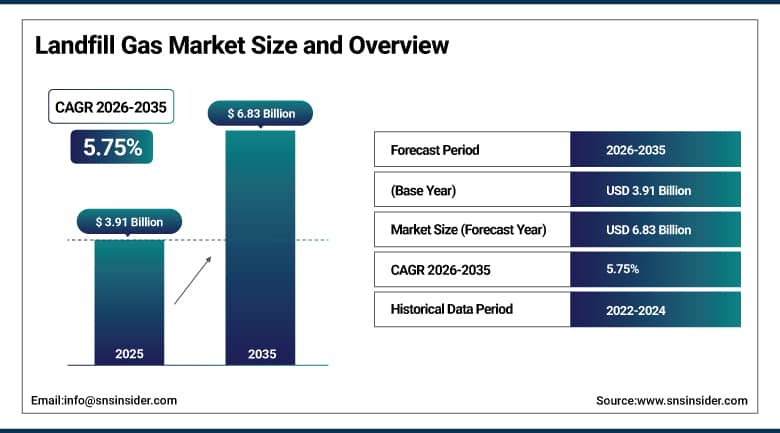
The Landfill Gas Market was valued at USD 3.91 Billion in 2025 and is expected to reach USD 6.83 Billion by 2035, growing at a CAGR of 5.75% from 2026 to 2035.
The governmental regulations like those of U.S. EPA for Methane, Green Deal by the EU, waste to energy systems implemented in China, and the Swachh Bharat Abhiyaan in India are contributing significantly to landfill gas recovery investments. This trend, along with increasing demands for effective solutions, will lead to further advancements in landfill gas management. The focus on circular economic principles, emissions reduction, and energy transition to green alternatives will further boost the industry.
To Get More Information On Landfill Gas Market - Request Free Sample Report
Landfill Gas Market Trends
-
Landfill gas-to-energy projects are expanding as governments promote renewable energy and methane reduction, increasing electricity and RNG production.
-
Carbon credit systems are encouraging landfill operators to capture methane and monetize emissions, improving project profitability.
-
Renewable natural gas (RNG) adoption is rising in transport and industrial sectors as a cleaner fuel alternative in North America and Europe.
-
IoT-based monitoring and advanced gas collection systems are improving methane capture efficiency and reducing leakage.
-
Public-private partnerships have been on the increase, which has been beneficial in building landfill gas recovery projects.
-
The circular economy approach encourages the adoption of landfill gas recovery system integrated with recycling programs.
Key Market Highlights
|
Market Parameter |
Market Highlight / Data |
Key Growth Driver |
|---|---|---|
|
Largest Application |
Electricity Generation – 42.85% share in 2025 |
Earlier commercialization and utility demand for low-cost renewable energy. |
|
Fastest-Growing Application |
Renewable Natural Gas Production – Fastest CAGR |
Growing need for cleaner fuels and reduced industrial carbon footprint. |
|
Largest Technology |
Gas Collection Systems – 46.25% share in 2025 |
Vital importance in capturing and extracting raw landfill gas initially. |
|
Fastest-Growing Technology |
Gas Treatment Systems – Fastest CAGR |
Rising demand for purified gas and stringent emissions regulations. |
|
Largest End User |
Municipal Landfills – 48.60% share in 2025 |
Large waste volumes and significant methane emission generation. |
|
Fastest-Growing End User |
Commercial Waste Facilities – Fastest CAGR |
Huge commercial waste generation and emission cost reduction potential. |
|
Largest Landfill Type |
Closed Landfills – 44.20% share in 2025 |
High methane output and assured gas source for electricity generation. |
|
Fastest-Growing Landfill Type |
Bioreactor Landfills – Fastest CAGR |
Advanced waste management practices facilitating quick organic decomposition. |
|
Largest Region |
North America – 38.45% share in 2025 |
Well-established waste management infrastructure and high recovery project penetration. |
|
Fastest-Growing Region |
Asia Pacific – 7.39% CAGR |
Rapid urbanization, increasing waste generation, and strong landfill infrastructure expansion. |
US Landfill Gas Market Size Outlook
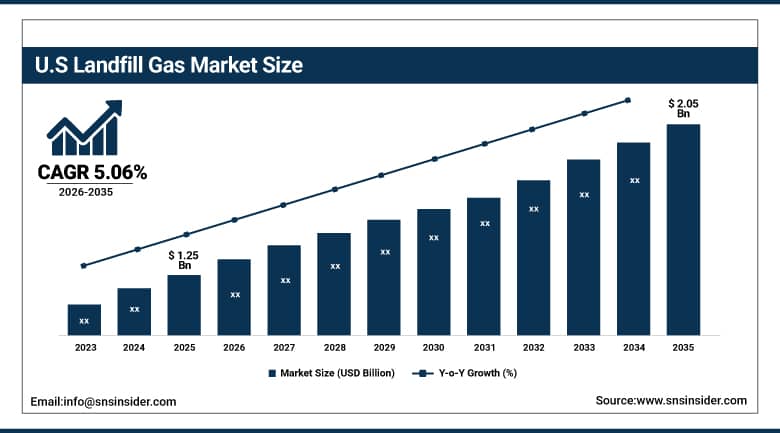
The U.S. Landfill Gas Market was valued at USD 1.25 billion in 2025 and is expected to reach around USD 2.05 billion by 2035, growing at a CAGR of 5.06% from 2026–2035.
The U.S. landfill gas market is considered one of the most developed renewable energy and waste-to-energy markets globally owing to strong presence of municipal solid waste management systems, advanced landfill infrastructure, and widespread adoption of landfill gas capture technologies for electricity generation, heating applications, combined heat and power (CHP), and renewable natural gas (RNG) production, along with increasing demand for low-carbon and sustainable energy solutions across utilities, industrial users, and transportation fuel sectors. Major companies such as Waste Management, Inc., Republic Services, Inc., Ameresco, Inc., Archaea Energy, Montauk Renewables, and NextEra Energy Resources are actively focusing on expanding landfill gas recovery projects and upgrading gas-to-energy infrastructure with improved efficiency, higher methane capture rates, and enhanced environmental compliance performance.
Government initiatives in the form of methane regulations by the U.S. Environmental Protection Agency (EPA), Renewable Fuel Standard (RFS) initiative, benefits from Inflation Reduction Act, and renewable portfolio standards are increasing the deployment of technologies using landfill gas. Initiatives for reducing greenhouse gas emissions, transitioning to renewable energy sources, and adopting sustainable waste management are also influencing investments in landfill gas capture technologies.
Landfill Gas Market Segment Analysis
-
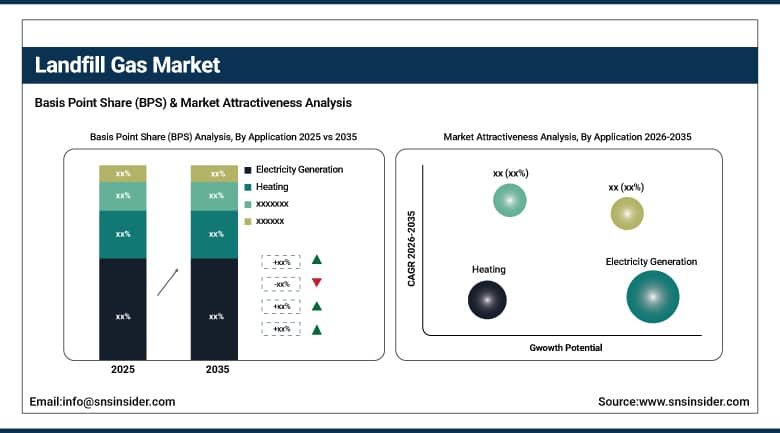
By Application, electricity generation dominated the landfill gas market with 42.85% share in 2025; while renewable natural gas (RNG) production are the fastest growing segment.
-
By Technology, gas collection systems dominated the landfill gas market with 46.25% share in 2025; while gas treatment systems are the fastest growing segment.
-
By End User, municipal landfills dominated the landfill gas market with 48.60% share in 2025; while commercial waste facilities are the fastest growing segment.
-
By Landfill Type, closed landfills dominated the landfill gas market with 44.20% share in 2025; while bioreactor landfills fastest are the growing segment.
By Application, electricity generation dominates the landfill gas market, while renewable natural gas (RNG) production is the fastest-growing segment.
Electricity generation segment held the dominated share of revenue in the landfill gas market in 2025 owing to its earlier commercialization and demand from utilities for low-cost renewable energy. The existing landfill gas equipment can be easily coupled with power plants to provide a stable supply of base-load electricity. The policies for renewable energy and reducing carbon emissions boost the growth of the segment due to large scale deployment at landfill sites across the globe.
Renewable natural gas RNG production segment is projected to witness the fastest CAGR during the forecast period of 2026-2035 on account of growing need for cleaner fuels for transportation as well as reduction in carbon footprint in industrial operations. Due to its high compatibility with natural gas, the adoption of RNG is easier than other segments in the landfill gas market.
By Technology, gas collection systems dominate the landfill gas market, while gas treatment systems are the fastest-growing segment.
Gas collection system segment dominated the landfill gas market with the highest revenue share in 2025 owing to its vital importance in capturing and extracting the raw landfill gas in the beginning. It has been extensively used in both municipal and industrial landfill gas sites owing to the need for regulatory compliance and efficient landfill gas collection in the process. The extensive use of the technology, along with its effectiveness, helps this segment to maintain its market dominance in the global landfill gas market.
Gas treatment system segment is projected to exhibit the highest CAGR during 2026-2035 on account of the rising demand for purified and quality landfill gas for electricity generation and renewable natural gas. Environmental norms and stringent emissions regulations necessitate the use of gas purification techniques that help filter CO2, hydrogen sulfide, and moisture among other pollutants. Investment in the conversion of landfill gases into clean fuels will drive the rapid growth of this segment in the market.
By End User, municipal landfills dominate the landfill gas market, while commercial waste facilities are the fastest-growing segment.
Municipal landfills dominated the landfill gas market, accounting for the largest share of revenue generated in the year 2025. They process large amounts of waste, which results in significant emission of gases. There are many municipal landfills all around the globe, providing the necessary scale for capturing and using the emitted gases. Government regulations and subsidies, along with the availability of infrastructure for renewable natural gas and electricity generation, favour the adoption of landfill gas recovery systems in such facilities.
The commercial waste treatment segment will witness the highest CAGR during 2026 to 2035. This is because there is a huge amount of commercial waste generated in cities by industries, malls, and other commercial activities. It has been seen that commercial businesses are setting up landfill gas recovery systems to reduce emission costs and make profits through energy generation.
By Landfill Type, closed landfills dominate the landfill gas market, while bioreactor landfills are the fastest-growing segment.
Closed landfill segment was the dominating segment by revenue in the landfill gas market during 2025, which was largely because there are numerous closed landfills where the decomposition of waste happens in high methane output. This results in an assured source of landfill gas, making them perfect sources for generating electricity. Other factors responsible for the dominance of this segment include infrastructure availability, lower risks of operations, and regulation that makes methane extraction mandatory.
Bioreactor landfills segment is expected to witness the fastest CAGR during the forecast period (2026-2035), owing to growing awareness regarding advanced waste management practices that facilitate quick decomposition of organic matter along with methane generation. Bioreactors provide better results in terms of gas recovery due to their efficient management of water and oxygen content. Growing emphasis on energy efficiency is fueling investments in bioreactor landfills.
Regional Analysis
|
Region |
Major Country |
Share within Region, 2025(%) |
|---|---|---|
|
North America |
United States |
83.20% |
|
Europe |
Germany |
22.15% |
|
Asia Pacific |
China |
28.60% |
|
Middle East & Africa |
UAE |
5.45% |
|
Latin America |
Brazil |
6.00% |
North America Landfill Gas Market Insights
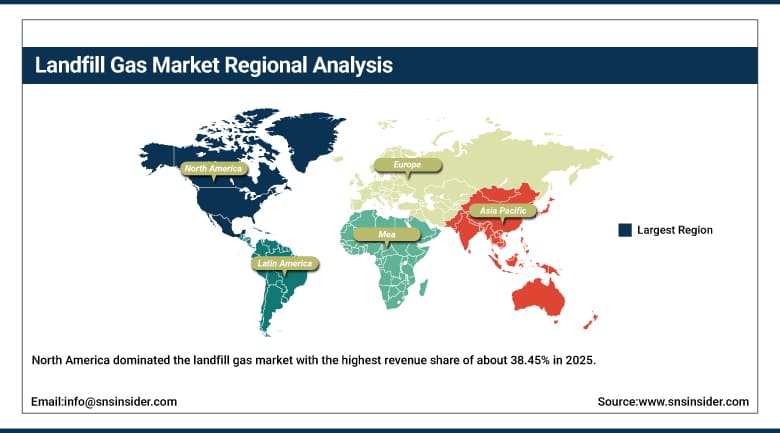
North America dominated the landfill gas market with the highest revenue share of about 38.45% in 2025 due to its well-established waste management infrastructure, high landfill gas recovery project penetration, and strong presence of advanced energy conversion technologies. The region benefits from large-scale deployment of electricity generation, renewable natural gas (RNG), and combined heat and power (CHP) systems across municipal and industrial landfills. Strict environmental regulations, EPA methane control policies, and strong government incentives for renewable energy further drive widespread adoption of landfill gas technologies, supporting consistent market leadership across the United States and Canada.
As a result of this dominance, methane regulations by the U.S. EPA, Renewable Fuel Standard (RFS), Inflation Reduction Act, and others related to clean energy policies have promoted more investments in the field of landfill gas recovery technologies. On the other hand, increased demands for renewable energy in power generation and transportation fuel are promoting landfill gas technologies.
Get Customized Report as Per Your Business Requirement - Enquiry Now
Europe Landfill Gas Market Insights
Europe is considered a highly important region in the landfill gas market owing to strong focus on carbon neutrality, renewable energy transition, and strict landfill emission regulations. Key countries such as Germany, the UK, France, and Italy are contributing significantly through expansion of landfill gas-to-energy plants, renewable natural gas production, and modernization of waste management systems. The European Green Deal and circular economy initiatives are supporting increased investment in methane capture, gas upgrading technologies, and sustainable landfill operations across the region.
Asia Pacific Landfill Gas Market Insights
Asia Pacific segment is expected to grow at the fastest CAGR of about 7.39% from 2026–2035 due to rapid urbanization, increasing municipal solid waste generation, and strong expansion of landfill infrastructure across emerging economies such as China, India, Japan, and Southeast Asia. Rising government investments in waste-to-energy projects, smart city development, and clean energy transition are accelerating adoption of landfill gas recovery systems. Supportive policies for emission reduction, growing energy demand, and increasing awareness of sustainable waste management practices are further driving rapid market expansion across the region.
Middle East & Africa and Latin America Landfill Gas Market Insights
The Middle East & Africa and Latin American countries are expected to experience consistent growth in the landfill gas sector owing to investment in sustainable waste management systems, urban infrastructural developments, and renewable energy projects. The countries experiencing growth in the MEA region include the United Arab Emirates, Saudi Arabia, and South Africa due to their initiatives in building smart cities and landfill developments coupled with renewable energy diversification. In Latin America, growth is being driven by Brazil and Mexico due to their development of infrastructure for managing waste in urban areas as well as their adoption of renewable energy. These strategies are further enhanced by the UAE Net Zero 2050 initiative and Saudi Vision 2030 in the MEA region.
Market Dynamics:
Growth Drivers: Increasing demand for renewable energy generation from landfill methane capture systems worldwide
The increased focus on renewable energy generation has been an important factor behind the adoption of the landfill gas collection system at municipal and industrial landfill sites. Funding is being put into generating electricity, renewable natural gas, and combined heat and power systems from methane gas. The pressure to cut greenhouse gas emissions and become less reliant on non-renewable energy sources is motivating government institutions to look at other options for energy generation. Policies, incentives, and energy security have been giving impetus to the expansion of projects based on the landfill gas collection technology. The increase in the capacity for waste energy generation and improved landfill facilities will guarantee the future success of the technology.
Restraints: Fluctuating landfill gas generation rates affecting consistent energy production and project efficiency
The discrepancies in terms of the structure of waste, rate of decomposition, and other environmental factors may have an impact on the regularity of methane gas production, leading to issues of reliability in terms of energy production. The season changes and waste disposal procedures have an effect on efficiency in the methane recovery process. Inconsistency is one of the key problems that arise in connection with regular power generation and conversion into RNG. The need for more monitoring and energy sources is a major impediment here.
Opportunities: Integration of landfill gas systems with circular economy and carbon credit markets
Increased incorporation of circular economy models and carbon credits trading platforms has created additional possibilities for landfill gas projects. The methane gas is increasingly becoming a source of carbon credits, thus increasing the financial success of these initiatives. Waste management firms are adopting landfill gas recovery alongside other resource recovery techniques. The increased emphasis across the globe on sustainability reporting and net-zero objectives has been driving corporations to participate in emission reduction initiatives. Increased environmental funding mechanisms have also driven the growth of the market.
Recent Developments:
-
2026: Veolia Environnement increased its landfill gas to energy activities by ramping up the amount of captured methane and production of biomethane from Europe and North American projects, enhancing its portfolio on renewable energies.
-
2025: Waste Management, Inc. improved RNG projects with new landfill gas installations at U.S. facilities, which increased efficiency in methane capture and promoted clean energy objectives.
-
2025: Republic Services, Inc. increased RNG projects with new landfill gas to RNG electricity production from infrastructure upgrades and partnerships, boosting the production of low carbon fuels.
-
2024: ENGIE increased projects on biomethane and landfill gas recovery in Europe, with investments in the upgrading of gas recovery systems.
Landfill Gas Market Key Players are:
-
Veolia Environnement
-
SUEZ
-
Waste Management, Inc.
-
Republic Services, Inc.
-
Covanta (Reworld Waste, Inc.)
-
Ameresco, Inc.
-
ENGIE
-
BP
-
Archaea Energy
-
Montauk Renewables
-
NextEra Energy Resources
-
Clean Energy Fuels Corp.
-
TotalEnergies
-
Shell plc
-
Waga Energy
-
Waste Connections, Inc.
-
Casella Waste Systems, Inc.
-
Viridor
-
Biffa
-
FCC Environment
Landfill Gas Market Report Scope:
| Report Attributes | Details |
|---|---|
| Market Size in 2025 | USD 3.91 Billion |
| Market Size by 2035 | USD 6.83 Billion |
| CAGR | CAGR of 5.75% From 2026 to 2035 |
| Base Year | 2025 |
| Forecast Period | 2026-2035 |
| Historical Data | 2022-2024 |
| Report Scope & Coverage | Market Size, Segments Analysis, Competitive Landscape, Regional Analysis, DROC & SWOT Analysis, Forecast Outlook |
| Key Segments | • By Application (Electricity Generation, Heating, Combined Heat & Power (CHP), Renewable Natural Gas (RNG) Production) • By Technology (Gas Collection Systems, Gas Treatment Systems, Gas Flaring Systems) • By End User (Municipal Landfills, Industrial Landfills, Commercial Waste Facilities, Waste Management Companies) • By Landfill Type (Open Landfills, Closed Landfills, Bioreactor Landfills) |
| Regional Analysis/Coverage | North America (US, Canada), Europe (Germany, UK, France, Italy, Spain, Russia, Poland, Rest of Europe), Asia Pacific (China, India, Japan, South Korea, Australia, ASEAN Countries, Rest of Asia Pacific), Middle East & Africa (UAE, Saudi Arabia, Qatar, South Africa, Rest of Middle East & Africa), Latin America (Brazil, Argentina, Mexico, Colombia, Rest of Latin America). |
| Company Profiles | Veolia Environnement, SUEZ, Waste Management, Inc., Republic Services, Inc., Covanta (Reworld Waste, Inc.), Ameresco, Inc., ENGIE, BP, Archaea Energy, Montauk Renewables, NextEra Energy Resources, Clean Energy Fuels Corp., TotalEnergies, Shell plc, Waga Energy, Waste Connections, Inc., Casella Waste Systems, Inc., Viridor, Biffa, FCC Environment |

Frequently Asked Questions
The landfill gas market is expected to grow at a CAGR of 5.75% from 2026 to 2035.
The landfill gas market was valued at USD 3.91 billion in 2025
Rising demand for renewable energy generation, increasing methane emission reduction targets, and expansion of landfill gas-to-energy projects are driving market growth globally.
The electricity generation segment dominated the landfill gas market in 2025.
North America dominated the landfill gas market in 2025.
