
Marketing Technology Outsourcing Market Report Scope & Overview:
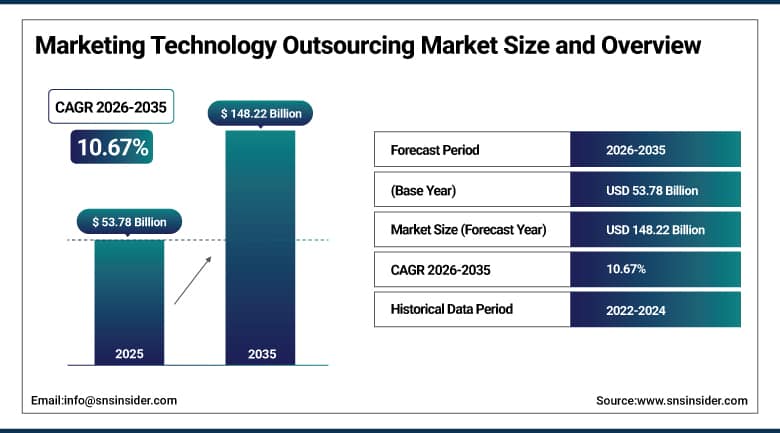
The Marketing Technology Outsourcing Market was valued at USD 53.78 Billion in 2025 and is estimated at USD 59.52 Billion in 2026 and is projected to reach USD 148.22 Billion by 2035, registering a compound annual growth rate (CAGR) of 10.67% from 2026 to 2035. Brands are handing complex marketing stacks to specialists as artificial intelligence (AI) tools multiply. Demand also rises as buyers seek measurable returns and faster launch cycles.
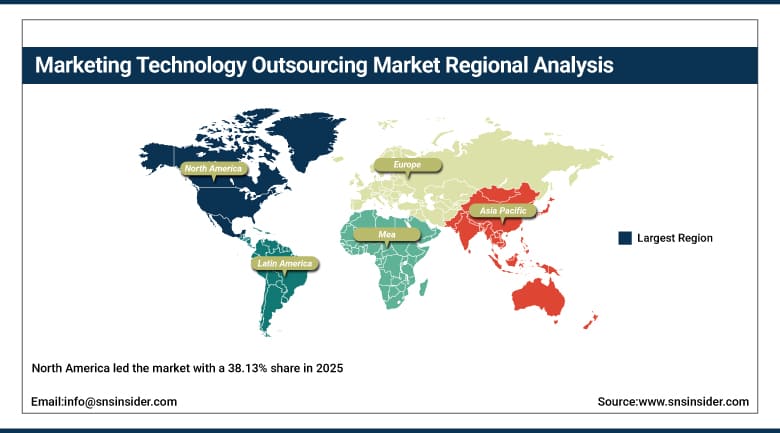
North America had the highest market share of 38.13% in 2025 due to high digital advertising expenditure, well-developed marketing technology platforms, and the presence of a significant number of agencies and consultancies. Europe is in second place, with privacy regulations impacting data handling. The Asia Pacific region will witness the highest growth rate up to 2035 due to growth in e-commerce and mobile marketing in China, India, and South East Asia. Latin America and Middle East & Africa regions have low market share. Growth in digital commerce widens the base of potential customers.
To Get More Information On Marketing Technology Outsourcing Market - Request Free Sample Report
Key Report Takeaways
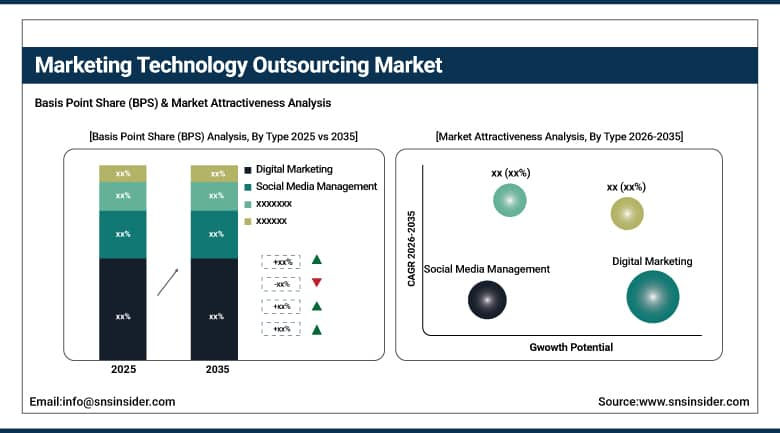
- By type, digital marketing held a 30.46% share in 2025, while social media management is the fastest growing.
- By end use, IT and telecom held a 23.62% share in 2025, while healthcare is the fastest growing.
- By enterprise size, large enterprises held a 64.35% share in 2025, while small and medium enterprises are the fastest growing.
- By deployment, cloud-based services held a 61.47% share in 2025, while hybrid deployment is the fastest growing.
- By region, North America held a 38.13% share in 2025, while Asia Pacific is the fastest growing.
Market Trends and Insights
- Agentic AI is being used to orchestrate campaign planning, content production, and media execution.
- Agency holding companies are consolidating and simplifying their structures to compete on technology.
- Agencies and consultancies are acquiring data, identity, and martech assets to widen managed offerings.
- Content supply chain and operating model redesign are becoming part of outsourced scope.
- Platform partnerships with Salesforce, Adobe, and Optimizely are the commercial wrapper for managed services.
Drivers Impact Analysis
|
Driver |
(~) Percentage Point Impact on Market CAGR |
Geographic Relevance |
Impact Timeline |
|---|---|---|---|
|
Agentic AI reshaping outsourced work |
+4.12% |
North America, India |
Short term (2 years or less) |
|
Ad spend growth and content volume |
+2.86% |
United States |
Short term (2 years or less) |
|
Data platform consolidation |
+2.17% |
United States, Europe |
Medium term (2 to 4 years) |
|
Compliance load and stack complexity |
+2.38% |
United States, Europe, India |
Medium term (2 to 4 years) |
|
Offshore scale and BPO convergence |
+2.93% |
India, Philippines, Global |
Long term (4 years or more) |
Agentic AI Reshapes What Brands Outsource
AI agents now draft copy, build audiences, adjust bids, and report on results, and providers that embed these tools in managed services can run more campaigns with fewer staff. Brands lack the skills to evaluate and connect many new tools, so they turn to partners that bring ready workflows, governance, and integration with existing customer data. Consultancies and agencies are packaging agent-based suites with their own data and content services. As models improve, buyers expect faster production at lower unit cost, which favors outsourcing.
Advertising Spend Growth and Content Volume Increase Operating Workloads
Marketing teams must produce more content for more channels, and each asset needs testing, personalization, and measurement. Interactive Advertising Bureau predicted in January 2026 that ad spending in the US would increase by 9.50 percent in 2026. As budgets increase and fragmentation occurs, there is an increased demand for campaigns which internal staff cannot handle, so outsourcing becomes necessary. Providers with shared delivery teams and reusable templates can absorb these peaks at a lower cost than internal hiring.
Data Platform Consolidation Pushes Brands Toward Integrated Providers
Customers, identity resolution, and analytics are becoming increasingly interconnected, and big service conglomerates are developing and acquiring these capabilities. For brands, it is better to have just one partner who can deal with the data pipeline management, audience activation, and reporting. Having all these processes consolidated in one place saves time on integration efforts and makes ROI demonstration easier. Big companies get an edge in enterprise deals thanks to such capabilities; small ones try to counteract that through partnerships and specialization.
Compliance Load and Stack Complexity Push Marketers Toward Specialists
Privacy rules, consent requirements, and automated decision-making obligations add effort to every marketing program. The California Privacy Protection Agency approved final regulations for the use of automated decision-making technologies, risk assessments, and cybersecurity audits in September 2025, which became enforceable from 1 January 2026. Marketing departments require experts who will be able to configure consent mechanisms, keep track of how the data is used, and ensure compliance of the stacks. The outsourcing of such services distributes the cost among customers. Costs fall with scale.
Offshore Scale and BPO Convergence Lower the Cost of Managed Operations
Global delivery centers in India, the Philippines, and Eastern Europe allow providers to run campaign operations, analytics, and content production at lower cost around the clock. Business process and technology service companies are extending into marketing operations and combining them with customer experience and data services. Buyers gain flexibility in onshore, nearshore, and offshore models, and the scale of these centers allows providers to invest in tools and training that individual brands cannot afford. Flexible team sizes also help brands scale work up or down.
Restraints Impact Analysis
|
Restraint |
(~) Percentage Point Impact on Market CAGR |
Geographic Relevance |
Impact Timeline |
|---|---|---|---|
|
Agency and consultancy cost pressure |
-1.05% |
Global |
Short term (2 years or less) |
|
Privacy and consent limits on targeting |
-1.12% |
Europe, United States, India |
Short term (2 years or less) |
|
Vendor concentration and independence concerns |
-0.84% |
United States |
Medium term (2 to 4 years) |
|
Regulatory uncertainty in the European Union |
-0.78% |
Europe |
Medium term (2 to 4 years) |
Agency and Consultancy Cost Pressure Weighs on Outsourcing Budgets
Agencies in big groups are slashing costs, consolidating operations, and shedding jobs since their clients want them to charge less while technology makes routine jobs obsolete. Such actions cause disruptions and delays in client relationships as well as in their transformation initiatives while they are restructuring. When brands outsource less by bringing work in-house to cut costs, and as they insist on outcome-based pricing, providers need to demonstrate value by delivering measurable results. This process takes time, thus making sales cycles longer.
Privacy and Consent Limits Constrain Targeting and Measurement
There are more restrictions when it comes to tracking and profiling, which makes some marketing campaigns less effective since these campaigns are controlled by the outsourcing firm. In October 2025, Google terminated ten Privacy Sandbox proposals, including Topics and Protected Audience, as a result of their underutilization; hence, the marketing industry lacked a uniform alternative to third-party cookie signals. Providers have to develop first-party data strategies for every client, and measuring becomes inconsistent across various channels. Transparency regarding data usage is expected by the clients, which means additional reporting. Reporting guidelines vary from region to region.
Vendor Concentration and Independence Concerns Create Buyer Hesitation
As big organizations gather more data and buy companies with identities, buyers have concerns regarding neutrality, conflict of interests, and reliance on one person. In September 2025, the Federal Trade Commission in the U.S. issued a consent order for the Omnicom and Interpublic merger, prohibiting coordination of decisions on advertising based on any political or ideological perspective, with a requirement for a compliance monitor. This creates fear for the client, and the process of consolidation might be slowed down. Buyers consider also ownership structures of agencies. Independent agencies benefit from this problem.
Regulatory Uncertainty in the European Union Delays Investment
European rules on data, cookies, and artificial intelligence are changing, and providers must adjust products and contracts as deadlines move. According to the European Commission, an AI omnibus package entered into force in July 2026 and shifted high-risk system deadlines to December 2027. Uncertainty about final obligations makes clients hesitant to commit to long projects that rely on automated decision tools, and providers add legal review to every new service. Smaller providers with limited legal teams find it harder to adapt than global groups.
Marketing Technology Outsourcing Market Segment Analysis
By Type, Digital Marketing Dominates Marketing Technology Outsourcing Market; Social Media Management to Register Fastest Growth.
Digital marketing accounted for a 30.46% share in 2025 because search, display, email, and programmatic channels make up the largest part of brand budgets and require continuous technical operation. Outsourced teams manage campaign setup, bidding, tagging, reporting, and tool integration for brands that lack in-house expertise. The service connects directly to revenue, so clients are willing to commit to long agreements, and providers extend their offerings with analytics and optimization. Clients also value clear and frequent reporting. Tests run weekly.
The social media management market is forecast to expand at a CAGR of 13.44% over the period from 2026 through 2035 because the need for consistent content generation, community engagement, and influencer alignment is required on numerous social media platforms. The short form video, partnerships of creators, and social commerce lead to the expansion of workload quantity and velocity. Social media management providers apply AI to plan and monitor content. Brands also value the speed at which specialist teams launch new campaigns and tests.
By End Use, IT and Telecom Dominates Marketing Technology Outsourcing Market; Healthcare to Register Fastest Growth.
The percentage of IT and telecom was 23.62% in 2025 as software companies and network providers operate campaigns for customers’ and subscribers' acquisition. Such companies have complex portfolios, numerous promotions and high customer turnover, so campaign execution is necessary constantly. For some firms, it would be preferable to delegate the campaign execution in order to concentrate on product development and partnership. Campaign providers include additional playsbooks and reporting corresponding to the sales process of the target buyers.
Healthcare is expected to register the fastest CAGR of 13.12% from 2026 to 2035 as hospitals, pharmaceutical companies, and digital health firms invest in patient engagement, physician outreach, and compliant digital campaigns. Strict rules on health data and promotion push them toward specialist partners. Telehealth, patient portals, and direct-to-consumer programs add to demand for managed marketing operations. Demand is rising steadily. Hospitals and drug makers therefore sign managed agreements to keep outreach accurate, documented, and aligned with changing rules.
By Enterprise Size, Large Enterprises Dominate Marketing Technology Outsourcing Market; Small and Medium Enterprises to Register Fastest Growth.
Large enterprises accounted for a 64.35% share in 2025. This is due to the fact that large companies have multi-country marketing campaigns that involve multi-country campaigns that include large IT systems, multiple agencies, and many compliance requirements. Large companies enter into multi-year contracts where managed services cover such aspects as platforms, data operations, and campaigns. Consolidation of vendors is done by procurement teams as they provide cost benefits and better governance, while global delivery models make it possible for suppliers to reach many markets out of one center.
Small and medium sized enterprises are estimated to show a compound annual growth rate of 13.27% during the forecast period, 2026 – 2035 due to the availability of economical subscription plans and predefined workflows, thus making outsourcing marketing technology an affordable option for them. They do not have the manpower required to handle various platforms and need partners to set up their campaigns and analyze results. Providers also offer tiered packages that match limited budgets, and onboarding takes weeks rather than months.
By Deployment, Cloud-Based Services Dominate Marketing Technology Outsourcing Market; Hybrid Deployment to Register Fastest Growth.
The cloud service segment comprised 61.47% in 2025 since the marketing platform is offered in a form of a software-as-a-service, which is installed, set up, and managed by an outsourced team from remote locations. The benefits of using the cloud-based solution are fast onboarding, regular updates, and integration with ad networks and data sources. Moreover, providers can offer their services to clients all around the world from a shared team. Also, they charge subscription fees, which make the cost of use predictable for brands.
A hybrid deployment is expected to exhibit a CAGR of 12.31% over the period of 2026 through 2035 owing to the storage of sensitive customer information in internal settings by the companies, using the cloud technology in order to activate and analyze. The requirement of data residency and security policies in various sectors motivates such hybridity. The vendors who have capabilities to govern the connection between different systems are getting bigger orders from banking, insurance, and healthcare segments. Mixed environments win larger contracts.
Geography Analysis
|
Region |
Major Country |
Share within Region, 2025 (%) |
|---|---|---|
|
North America |
United States |
71.52% |
|
Europe |
United Kingdom |
26.47% |
|
Asia Pacific |
China |
34.86% |
|
Middle East & Africa |
Saudi Arabia |
31.29% |
|
Latin America |
Brazil |
53.94% |
North America Marketing Technology Outsourcing Market
North America led the market with a 38.13% share in 2025, supported by high digital advertising spend, mature marketing technology stacks, and a large base of agencies and consultancies. The US market has produced revenues amounting to USD 14.67 Billion in 2025 and is expected to have a CAGR of 10.63% during 2026 to 2035. Huge brands in retail, financial service, tech, and health sectors outsource platform management and campaigns, and Canada contributes through their bilingual programs and cross-border campaigns. There are additional cross-border campaigns with Mexico.
Agency firms and consultants are acquiring data/content firms in order to increase their managed services portfolio. Clients want to see outcome-based pricing, which is linked to revenue or leads. The constant updating of deliverability requirements, state privacy laws, and changes in the platforms necessitate adaptation and this is where specialists are needed to make sure the programs are compliant and effective for the brands. Content/data providers that can combine creativity, data, and platforms and present results in dashboards are preferred in the area.
Get Customized Report as Per Your Business Requirement - Enquiry Now
Europe Marketing Technology Outsourcing Market
Regionally, Europe ranks second-largest, with 27.18% market share in 2025. The UK dominates the region, while Germany, France, the Netherlands, and Spain follow. Data protection law governs the collection and use of customer data, leading to the choice of service providers that have extensive experience in compliance and also offer local hosting. The linguistic differences and diverse laws also lead to outsourcing of localization and campaign management. In Germany, there is additional need due to manufacturers and car brands having dealer and customer programs.
CNIL slapped fines on Google for its advertisements through cookies and ads in-between emails in Gmail in September 2025, a move that highlights the importance of consent in marketing initiatives. Consent platform providers who also give their clients first-party data solutions and regional centers stand a good chance of getting business from banks, telecoms, and retailers. Nordic and Benelux markets also adopt automation early, and brands in these countries ask for providers with strong security records and clear exit terms.
Asia Pacific Marketing Technology Outsourcing Market
The fastest growth rate of 12.46% is anticipated to be seen in the Asia-Pacific region during the forecast period 2026-2035 due to rapid growth in e-commerce, mobile commerce, and social media. In terms of national shares in the region, China leads the way, owing to its large-scale digital platforms, livestream commerce, and requirement for localized content. Japan has an established market with a high need for analytics and CRM solutions, whereas Australia and South Korea lead in the implementation of marketing automation.
In November 2025, India notified the Digital Personal Data Protection Rules, which phase in obligations over eighteen months and require clear consent notices. India is the fastest growing country in the region and also a major delivery base for global providers. Singapore, Malaysia, and Indonesia add demand through regional headquarters and fast-growing digital economies. Local language skills remain a key selection criterion. Southeast Asian brands increasingly want regional providers that can manage campaigns across languages, currencies, and platforms from a single operations center.
Latin America Marketing Technology Outsourcing Market
The share of Latin America in 2025 was 6.84%, with Brazil being the leader of Latin America because it is home to the biggest digital marketing and e-commerce market in the region. Mexico, Argentina, Chile, and Colombia are the other markets that drive demand through online retailing, fintech and mobile advertising. Outsourced professionals handle campaigns in Spanish and Portuguese, while nearshoring facilities handle North American clients operating in the same time zone. The contribution of Chile and Peru is small but significant as well, coming from retailers and banks.
Growing levels of internet usage, social commerce, and mobile payments increase the requirement for marketing automation tools and customer engagement solutions. Fluctuations in the exchange rate make businesses prefer flexible agreements and local payment methods. Nearshore centers for delivering creative and customer services are being developed in Mexico and Colombia, thus increasing the pool of qualified professionals. Local pricing matters. Local agencies partner with global groups to access platforms, and bilingual teams serve both Latin American and United States Hispanic audiences across many channels.
Middle East & Africa Marketing Technology Outsourcing Market
The Middle East and Africa held a 4.78% share of the market in 2025. Gulf nations account for the highest demands, where Saudi Arabia commands the highest percentage, followed by United Arab Emirates and Qatar. The cost of marketing technology is driven by the efforts of the government for digitization, the campaigns for promoting tourism, and the rapid evolution of e-commerce systems, and international marketing firms have opened up regional offices to serve multinationals. Egypt and Turkey contribute to this phenomenon because of the high proportion of youth on social media and e-commerce.
Africa’s best developed market is South Africa, where there are already well-established agencies and increasing demand from banks and retailers. There is increasing demand from mobile-led organizations and fintech companies in Nigeria and Kenya. The combination of Arabic language content, regional data regulations, and lack of skilled professionals makes the collaboration with regional players important for international brands. Local partners remain essential. Regional governments also support digital skills programs, which should gradually widen the local talent pool and lower delivery costs for providers over time and across sectors.
Competitive Landscape
The Marketing Technology Outsourcing Market is fragmented. Global agency holding companies, consulting and technology service firms, business process providers, and thousands of specialist agencies all sell managed marketing technology, and no single provider holds a large share of total revenue. Large groups win enterprise accounts through scale, data assets, and global delivery, while boutique firms compete on creative skill, platform expertise, and speed.
Vendors follow three main strategic lines. First, they combine and simplify their structures to offer integrated services and shared platforms. Second, they acquire data, identity, content, and platform specialists to widen managed offerings. Third, they build AI and agent-based tools that automate campaign planning, content production, and reporting, and they bundle these tools with outcome-based pricing.
Marketing Technology Outsourcing Market Industry Leaders
1. Accenture: Offers Accenture Song marketing services, managed operations, and generative content platforms.
2. Omnicom: Operates a combined marketing and sales group with data, media, and technology services after the Interpublic acquisition.
3. Publicis Groupe: Provides Epsilon, Publicis Sapient, and Marcel for data, technology, and managed marketing services.
4. WPP: Runs creative, media, production, and enterprise solutions businesses for global brands.
5. Dentsu: Delivers customer experience and marketing technology services through its Merkle business.
Companies Covered in this Report
- Accenture
- Omnicom
- Publicis Groupe
- WPP
- Dentsu
- Cognizant
- Infosys
- Tata Consultancy Services
- Deloitte Digital
Recent Industry Developments
- October 2025: Tata Consultancy Services acquired ListEngage, a United States firm that implements Salesforce Marketing Cloud and Data Cloud.
- November 2025: Omnicom completed its acquisition of Interpublic, forming a combined marketing and sales group.
- January 2026: Cognizant announced a partnership with Typeface to modernize enterprise marketing through agentic workflows.
- May 2026: Dentsu integrated Merkle into dentsu in Australia and New Zealand and agreed to sell its local Salesforce implementation unit.
- May 2026: Publicis Groupe agreed to acquire LiveRamp in a transaction valued at USD 2.20 Billion.
- May 2026: Deloitte Digital announced a partnership with Optimizely on AI-driven personalization and content supply chain redesign.
- June 2026: Accenture agreed to acquire creator and social agency Whalar.
- August 2026: Infosys introduced Aster, an AI marketing suite covering orchestration, data, content, commerce, and personalization.
Scope and Research Methodology
The study defines the Marketing Technology Outsourcing Market as services in which external providers operate, manage, or implement marketing technology on behalf of brands. Covered services include digital marketing operations, customer relationship and loyalty program management, social media management, design and content services, web content publishing, and sales operations support delivered through cloud-based, on-premises, and hybrid environments. The base year is 2025, the forecast period runs from 2026 to 2035, and all values are expressed in USD. Standalone software licenses, media purchases, and general business process outsourcing are excluded. Hardware, in-house staffing costs, and consumer research services are also outside the definition. Pure advertising media buying is included only where the provider operates the technology used to plan, buy, and report on it, and not for pass-through media spend.
The research program combines secondary and primary research. Secondary research draws on company annual reports, investor presentations, regulatory filings, trade association publications, product documentation, and peer-reviewed and industry literature. Primary research consists of structured interviews and surveys with marketing executives, technology officers, agency leaders, and procurement heads across the value chain. These discussions validate assumptions on outsourcing rates, service mix, pricing models, and contract terms. Interview findings are weighted by the relevance and seniority of each respondent, and conflicting inputs are checked against company disclosures and published contract values.
Market engineering utilizes a bottom-up approach based on provider revenues, numbers of clients, and volume of services. Top-down verification of the data is made using global marketing technologies and advertising budgets. Both types of data help to reduce discrepancies prior to setting the final values. The forecasts take into account such factors as the adoption of AI, changes in privacy regulations, and mergers among agencies. Estimations for regions are consistent in terms of sums of numbers in countries. Each regional estimation goes through the quality control procedure by analysts. Sensitivity analysis is conducted for each segment.
Marketing Technology Outsourcing Market Report Scope :
| Report Attributes | Details |
|---|---|
| Market Size in 2025 | USD 53.78 Billion |
| Market Size by 2035 | USD 148.22 Billion |
| CAGR | CAGR of 10.67% From 2026 to 2035 |
| Base Year | 2025 |
| Forecast Period | 2026-2035 |
| Historical Data | 2022-2024 |
| Report Scope & Coverage | Market Size, Segments Analysis, Competitive Landscape, Regional Analysis, DROC & SWOT Analysis, Forecast Outlook |
| Key Segments | • By Type (Digital Marketing, CRM and Loyalty Program Management, Social Media Management, Design and Content Services, Web Content Publishing, Sales Operations Support, and Others) • By End Use (IT and Telecom, Retail and E-Commerce, Healthcare, Media and Entertainment, BFSI, and Others) • By Enterprise Size (Large Enterprises and Small and Medium Enterprises) • By Deployment (Cloud-Based, On-Premises, and Hybrid) |
| Regional Analysis/Coverage | North America (US, Canada), Europe (Germany, UK, France, Italy, Spain, Russia, Poland, Rest of Europe), Asia Pacific (China, India, Japan, South Korea, Australia, ASEAN Countries, Rest of Asia Pacific), Middle East & Africa (UAE, Saudi Arabia, Qatar, South Africa, Rest of Middle East & Africa), Latin America (Brazil, Argentina, Mexico, Colombia, Rest of Latin America). |
| Company Profiles | Accenture, Omnicom, Publicis Groupe, WPP, Dentsu, Cognizant, Infosys, Tata Consultancy Services, Deloitte Digital |

Frequently Asked Questions
The market was valued at USD 53.78 Billion in 2025 and is projected to reach USD 148.22 Billion by 2035 at a CAGR of 10.67%.
North America led the market with a 38.13% share in 2025, supported by high digital advertising spend and mature marketing technology stacks.
Asia Pacific is expected to grow the fastest, at a CAGR of 12.46% from 2026 to 2035.
Digital marketing, IT and telecom, large enterprises, and cloud-based services hold the largest shares in their segments.
Social media management, healthcare, small and medium enterprises, and hybrid deployment are the fastest growing segments.
Major players include Accenture, Omnicom, Publicis Groupe, WPP, and Dentsu.
Cost pressure on agencies, privacy limits, vendor concentration concerns, and European regulatory uncertainty limit faster growth.
