
Medical Tape and Bandage Market Report Scope & Overview:
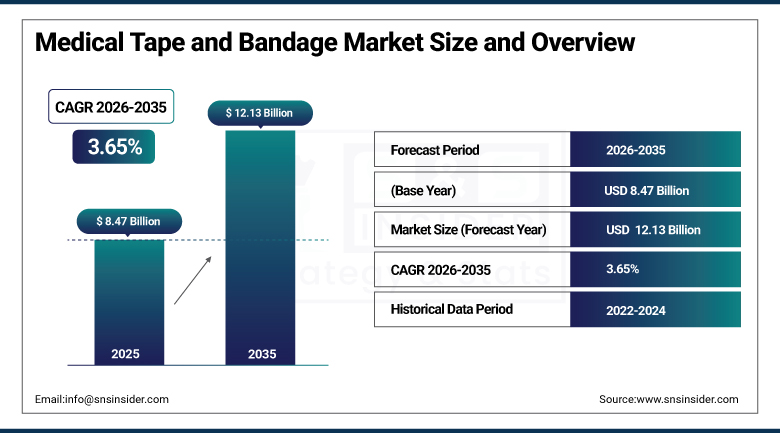
The Medical Tape and Bandage Market was valued at USD 8.47 Billion in 2025 and is expected to reach USD 12.13 Billion by 2035, growing at a CAGR of 3.65% from 2026-2035.
Medical tapes and bandages constitute a foundational category within wound care and surgical fixation, integrating adhesive tapes, gauze, and elastic bandages used to secure dressings, immobilize injuries, and support post-operative recovery. Rising surgical procedure volumes, an ageing population with growing chronic wound incidence, and expanding home healthcare adoption continue to broaden the clinical base requiring these products. Hospitals, home healthcare providers, and an expanding base of ambulatory surgical centers rely on medical tapes and bandages to deliver secure fixation, infection protection, and patient comfort across a wide range of clinical settings. Sustained growth is being shaped by continued advancement in hypoallergenic and antimicrobial adhesive technology, rising adoption of sustainable and eco-friendly tape formulations, and expanding smart bandage development integrating wireless wound monitoring.
In 2024, 3M introduced the 3M Medical Tape 4578, designed to support twenty-eight-day wear times for health monitors, sensors, glucose monitors, and other long-term medical wearables. The company stated the launch expands its medical adhesive tape portfolio to address rising demand for extended-wear device adhesion in remote patient monitoring applications.
To Get more information On Medical Tape and Bandage Market - Request Free Sample Report
Medical Tape and Bandage Market Trends:
-
Growing adoption of hypoallergenic silicone-based adhesive tapes reducing skin trauma in sensitive patients.
-
Rising development of smart bandage technology enabling real-time wireless wound monitoring.
-
Expanding manufacturer investment in sustainable, eco-friendly tape formulations addressing environmental priorities.
-
Increasing use of antimicrobial and waterproof bandages supporting active patients and chronic wound care.
-
Rising growth of home healthcare and outdoor first aid solutions extending demand beyond clinical settings.
-
Growing regional manufacturing capacity expansion supporting localized wound care product distribution.
-
Expanding retail and e-commerce distribution channels broadening consumer access to advanced first-aid products.
U.S. Medical Tape and Bandage Market Overview:
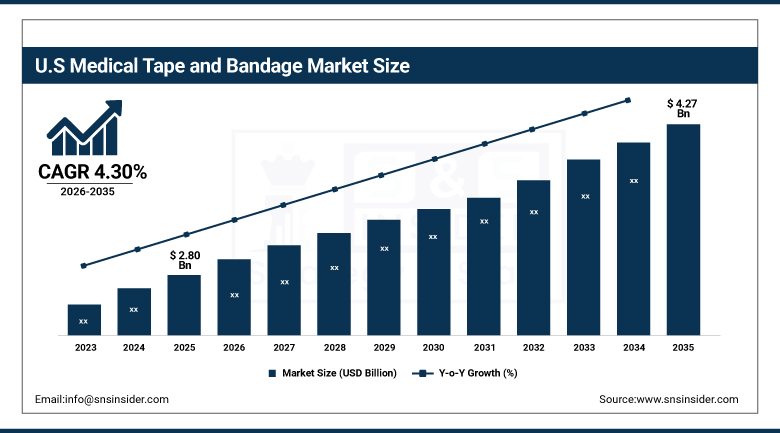
The U.S. Medical Tape and Bandage Market was valued at USD 2.80 Billion in 2025 and is expected to reach USD 4.27 Billion by 2035, growing at a CAGR of 4.30% from 2026-2035.
Demand from the U.S. remains backed by the high volumes of surgeries performed and the increased need for home health care services that demand the use of wound fixation and dressing products which are reliable. Major players remain committed to increasing the number of hospital contracts that they have as well as introducing innovative dressings such as antibacterial and antimicrobial bandages meant to minimize infections. The constant investments in extended wear adhesives ensure that the competitive advantage continues to increase. Outpatient and first-aid services also continue to facilitate market growth in the U.S. as more people gain access to wound care products.
In March 2025, Johnson & Johnson expanded its advanced dressings portfolio and hospital contracts across North America, strengthening its regional wound care specialist positioning. The company stated the expansion reflects continued investment in serving hospital systems with a comprehensive range of surgical and chronic wound management solutions.
Medical Tape and Bandage Market Segment Analysis:
-
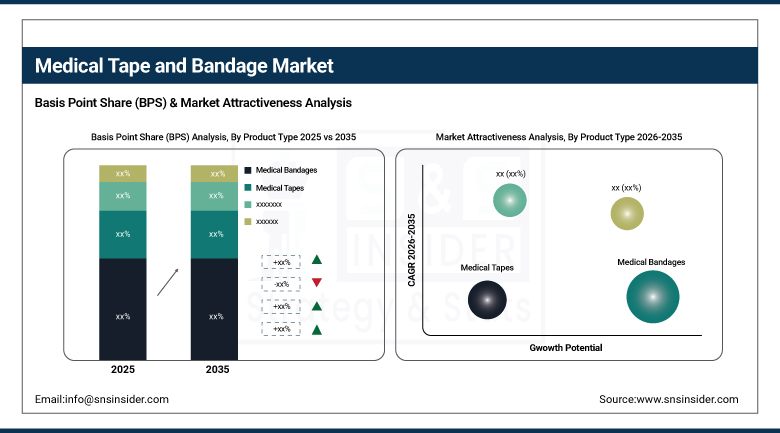
By Product Type, the Medical Bandages segment dominated the market with a 54.60% share in 2025, while the Medical Tapes segment is the fastest growing with a CAGR of 4.60% during 2026-2035.
-
By Material, the Fabric/Cloth segment dominated the market with a 38.60% share in 2025, while the Plastic/Film segment is the fastest growing with a CAGR of 5.20% during 2026-2035.
-
By Application, the Surgical Wound Treatment segment dominated the market with a 57.90% share in 2025, while the Ulcer Treatment segment is the fastest growing with a CAGR of 4.70% during 2026-2035.
-
By End User, the Hospitals segment dominated the market with a 48.60% share in 2025, while the Home Healthcare segment is the fastest growing with a CAGR of 5.40% during 2026-2035.
By Product Type, Medical Bandages Dominates the Market and Medical Tapes Grows Fastest
Medical Bandages dominated the market in 2025, a position built on their essential role across virtually every wound care and orthopedic support context, spanning gauze, adhesive, and cohesive elastic formats used in trauma care, burns, and sports medicine. Clinicians favour this product category precisely because it delivers foundational wound protection and support functionality required across the broadest range of clinical applications, a combination that continues to make bandages the largest single product category across the broader market, even as specialty medical tapes continue to expand around it for device fixation and post-operative applications.
Medical Tapes are projected to be the fastest-growing product category over the forecast period. Rising demand for extended-wear adhesive technology continues to expand the addressable application base for this product category as remote patient monitoring, wearable health devices, and long-term device fixation applications increasingly require specialized tape formulations. As manufacturers continue advancing hypoallergenic and twenty-eight-day wear tape technology, medical tapes continue closing the gap with bandages in overall market demand, particularly across the growing wearable health monitoring segment.
By Material, Fabric/Cloth Dominates the Market and Plastic/Film Grows Fastest
Fabric/Cloth materials dominated the market in 2025. This material category continues to offer superior breathability, flexibility, and conformability across joints and irregular body contours, making it the preferred choice for orthopedic support bandages and general-purpose surgical tapes requiring extended wear comfort. This versatility continues to sustain fabric and cloth materials as the dominant material category across the broadest range of wound care and fixation applications worldwide.
Plastic/Film materials are expected to be the fastest-growing material category over the forecast period. Rising demand for transparent, waterproof dressing options continues to expand the addressable application base for this material category as clinicians and active patients increasingly favour film-based products offering visible wound monitoring and secure protection during bathing or physical activity. As manufacturers continue improving film breathability and adhesive performance, plastic and film materials continue closing the gap with fabric-based alternatives in overall market demand.
By Application, Surgical Wound Treatment Dominates the Market and Ulcer Treatment Grows Fastest
Surgical Wound Treatment applications dominated the market in 2025, accounting for well over half of overall global market share. Rising global surgical procedure volumes continue to represent the single largest driver of overall medical tape and bandage consumption worldwide, as post-operative recovery consistently requires dependable dressing fixation and wound protection across virtually every surgical specialty. This foundational surgical role continues to sustain this application category as the largest segment by a clear margin across the broader market.
Ulcer Treatment applications are projected to expand fastest over the forecast period. Rising global incidence of diabetes and an ageing population continue to drive demand for specialized bandaging supporting chronic wound and pressure ulcer management, where extended healing timelines require materials engineered for prolonged wear and exudate management. As diabetes prevalence continues climbing worldwide, ulcer treatment applications continue closing the gap with surgical wound treatment in overall market demand.
By End User, Hospitals Dominates the Market and Home Healthcare Grows Fastest
Hospitals dominated the market in 2025. The scale and complexity of surgical and trauma care delivered within hospital settings continues to require the broadest and most comprehensive wound care product portfolio of any single facility type, spanning routine dressing changes through complex chronic wound management. This breadth of clinical need, combined with the sheer patient volume that major hospital systems process daily, continues to sustain hospitals as the clear leading end-user category across the broader market.
Home Healthcare is expected to be the fastest-growing end-user category over the forecast period. The growth of home healthcare and outdoor first-aid solutions continues to expand the addressable application base for this category as patients increasingly manage wound care and chronic condition monitoring outside traditional clinical settings. As healthcare systems continue shifting recovery and chronic disease management toward home-based care models, home healthcare continues closing the gap with hospital-based end-users in overall market demand.
Regional Analysis:
|
Region |
Major Country |
Share within Region, 2025 |
|---|---|---|
|
North America |
United States |
89.83% |
|
Asia Pacific |
China |
41.26% |
|
Europe |
Germany |
33.57% |
|
Latin America |
Brazil |
46.18% |
|
Middle East & Africa |
United Arab Emirates |
29.42% |
North America Medical Tape and Bandage Market Insights
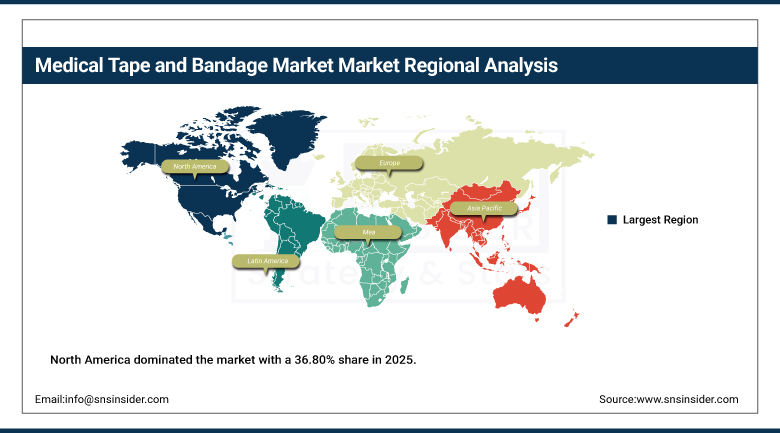
North America dominated the market with a 36.80% share in 2025. The region's substantial surgical procedure volume, dense concentration of leading wound care manufacturers, and well-established home healthcare infrastructure continue to anchor this leadership position across both hospital and home-based care settings. The United States shapes regional demand through its concentration of leading manufacturers and its role as a proving ground for advanced adhesive and antimicrobial wound care innovation.
Canada contributes additional regional demand through its participation in North American healthcare procurement and distribution networks. Continued domestic investment in advanced dressing technology and home healthcare infrastructure is expected to keep North America in the lead through the forecast period, even as growth in percentage terms trails faster-scaling Asia Pacific markets building out wound care manufacturing and distribution capacity from a considerably smaller existing base. Mexico's growing cross-border healthcare supply chain integration with the United States further reinforces the broader North American market's scale advantage relative to other global regions.
Get Customized Report as per Your Business Requirement - Enquiry Now
Asia Pacific Medical Tape and Bandage Market Insights
Asia Pacific is projected to be the fastest-growing region, registering a CAGR of 5.60% during 2026-2035, supported by an ageing population, rising prevalence of chronic diseases including diabetes, and a rapidly maturing regional wound care manufacturing base. China continues to anchor regional demand as domestic manufacturers expand production capability across both established coastal manufacturing hubs and rapidly developing regional facilities, supported by sustained investment in modernising the region's broader healthcare infrastructure.
Malaysia's growing role as a regional manufacturing hub, supported by new facility investment serving the Asia-Pacific market with locally produced tapes and bandages, continues adding meaningful regional supply capability. Japan and South Korea contribute further depth through established, technically advanced healthcare systems, positioning the wider region to sustain the fastest percentage growth of any global market through 2035.
Europe Medical Tape and Bandage Market Insights
Europe holds a meaningful share of the global market, underpinned by a dense concentration of established wound care manufacturers and continued advancement in hypoallergenic and antimicrobial adhesive technology developed for surgical and chronic wound applications. Germany's substantial hospital and manufacturing base anchors regional demand, supported by a well-developed regulatory framework that continues to favour early adoption of next-generation wound care technology across the country and neighbouring markets.
The United Kingdom, France, and other major European markets contribute consistent demand as national health systems keep extending advanced wound care technology into routine clinical practice. Continued European investment in sterile surgical tape and bandage distribution supports steady regional demand for advanced, evidence-based wound care solutions.
MEA & Latin America Medical Tape and Bandage Market Insights
The Middle East & Africa market is supported by growing healthcare infrastructure spending across the United Arab Emirates and Saudi Arabia, where rising hospital and surgical center investment continues to lift demand for modern wound care products across both public hospital networks and an expanding private healthcare sector. Regional governments continue channeling substantial investment into expanding healthcare access, including dedicated surgical facilities designed to reduce reliance on overseas treatment for complex cases. Israel's advanced medical technology sector further contributes to regional innovation in wound care product development.
Latin America's market is anchored by Brazil, where a sizeable domestic healthcare sector sustains steady equipment demand across both public and private hospital systems. Mexico contributes further incremental growth as healthcare access continues to widen across the broader region, though adoption of the most advanced antimicrobial and smart bandage technology across Latin America as a whole still lags meaningfully behind more established markets in North America and Europe. Argentina and Colombia contribute additional incremental regional demand as domestic healthcare infrastructure investment continues to expand.
Market Dynamics:
Growth Drivers: Rising Surgical Volumes and Chronic Wound Prevalence
Rising global surgical procedure volumes stand as a primary growth driver, reinforced by an ageing population and growing prevalence of chronic diseases such as diabetes that continue widening the patient pool requiring dependable wound fixation and dressing products worldwide. This demographic shift translates directly into a larger base of patients requiring both surgical wound care and long-term chronic wound management across both developed and emerging healthcare systems alike. Increasing minimally invasive and outpatient surgical volumes further compound this trend, as each procedure category continues to generate its own distinct wound care and dressing requirements.
Growing adoption of advanced wound care technology represents a second major driver, supported by hospital and home healthcare investment and rising clinician demand for antimicrobial and hypoallergenic products reducing infection rates and patient discomfort. Increasing growth of home healthcare and outdoor first-aid solutions, paired with rising smart bandage development integrating real-time wound monitoring, continues to reinforce sustained market expansion across both established Western healthcare systems and rapidly developing markets. Rising consumer awareness of wound care best practices, amplified through digital health education channels, further supports steady demand for premium first-aid products beyond traditional clinical procurement.
Restraints: Premium Product Cost Sensitivity and Product Recall Risk
Cost sensitivity of premium products still is an obstacle to market growth, since the latest innovations in transparent film dressings and hydrocolloid bandages are much more expensive than ordinary gauze or tapes, which makes it difficult to use them in hospitals and care facilities that cannot afford them due to budget restrictions. The cost obstacle especially influences small-scale healthcare facilities and price-sensitive markets where the cost of implementing the most advanced technology in wound care can exceed the available budget.
The obstacle of potential product recalls and regulation-related barriers consists of continuous changes in the regulation standards in major markets, which involve significant costs of maintenance in quality control and regulatory documentation. Manufacturers working on a large scale need to invest in continuous compliance, which can create serious difficulties in introducing innovative products in different regulatory markets. Fluctuations in prices for raw materials used in manufacturing nonwoven fabrics and specialized adhesives create additional margins reduction risks for manufacturers competing on prices in commodity product categories such as gauze and tapes.
Opportunities: Smart Bandage Innovation and Sustainable Formulation Development
Continued advancement of smart bandage technology offers a substantial opportunity, as researchers and manufacturers developing wireless wound monitoring systems capable of detecting inflammation and infection through real-time data transmission stand to capture meaningful new demand from healthcare providers seeking improved chronic wound management outcomes. Manufacturers increasingly view this technology not as a novelty feature but as a genuine clinical advancement capable of reducing complications and improving remote patient monitoring capability.
The continued development of sustainable, eco-friendly tape formulations presents a further avenue for growth, as manufacturers increasingly address environmental priorities alongside patient comfort in product development. This innovation pathway continues to open new differentiation opportunities across both hospital procurement and consumer retail channels while giving manufacturers a genuine sustainability credential relative to conventional adhesive formulations.
Recent Developments:
-
2025, Smith & Nephew launched a new hypoallergenic silicone-based surgical tape, developed to minimize skin trauma, particularly in elderly and sensitive patients.
-
2024, Mölnlycke Health Care opened a new wound care manufacturing facility in Malaysia to serve the Asia-Pacific market with locally produced tapes and bandages.
-
2024, Cardinal Health partnered with a leading athletic brand to co-develop compression and sports bandage products for the active consumer market.
-
2025, BSN Medical expanded its product line of sterile surgical tapes and bandages across European and Asian markets to meet growing demand for post-operative and chronic wound care.
Medical Tape and Bandage Market Key Players:
-
3M Company
-
Johnson & Johnson
-
Smith & Nephew plc
-
Cardinal Health, Inc.
-
Medline Industries, LP
-
Beiersdorf AG
-
Coloplast A/S
-
Mölnlycke Health Care AB
-
Paul Hartmann AG
-
B. Braun Melsungen AG
-
Baxter International Inc.
-
ConvaTec Group PLC
-
Integra LifeSciences Holdings Corporation
-
Nichiban Co., Ltd.
-
Lohmann & Rauscher International GmbH & Co. KG
-
Dynarex Corporation
-
Advanced Medical Solutions Group plc
-
Winner Medical Group, Inc.
-
Andover Healthcare, Inc.
-
BSN Medical GmbH
Medical Tape and Bandage Market Report Scope:
| Report Attributes | Details |
|---|---|
| Market Size in 2025 | USD 8.47 Billion |
| Market Size by 2035 | USD 12.13 Billion |
| CAGR | CAGR of 3.65% From 2026 to 2035 |
| Base Year | 2025 |
| Forecast Period | 2026-2035 |
| Historical Data | 2022-2024 |
| Report Scope & Coverage | Market Size, Segments Analysis, Competitive Landscape, Regional Analysis, DROC & SWOT Analysis, Forecast Outlook |
| Key Segments | • By Product Type (Medical Tapes and Medical Bandages) • By Material (Fabric/Cloth, Paper, Plastic/Film, and Foam/Other) • By Application (Surgical Wound Treatment, Traumatic Wound Treatment, Ulcer Treatment, and IV Set Placement/Other) • By End User (Hospitals, Home Healthcare, Ambulatory Surgical Centers, and Others) |
| Regional Analysis/Coverage | North America (US, Canada), Europe (Germany, UK, France, Italy, Spain, Russia, Poland, Rest of Europe), Asia Pacific (China, India, Japan, South Korea, Australia, ASEAN Countries, Rest of Asia Pacific), Middle East & Africa (UAE, Saudi Arabia, Qatar, South Africa, Rest of Middle East & Africa), Latin America (Brazil, Argentina, Mexico, Colombia, Rest of Latin America). |
| Company Profiles | 3M Company, Johnson & Johnson, Smith & Nephew plc, Cardinal Health, Inc., Medline Industries, LP, Beiersdorf AG, Coloplast A/S, Mölnlycke Health Care AB, Paul Hartmann AG, B. Braun Melsungen AG, Baxter International Inc., ConvaTec Group PLC, Integra LifeSciences Holdings Corporation, Nichiban Co., Ltd., Lohmann & Rauscher International GmbH & Co. KG, Dynarex Corporation, Advanced Medical Solutions Group plc, Winner Medical Group, Inc., Andover Healthcare, Inc., BSN Medical GmbH |
Frequently Asked Questions
Key players include 3M, Johnson & Johnson, Smith & Nephew, Cardinal Health, Medline Industries, Beiersdorf, Coloplast, Mölnlycke Health Care, Paul Hartmann, and B. Braun Melsungen, among others.
Continued advancement of smart bandage technology and the continued development of sustainable, eco-friendly tape formulations represent the two most significant opportunities shaping the market's next phase of growth.
Growth is primarily driven by rising global surgical procedure volumes, combined with growing prevalence of chronic diseases such as diabetes requiring long-term wound management.
By Application, Surgical Wound Treatment dominated the market with a 57.90% share in 2025, reflecting rising global surgical procedure volumes requiring dependable dressing fixation.
North America dominated the market with a 36.80% share in 2025, supported by the region's substantial surgical procedure volume and dense concentration of leading manufacturers.
