
Biomedical Refrigerators Market Report Scope & Overview:
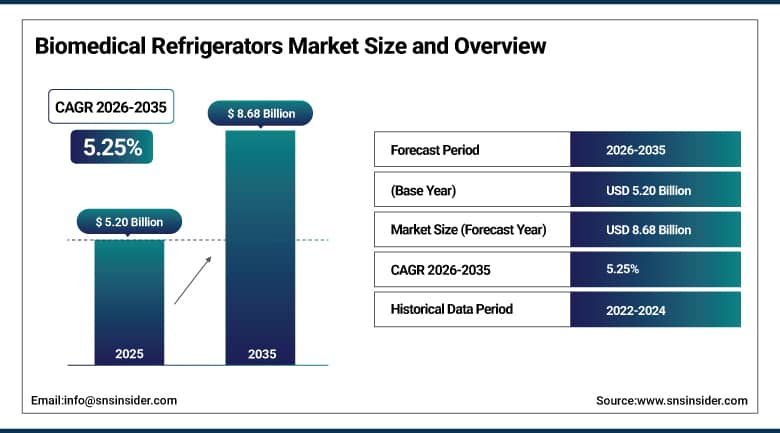
The Biomedical Refrigerators Market was valued at USD 5.20 Billion in 2025 and is projected to reach USD 8.68 Billion by 2035, expanding at a CAGR of 5.25% during the forecast period 2026–2035.
The market for biomedical refrigerators is growing steadily because of the rising requirement for reliable temperature control storage facilities in hospitals, pharmaceutical manufacturing plants, biotech companies, blood banks, diagnostics centers, and research labs. Surging manufacturing of biologics, cell and gene therapies, vaccines, blood components, and temperature sensitive drugs has ramped up the demand for highly trustworthy refrigeration units capable of strict storage parameters. Increasing governmental push in the direction of products quality, lab accreditation, GMP & GDP regulations, and increased focus on compliance is motivating checkups and research centers to exchange outmoded refrigeration units with advanced biomedical refrigeration units featuring enhanced temperature consistency and digital alerts.
The market will also be boosted by advances in technology such as IoT-enabled temperature monitoring, cloud data logger technology, predictive maintenance software, AI-enabled troubleshooting, and energy-saving compressor technology and greener refrigerants with the same security. In January 2026, the U.S. Food and Drug Administration (FDA) issued expanded guidance on supporting digital temperature monitoring, electronic recordkeeping and ongoing environment monitoring throughout regulated pharmaceutical and biologic storage facilities, an additional boost to the needs for advanced biomedical refrigeration systems.
To Get More Information On Biomedical Refrigerators Market - Request Free Sample Report
Biomedical Refrigerators Market Trends:
-
Growing deployment of IoT-enabled biomedical refrigeration monitoring systems.
-
Increasing investments in biopharmaceutical cold-chain storage infrastructure globally.
-
Rising adoption of ultra-low temperature storage for advanced biologics.
-
Expansion of automated laboratory refrigeration with cloud-based monitoring platforms.
-
AI-powered predictive maintenance improving biomedical equipment reliability and compliance.
U.S. Biomedical Refrigerators Market Size Outlook:
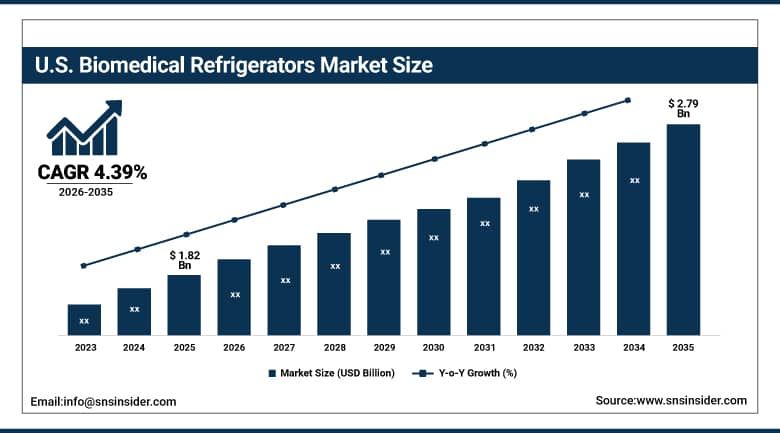
The U.S. Biomedical Refrigerators Market was valued at USD 1.82 billion in 2025 and is expected to reach approximately USD 2.79 billion by 2035, expanding at a CAGR of 4.39% during 2026–2035.
The United States continues to lead the North American biomedical refrigerators market due to robust healthcare infrastructure, manufacturing capabilities in pharmaceuticals, rapidly advancing biotechnology, well-developed research ecosystem in laboratory settings, and consistent investment in vaccine manufacturing, precision medicine, genetic studies, clinical diagnostics, and biological production industries leading to high demand for reliable biomedical refrigerator systems offering precisely controlled conditions to maintain a stable, regulated storage temperature for temperature-sensitive biologic samples.
Growth and rapid commercialization in cell and gene therapies along with increasing bio repository establishment and building blood banking systems provides substantial sales opportunities for the best biomedical refrigerator manufactures on a persistent basis throughout The United States. The US life science industry had multiple organizations increase laboratory spaces in 2025 in anticipation of increased biologics, vaccines, and advanced therapy production, prompting adoption of connected biomedical cold storage across research and manufacturing labs.
Biomedical Refrigerators Market Segmentation Analysis:
-
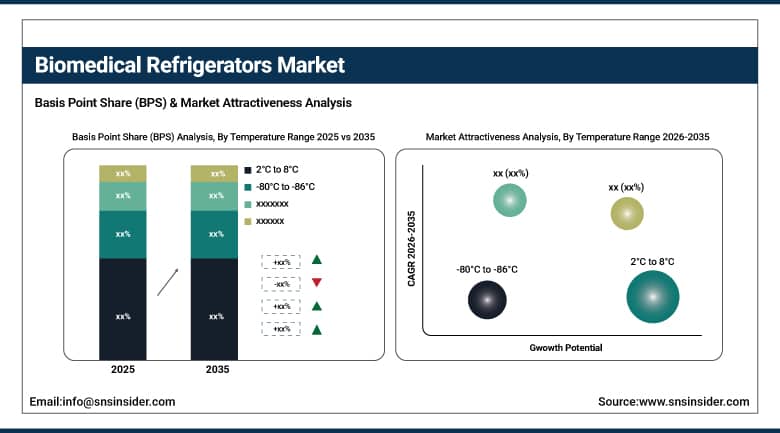
By Temperature Range, 2°C to 8°C dominated the market with 33.00% share in 2025, while -80°C to -86°C is projected to witness the fastest growth with 6.98% CAGR during the forecast period.
-
By Product Type, ultra-low temperature refrigerators dominated the market with 34.00% share in 2025, while plasma refrigerators are projected to witness the fastest growth with 7.07% CAGR during the forecast period.
-
By Application, biological sample storage dominated the market with 29.00% share in 2025, while pharmaceutical storage is projected to witness the fastest growth with 5.86% CAGR during the forecast period.
-
By End User, hospitals dominated the market with 31.00% share in 2025, while pharmaceutical & biotechnology companies are projected to witness the fastest growth with 6.37% CAGR during the forecast period.
By Temperature Range, 2°C to 8°c dominated, while -80°c to -86°c grows fastest.
The segment within 2℃ to 8℃ held the largest market share of 33.00% in 2025, due to the necessity of this storage range for vast number of vaccines, pharmaceutical products, reagents, diagnostic kits, blood, and laboratory samples, hospitals, pharmacies, diagnostic laboratories, and blood banks depend on refrigeration within this temperature range for their effectiveness and compliance to international standards and regulations.
The CAGR for -80℃ to -86℃ is predicted to rise at the highest rate of 6.98% over the predicted period driven by the development of cell- and gene- based therapies and bio banking services as well as growth in diagnostics at the molecular level, research related to genome, etc. Ultra-low temperature storage has gained significance for long-term stability of RNA and DNA molecules, stem cells, viral vectors, bio samples, high-value bio-products. Thermo Fisher Scientific increased its portfolio on laboratory cold-storage in 2025 to provide efficient preservation during advanced genomic research, biologics manufacturing and pharmaceutical quality control of drugs and vaccines through their ultra-low temperature storage technology.
By Product Type, ultra-low temperature refrigerators dominated, while plasma refrigerators grows fastest.
Ultra-low temperature refrigerators represented the largest product segment in 2025, representing a 34.00% share in the biomedical refrigerators market owing to its vital function of safeguarding sensitive biological materials such as vaccines, cell cultures, tissue samples, DNA libraries, enzymes, biologics, high value pharmaceuticals and more. The increasing funding into genomic research, personalized medicine, vaccine development and biopharmaceutical production has driven significant purchase of ultra-low temperature storage solutions. PHCbi enhanced its range of ultra-low temperature freezers and connected monitoring systems to better serve the domains of bio banking, pharmaceutical research and cell therapies, amidst the rising global demand for intelligent cold storage solutions for biomedical applications in the year 2025.
Plasma refrigerators are expected to witness the fastest growth at a CAGR of 7.07%, for 2026-2035, as a result of increasing blood donation programs, scale up of production of plasma-derived therapies and the widespread demand for plasma-based biologics in the healthcare sector globally. The ever-growing prevalence of immune related disorders, hemophilia and critical care procedures and trauma treatment have amplified demand for collection and storage of plasma across the global healthcare network. Haier Biomedical expanded its blood management offerings with integrated intelligent monitoring and traceable solutions for plasma and blood refrigeration systems in 2025, and also expanded their portfolio of blood and plasma refrigerators in the market.
By Application, biological sample storage dominated, while pharmaceutical storage grows fastest.
The biologic sample storage was the biggest segment by application, claiming 29.00% of the market share in 2025. Its growth was fueled by the global fast expansion of clinical research, biobanking, genomics, pathology, and precision medicine applications in each nation. Biomedical institutions demand of dependable biomedical refrigeration systems more than ever before; the systems need to maintain biological blood samples, tissue samples, DNA, RNA, stem cells, and microbiological culture in specified environment. In 2025, multiple national bio bank expansion projects in North America and Europe led to the rise of procurement for sophisticated biomedical refrigeration systems, thus enhancing the long-term viability of biologic sample storage.
Pharmaceutical storage is expected to record the highest growth at a CAGR of 5.86 % over the forecast period due to the rising production of biologics, specialty medicines, biosimilars, vaccines, and personalized therapeutics which require tight cold-chain environments. Investment in smart refrigerators by pharmaceutical producers and distribution centers to facilitate digital compliance, automated inventory management, remote monitoring, and continuous environmental monitoring increased throughout the period. Due to strict regulations on pharmaceutical quality assurance and product traceability, demand for biomedical refrigeration systems for pharmaceuticals would remain robust in long-term.
Regional Analysis:
|
Region |
Major Country |
Share within Region, 2025 (%) |
|---|---|---|
|
North America |
United States |
92.00% |
|
Europe |
Germany |
28.00% |
|
Asia Pacific |
China |
27.00% |
|
Middle East & Africa |
UAE |
4.00% |
|
Latin America |
Brazil |
3.00% |
North America Biomedical Refrigerators Market Insights
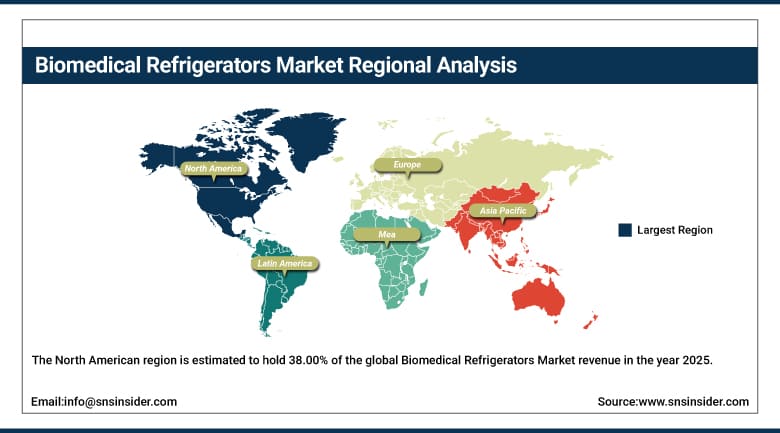
The North American region is estimated to hold 38.00% of the global Biomedical Refrigerators Market revenue in the year 2025 and the region is expected to continue to lead due to well-established healthcare infrastructure, robust pharmaceutical manufacturing, growing biotech industry, and well-established hospital network, blood banks, research labs, and diagnostic centers. The U.S. remains the largest demand in the region due to higher investment in the biopharma manufacturing and vaccine production as well as in genomic medicine and in clinical research.
Stringent regulatory guidelines on maintaining integrity of stored pharmaceuticals, vaccines, blood products, biological specimens are accelerating demand for substitution of standard refrigerating appliances with advanced biomedical refrigerators with IoT driven monitoring, cloud based data management, predictive maintenance and on-line verification of temperatures. In January 2026, the US FDA issued enhancing guidance favoring sustained environmental monitoring and electronic temperature records for drug and biologic storage facilities, thereby increasing usage of smart biomedical refrigerators in life science as well as healthcare establishments.
Get Customized Report as Per Your Business Requirement - Enquiry Now
Europe Biomedical Refrigerators Market Insights
Europe continues to remain one of the leading regional market for biomedical refrigerators, with mature healthcare systems, leading pharmaceutical manufacturers, nascent research across biotechnology sector and established lab facilities across countries like Germany, France, United Kingdom, Italy, among others. Rising investment in complex biologics, vaccine manufacturing, personalized medicine and collaborative research projects has accelerated adoption of these high-performance refrigerator devices that maintain rigid temperature consistency and stringent regulations.
Upgrading the laboratory infrastructure, including updating blood banking and public health laboratories is predicted to ensure healthy expansion of the market across this continent. In 2025, a majority of pharmaceutical companies in European countries expanded their capacity for biologic production and ramped up investment in digital biomedical refrigeration units which ensure compliance and GMP data integrity in their labs and storage systems.
Asia Pacific Biomedical Refrigerators Market Insights
Asia Pacific will have the fastest CAGR, projected at 7.39% due to the rapid expansion of pharmaceutical and biotech manufacturing processes, advancements in vaccines and healthcare infrastructure, as well as government support to life science research and innovation. Countries such as China, Japan, India, South Korea, and Singapore consistently boost in-house drug manufacturing capabilities for biologics, biosimilars, vaccines, and specialized medicines, enhancing the need for dependable biomedical cooling technology.
Clinical study growth, as well as more research facilities and bio storage development, offer immense opportunities for manufacturers to supply intelligent and energy-saving refrigeration. In Asia Pacific Haier Biomedical updated its integrated laboratory cold-storage portfolio across regions, providing connected biomedical refrigeration solutions aimed at ensuring consistent storage for vaccines, improving research facilities, and bolstering bio-pharma production capabilities.
Middle East & Africa and Latin America Biomedical Refrigerators Market Insights
Middle East & Africa market expanding moderately – MEA market set to continue its strong expansion on the back of growing healthcare infrastructure, diagnostic laboratory updates, and new blood banking facilities across UAE, Saudi Arabia, South Africa & other parts of region. Health facilities are upgrading existing capacity and creating capacity to store vaccines, develop systems to track diseases, expand capabilities to provide a wide range of diagnoses, increasing sustained demand for biomedical refrigeration systems. In 2025 several organizations in the Gulf States in Middle East developed new laboratory and diagnostic facilities by deploying smart connected biomedical refrigerator, supported biologics warehousing for pharmaceutical manufacturing capabilities.
Latin America’s developing healthcare infrastructure, increased pharmaceutical output, accelerated vaccination plans and modernization of laboratories in Brazil, Mexico, Argentina and Chile contributed to steady market growth rate. Growing biotechnological research operations, expansion of public health laboratories, an enhanced blood bank infrastructure for meeting the demands are promoting faster implementation of Biomedical Refrigeration Systems which provide remote monitoring, real-time data validation, and high-energy efficiency. In 2025, leading Brazilian medical centers expanded its storage requirements for managing biologics drugs and vaccine inventory by implementing smart connected lab equipment.
Growth Drivers: Expansion in biologics, vaccine manufacturing and life science advanced infrastructure.
Increase in biologics manufacturing, vaccine production, advanced life sciences research and precision medicine facilities globally is emerging as one of the strongest drivers of growth for the biomedical refrigerators market. Commercialization of monoclonal antibodies, biosimilars, plasma derived therapies, cell and gene therapies as well as personalized medicine have elevated demand for high-reliability biomedical storage solutions across diverse applications in pharmaceutical companies, research laboratories, bio banks and hospitals, driving the overall growth of the Biomedical Refrigerators Market.
Strict adherence to guidelines for storing and documenting sensitive biological samples and the continuously evolving expectations by regulators regarding storage temperature monitoring continue to force existing equipment owners towards the adoption of modernized systems integrated with electronic record keeping, cloud connectivity for data, automatic alerts, and prediction analytics of equipment failure and downtime. In Jan 2026, the U.S. Food and Drug Administration’s heightened expectation for 21 CFR Part 11-compliant continuous monitoring and electronic records-based environmental controls for the storage of regulated pharmaceutical and biologic goods across a spectrum of facility types has provided further acceleration of modern- biomedical storage infrastructure.
Restraints: High acquisition and maintenance costs of sophisticated refrigeration systems.
High capital investment for sophisticated biomedical refrigeration equipment continue to limit access even in the presence of favorable market expansion among small hospitals, research institutions, blood banks, and healthcare providers with limited budgets. Ultra low temperature freezers necessitates sophisticated compressors, auxiliary power supplies, calibration providers, remote monitoring platforms, and regular maintenance to satisfy requirements for regulatory compliance as well as the safety of the products and drugs stored in the units.
With rising power requirements, escalating maintenance expenses, refrigerant re-fill costs, and a need for periodic re-validation, total cost of ownership for biomedical refrigeration systems remains on an uptrend over equipment life cycle. Equipment manufacturers will continue to need to find ways to improve affordability with energy efficient equipment, predictive maintenance software and lifecycle cost optimizations. In 2025, numerous manufacturers had launched next generation of energy efficient biomedical refrigeration platforms to address these needs of increasing energy cost of operation while meeting regulatory compliance.
Opportunities: Digital laboratory transformation and smart cold chain monitoring technology.
There is a large opportunity for biomedical refrigerator manufacturers in the digital transformation of the laboratories, pharmaceutical manufacturing facilities and the healthcare industry. Increasing deployment of IoT-enabled monitoring systems, cloud-based asset management systems, AI-powered predictive maintenance, RFID-enabled inventory tracking, and automated regulatory reporting and IoT-enabled and cyber security enhanced laboratory infrastructure is restructuring how cold storage operations function across the world. Hospitals need intelligent and integrated refrigeration solutions that can sync with their LIMS, HIS systems, and central facility management systems; which also deliver reliable real-time monitoring and regulatory records without a glitch.
Continued investments in the Smart Hospitals project, decentralized clinical trials, bio-banking infrastructure and the modernization of pharmaceutical cold chains are expected to fuel long-term demand for connected biomedical refrigeration products. Haier Biomedical extended its Smart Laboratory ecosystem in 2025 with its IoT-enabled cold storage appliances integrated with smart laboratory management and remote monitoring solutions that serve the Pharmaceutical, research and healthcare industry.
Recent Developments:
-
2026: The U.S. Food and Drug Administration (FDA) strengthened guidance supporting continuous environmental monitoring and electronic documentation for regulated pharmaceutical and biologic storage facilities, encouraging wider deployment of digitally connected biomedical refrigeration systems.
-
2025: PHCbi expanded its biomedical cold-storage portfolio with advanced ultra-low temperature refrigeration systems featuring enhanced energy efficiency, intelligent monitoring, and improved sample protection for research laboratories and biopharmaceutical facilities.
-
2025: Haier Biomedical introduced upgraded Smart Laboratory cold-storage solutions integrating IoT connectivity, cloud-based monitoring, and automated equipment management for healthcare and life science laboratories.
-
2025: Thermo Fisher Scientific expanded its laboratory cold-storage product portfolio with enhanced ultra-low temperature storage systems supporting biologics manufacturing, genomic research, and pharmaceutical quality assurance.
Biomedical Refrigerators Market Key Players are:
-
Helmer Scientific
-
Eppendorf SE
-
B Medical Systems S.à r.l.
-
Philipp Kirsch GmbH
-
Vestfrost Solutions
-
Liebherr-International AG
-
Follett Products LLC
-
Migali Scientific
-
Arctiko A/S
-
EVERmed S.R.L.
-
Fiocchetti Scientific S.r.l.
-
Blue Star Limited
-
Godrej & Boyce Manufacturing Limited
-
Zhongke Meiling Cryogenics Limited
-
Angelantoni Life Science S.r.l.
-
So-Low Environmental Equipment Co., Inc.
-
Labcold Ltd.
Biomedical Refrigerators Market Report Scope:
| Report Attributes | Details |
|---|---|
| Market Size in 2025 | USD 5.20 Billion |
| Market Size by 2035 | USD 8.68 Billion |
| CAGR | CAGR of 5.25% From 2026 to 2035 |
| Base Year | 2025 |
| Forecast Period | 2026-2035 |
| Historical Data | 2022-2024 |
| Report Scope & Coverage | Market Size, Segments Analysis, Competitive Landscape, Regional Analysis, DROC & SWOT Analysis, Forecast Outlook |
| Key Segments | • By Product Type (Ultra-Low Temperature Refrigerators, Biomedical Refrigerators, Blood Bank Refrigerators, Plasma Refrigerators, Others) • By Temperature Range (2°C to 8°C, -20°C to -40°C, -80°C to -86°C, Below -150°C) • By Application (Biological Sample Storage, Vaccine Storage, Blood & Plasma Storage, Pharmaceutical Storage, Others) • By End User (Hospitals, Research Laboratories, Blood Banks, Pharmaceutical & Biotechnology Companies, Others) |
| Regional Analysis/Coverage | North America (US, Canada), Europe (Germany, UK, France, Italy, Spain, Russia, Poland, Rest of Europe), Asia Pacific (China, India, Japan, South Korea, Australia, ASEAN Countries, Rest of Asia Pacific), Middle East & Africa (UAE, Saudi Arabia, Qatar, South Africa, Rest of Middle East & Africa), Latin America (Brazil, Argentina, Mexico, Colombia, Rest of Latin America). |
| Company Profiles | Thermo Fisher Scientific Inc., PHC Holdings Corporation, Haier Biomedical, Helmer Scientific, Eppendorf SE, B Medical Systems S.à r.l., Philipp Kirsch GmbH, Vestfrost Solutions, Liebherr-International AG, Follett Products LLC, Migali Scientific, Arctiko A/S, EVERmed S.R.L., Fiocchetti Scientific S.r.l., Blue Star Limited, Godrej & Boyce Manufacturing Limited, Zhongke Meiling Cryogenics Limited, Angelantoni Life Science S.r.l., So-Low Environmental Equipment Co., Inc., Labcold Ltd. |
Frequently Asked Questions
The Biomedical Refrigerators Market was valued at USD 5.20 Billion in 2025.
The market is projected to reach USD 8.68 Billion by 2035.
The market is anticipated to expand at a CAGR of 5.25% during the forecast period.
North America dominated the global Biomedical Refrigerators Market in 2025 with a 38.00% revenue share.
Ultra-Low Temperature Refrigerators accounted for the largest revenue share of 34.00% in 2025.
