
Metal Forging Market Report Scope & Overview:
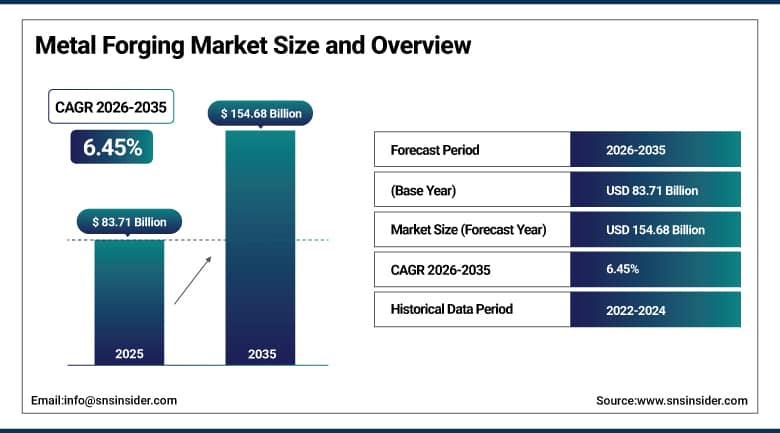
The Metal Forging Market was valued at USD 83.71 billion in 2025 and is expected to reach USD 154.68 billion by 2035, growing at a CAGR of 6.45% from 2026-2035.
The growth of the metal forging market can be largely credited to the increase in demands from the automobile industry, the aerospace industry, and the industrial machinery sectors. The automobile sector makes use of several types of forged products, including gears, crankshafts, and transmissions. Similarly, the other two industries make use of the metal forging industry because of the stress resistance and heat resistance of the products. The increasing production of vehicles, aircrafts, and machinery are collectively fueling the growth of the metal forging industry.
The International Organization of Motor Vehicle Manufacturers (OICA) reported that around 93.5 million motor vehicles were manufactured globally in 2023 due to significant production activities and continued demand for forged automotive parts including crankshafts, gears, and connecting rods. The growing manufacture of vehicles, aircraft, and industrial machines are significantly enhancing the consumption of high-strength forged metal parts.
To Get More Information On Metal Forging Market - Request Free Sample Report
Metal Forging Market Trends
-
Increasing adoption of Industry 4.0 and smart forging technologies for real-time production monitoring and efficiency enhancement.
-
Rising use of lightweight aluminum and titanium forgings in electric vehicles and aerospace applications.
-
Growing investments in automation and robotic forging systems to improve productivity and reduce labor dependence.
-
Expanding adoption of electric arc furnace technologies and recycled metals for low-carbon forging operations.
-
Increasing demand for precision and near-net-shape forging to minimize material waste and machining costs.
U.S. Metal Forging Market Outlook
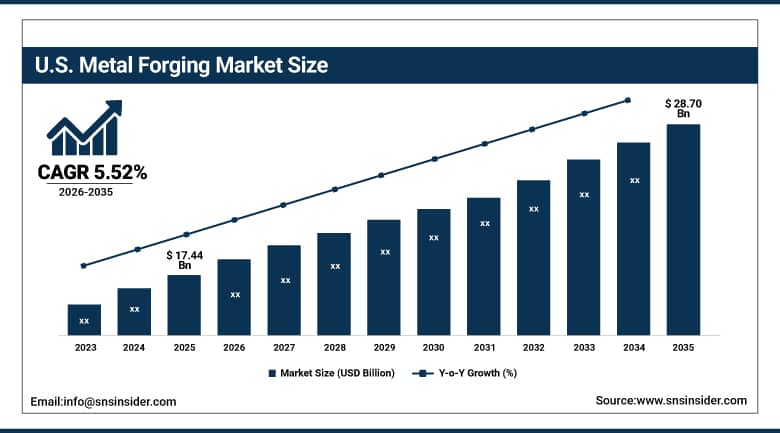
The U.S. Metal Forging Market was valued at USD 17.44 billion in 2025 and is expected to reach USD 28.70 billion by 2035, growing at a CAGR of 5.52% from 2026-2035.
The metal forging industry in the U.S. is experiencing positive impacts due to the reshoring of manufacturing operations and the increase in investments in infrastructure and industrial projects. Due to government efforts in favor of manufacturing and supply chain resiliency, automobile manufacturers, machinery makers, and industrial equipment companies have been motivated to procure parts domestically. The investment in transportation, energy, and construction infrastructure has led to a rise in demand for forged steel and aluminum parts.
The U.S. metal forging market is being driven by large-scale infrastructure investments and expanding aerospace and defense production. The U.S. Infrastructure Investment and Jobs Act provide more than USD 50 billion for water infrastructure projects and USD 5 billion for clean school buses, representing one of the largest infrastructure investment programs in U.S. history. Such projects increase demand for forged steel and aluminum components used in construction equipment, heavy machinery, pipelines, and transportation systems.
Metal Forging Market Segment Analysis
-
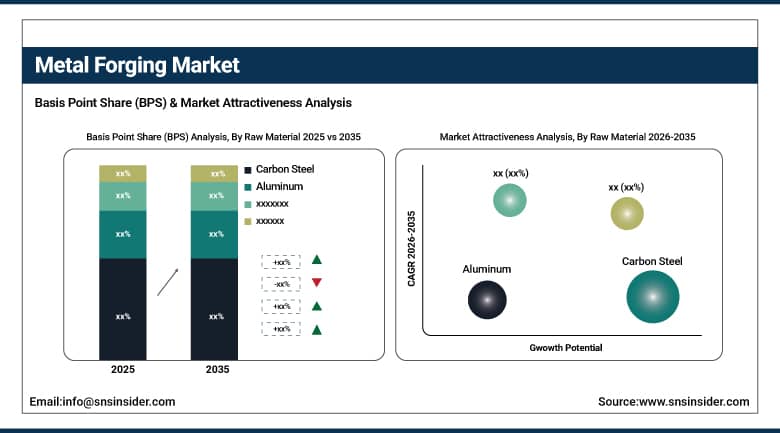
By Raw Material, Carbon Steel dominated the metal forging market in 2025 with 43.80% share; Aluminum is the fastest-growing segment with a 9.64% CAGR.
-
By Technology, Closed Die dominated the market in 2025 with 67.40% share and is also the fastest-growing segment with a 7.08% CAGR.
-
By End-User, Automotive dominated the market in 2025 with 51.60% share; Aerospace & Railways are the fastest-growing segment with 8.61% CAGR.
By Raw Material, Carbon Steel segment dominates the Metal Forging Market, Aluminum segment expected to grow fastest
The Carbon Steel segment holds the largest share in the metal forging market on account of its great strength, durability, cost-effectiveness, and utility in various sectors. Carbon steel forgings find extensive applications in the automotive, construction, industrial machines, and energy industry segments since these alloys have superior wear resistance and mechanical properties when compared to specialist metals, but with lower costs. The ready availability of carbon steel and its utility in high volume production makes it the favored raw material for producing gears, shafts, bolts, and other heavy-duty parts.
The Aluminum segment is projected to register the highest growth among all market segments owing to rising demand for lightweight components. The forgings made out of aluminum have a higher strength-to-weight ratio and are more resistant to corrosion and have higher energy efficiency than the conventional materials. Rising usage of electric vehicles and advanced aircraft has led to an increasing demand for components made of aluminum to help reduce the overall weight and pollution.
By Technology, Closed Die segment dominates the Metal Forging Market and also shows the fastest growth
The Closed Die Forging segment holds the leading position in the market because of its ability to provide extremely accurate and strong components that can be mass-produced. Closed die forgings are widely used in various industries like automotive, aerospace, and industrial machinery due to their mechanical strength and high accuracy, as well as low material losses in manufacturing complex parts. The process provides high consistency, good surface quality, and efficient production, which allows manufacturing various critical parts like crankshafts, connecting rods, and aircraft structure parts.
Moreover, the highest growth rate is seen in the Closed Die segment due to the increasing demand for high performance and precision-engineered components used in end-use applications. Higher investment in the use of lightweight materials, automation, and new manufacturing processes increases the development of closed die forgings. This process allows manufacturing complex components more efficiently with less need for post-processing. Increased production of electric vehicles, aircraft, and industrial equipment is driving the global market growth for closed die forgings.
By End-User, Automotive segment dominates the Metal Forging Market, Aerospace & Railways segment expected to grow fastest
The Automotive Segment accounts for the major share in the global metal forgings market because of the wide applications of metal forgings in the manufacture of engine, transmission, axle, and suspension parts. Metal forgings are known for their increased strength, toughness, and durability and play an integral role in ensuring safety and high performance of vehicles. There is an ongoing massive production of passenger and commercial vehicles all around the world, leading to huge demand for metal forging components in the sector. Moreover, the growing popularity of electric vehicles is expected to fuel the demand for metal forged light-weighted and highly durable components for automobiles.
Aerospace & Railways is anticipated to register the highest CAGR in the metal forging market due to increased aircraft production, railway modernization projects, and investments in transportation infrastructure. Rising demand for fuel-efficient aircraft and high-speed rail systems is increasing the consumption of forged aluminum, titanium, and specialty steel components. Furthermore, growing defense spending and fleet expansion programs are supporting rapid market growth in this segment.
Regional Analysis
|
Region |
Major Country |
Share within Region, 2025 (%) |
|---|---|---|
|
North America |
United States |
84.73% |
|
Europe |
Germany |
27.81% |
|
Asia Pacific |
China |
42.63% |
|
Middle East & Africa |
UAE |
24.37% |
|
Latin America |
Brazil |
46.45% |
Asia Pacific Metal Forging Market Insights
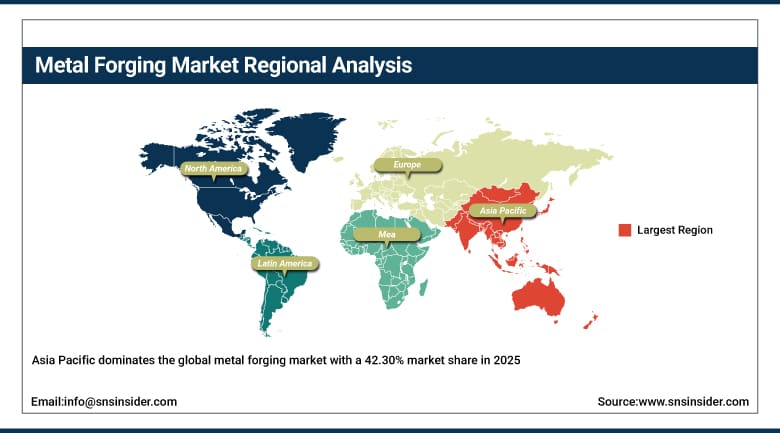
Asia Pacific dominates the global metal forging market with a 42.30% market share in 2025 and is also the fastest growing region with CAGR 7.49%. This growth is due to rapid industrialization and the continuous expansion of manufacturing activities in China, India, Japan, and Southeast Asia. Increasing production of automobiles, industrial machinery, and construction equipment is generating substantial demand for forged metal components. Government initiatives supporting domestic manufacturing and infrastructure development are further strengthening regional forging capacities and investments.
The growing adoption of electric vehicles and increasing aircraft production are creating significant opportunities for metal forging manufacturers in Asia Pacific. Automakers are increasingly using lightweight forged aluminum components to improve vehicle efficiency, while aerospace manufacturers require precision-forged titanium and specialty alloys. Rising investments in transportation and defense industries are further supporting demand for advanced forged components throughout the region.
Get Customized Report as Per Your Business Requirement - Enquiry Now
North America Metal Forging Market Insights
The growth of North America metal forging market can be credited largely to the growth of aerospace and defense sectors. The US is among the biggest manufacturers of commercial aircrafts, weapons, and defense systems, which need strong forged components. Growing expenditure on the development of the new generation of aircrafts, missiles, and defense systems is driving up demand for titanium, aluminum, and special steels forgings.
Investments in infrastructure and industrial development drive demand for forged components in North America. Heavy machinery, mining equipment, and infrastructure systems need robust forgings that can withstand large loads and severe working conditions. Spending of the government on transportation, utilities, and industrial infrastructure development drives up consumption of steel forgings and encourages production capacity of forged components in the region.
Europe Metal Forging Market Insights
The European metal forging market is motivated by the established automobile manufacturing industry in countries like Germany, France, and Italy. The automobile manufacturing industry uses a significant amount of metal forgings because of their greater strength and durability, including parts such as gears, crankshafts, and transmission. The increased manufacture of luxury cars and electric cars is generating consistent demand for forged metal products.
Sustainability is a major concern in Europe. The emphasis that Europe puts on sustainability and the reduction of carbon emissions is leading to advancements in forging technology. In Europe, manufacturers are increasingly turning to forging technologies that involve the use of recycled metals and the adoption of energy efficient forging processes.
Middle East & Africa and Latin America Metal Forging Market Insights
The metal forging market in the Middle East, Africa, and Latin America regions is expected to gain momentum from growing investments in infrastructure, energy, and mining projects. Governments in these regions have been investing heavily in transport infrastructure, power plants, ports, and industrial facilities, leading to increased requirement for heavy machines and forging products. Besides, the booming mining sector in countries like Brazil, Chile, and South Africa will boost the consumption of high-strength forging products for excavations and processing machinery.
Industrial diversification efforts and growth in manufacturing activities will also help in boosting the demand for metal forging products in these regions. In the Middle East, there has been heavy investment in non-oil based industrial sectors, while in Latin America, the automotive, agricultural, and industrial machinery manufacturing sector is becoming stronger. The development of new industrial parks, increased foreign investments, and capacity expansion of local manufacturers will increase the demand for forged steel and aluminum products in various end-user applications.
Market Dynamics
Growth Drivers: Rising Demand for High-Strength Components in Automotive and Aerospace Industries
The metal forging market is experiencing significant growth due to rising demand from the automotive, aerospace, and defense industries, which require highly durable, reliable, and lightweight components. Forged parts possess superior mechanical properties, including higher fatigue strength, improved structural integrity, and better resistance to wear and impact compared to cast or machined components. In the automotive sector, increasing production of electric vehicles and fuel-efficient automobiles is driving the adoption of forged aluminum and high-strength steel components. Similarly, the aerospace industry relies heavily on forged titanium and aluminum parts for aircraft engines and structural applications. Growing defense spending and expanding commercial aircraft production are further increasing the demand for advanced forged metal components worldwide, supporting sustained market growth.
Restraints: Volatility in Raw Material Prices and High Energy Consumption in Forging Operations
The metal forging market faces significant challenges due to the volatility in the prices of key raw materials, including steel, aluminum, titanium, and specialty alloys. Fluctuating material costs directly impact manufacturing expenses and create uncertainty in pricing strategies and profit margins for forging companies. Additionally, the forging process is highly energy-intensive, requiring substantial amounts of electricity and fuel to operate furnaces, presses, and heat-treatment equipment, thereby increasing production costs. The industry is also under growing pressure to reduce carbon emissions and comply with stringent environmental regulations. As a result, manufacturers are being compelled to invest heavily in renewable energy sources, energy-efficient technologies, and low-carbon production methods, increasing capital expenditure and operational complexities.
Opportunities: Growing Adoption of Lightweight Materials and Advanced Precision Forging Technologies
The growing adoption of lightweight materials and advancements in precision forging technologies are creating significant growth opportunities for the global metal forging market. Automotive and aerospace manufacturers are increasingly utilizing aluminum, titanium, and other lightweight alloys to improve fuel efficiency, enhance performance, and reduce carbon emissions. At the same time, advancements in automation, robotics, and digital manufacturing technologies are enabling forging companies to achieve higher production efficiency, improved product quality, and reduced material waste. Near-net-shape and precision forging techniques are also lowering machining requirements and production costs. Furthermore, the rapid expansion of electric vehicles, renewable energy equipment, industrial machinery, and advanced transportation systems is expected to generate substantial demand for high-performance forged components in the coming years.
Recent Developments:
-
2023: Nippon Steel announced a USD 14.9 billion acquisition of U.S. Steel, one of the largest transactions in the global steel industry. The deal was expected to strengthen supply chain integration, expand production capabilities, and enhance the availability of high-quality steel used in automotive, construction, and forging applications worldwide.
-
2024: Arconic commissioned a USD 57.5 million expansion project at its Iowa facility to increase the production of high-purity aluminum products for aerospace and defense industries. The investment supports rising demand for lightweight forged components used in aircraft structures, engines, and advanced defense systems.
-
2025: Sheffield Forgemasters partnered with BAE Systems under a UK government defense contract to manufacture artillery barrel forgings. The agreement reinforces domestic defense manufacturing capabilities and increases demand for high-strength forged steel products required in advanced military equipment and ammunition systems.
Metal Forging Market key players are:
-
Wyman Gordon
-
Shultz Steel
-
Consolidated Industries, Inc.
-
Pacific Forge Incorporated
-
Otto Fuchs KG
-
Weber Metals California
-
ATI Ladish LLC
-
Patriot Forge Co.
-
Arconic Corporation
-
Alcoa Corporation
-
voestalpine BÖHLER Aerospace GmbH & Co KG
-
China National Erzhong Group Deyang Wanhang Die Forging Co., Ltd.
-
ThyssenKrupp AG
-
Scot Forge Company
-
Precision Castparts Corp
-
Bruck GmbH
-
ELLWOOD Group Inc.
-
Lolu Alloys Ltd
-
Ovako AB
-
Celsa Group
Metal Forging Market Report Scope:
| Report Attributes | Details |
|---|---|
| Market Size in 2025 | USD 83.71 Billion |
| Market Size by 2035 | USD 154.68 Billion |
| CAGR | CAGR of 6.45% From 2026 to 2035 |
| Base Year | 2025 |
| Forecast Period | 2026-2035 |
| Historical Data | 2022-2024 |
| Report Scope & Coverage | Market Size, Segments Analysis, Competitive Landscape, Regional Analysis, DROC & SWOT Analysis, Forecast Outlook |
| Key Segments | • By Raw Material (Carbon Steel, Alloy Steel, Stainless Steel, Aluminum, Magnesium, Titanium, Others) • By Technology (Closed Die, Open Die, Others) • By End-User (Automotive, Mechanical Equipment, Aerospace & Railways, Others) |
| Regional Analysis/Coverage | North America (US, Canada), Europe (Germany, UK, France, Italy, Spain, Russia, Poland, Rest of Europe), Asia Pacific (China, India, Japan, South Korea, Australia, ASEAN Countries, Rest of Asia Pacific), Middle East & Africa (UAE, Saudi Arabia, Qatar, South Africa, Rest of Middle East & Africa), Latin America (Brazil, Argentina, Mexico, Colombia, Rest of Latin America). |
| Company Profiles | Wyman Gordon, Shultz Steel, Consolidated Industries, Inc., Pacific Forge Incorporated, Otto Fuchs KG, Weber Metals California, ATI Ladish LLC, Patriot Forge Co., Arconic Corporation, Alcoa Corporation, voestalpine BÖHLER Aerospace GmbH & Co KG, China National Erzhong Group Deyang Wanhang Die Forging Co., Ltd., ThyssenKrupp AG, Scot Forge Company, Precision Castparts Corp, Bruck GmbH, ELLWOOD Group Inc., Lolu Alloys Ltd, Ovako AB, Celsa Group. |

Frequently Asked Questions
Metal Forging Market is expected to grow at a CAGR of 6.45% from 2026 to 2035.
The Rising demand from automotive and aerospace industries for high-strength, lightweight, and durable metal components is driving market growth.
The Closed Die segment dominated the Metal Forging Market in 2025.
Asia Pacific dominated the Metal Forging Market in 2025.
