
Microbiome Diagnostics Market Report Scope & Overview:
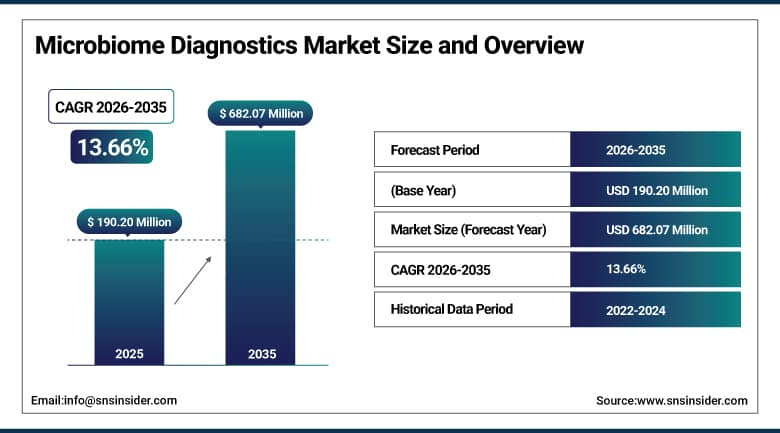
The Microbiome Diagnostics Market was valued at USD 190.20 million in 2025 and is expected to reach USD 682.07 million by 2035, growing at a CAGR of 13.66% from 2026-2035.
The Microbiome Diagnostics Market is witnessing rapid growth because of increasing scientific exploration of the connection between the microbial flora and human health, the increased need for personalized medical care, and the application of technology for disease diagnosis. Rising understanding of the part that the microbiome plays in digestive diseases, metabolic diseases, immune response, and other health issues is creating demand for sophisticated diagnostic tools. Scientific progress in the fields of next generation sequencing, metagenomics, polymerase chain reaction, bioinformatics, and microbial analysis is improving the performance of the tests. Moreover, increasing research into the microbiome, growing clinical trials, and increasing collaboration between biotech firms, healthcare institutions, and scientific organizations is helping drive the growth of the market.
⮞The NIH Human Microbiome Project established reference datasets and research resources to investigate microbial communities and their relationship with human health.
To Get More Information On Microbiome Diagnostics Market - Request Free Sample Report
Microbiome Diagnostics Market Trends:
-
Rising awareness of gut health is driving demand for microbiome testing and personalized diagnostic solutions.
-
Increasing prevalence of gastrointestinal disorders is expanding adoption of microbiome diagnostics across clinical and research settings.
-
Growing use of next-generation sequencing is improving microbiome profiling accuracy and microbial identification.
-
Advancements in artificial intelligence are enabling faster analysis of complex microbiome data and diagnostic interpretation.
-
Increasing interest in personalized medicine is supporting microbiome-based insights for individualized treatment and disease management.
U.S. Microbiome Diagnostics Market Outlook:
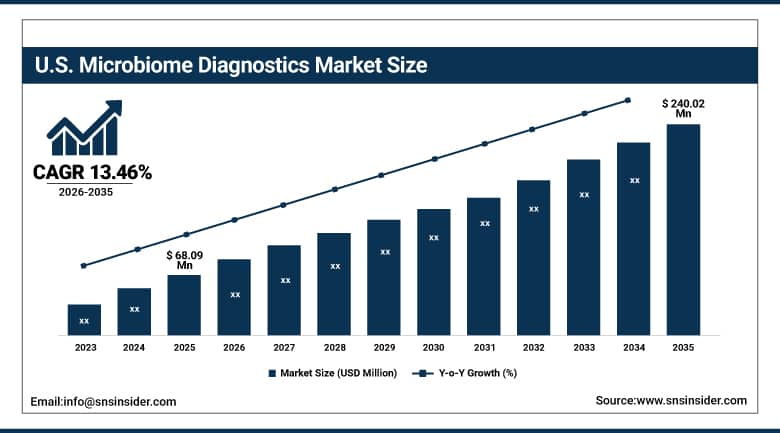
The U.S. Microbiome Diagnostics Market was valued at USD 68.09 million in 2025 and is expected to reach USD 240.02 million by 2035, growing at a CAGR of 13.46% from 2026-2035.
The U.S. Microbiome Diagnostics Market is witnessing rapid growth as a result of research in the area of connection between microbes and human health, increasing demand for personalized care and increasing use in disease diagnosis. Growing knowledge about the impact of the microbiome on digestion problems, metabolic disorders, immune system functioning, etc., is driving the demand for microbiome diagnostics. Technological improvements in such areas as next generation sequencing, metagenomics, polymerase chain reaction, bioinformatics, and microbial profiling are facilitating the process of making more accurate diagnoses. Moreover, increased funding for the research, growing interest of the clinical community in precision medicine, and collaboration between biotech companies, healthcare organizations, and research institutes contribute to the growth of the market. The necessity for better disease identification, risk assessment and treatment options is driving the uptake of microbiome diagnostics in the United States.
⮞The CDC reported on joint CDC–NIH work exploring microbiome science to support infection prevention, clinical care, and public health strategies against infectious diseases.
Microbiome Diagnostics Market Segment Analysis:
-
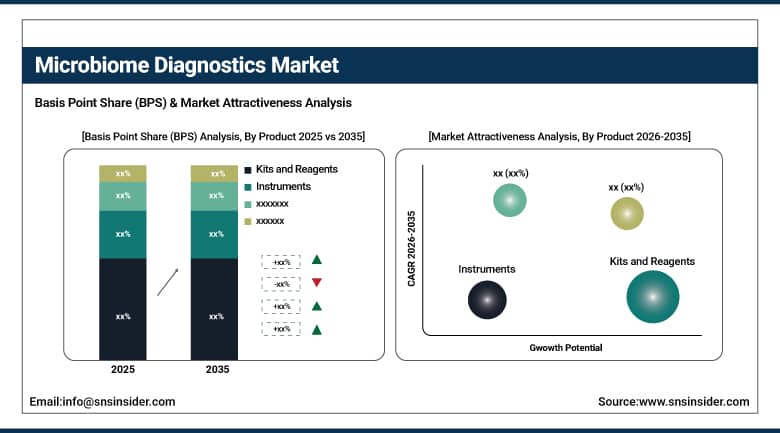
By Product, Kits and Reagents dominate the Microbiome Diagnostics Market with 65% share in 2025; Instruments are expected to grow at the fastest CAGR of 14.16% from 2026–2035.
-
By Technology, 16S rRNA Sequencing dominates the Microbiome Diagnostics Market with 38% share in 2025; Shotgun Metagenomics is expected to grow at the fastest CAGR of 14.41% from 2026–2035.
-
By Sample, Fecal Samples dominate the Microbiome Diagnostics Market with 55% share in 2025; Skin Samples are expected to grow at the fastest CAGR of 15.91% from 2026–2035.
-
By Application, Disease Diagnostics dominates the Microbiome Diagnostics Market with 62% share in 2025; Disease Diagnostics is expected to grow at the fastest CAGR of 13.91% from 2026–2035.
-
By End Use, Academic and Research Institutes dominate the Microbiome Diagnostics Market with 42% share in 2025; Pharmaceutical and Biotechnology Companies are expected to grow at the fastest CAGR of 14.50% from 2026–2035.
By Product, Kits and Reagents dominate the Microbiome Diagnostics Market, Instruments grow fastest.
Kits and Reagents dominated the Microbiome Diagnostics Market with the highest revenue share of about 65% in 2025, due to their repetitive usage in microbiome analysis. The kits and reagents are necessary for the diagnostic procedures and experiments. With the rise in microbiome research, high demand for such products is guaranteed due to the increased need for testing.
Instruments are expected to grow at the fastest CAGR of 14.16% from 2026–2035, due to rising requirements for automation, sensitivity, and high-throughput analysis of the microbiome. High-end sequencing equipment, molecular diagnostics solutions, and laboratory automation can increase the efficiency and quality of the tests performed. The rising focus on precision medicine, clinical microbiome studies, and laboratory automation is likely to boost the deployment of these instruments.
By Technology, 16S rRNA Sequencing dominates the Microbiome Diagnostics Market, Shotgun Metagenomics grows fastest.
16S rRNA Sequencing dominated the Microbiome Diagnostics Market with the highest revenue share of about 38% in 2025, Justified by its well-known utility in characterizing and profiling bacterial communities. The technique provides relatively low-cost procedures, proven methodologies, and applicability to a wide range of microbiome studies. The technique’s popularity in academic, clinical, and microbial diversity research is likely to maintain its dominant market share.
Shotgun Metagenomics is expected to grow at the fastest CAGR of 14.41% from 2026–2035, driven by its capability to enable thorough analysis of microbes that go beyond just identifying the bacteria. The tool allows one to identify bacteria, viruses, fungi, and functional genes. There will be an increase in the adoption of this method driven by high demand for thorough microbiome studies among others.
By Sample, Fecal Samples dominate the Microbiome Diagnostics Market, Skin Samples grow fastest.
Fecal Samples dominated the Microbiome Diagnostics Market with the highest revenue share of about 55% in 2025, This is mainly because these fecal samples give an effective method of studying the microbial flora in the guts. The samples are mostly collected in a non-invasive way, and laboratory techniques have been used to process and analyze the samples. Many studies on digestive and metabolic diseases have also increased the need for fecal samples.
Skin Samples are expected to grow at the fastest CAGR of 15.91% from 2026–2035, motivated by an increasing number of studies on skin microbiome and its link with skin diseases. Techniques like swabbing provide easy means to collect samples for analysis of microbes. An increasing awareness about diseases like acne, eczema, skin infections, and personal care will drive future research in skin samples.
By Application, Disease Diagnostics dominates the Microbiome Diagnostics Market and grows fastest.
Disease Diagnostics dominated the Microbiome Diagnostics Market with the highest revenue share of about 62% in 2025, stimulated by rising evidence on the role of microbe imbalance in causing gastrointestinal, metabolic, inflammatory, and infectious diseases. The study of the microbiome allows scientists to analyze the disease-related patterns in microbes. Rising demand for better understanding of the disease, advanced molecular testing, and increasing clinical research support the leadership of the market segment.
Disease Diagnostics is expected to grow at the fastest CAGR of 13.91% from 2026–2035, Backed by the progress being made in microbial biomarker discovery and growing awareness for individualized diagnostics. Scientists are searching for microbial markers that can be used for better diagnosis, risk assessment, and treatment monitoring of various diseases. Better funding for research, sequencing technologies and understanding of host-microbiome interactions are anticipated to boost usage despite varying applications for clinical use.
By End Use, Academic and Research Institutes dominate the Microbiome Diagnostics Market, Pharmaceutical and Biotechnology Companies grow fastest.
Academic and Research Institutes dominated the Microbiome Diagnostics Market with the highest revenue share of about 42% in 2025, backed by substantial research in the field of the microbiome, microbial diversity, and biomarkers. These organizations utilize sequencing technology as well as diagnostic tools for studying the connections between microbes and human health. Public research funding, academic partnerships, and increased life science research drive continued growth in the area.
Pharmaceutical and Biotechnology Companies are expected to grow at the fastest CAGR of 14.50% from 2026–2035, fuelled by growing investments in microbiome therapies, drugs discovery and development. Such companies leverage the use of microbiome analysis to explore pathogenesis, find out biomarkers and assess treatment responses. Increased interest in live biotherapeutics, personalized medicine and microbiome-based therapies will drive the use of this technology within pharmaceuticals and biotech research projects.
Regional Analysis:
|
Region |
Major Country |
Share within Region, 2025 (%) |
|---|---|---|
|
North America |
United States |
89.5% |
|
Europe |
Germany |
24.0% |
|
Asia Pacific |
China |
38.0% |
|
Middle East & Africa |
UAE |
18.0% |
|
Latin America |
Brazil |
35.0% |
North America Microbiome Diagnostics Market Insights
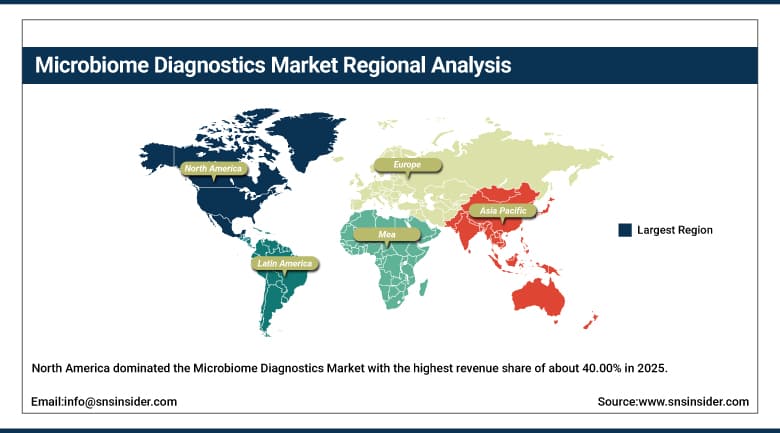
North America dominated the Microbiome Diagnostics Market with the highest revenue share of about 40.00% in 2025, backed by sophisticated diagnostic infrastructure, robust biotechnology research, and considerable investments in microbiome studies. The existence of leading diagnostic firms, healthcare systems, and growing awareness of gut health and personalized medicine serves to reinforce this trend. Growing clinical research in diseases associated with the microbiome helps establish regional market leadership.
The U.S. Microbiome Diagnostics Market accounted for a market share of 89.5% within North America in 2025, Backed by high-end laboratory setups, robust research on biotechnology and heavy investment in microbiome research. Increasing popularity of personalized medicines, growing research related to gut conditions and availability of leading diagnostic companies is also aiding the market. Clinical research is also contributing to market growth.
Get Customized Report as Per Your Business Requirement - Enquiry Now
Europe Microbiome Diagnostics Market Insights
Europe’s Microbiome Diagnostics Market is supported by expanding microbiome research, established healthcare infrastructure, and growing interest in personalized healthcare. Collaborative research programs among universities, biotech firms, and diagnostics are helping to improve testing procedures. Furthermore, studies on gut microflora and its relationship with gastrointestinal, metabolic, and autoimmune diseases are contributing to the acceptance of these diagnostics tests, with funding for research assisting in developing the regional market.
The Germany Microbiome Diagnostics Market accounted for a market share of 24.0% within Europe in 2025, motivated by existing research facilities, superior diagnostics technologies, and increasing funds for microbiome research. The rise in research on connections between the gut microbiota and various diseases is contributing to the growth of demand. Moreover, collaboration between universities, healthcare organizations, and biotech firms drives development of diagnostics technologies.
Asia Pacific Microbiome Diagnostics Market Insights
Asia Pacific is expected to grow at the fastest CAGR of about 14.75% from 2026–2035, driven by rising healthcare expenditure, expanding diagnostic infrastructure, and increasing awareness of microbiome health. Growing research investments, large patient populations, and rising interest in personalized medicine are accelerating demand. Furthermore, biotechnology development, expanding clinical research activities, and increasing investigation of microbiome-related diseases support regional growth.
The China Microbiome Diagnostics Market accounted for a market share of 38.0% within Asia Pacific in 2025, backed by an increase in healthcare infrastructure, an increase in investment in biotechnology, and increased research in microbiome diseases. The increased knowledge about gut health and personalized medicine is prompting the adoption of diagnostics. Furthermore, a vast number of patients, increased laboratory capacity, and clinical research activities have supported market growth.
Middle East & Africa and Latin America Microbiome Diagnostics Market Insights
The Middle East & Africa and Latin America Microbiome Diagnostics Market is gradually expanding through improvements in diagnostic infrastructure, increasing healthcare investment, and growing interest in personalized medicine. Increasing research about digestive and metabolic diseases is paving the way for microbiome tests. In addition to that, collaboration with foreign diagnostic firms, increased laboratory capacity, and enhanced focus on microbiome health is providing growth opportunities in these regions.
The UAE Microbiome Diagnostics Market accounted for a market share of 18.0% within the Middle East in 2025, This development is driven by the advancements in the field of healthcare modernization, increased capabilities of diagnostic laboratories, and personal medicine. Rising consciousness about digestive diseases and disorders associated with microbiome is promoting the demand. Besides, there are increased investments in diagnostic technology and partnership with global healthcare/biotech organizations.
Market Dynamics:
Growth Drivers: Advancements in sequencing technologies are strengthening microbiome diagnostic capabilities.
With the help of new generation sequencing, metagenomic analysis, polymerase chain reaction, and bioinformatics, it is becoming easier to determine and understand the nature of microbial populations in biological samples. These techniques allow scientists and diagnostic labs to study microbial populations, identify certain microbes, and analyze links between the microbiome and health conditions. Enhanced sequencing capacity and bioinformatics software are aiding in more comprehensive profiling and processing of large and complicated datasets. The increasing studies on gut, oral, vaginal, and skin microbiomes are also contributing to the possible uses of microbiome in diagnostics. This progress is pushing the diagnostic companies and research organizations to develop better testing solutions for the microbiome diagnostics market.
Restraints: Limited clinical validation can restrict routine adoption of microbiome diagnostic tests.
There are several issues in the clinical validation of microbiome diagnostic applications that make it difficult to confirm if the discovered pattern of the microbiome could be used as a reliable basis for any medical decisions. Variations among the population of patients, sample preparation and analysis, and interpretation of the results might be factors that influence the reproducibility of the research findings. A specific microbiome pattern found for a certain illness does not mean that the microorganism was responsible for it or that modifying the pattern would have a positive impact on the health of the patients. An international expert panel consensus from The Lancet Gastroenterology & Hepatology noted lack of evidence for the use of microbiome diagnostic in practice.
Opportunities: Expanding precision medicine research creates opportunities for microbiome-based biomarkers.
The rising popularity of personalized medicine offers chances to explore the use of microbiome-based biomarkers for characterizing diseases, stratifying patients, and assessing the responses of individuals to treatments. Studies are underway to determine whether microbial profiles can be used in distinguishing between subtypes of a disease or different responses to certain drugs in patients. Diagnostic makers can cooperate with drug companies, universities, and clinical labs in verifying biomarkers and establishing standard test procedures. Sequencing tools and bioinformatics software may aid in analyzing complex microbial profiles in large patient cohorts. Yet, the successful commercialization of such markers will need evidence about their superiority to current diagnostic tests in providing clinically valuable information.
Recent Developments:
-
2026 : Genetic Analysis AS launched GA-map® Dysbiosis Test AInsight, an AI-assisted interpretation platform that converts microbiome test results into structured clinical insights and supports more efficient laboratory reporting.
-
2026 : Microba Life Sciences Limited released Microbiome Explorer 3.0, improving report readability, species-level insights, evidence-graded intervention recommendations, and healthy-reference ranges for clinical microbiome testing.
-
2026 : Viome Life Sciences, Inc. launched CancerDetect® Pancreatic, a blood-based diagnostic test designed to support early detection of pancreatic cancer, expanding its molecular diagnostics portfolio.
-
2025 : Genetic Analysis AS launched the GA-map® MHI GutHealth research-use-only reagent kit, enabling measurement of antibiotic-induced microbiome imbalances and supporting research into recurrent Clostridioides difficile infection.
Microbiome Diagnostics Market key players are:
-
Genetic Analysis AS
-
Microba Life Sciences Limited
-
DNA Genotek Inc. (OraSure Technologies, Inc.)
-
Illumina, Inc.
-
Becton, Dickinson and Company (BD)
-
Oxford Nanopore Technologies plc
-
ViennaLab Diagnostics GmbH
-
Viome Life Sciences, Inc.
-
Genova Diagnostics, Inc.
-
Micronoma, Inc.
-
Quantbiome, Inc.
-
BioMe Oxford Ltd.
-
DayTwo Ltd.
-
Sun Genomics, Inc.
-
Flightpath Biosciences, Inc.
-
GoodGut S.L.
-
Admera Health LLC
-
CosmosID, Inc.
-
Zymo Research Corporation
-
Thermo Fisher Scientific Inc.
Microbiome Diagnostics Market Report Scope:
| Report Attributes | Details |
|---|---|
| Market Size in 2025 | USD 190.20 Million |
| Market Size by 2035 | USD 682.07 Million |
| CAGR | CAGR of 13.66% From 2026 to 2035 |
| Base Year | 2025 |
| Forecast Period | 2026-2035 |
| Historical Data | 2022-2024 |
| Report Scope & Coverage | Market Size, Segments Analysis, Competitive Landscape, Regional Analysis, DROC & SWOT Analysis, Forecast Outlook |
| Key Segments | • By Product (Kits and Reagents, Instruments) • By Technology (16S rRNA Sequencing, Shotgun Metagenomics, Metatranscriptomics, Other Technologies) • By Sample (Fecal Samples, Saliva Samples, Skin Samples, Other Samples) • By Application (Disease Diagnostics [Gastrointestinal Disorders, Metabolic Disorders, Other Disease Diagnostics], Research Applications) • By End Use (Hospitals, Academic and Research Institutes, Pharmaceutical and Biotechnology Companies) |
| Regional Analysis/Coverage | North America (US, Canada), Europe (Germany, UK, France, Italy, Spain, Russia, Poland, Rest of Europe), Asia Pacific (China, India, Japan, South Korea, Australia, ASEAN Countries, Rest of Asia Pacific), Middle East & Africa (UAE, Saudi Arabia, Qatar, South Africa, Rest of Middle East & Africa), Latin America (Brazil, Argentina, Mexico, Colombia, Rest of Latin America). |
| Company Profiles | Genetic Analysis AS, Microba Life Sciences Limited, DNA Genotek Inc. (OraSure Technologies, Inc.), Illumina, Inc., Becton, Dickinson and Company (BD), Oxford Nanopore Technologies plc, ViennaLab Diagnostics GmbH, Viome Life Sciences, Inc., Genova Diagnostics, Inc., Micronoma, Inc., Quantbiome, Inc., BioMe Oxford Ltd., DayTwo Ltd., Sun Genomics, Inc., Flightpath Biosciences, Inc., GoodGut S.L., Admera Health LLC, CosmosID, Inc., Zymo Research Corporation, and Thermo Fisher Scientific Inc. |

Frequently Asked Questions
Key players in the Microbiome Diagnostics Market include Diversigen, Inc., Microba Life Sciences Limited, DayTwo, Inc., Viome Life Sciences, Inc., and CosmosID, Inc., among others.
Key opportunities in the Microbiome Diagnostics Market include advancements in microbiome sequencing, growing adoption of personalized medicine, and expanding applications in gastrointestinal disease diagnosis and precision healthcare.
The market is driven by increasing research into the human microbiome, rising prevalence of gastrointestinal disorders, and growing demand for personalized diagnostic and treatment approaches.
The Kits and Reagents segment dominated the Microbiome Diagnostics Market, accounting for approximately 65.00% market share.
The North America region dominated the Microbiome Diagnostics Market in 2025 with a 40.00% share, driven by advanced healthcare infrastructure and increasing adoption of microbiome testing.
