
Military Satellite Market Report Scope & Overview:
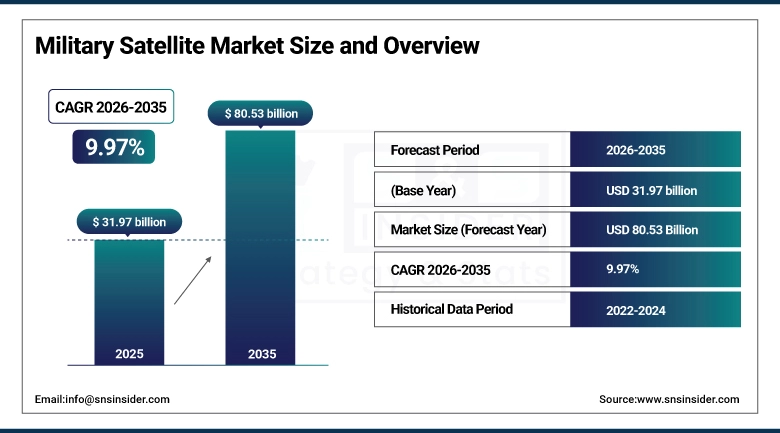
The Military Satellite Market size is valued at USD 31.97 Billion in 2025 and is projected to reach USD 80.53 Billion by 2035, growing at a CAGR of 9.97% during the forecast period 2026–2035.
Market Dynamics: The report on the Military Satellite Market provides detailed information about the market trends, technology evolution, and demand in various applications, such as communication, ISR, navigation, and missile warning. Increased investments in defense space, increased geopolitical conflicts, and launch of LEO satellite constellations have led to growth in the market.
The number of military satellites launched surpassed 8,500 defense-related satellites by 2025.
Market Size and Forecast:
-
Market Size in 2025: USD 31.97 Billion
-
Market Size by 2035: USD 80.53 Billion
-
CAGR: 9.97% from 2026 to 2035
-
Base Year: 2025
-
Forecast Period: 2026–2035
-
Historical Data: 2022–2024
To Get more information on Military Satellite Market - Request Free Sample Report
Military Satellite Market Trends:
-
Rising geopolitical tensions and increasing defense budgets are driving strong demand for advanced military satellite systems.
-
Growing reliance on real-time intelligence, surveillance, and reconnaissance (ISR) capabilities is accelerating deployment of high-performance satellites.
-
Expansion of LEO satellite constellations is enhancing secure, low-latency communication for modern military operations.
-
Increasing need for missile detection and early warning systems is boosting investment in space-based defense infrastructure.
-
Advancements in satellite miniaturization, AI-enabled data processing, and inter-satellite communication are improving operational efficiency and scalability.
-
Strategic collaborations between defense agencies, space organizations, and private companies are accelerating innovation and deployment of next-generation military satellites.
U.S. Military Satellite Market Insights:
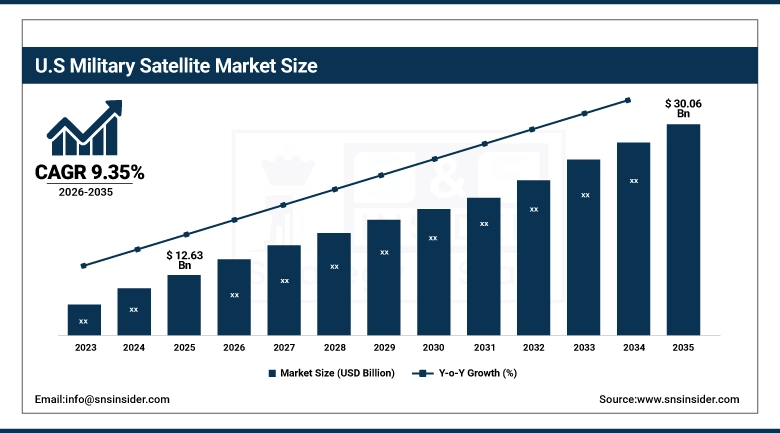
The U.S. Military Satellite Market is projected to grow from USD 12.63 Billion in 2025 to USD 30.06 Billion by 2035, at a CAGR of 9.35%. This growth will be driven by increased defense space budgets, the growth in the use of ISR and secure communications satellites, increased spending on missile warning and space defense systems, and high usage of LEO satellite constellations for defense purposes.
Military Satellite Market Growth Drivers:
-
Rising demand for real-time intelligence and secure communication is driving military satellite adoption across defense forces.
Growing dependency on satellite-based communications and ISR capabilities is one of the key drivers influencing the Military Satellite Market. In contemporary wars, there has been an increased focus on the exchange of information and efficient communication between troops that necessitates the use of advanced satellites by defense organizations. Geopolitical conflicts and the requirement to constantly monitor the boundaries and other vital assets have increased the need for satellite procurement by defense organizations. Innovations in the form of LEO constellations, Artificial Intelligence-based analytics, and secure inter-satellite communications are contributing to operational efficiency.
More than 68% of defense operations involved satellite-based communications and ISR capabilities in 2025.
Military Satellite Market Restraints:
-
High development, deployment, and maintenance costs of military satellites are restraining adoption across budget-constrained defense programs.
Another limitation affecting the Military Satellite Market is the costly aspect of deploying modern military satellite technology systems. High expenses involved in designing, launching, ground support facilities, and maintenance in orbit can be cited as factors that make it difficult for the market to thrive. The financial constraints imposed by most developing countries, which inhibit their ability to fund large-scale space-based military technology systems, have made them dependent on other countries' satellites.
Over 55% of emerging defense economies face budget constraints in deploying dedicated military satellite systems in 2025, impacting the pace of market expansion.
Military Satellite Market Opportunities:
-
Increasing commercialization of space and public-private partnerships are creating significant growth opportunities for the Military Satellite Market.
As the private space companies get more involved in space activities through the commercialization of satellite technology, it has become common practice in the defense industry for governments to use partnership to improve satellite capabilities without extending the production time and cost. Government institutions have been partnering with satellite manufacturers to share data, provide launches, and even deploy satellite constellations to make their military satellite systems scalable within a short period. This process has led to new opportunities for growth in the satellite manufacturing, launch, and payload installation processes.
Partnerships with private space organizations were seen in over 52% of all new defense satellite projects in 2025.
Military Satellite Market Segmentation Analysis:
-
By Satellite Type, Communication Satellites held the largest market share of 38.55% in 2025, while Early Warning Satellites are expected to grow at the fastest CAGR of 13.35% during 2026–2035.
-
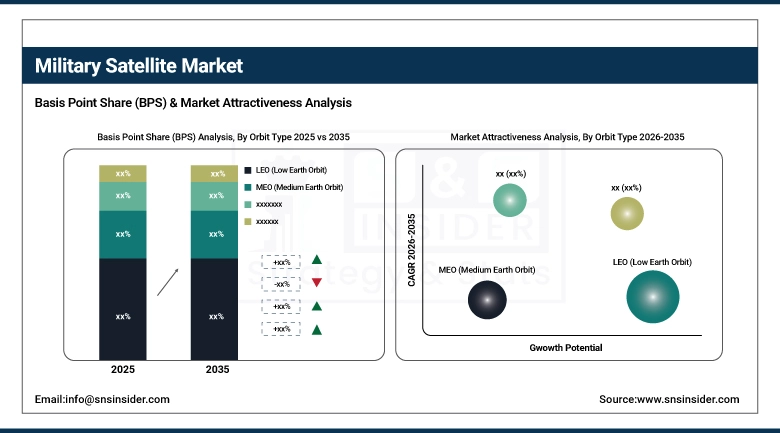
By Orbit Type, LEO (Low Earth Orbit) dominated with a 42.05% market share in 2025, while LEO is also projected to grow at the fastest CAGR of 11.95% during 2026–2035.
-
By Application, Military Communication accounted for the largest share of 30.85% in 2025, while Missile Detection & Early Warning is expected to grow at the fastest CAGR of 17.45% during the forecast period.
-
By End User, Air Force held the largest share of 27.12% in 2025, while Space/Defense Agencies are expected to grow at the fastest CAGR of 15.86% during 2026–2035.
-
By Payload Type, Imaging & Optical Sensors dominated with a 31.23% market share in 2025, while Radar Payloads (SAR, space-based radar) are projected to grow at the fastest CAGR of 14.24% during the forecast period.
By Orbit Type, LEO Dominates While LEO Grows Rapidly:
LEO (Low Earth Orbit) segment dominated the market due to its advantages it offered in terms of offering low-latency communications, high-resolution imaging, and fast data transmission for military purposes. The rise in the use of satellite constellations for monitoring, reconnaissance, and communication has further propelled its growth in today’s defense systems.
LEO is also the fastest-growing segment due to fast technological developments in the small satellite segment, rising implementation of distributed satellite systems, and rising investment in resilient space architecture.
By Satellite Type, Communication Satellites Dominates While Early Warning Satellites Grow Rapidly:
Communication Satellites segment dominated the market due to its vital importance in military communications, data transfers, and network centric warfare. The Communication Satellites segment holds the largest market share due to the consistent requirement for reliable and real-time communication between different branches of the military forces, including ground, aerial, and maritime units.
The Early Warning Satellites segment is expected to witness the fastest growth rate in the satellite industry market, followed by other segments. This is mainly due to the escalating investments in the missile detection and space threat monitoring systems, along with other strategic defense operations.
By Application, Military Communication Dominates While Missile Detection & Early Warning Grows Rapidly:
Military Communication segment dominated owing to the importance of facilitating seamless communication among military operations. The heavy dependence on satellite communication technology to ensure command, control, and coordination in different domains has been one of the key factors driving the success of the segment. Defense organizations are increasingly making efforts to enhance communication infrastructure to facilitate warfare initiatives.
Missile Detection & Early Warning is the fastest-growing segment as a result of increasing threats posed by missiles, increased focus on national security, and increasing utilization of space-based observation technologies.
By End User, Air Force Dominates While Space/Defense Agencies Grow Rapidly:
Air Force segment dominated the market share due to the heavy use of satellites for aerial operations, reconnaissance, navigation, and communications. The usage of satellites in air defense systems and the constant investment in aerial warfare technology is contributing factors that are generating high demand from this segment.
Space/Defense Agencies are the fastest-growing segment, due to the emergence of space commands and the increased emphasis on defense in space. The need for developing their own space program is motivating governments to invest more in satellites, monitoring devices, and space programs.
By Payload Type, Imaging & Optical Sensors Dominate While Radar Payloads Grow Rapidly:
Imaging & Optical Sensors segment dominated the market due to its critical role in high-resolution Earth observation, intelligence gathering, and surveillance operations. These sensors are widely used for monitoring enemy activities, border surveillance, and mission planning, making them essential components of military satellite systems.
Radar Payloads (SAR, space-based radar) are the fastest-growing segment, owing to their capability to provide all-weather, day-and-night surveillance and accurate detection of targets regardless of environmental conditions. Increasing demand for advanced reconnaissance capabilities and real-time situational awareness is driving the adoption of radar-based payload systems in modern military satellites.
Military Satellite Market Regional Analysis:
North America Military Satellite Market Insights:
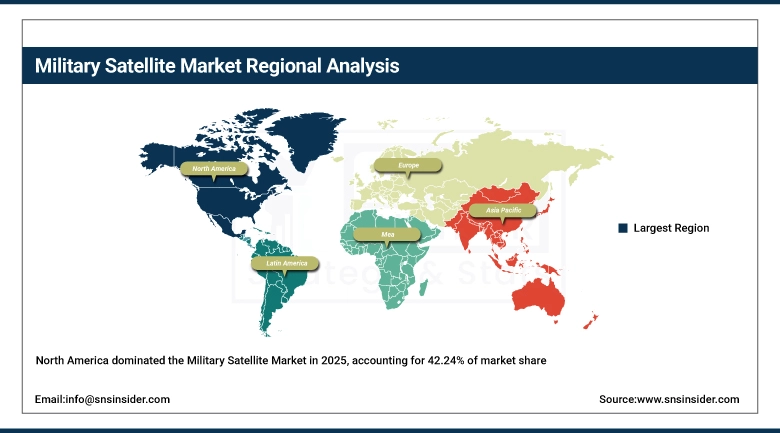
The North America Military Satellite Market is dominated, holding a 42.24% share in 2025, backed by generous defense budgets, technological superiority, and the presence of prominent satellite manufacturing companies and defense organizations in both the United States and Canada. The widespread use of satellites in communication, ISR, navigation, and missile warning systems aids the region in maintaining its dominance. Investments in space-based defense programs, the design of robust satellite systems, and the integration of cutting-edge technologies including artificial intelligence-based data analysis and secure communication networks help the region maintain its dominance. Space agencies and modernizing defense infrastructure are some factors that add strength to North America's supremacy in the international arena.
Get Customized Report as per Your Business Requirement - Enquiry Now
U.S. Military Satellite Market Insights:
The United States' Military Satellite Market is fueled by substantial capital investment in space defense programs, increased satellite constellations, and high emphasis on national security programs. The extensive use of satellites in communication, surveillance, and missile detection missions propels market growth. The nation possesses a conducive environment for defense contractors, space agencies, and private enterprises involved in satellite operations.
Asia-Pacific Military Satellite Market Insights:
The Asia-Pacific Military Satellite Market is the fastest-growing region, projected to expand at a CAGR of 11.61% during 2026–2035. Growth factors include higher defense spending, growing geopolitical conflicts, and increased investment in indigenous satellites in countries such as China, India, Japan, and other Southeast Asian nations. There is fast-paced development of satellites production, launching, and space-based surveillance technologies in the region. Rising efforts toward securing borders, monitoring the maritime regions, and enhancing real-time intelligence gathering are contributing to higher uptake of innovative satellites technologies. Moreover, government efforts toward ensuring self-sufficiency in space-related infrastructures and partnerships between the public and private sectors are propelling the market in the region.
China Military Satellite Market Insights:
In the China Military Satellite Market there have been considerable developments in the Market, largely attributed to growing investments in indigenous space capabilities, expansion in satellite constellations, and focus on national security. The country has made substantial advancements in developing satellite-based surveillance, navigation, and communications technology to enhance military operations.
Europe Military Satellite Market Insights:
The Europe Military Satellite Market is supported by strong collaboration among regional defense organizations, increasing investments in joint space programs, and a well-established aerospace industry. Growth in the region is driven by rising demand for secure communication, surveillance systems, and enhanced situational awareness across defense operations. Ongoing initiatives focused on strengthening space-based defense infrastructure, along with advancements in satellite technologies and integration of multi-national defense systems, are contributing to sustained market development across European countries.
Germany Military Satellite Market Insights:
Germany represents a key contributor to the military satellite market in Europe, supported by advanced engineering expertise and a strong industrial base in aerospace and defense technologies. Increasing focus on space-based surveillance, communication systems, and participation in collaborative European space programs is driving growth. Investments in research and development, along with emphasis on enhancing satellite capabilities for defense applications, are playing a vital role in strengthening the country’s position within the regional market.
Latin America Military Satellite Market Insights:
The Latin America Military Satellite Market is registering consistent growth owing to an increased need for surveillance, communication, and disaster monitoring applications. Nations such as Brazil, Mexico, and Argentina are acquiring satellites to enhance their security, border surveillance, and maritime security measures. The growth of the space industry, cooperation with foreign entities, and the usage of satellite data for defense purposes are adding value to the market. The lack of ground infrastructure in certain areas also boosts the usage of satellite technology for surveillance and communication purposes.
Middle East & Africa Military Satellite Market Insights:
The Middle East & Africa Military Satellite Market is growing steadily, driven by increasing defense spending, geopolitical tensions, and the need for advanced surveillance and communication systems. Countries including Saudi Arabia, the United Arab Emirates, and South Africa are investing in satellite technologies to enhance border security, intelligence capabilities, and defense coordination. Development of space programs, modernization of defense infrastructure, and growing adoption of satellite-based monitoring systems for strategic operations are fueling market growth across the region.
Military Satellite Market Competitive Landscape:
Lockheed Martin is known as a key player in the field of military satellites due to its sophisticated satellite technology and active participation in projects associated with the sphere of national security space programs. In particular, the corporation is engaged in the process of developing communication, missile warning, and reconnaissance satellites. The corporation’s key strengths can be identified as space systems integration, governmental contracts, and innovative designs of next generation satellites, such as missile defense and space situational awareness satellites.
-
In October 2025, Lockheed Martin Corporation advanced its Next-Generation Overhead Persistent Infrared (Next-Gen OPIR) satellite program, focusing on enhanced missile warning capabilities, improved infrared sensing, and resilient space-based defense systems for modern military operations.
Northrop Grumman Corporation is a key competitor in the military satellite market, known for its strong capabilities in space systems engineering, ISR satellites, and missile defense technologies. The company specializes in developing advanced satellite payloads, early warning systems, and secure communication platforms for defense applications. Its competitive advantage lies in its expertise in space-based radar, autonomous systems, and integrated defense solutions, along with a robust portfolio of government contracts and space programs.
-
In September 2025, Northrop Grumman Corporation continued development of its missile tracking satellite systems under advanced defense programs, aimed at improving space-based detection, tracking accuracy, and real-time threat response capabilities.
RTX Corp (Raytheon Technologies) is one of the main players in the military satellite value chain, especially in the areas of payload, sensors, and defense electronics in space. Its key areas of operation involve the production of innovative radar systems, missile warning sensors, and secure communications systems, which are incorporated into military satellites. The organization's core competencies lie in its innovations in sensors technology, its solid defense industry relationships, and consistent investment in next-generation space-based detection and tracking technologies.
-
In August 2025, RTX Corporation expanded its development of advanced space-based sensor technologies, aimed at strengthening missile warning systems, improving tracking precision, and supporting integrated space defense architectures.
Military Satellite Market Key Players:
Some of The Military Satellite Market Companies are:
-
RTX Corporation (Raytheon Technologies)
-
Thales Group
-
Boeing Defense Space & Security
-
L3Harris Technologies Inc.
-
Leonardo S.p.A.
-
Israel Aerospace Industries Ltd.
-
Mitsubishi Electric Corporation
-
Ball Corporation
-
General Dynamics Corporation
-
OHB SE
-
Sierra Space Corporation
-
Maxar Technologies Inc.
-
Saab AB
-
BAE Systems plc
-
China Aerospace Science and Technology Corporation (CASC)
-
Indian Space Research Organisation (ISRO)
-
Korea Aerospace Industries Ltd.
| Report Attributes | Details |
|---|---|
| Market Size in 2025 | USD 31.97 Billion |
| Market Size by 2035 | USD 80.53 Billion |
| CAGR | CAGR of 9.97% From 2026 to 2035 |
| Base Year | 2025 |
| Forecast Period | 2026-2035 |
| Historical Data | 2022-2024 |
| Report Scope & Coverage | Market Size, Segments Analysis, Competitive Landscape, Regional Analysis, DROC & SWOT Analysis, Forecast Outlook |
| Key Segments | By Satellite Type (Communication Satellites, Reconnaissance & Surveillance Satellites, Navigation Satellites, Early Warning Satellites, Others) • By Orbit Type (LEO – Low Earth Orbit, MEO – Medium Earth Orbit, GEO – Geostationary Orbit, HEO – Highly Elliptical Orbit, Others) • By Application (Military Communication, Intelligence Surveillance & Reconnaissance (ISR), Navigation & Positioning, Missile Detection & Early Warning, Others) • By End User (Army, Navy, Air Force, Space/Defense Agencies, Others) • By Payload Type (Imaging & Optical Sensors, Radar Payloads (SAR, Space-Based Radar), SIGINT/ELINT Systems, Communication Transponders, Others) |
| Regional Analysis/Coverage | North America (US, Canada), Europe (Germany, UK, France, Italy, Spain, Russia, Poland, Rest of Europe), Asia Pacific (China, India, Japan, South Korea, Australia, ASEAN Countries, Rest of Asia Pacific), Middle East & Africa (UAE, Saudi Arabia, Qatar, South Africa, Rest of Middle East & Africa), Latin America (Brazil, Argentina, Mexico, Colombia, Rest of Latin America). |
| Company Profiles | Lockheed Martin Corporation, Northrop Grumman Corporation, RTX Corporation (Raytheon Technologies), Airbus Defence and Space, Thales Group, Boeing Defense Space & Security, L3Harris Technologies Inc., Leonardo S.p.A., Israel Aerospace Industries Ltd., Mitsubishi Electric Corporation, Ball Corporation, General Dynamics Corporation, OHB SE, Sierra Space Corporation, Maxar Technologies Inc., Saab AB, BAE Systems plc, China Aerospace Science and Technology Corporation (CASC), Indian Space Research Organisation (ISRO), Korea Aerospace Industries Ltd. |
Frequently Asked Questions
North America dominated with a 42.24% share in 2025, while Asia-Pacific is the fastest-growing region, expected to expand at a CAGR of 11.61% during 2026–2035.
Communication Satellites dominated with a 38.55% share in 2025 Early Warning Satellites are projected to grow at the fastest CAGR of 13.35% during 2026–2035.
Growth is driven by rising defense space investments, increasing demand for real-time ISR and secure communication, and expansion of LEO satellite constellations for modern warfare capabilities.
The market is valued at USD 31.97 Billion in 2025 and is projected to reach USD 80.53 billion by 2035.
The Military Satellite Market is projected to grow at a CAGR of 9.97% during 2026–2035.
Get in Touch
