
Mixed Signal IC Market Report Scope & Overview:
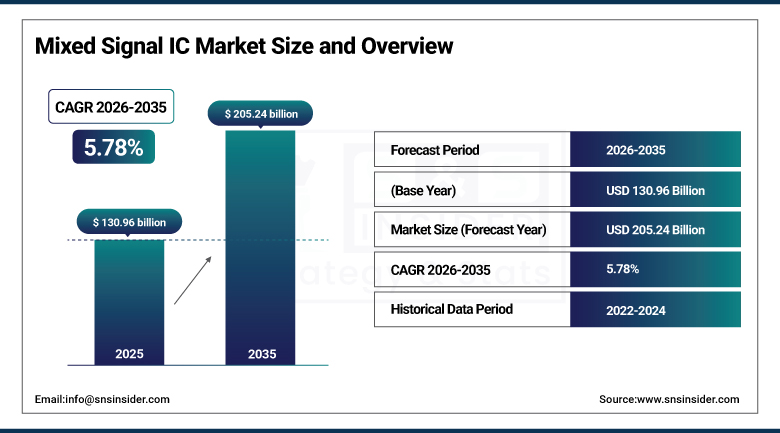
The Mixed Signal IC Market was valued at USD 130.96 Billion in 2025 and is expected to reach USD 205.24 Billion by 2035, growing at a CAGR of 5.78% from 2026 to 2035.
his expansion has been propelled by the incorporation of next generation technologies such as 5G, IoT, and AI, thus resulting in a greater need for advanced and efficient mixed signal ICs. Energy efficiency trends are also spurring the development of low-power, high-performance ICs. Mixed signal ICs are also influenced by regulations and compliance trends such as RoHS and WEEE that dictate the manufacturing and distribution of mixed signal ICs. There is also a rising demand for smartphones, wearables, and IoT devices, which is driving the adoption of mixed signal ICs, as the number of IoT devices is set to surpass 30 billion worldwide during the forecast period.
Texas Instruments Inc. made the announcement regarding its data converter ICs family for automotive radar applications in January 2024. This launch shows the importance of the automotive end user market in the business of mixed signal ICs since there is above-average demand growth for precision analog and mixed signal ICs due to the fast-growing EVs, ADAS functionalities, and automotive connectivity.
To Get more information on Mixed Signal IC Market - Request Free Sample Report
Mixed Signal IC Market Trends
-
Rising demand for smartphones, wearables, and IoT devices is accelerating mixed signal IC adoption, with the IoT device base expected to exceed 30 billion units globally and driving need for high efficiency signal processing at the chip level.
-
Growth of automotive electronics and EVs is boosting demand for mixed signal ICs in ADAS, battery management, and infotainment systems, with automotive semiconductor content rising by over 12% annually across leading vehicle platforms.
-
Expansion of 5G infrastructure and high speed connectivity is increasing demand for data converters and RF mixed signal ICs, supporting over 50% growth in 5G device shipments across consumer and infrastructure segments.
-
Increasing integration of analog, digital, and RF functions into single chips is reducing power consumption by 20 to 25% and PCB footprint by 30%, driving adoption in size and power constrained applications.
-
Adoption of AI enabled edge devices is driving demand for high precision data acquisition and signal conditioning, with mixed signal ICs enabling real time AI inference directly within sensor and actuator systems.
U.S. Mixed Signal IC Market Outlook
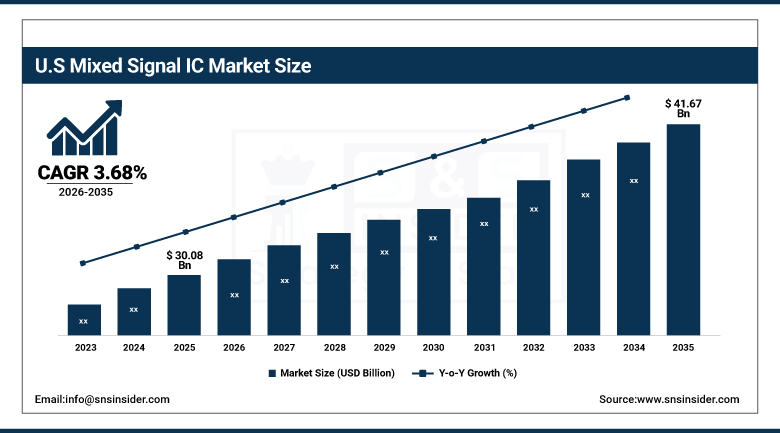
The U.S. Mixed Signal IC Market was valued at approximately USD 30.08 Billion in 2023 and is expected to reach approximately USD 41.67 Billion by 2032, growing at a CAGR of approximately 3.68%.
In the USA, the presence of companies such as Texas Instruments, Analog Devices, and Broadcom ensures that the country retains its position as the leader in terms of the technology industry because of their investments in R&D and wide platforms. With the development of all these things, the rate of failures and reliability continues to improve and help in adopting mixed signal ICs in various industries such as the automotive industry, consumer electronics, and industrial automation industry. With the USA taking the leading position in the adoption of 5G network, autonomous vehicles, and smart technologies, there is an increased need for high-performance mixed signal ICs.
In 2023, Analog Devices Inc. launched its AD9174 dual channel, 16 bit digital to analog converter, targeting 5G base station infrastructure and defense radar applications requiring high speed, high resolution signal generation. The product introduction demonstrates Analog Devices' continued investment in the highest performance tier of the data converter segment, where the demanding specifications of 5G radio infrastructure and defense electronics create premium pricing opportunities that sustain above average revenue contribution relative to commodity mixed signal IC categories.
Mixed Signal IC Market Segment Analysis
-
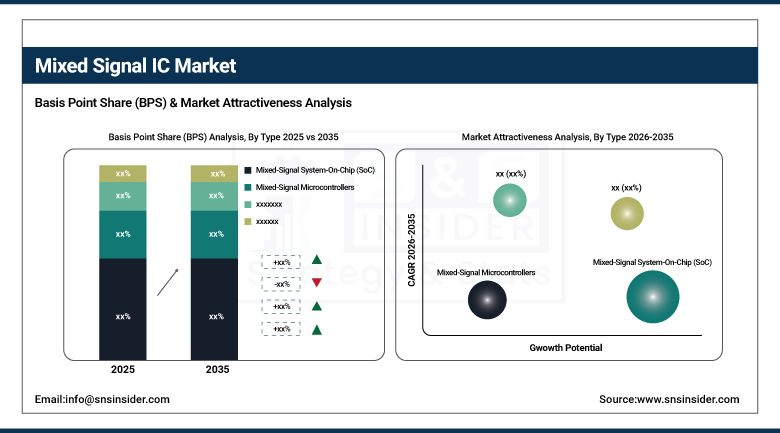
By Type, the Mixed-Signal System-On-Chip segment dominated the Mixed Signal IC Market in 2025 with approximately 36.8% of total revenue, , while the Data Converter segment is gaining fastest CAGR.
-
By End Use Industry, the Consumer Electronics segment dominated the Mixed Signal IC Market in 2025 with approximately 35% of revenue share, , while the Automotive segment is anticipated to record the highest CAGR.
By Type, mixed-signal SoC dominates, data converters grow fastest
The Mixed-Signal System-On-Chip segment dominated the mixed signal IC market in 2025 with approximately 36.8% of total revenue. Its leadership is driven by its ability to consolidate analog and digital functionalities within a single chip, reducing board space, power consumption, and component count. Mixed signal SoCs enable seamless integration of both analog and digital signals for complex electronic systems, offering exceptional capabilities that make them the preferred design choice for applications ranging from consumer wearables to industrial automation controllers. Each device design that replaces multiple discrete analog and digital components with a single integrated SoC creates structured procurement whose commercial aggregate across the global electronics design ecosystem sustains the type segment's commanding market position.
Data converters are gaining the fastest CAGR as ADCs and DACs become critical for interfacing real world continuous signals with digital processing systems. Data converters enable digital systems to interact with the real world's continuous signals, a fundamental need for modern electronics across sectors like IoT, automotive, healthcare, and consumer electronics. The trend toward higher resolution and faster sampling rates is fueling adoption, with the expansion of IoT sensors, electric vehicles, and AI at the edge amplifying data converter integration in end user applications. Each new IoT sensor deployment, ADAS radar module, and wireless communications infrastructure installation creates structured data converter procurement sustaining this sub segment's above average growth trajectory.
By End Use, consumer electronics dominates, automotive grows fastest
Consumer electronics was leading the market of mixed signal ICs in 2025, accounting for about 35% of the revenue. This position is attributed to the increasing need for advanced and efficient devices such as smartphones, wearable and smart home devices, which require an integrated approach in terms of analog and digital capabilities. Consumers' desire for small, mobile, and efficient devices necessitates the integration of various analog and digital capabilities in one device in order to make the process of signal processing and conversion effective. The popularity of smartphones, smart speakers, fitness devices, and smart home devices constitutes the largest procurement base in the world for the procurement of mixed signal ICs.
The Automotive segment is anticipated to record the highest CAGR during the forecast period. This growth is driven by the increasing complexity of vehicles, fueled by advancements in electric vehicles, autonomous driving, and ADAS. Incorporating AI into vehicles also boosts the need for mixed signal ICs to handle complex data processing in real time. As vehicles become more automated and connected, mixed signal ICs are at the forefront of enabling these innovations. The automotive semiconductor content per vehicle is rising by over 12% annually as each new ADAS feature, battery management system function, and in vehicle connectivity module creates structured mixed signal IC procurement across the global automotive supply chain.
Regional Analysis
|
Region |
Major Country |
Share within Region, 2025 (%) |
|---|---|---|
|
North America |
United States |
87.4% |
|
Europe |
Germany |
22.3% |
|
Asia Pacific |
China |
44.8% |
|
Middle East & Africa |
UAE |
31.2% |
|
Latin America |
Brazil |
44.2% |
Asia Pacific Mixed Signal IC Market Insights
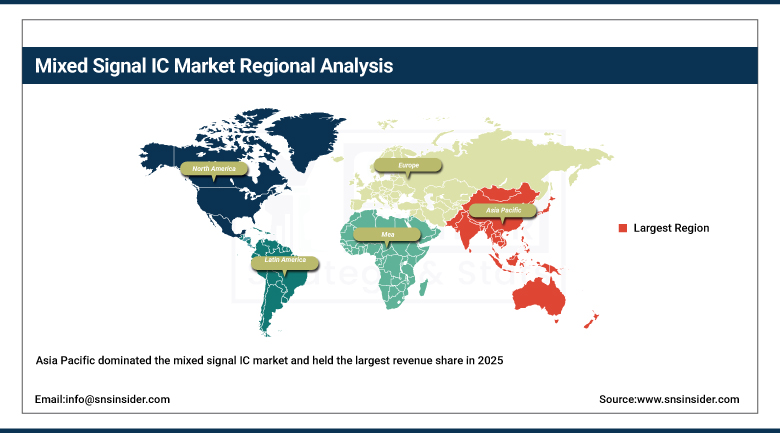
Asia Pacific dominated the mixed signal IC market and held the largest revenue share in 2025. The region's leadership in consumer electronics manufacturing, strong semiconductor foundry presence, and rising automotive electronics adoption underpin this market position. China, South Korea, Taiwan, and Japan dominate global production of smartphones, IoT devices, and automotive systems that are all heavy users of mixed signal ICs. China accounts for approximately 44.8% of Asia Pacific revenues through its extraordinary consumer electronics manufacturing scale and growing automotive electronics adoption.
India represents the most commercially dynamic emerging market within Asia Pacific where the rising demand for consumer electronics and increasing automotive applications are driving mixed signal IC procurement growth, with the country's growing semiconductor design ecosystem strengthening its commercial position across the global mixed signal IC supply chain.
Get Customized Report as per Your Business Requirement - Enquiry Now
North America Mixed Signal IC Market Insights
North America maintains a significant market share and is the home of leading global mixed signal IC vendors. The region benefits from the strong presence of major companies including Texas Instruments, Analog Devices, Broadcom, and Microchip Technology, alongside advanced technology adoption in telecommunications and automotive sectors. The United States accounts for approximately 87.4% of North American revenues through these dominant semiconductor companies whose combined platform breadth defines global mixed signal IC technology standards.
Canada contributes complementary North American revenue through its focus on niche areas like design, R&D, photonics, and AI driven semiconductors, with research hubs in Toronto, Ottawa, and Montreal specializing in intelligent sensors and AI chips for IoT and automotive applications.
Europe Mixed Signal IC Market Insights
Europe is a technically sophisticated mixed signal IC market where strong automotive manufacturing and industrial automation demand create consistent procurement. Germany accounts for approximately 22.3% of European revenues through its dominant automotive manufacturing base and strong industrial electronics sector that creates substantial mixed signal IC demand from Infineon Technologies and STMicroelectronics' domestic commercial operations.
The United Kingdom and France are significant secondary markets where telecommunications infrastructure investment and automotive manufacturing create consistent procurement. STMicroelectronics' Swiss and Italian operations and Infineon's German headquarters sustain regional commercial supply across the continent's mixed signal IC landscape.
MEA & Latin America Mixed Signal IC Market Insights
The UAE leads MEA revenues through its growing telecommunications infrastructure investment and expanding smart city technology deployment that create structured mixed signal IC procurement across industrial and consumer electronics applications. Saudi Arabia's Vision 2030 technology investment program and growing electronics manufacturing sector add substantial complementary regional demand. Brazil leads Latin American revenues through its large consumer electronics market and growing automotive manufacturing sector. Mexico's expanding electronics manufacturing sector and Argentina's growing technology adoption collectively sustain regional market development through 2035.
Market Dynamics
Growth Drivers: Smart device proliferation and automotive electronics expansion
The increasing demand for smartphones, wearables, and IoT devices is driving the need for mixed signal ICs, which are crucial for efficient signal processing. These ICs enable seamless connectivity and optimize device performance by handling both analog and digital signals. As consumers embrace smart devices more widely, mixed signal ICs ensure high speed data transmission, low power consumption, and superior functionality across applications like health monitoring, smart home automation, and communication systems. This rising adoption of interconnected technologies highlights the essential role of mixed signal ICs in supporting the growing complexity and diversity of modern, smart devices.
Growth of automotive electronics and EVs is boosting demand for mixed signal ICs in ADAS, battery management, and infotainment systems. The automotive semiconductor content per vehicle is rising rapidly as electrification and vehicle automation create structured incremental procurement that compounds with global vehicle production volume, with each new EV platform and each new autonomous driving feature set creating additional mixed signal IC bill of materials content whose aggregate commercial significance sustains the automotive segment's position as the market's fastest growing end use category.
Restraints: Design complexity and legacy system integration challenges
Designing and testing mixed signal ICs can be quite difficult because of their nature which involves integration of both analog and digital circuits into one device. Designing such a system needs skills and knowledge from both the analog circuit designing world and the digital IC designing world. It also requires sophisticated test equipment for its reliable functioning. Testing such an IC becomes quite hard because of their integration, making it hard to pinpoint any design errors.
Integrating the newly developed mixed signal ICs into the legacy system can also pose another challenge to their integration because of the incompatibility problem of these two technologies. The legacy systems are based on old technology hardware and software and cannot support the functionality of modern ICs.
Opportunities: Smart manufacturing and Industry 4.0 adoption
The growth of smart manufacturing and Industry 4.0 drives the need for mixed signal ICs, real time data processing and efficient control systems. Through integration of the IoT, cyber physical systems, and analytics, Industry 4.0 allows for the management of all manufacturing processes, ranging from optimal use of resources to reduction of downtimes and improvement of product quality. Mixed signal ICs play an important role in translating the analog signals collected by sensors to the digital format for control systems and thus facilitate monitoring and control of the machinery. The ICs are critical in automation of manufacturing processes, robot operation, and automatic maintenance system.
In the light of the emergence of smart manufacturing facilities that rely on interconnected machines and devices, the mixed signal ICs provide for proper communication and functionality of the machines in the production process. With the development and maturity of these technologies at a rapid pace, the need for mixed signal ICs that can increase manufacturing efficiencies, reduce costs, and allow manufacturing facilities to become more intelligent is growing, thus offering commercial prospects to vendors offering such solutions.
Recent Developments:
-
2024: Texas Instruments Inc. announced the launch of a new family of data converter ICs in January 2024 optimized for automotive radar applications, targeting the growing ADAS and autonomous vehicle sensor ecosystem.
-
2023: Analog Devices Inc. launched its AD9174 dual channel 16 bit digital to analog converter in 2023, targeting 5G base station infrastructure and defense radar applications requiring high speed signal generation.
-
2024: Microchip Technology Inc. expanded its mixed signal microcontroller portfolio in 2024 with new AI accelerated edge computing variants targeting industrial automation and IoT sensor node applications.
-
2023: STMicroelectronics expanded its mixed signal SoC product range in 2023 with new automotive grade ICs supporting ADAS and EV powertrain applications with enhanced functional safety compliance.
-
2024: NXP Semiconductors expanded its automotive mixed signal IC platform in 2024 with new radar and V2X communication ICs targeting advanced driver assistance and connected vehicle applications.
Mixed Signal IC Market Key Players
-
Texas Instruments Inc.
-
Analog Devices Inc.
-
Infineon Technologies AG
-
STMicroelectronics N.V.
-
NXP Semiconductors N.V.
-
Microchip Technology Inc.
-
Renesas Electronics Corporation
-
Broadcom Inc.
-
Intel Corporation
-
Qualcomm Incorporated
-
Marvell Technology Inc.
-
Silicon Laboratories Inc.
-
Cirrus Logic Inc.
-
Maxim Integrated (Analog Devices)
-
Skyworks Solutions Inc.
-
Qorvo Inc.
-
ams AG (ams-OSRAM)
-
Lattice Semiconductor Corporation
-
Semtech Corporation
-
Monolithic Power Systems Inc.
Mixed Signal IC Market Report Scope:
| Report Attributes | Details |
|---|---|
| Market Size in 2025 | USD 130.96 Billion |
| Market Size by 2035 | USD 205.24 Billion |
| CAGR | CAGR of 5.78% From 2026 to 2035 |
| Base Year | 2025 |
| Forecast Period | 2026-2035 |
| Historical Data | 2022-2024 |
| Report Scope & Coverage | Market Size, Segments Analysis, Competitive Landscape, Regional Analysis, DROC & SWOT Analysis, Forecast Outlook |
| Key Segments | • by Type (Mixed-Signal System-On-Chip, Mixed-Signal Microcontrollers, Data Converter, Others) • by End Use Industry (Consumer Electronics, Healthcare, Automotive, Telecommunication, Aerospace & Defense, Others) |
| Regional Analysis/Coverage | North America (US, Canada, Mexico), Europe (Eastern Europe [Poland, Romania, Hungary, Turkey, Rest of Eastern Europe] Western Europe] Germany, France, UK, Italy, Spain, Netherlands, Switzerland, Austria, Rest of Western Europe]), Asia Pacific (China, India, Japan, South Korea, Vietnam, Singapore, Australia, Rest of Asia Pacific), Middle East & Africa (Middle East [UAE, Egypt, Saudi Arabia, Qatar, Rest of Middle East], Africa [Nigeria, South Africa, Rest of Africa], Latin America (Brazil, Argentina, Colombia, Rest of Latin America) |
| Company Profiles | Texas Instruments Inc., Analog Devices Inc., Infineon Technologies AG, STMicroelectronics N.V., NXP Semiconductors N.V., Microchip Technology Inc., Renesas Electronics Corporation, Broadcom Inc., Intel Corporation, Qualcomm Incorporated, Marvell Technology Inc., Silicon Laboratories Inc., Cirrus Logic Inc., Maxim Integrated (Analog Devices), Skyworks Solutions Inc., Qorvo Inc., ams AG (ams-OSRAM), Lattice Semiconductor Corporation, Semtech Corporation, Monolithic Power Systems Inc. |
Frequently Asked Questions
The Mixed Signal IC Market is expected to grow at a CAGR of 5.78% from 2026 to 2035.
The Mixed Signal IC Market was valued at USD 130.96 Billion in 2025.
Rising demand for smartphones, wearables, and IoT devices driving need for efficient signal processing, and the integration of next generation technologies like 5G, IoT, and AI increasing demand for more advanced and energy efficient mixed signal ICs across consumer, automotive, and industrial applications.
The Mixed-Signal System-On-Chip segment dominated the Mixed Signal IC Market in 2025 with approximately 36.8% of total revenue, while Data Converters are gaining the fastest CAGR.
Asia Pacific dominated the Mixed Signal IC Market and held the largest revenue share in 2025, driven by its leadership in consumer electronics manufacturing, strong semiconductor foundry presence, and rising automotive electronics adoption.
