
Network on Chip Market Report Scope and Overview:
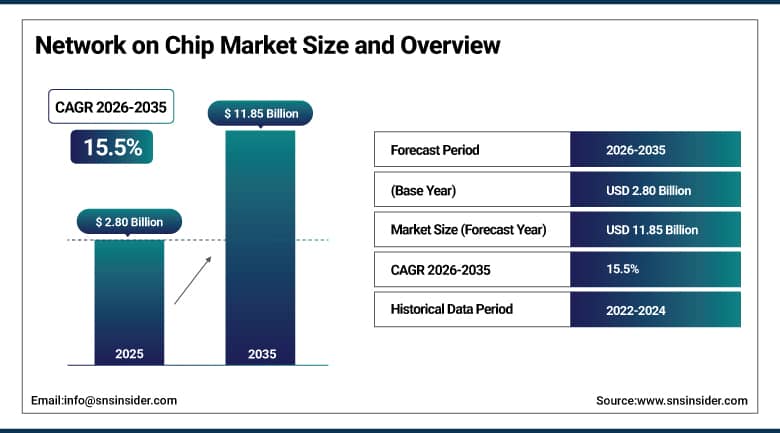
The Network on Chip Market size was valued at USD 2.80 Billion in 2025 and is projected to reach USD 11.85 Billion by 2035, registering a CAGR of 15.5% from 2026 to 2035.
The Network on Chip Market is redefining on-chip data communication by replacing traditional bus-based architectures with scalable, packet-switched interconnect fabrics for increasingly complex multi-core system-on-chip designs. The market is characterized by rising integration of heterogeneous compute elements such as CPUs, GPUs, and AI accelerators on a single die, growing adoption of licensable NoC intellectual property among fabless semiconductor companies, and expanding use of advanced 2.5D and 3D chiplet packaging techniques across the industry. Significant growth is being witnessed in AI accelerator, automotive, and data center processor design, considering that semiconductor companies and hyperscalers are investing heavily in efficient, low-latency, low-power interconnect fabrics capable of supporting increasingly dense, heterogeneous, chiplet-based system architectures at scale.
Arteris introduced its FlexNoC 5 interconnect IP platform throughout 2025, engineered to deliver higher bandwidth and lower latency on-chip communication for AI accelerator, automotive, and data center system-on-chip designs across multiple end markets.
To Get More Information On Network on Chip Market - Request Free Sample Report
Network on Chip Market Trends
-
Growing integration of heterogeneous compute elements on a single die continues driving adoption of scalable, packet-switched NoC interconnect fabrics.
-
Rising use of 2.5D and 3D chiplet packaging continues expanding demand for NoC architectures capable of managing multi-die communication.
-
Increasing adoption of licensable NoC intellectual property continues reducing design complexity for fabless semiconductor companies building custom SoCs.
-
Expanding AI accelerator and data center processor design continues pushing NoC architectures toward higher bandwidth, lower latency configurations.
-
Growing automotive adoption of advanced driver assistance systems continues broadening NoC use beyond traditional computing and mobile applications.
U.S. Network on Chip Market Size Outlook
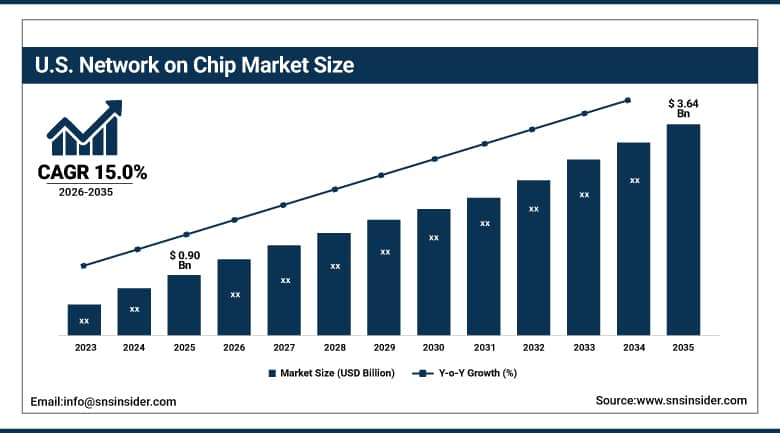
The U.S. Network on Chip Market was valued at approximately USD 0.90 Billion in 2025 and is projected to reach approximately USD 3.64 Billion by 2035, registering a CAGR of approximately 15.0% from 2026 to 2035.
Demand across the United States continued to be shaped by a deep concentration of leading semiconductor design companies, sustained hyperscaler investment in AI accelerator development, and strong domestic demand for chiplet-based, heterogeneous computing architectures. Rising deployment of licensable NoC intellectual property by domestic fabless semiconductor companies continued reinforcing the country's position as both the largest and one of the most innovation-driven markets tracked in this report. Growing adoption across data center processors, automotive electronics, and AI accelerator design added further layers of sustained domestic demand well beyond the technology's original mobile and consumer electronics use case.
Arm expanded its CoreLink interconnect IP portfolio throughout 2025 with new coherent mesh network architecture, targeting next-generation data center and automotive system-on-chip designs requiring scalable multi-core communication for U.S.-based customers.
Network on Chip Market Segment Analysis
-
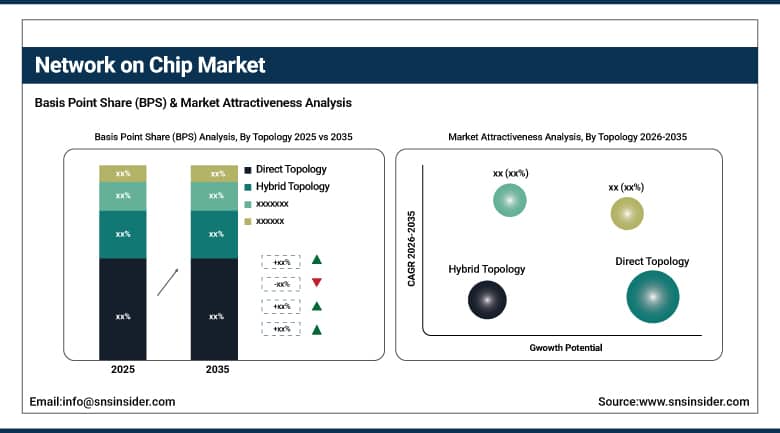
By Topology, Direct Topology dominated the Network on Chip Market with a 54.00% share in 2025, while Hybrid Topology is the fastest-growing topology segment with a CAGR of 17.20% from 2026–2035.
-
By Application, Consumer Electronics dominated the market with a 32.00% share in 2025, while Data Center & HPC is the fastest-growing application segment with a CAGR of 18.40% from 2026–2035.
-
By Offering, NoC IP (Licensable) dominated the market with a 58.00% share in 2025, while NoC Design Services is the fastest-growing offering segment with a CAGR of 16.90% from 2026–2035.
-
By End-User, Semiconductor Companies dominated the market with a 64.00% share in 2025, while Foundries are the fastest-growing end-user segment with a CAGR of 17.60% from 2026–2035.
By Topology, Direct Topology Leads While Hybrid Topology Grows Fastest
The Direct Topology segment dominated the Network on Chip Market in 2025 owing to its established maturity, predictable performance characteristics, and widespread use of mesh and torus configurations across mainstream multi-core processor designs. Chip architects favor direct topology for its simpler routing logic and proven scalability across moderate core counts common in consumer and computing applications. Continuous refinement of mesh-based routing algorithms and buffer management techniques has further strengthened direct topology’s position as the default choice across the majority of commercial SoC designs tracked in this report.
The Hybrid Topology segment is the fastest growing in the Network on Chip Market owing to rising design complexity in AI accelerator and heterogeneous computing chips that combine CPUs, GPUs, and specialized accelerators requiring varied communication patterns. Chip architects increasingly favor hybrid configurations that blend direct and indirect topology elements to optimize both latency-sensitive and bandwidth-intensive data paths. Growing adoption of chiplet-based, multi-die system architectures continues accelerating demand for hybrid topology NoC solutions capable of managing increasingly heterogeneous on-chip traffic patterns.
By Application, Consumer Electronics Dominates While Data Center & HPC Records Fastest Growth
The Consumer Electronics segment dominated the Network on Chip Market in 2025 due to sustained global demand for smartphones, tablets, and computing devices requiring multi-core system-on-chip designs with efficient internal data communication. Chip designers continue prioritizing NoC integration in consumer electronics given the segment’s scale and recurring device replacement cycles. Sustained global smartphone and computing device shipment volumes have kept this application the largest overall revenue contributor across the market.
The Data Center & HPC segment is the fastest growing in the Network on Chip Market owing to surging demand for AI accelerator, GPU, and cloud server processors requiring maximum on-chip bandwidth and minimal communication latency. Hyperscale cloud operators and chip designers increasingly demand advanced NoC architectures to support generative AI training and inference workloads. Accelerating global AI infrastructure investment continues driving sustained growth in data center and high-performance computing NoC demand.
By Offering, NoC IP Dominates While Design Services Grow Fastest
The NoC IP (Licensable) segment dominated the Network on Chip Market in 2025 due to widespread preference among fabless semiconductor companies for proven, pre-verified interconnect intellectual property over costly in-house development. Licensable IP providers continue expanding their portfolios to cover increasingly diverse topology and protocol requirements across customer designs. Sustained fabless industry growth and shrinking chip development timelines have kept licensable IP the largest overall contributor to market revenue.
The NoC Design Services segment is the fastest growing in the Network on Chip Market owing to rising demand for customized interconnect architectures tailored to increasingly specialized AI accelerator and heterogeneous computing chip designs. Semiconductor companies increasingly engage specialized design service providers to optimize NoC configurations for specific workload and power requirements. Growing chip design complexity continues accelerating demand for expert NoC design and verification services across the industry.
By End-User, Semiconductor Companies Lead While Foundries Grow Fastest
The Semiconductor Companies segment dominated the Network on Chip Market in 2025 due to sustained fabless and integrated device manufacturer demand for efficient on-chip interconnect solutions across virtually every major chip category. Semiconductor companies continue driving the majority of NoC IP licensing and design service engagements given their central role in SoC development. Continued semiconductor industry growth has kept this end-user segment the largest overall contributor to market revenue.
The Foundries segment is the fastest growing in the Network on Chip Market owing to expanding foundry involvement in advanced packaging and chiplet integration services that require sophisticated inter-die communication architectures. Growing foundry investment in 2.5D and 3D packaging capability continues driving demand for NoC expertise embedded within foundry service offerings. Rising customer interest in foundry-supported chiplet integration continues accelerating growth in this end-user category.
Regional Analysis
|
Region |
Major Country |
Share within Region, 2025 (%) |
|---|---|---|
|
North America |
United States |
87.00% |
|
Europe |
United Kingdom |
28.00% |
|
Asia Pacific |
China |
36.00% |
|
Middle East and Africa |
Israel |
31.00% |
|
Latin America |
Brazil |
33.00% |
North America Network on Chip Market Insights
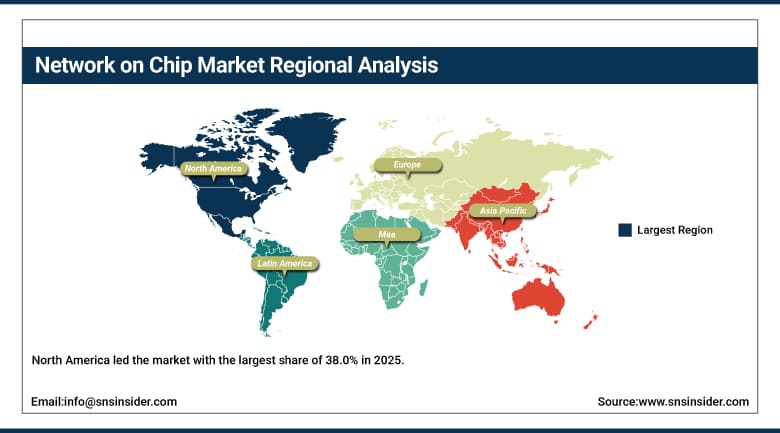
North America led the market with the largest share of 38.0% in 2025. A deep concentration of leading semiconductor design companies, sustained hyperscaler investment in AI accelerator development, and strong domestic demand for chiplet-based, heterogeneous computing architectures continued reinforcing the region’s dominant position. Growing deployment of licensable NoC intellectual property across data center, automotive, and AI accelerator design further strengthened North America’s standing as both the largest and one of the most innovation-driven markets tracked in this report, with continued hyperscaler capital expenditure expected to sustain regional demand through the forecast period.
The United States anchored by its deep concentration of fabless semiconductor design companies and substantial hyperscaler AI infrastructure investment. Canada added further regional demand through its own growing semiconductor design ecosystem, and that combined strength kept the continent the largest addressable market for NoC IP and design service vendors through the forecast period, with continued AI accelerator design activity expected to sustain regional demand well into the next decade.
Get Customized Report as Per Your Business Requirement - Enquiry Now
Europe Network on Chip Market Insights
Europe held a meaningful share of global revenue, supported by growing automotive semiconductor demand and continued expansion of domestic chip design capability across the region’s major economies. Regulatory momentum around European Chips Act-backed semiconductor investment continued shaping regional development priorities without meaningfully slowing commercialization across the continent, while sustained automotive and industrial design activity kept the region among the more resilient NoC markets tracked in this report.
The United Kingdom led demand of European revenue, supported by its substantial semiconductor IP design base including several leading interconnect and processor architecture providers. Germany and France contributed substantial additional demand, and continued European investment in automotive semiconductor design should keep regional demand for NoC technology climbing steadily through the forecast period.
Asia Pacific Network on Chip Market Insights
Asia Pacific is advancing at the fastest pace among all regions, registering a CAGR of 17.5% from 2026 to 2035, driven by rapidly expanding fabless semiconductor design activity, growing domestic foundry capacity, and sustained government-backed investment in chip design capability across the region’s largest economies. That combination of expanding design ecosystem and genuine downstream demand across smartphones, computing, and automotive electronics kept the region’s growth trajectory well ahead of every other region tracked in this report, with government semiconductor investment programs adding a further, sustained layer of demand.
China led the pack, supported by its rapidly expanding domestic fabless semiconductor design ecosystem and growing government investment in chip design capability. Taiwan and South Korea contributed meaningful additional demand, with China’s expanding fabless design sector and Taiwan’s advanced foundry capability both reinforcing the region’s position as the fastest-growing NoC market tracked in this report, while Japan and India added further steady regional contribution.
MEA and Latin America Network on Chip Market Insights
The Middle East and Africa and Latin America both showed steady growth, driven by expanding semiconductor design investment, growing government focus on technology sector diversification, and rising demand for domestic chip design capability across both regions. As these markets continued building out modern semiconductor design infrastructure, NoC technology proved a genuinely valuable enabler of increasingly capable, locally designed system-on-chip products.
Israel led Middle East and Africa demand, supported by the country’s established semiconductor design presence and substantial multinational research and development investment. Saudi Arabia contributed further demand through its own technology sector diversification initiatives. In Latin America, Brazil accounted for the largest share of regional revenue, with growing semiconductor design and technology investment continuing to anchor regional demand for NoC technology.
Market Dynamics
Growth Drivers: Rising SoC Complexity and AI Accelerator Design Investment
The industry is driven by rising integration of heterogeneous compute elements on a single die, growing adoption of licensable NoC intellectual property among fabless semiconductor companies, expanding use of advanced 2.5D and 3D chiplet packaging, and increasing demand for AI accelerator and data center processor design. As chip designs continue growing more complex while requiring lower power consumption, the need for efficient, scalable on-chip interconnect fabrics continues driving sustained adoption of NoC technology across virtually every major semiconductor end market.
Rising AI accelerator and data center processor design continues reinforcing this driver, as generative AI workloads require maximum on-chip bandwidth and minimal communication latency achievable only through advanced NoC architectures. Growing automotive demand for advanced driver assistance chipsets continues defining a further layer of sustained demand, and that combination of AI infrastructure investment and automotive semiconductor content growth is exactly what keeps overall demand climbing at such a steady, sustained pace.
Restraints: Design Complexity and Verification Cost Challenges
The substantial engineering effort and verification cost required to integrate and validate NoC architectures within increasingly complex system-on-chip designs continues posing a genuine restraint on faster market-wide expansion, particularly for smaller fabless companies without the design resources that established semiconductor companies can commit. That complexity has kept advanced NoC adoption concentrated among a comparatively small number of well-resourced chip designers.
Ongoing challenges around interoperability between NoC IP from different vendors and legacy bus-based architectures continue posing a further restraint, as chip designers face genuine integration hurdles when migrating from established interconnect approaches. Regulatory export control complexity around advanced semiconductor design tools in certain jurisdictions keeps some NoC IP licensing scenarios more administratively complicated than traditional interconnect approaches ever required.
Opportunities: Chiplet Integration and Automotive Semiconductor Expansion
Rising chiplet-based system architecture adoption represents a genuinely significant opportunity, as semiconductor companies increasingly combine multiple specialized dies to optimize cost and performance simultaneously. Vendors positioned early in inter-die and intra-die NoC technology stand to capture meaningful share as this capability continues expanding from traditional monolithic SoC designs into broader heterogeneous, multi-die system architectures.
Expanding automotive semiconductor content offers a second substantial opportunity, as vehicles increasingly integrate advanced driver assistance systems, infotainment platforms, and power electronics requiring efficient on-chip communication. Vendors with proven, automotive-qualified NoC technology stand to capture meaningful share as global vehicle electrification and autonomous driving development continues scaling across established and emerging automotive markets alike.
Recent Developments:
-
2026: Arteris announced that its Network-on-Chip technology had been deployed in more than 4 billion chips and chiplets, reflecting accelerating adoption across AI, automotive, enterprise computing, consumer electronics, and industrial applications.
-
2025: Arteris introduced FlexGen Smart NoC IP, using AI-driven design automation to accelerate complex SoC development, reduce wire length, and improve routing and power efficiency for AI, automotive, data-center, and industrial applications.
-
2024: Synopsys enhanced its DesignWare interconnect IP with added support for chiplet-based, multi-die on-chip network architectures for high-performance computing customers.
Network on Chip Companies are:
-
Arteris, Inc.
-
Synopsys, Inc.
-
Cadence Design Systems, Inc.
-
Intel Corporation
-
Qualcomm Incorporated
-
NVIDIA Corporation
-
Marvell Technology, Inc.
-
MediaTek Inc.
-
Renesas Electronics Corporation
-
Silicon Laboratories Inc.
-
Advanced Micro Devices, Inc. (AMD)
-
Achronix Semiconductor Corporation
-
SiFive, Inc.
-
Andes Technology Corporation
-
Ceva, Inc.
-
Imagination Technologies Limited
-
STMicroelectronics N.V.
-
Texas Instruments Incorporated
Network on Chip Market Report Scope:
| Report Attributes | Details |
|---|---|
| Market Size in 2025 | USD 2.80 Billion |
| Market Size by 2035 | USD 11.85 Billion |
| CAGR | CAGR of 15.5% From 2026 to 2035 |
| Base Year | 2025 |
| Forecast Period | 2026-2035 |
| Historical Data | 2022-2024 |
| Report Scope & Coverage | Market Size, Segments Analysis, Competitive Landscape, Regional Analysis, DROC & SWOT Analysis, Forecast Outlook |
| Key Segments | • By Topology (Direct Topology, Indirect Topology, Hybrid Topology) • By Application (Consumer Electronics, Automotive, Telecommunications, Data Center & HPC, Aerospace & Defense, Industrial) • By Offering (NoC IP (Licensable), NoC Design Services, EDA Tools for NoC) • By End-User (Semiconductor Companies, Foundries, System OEMs) |
| Regional Analysis/Coverage | North America (US, Canada), Europe (Germany, UK, France, Italy, Spain, Russia, Poland, Rest of Europe), Asia Pacific (China, India, Japan, South Korea, Australia, ASEAN Countries, Rest of Asia Pacific), Middle East & Africa (UAE, Saudi Arabia, Qatar, South Africa, Rest of Middle East & Africa), Latin America (Brazil, Argentina, Mexico, Colombia, Rest of Latin America). |
| Company Profiles | Arteris, Inc., Arm Limited, Synopsys, Inc., Cadence Design Systems, Inc., Intel Corporation, Qualcomm Incorporated, NVIDIA Corporation, Broadcom Inc., Marvell Technology, Inc., MediaTek Inc., Renesas Electronics Corporation, Silicon Laboratories Inc., Advanced Micro Devices, Inc. (AMD), Achronix Semiconductor Corporation, SiFive, Inc., Andes Technology Corporation, Ceva, Inc., Imagination Technologies Limited, STMicroelectronics N.V., Texas Instruments Incorporated |

Frequently Asked Questions
The major growth factor is rising integration of heterogeneous compute elements on a single die, growing AI accelerator design activity, and expanding chiplet-based system architectures.
The major growth factor is rising integration of heterogeneous compute elements on a single die, growing AI accelerator design activity, and expanding chiplet-based system architectures.
The Direct Topology segment dominated the Network on Chip Market by topology, representing the largest share of revenue in 2025.
North America dominated the Network on Chip Market in 2025, holding an estimated 38.0% share of total global market revenue.
