
Network Observability Market Report Scope & Overview:
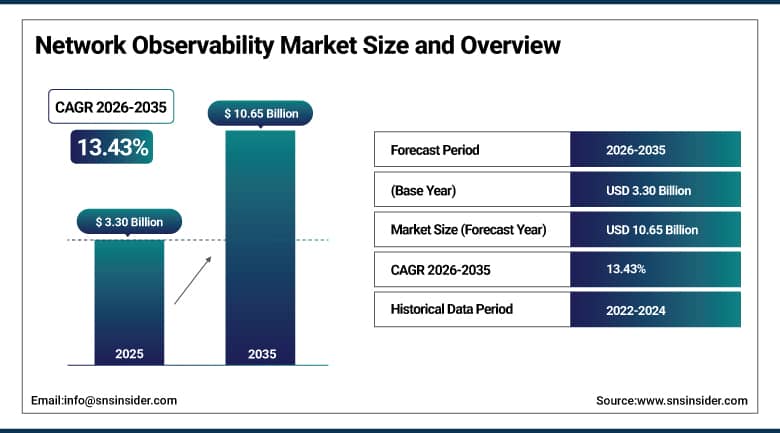
Network Observability Market was valued at USD 3.30 Billion in 2025 and is expected to reach USD 10.65 Billion by 2035, growing at a CAGR of 13.43% from 2026–2035.
The key factors contributing to the growth of the global network observability market include the increasing complexity of modern network infrastructures, rapid adoption of cloud-native architectures, and the growing need for real-time visibility across distributed IT environments. Organizations are increasingly deploying network observability solutions to improve network performance, detect anomalies proactively, and reduce downtime through advanced analytics and automation. Furthermore, the rising adoption of hybrid and multi-cloud environments, expansion of microservices and containerized applications, and increasing reliance on AI-driven monitoring and predictive analytics are accelerating market growth. The growing emphasis on cybersecurity, regulatory compliance, and seamless digital experiences, coupled with increasing investments in digital transformation and 5G-enabled networks, is further driving the adoption of network observability solutions across enterprises.
In June 2026 Cisco enhanced its Thousand Eyes platform with AI-driven network observability capabilities, enabling enterprises to gain end-to-end visibility across hybrid networks, cloud environments, and Internet-connected applications while improving proactive issue detection and root cause analysis.
Market Size and Forecast
-
Market Size 2026E: USD 3.43 Billion
-
Market Size 2035: USD 10.65 Billion
-
CAGR: 13.43% from 2026 to 2035
-
Fastest Growing Region: Asia-Pacific
-
Largest Region: North America
To Get More Information On Network Observability Market - Request Free Sample Report
Network Observability Market Trends
-
Increasing adoption of cloud-native architectures is driving demand for network observability solutions delivering real-time network visibility.
-
Rising deployment of AI-powered analytics enables network observability platforms to accelerate anomaly detection and root cause analysis.
-
Growing integration with APM, SIEM, and IT operations platforms enhances end-to-end network visibility and operational efficiency.
-
Advancements in Open Telemetry, streaming telemetry, and network analytics improve performance monitoring across distributed enterprise infrastructures.
-
Increasing adoption of multi-cloud, edge computing, and 5G drives centralized network observability for performance optimization and compliance.
U.S. Network Observability Market Outlook
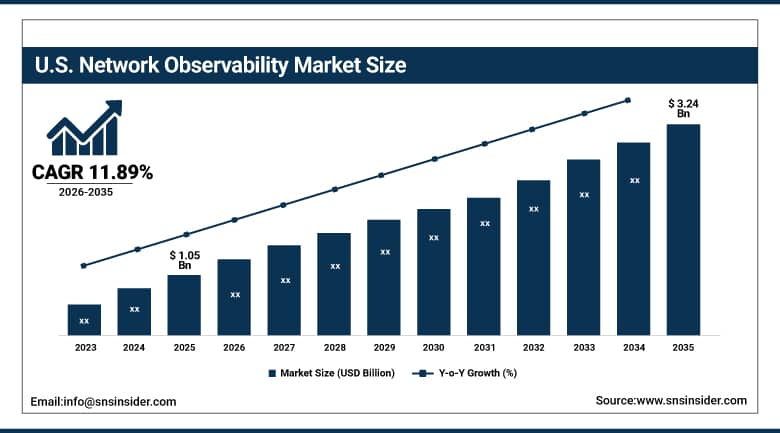
The U.S. Network Observability Market was valued at USD 1.05 Billion in 2025 and is expected to reach around USD 3.24 Billion by 2035, growing at a CAGR of 11.89% from 2026–2035.
The US market for network observability is witnessing constant growth due to the increased use of cloud-native infrastructure, hybrid IT systems, and network management software that leverages AI. Network observability tools are used by organizations in various sectors to achieve real-time insight into the performance of their networks and ensure maximum availability of services offered through the networks. Network observability technologies have become an important tool to enhance operational efficiency, speed up root cause analysis, enhance cybersecurity, and reduce network downtime. Furthermore, investments in automation, integration with AIOps, APM tools, and improvements in telemetry, open telemetry, and predictive analytics are also contributing to market growth.
In February 2026: Island announced the integration of its Enterprise Browser with AWS Security Hub Extended in the United States, enabling organizations to strengthen browser-native security, enhance AI governance, improve centralized threat management, and simplify enterprise cybersecurity deployment across distributed IT environments.
Network Observability Market Segment Analysis
-
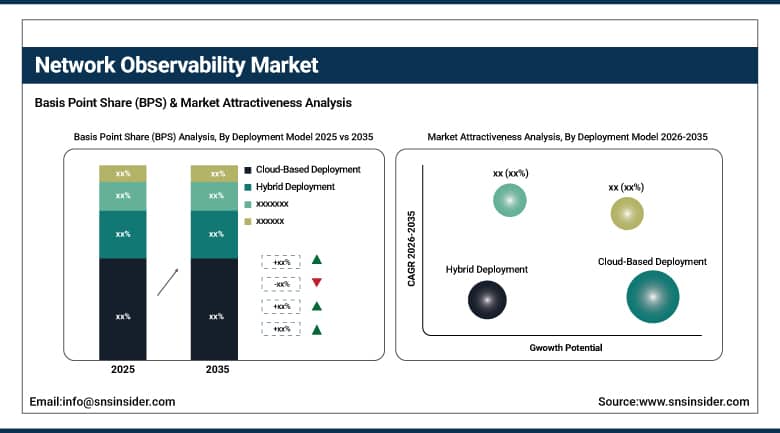
By Deployment Model, cloud-based deployment dominated the network observability market with a 69.20% share in 2025, while hybrid deployment is projected to be the fastest-growing segment, registering a CAGR of 17.90% during 2026–2035.
-
By Offering Type, observability platforms and software dominated the network observability market with a 72.40% share in 2025, while observability services is projected to be the fastest-growing segment, registering a CAGR of 13.61% during 2026–2035.
-
By Data Type Observed, infrastructure and machine data dominated the network observability market with a 35.80% share in 2025, while application telemetry data is projected to be the fastest-growing segment, registering a CAGR of 15.68% during 2026–2035.
-
By Application, application performance monitoring dominated the network observability market with a 38.60% share in 2025, while network observability is projected to be the fastest-growing segment, registering a CAGR of 17.32% during 2026–2035.
-
By Industry Vertical, information technology and telecommunications dominated the network observability market with a 29.80% share in 2025, while healthcare and life sciences is projected to be the fastest-growing segment, registering a CAGR of 16.51% during 2026–2035.
By Deployment Mode, cloud-based deployment dominated the network observability market, while the hybrid deployment segment is expected to grow fastest.
In 2025, the cloud-based deployment type dominated the network observability market owing to its scalable nature, centralized management, low deployment costs, and ability to monitor cloud and hybrid environments without any difficulty. Companies opted for cloud-based network observability systems in order to have access to real-time analysis of their networks, automation capabilities, multi-cloud infrastructure support, and AI-powered monitoring services, thus making this deployment type the most popular one on the market.
The hybrid deployment segment is expected to register the highest compound annual growth rate during the forecast period thanks to growing adoption of hybrid IT infrastructures that include both on-premise and cloud deployments. Enterprises need to ensure network visibility, secure data management, and flexible deployment solutions at the same time. Growing investments in hybrid cloud, digital transformation initiatives, and network analytics will fuel the segment's growth until 2035.
By offering type, observability platforms and software dominated the network observability market, while the observability services segment is expected to grow fastest
The observability platforms and software segment held the largest market share in 2025 because of the rise in the use of unified observability platforms that monitor application, infrastructure, and network performance in hybrid and cloud-based settings. Demand for real-time analysis of telemetry, AI-driven monitoring, and overall visibility of complicated IT environments will further consolidate the dominance of the segment.
The observability services segment is projected to be the fastest-growing segment throughout the forecast period because of growing demand for consulting, deployment, integration, managed services, and continuous optimization of the platforms. Organizations now more frequently use service providers to implement their observability strategies and optimize their telemetry pipelines and comply with regulations.
By Industry Vertical, information technology and telecommunications dominated the network observability market, while the healthcare and life sciences segment is expected to grow fastest
In 2025, the information technology and telecommunications segment held the biggest market share, owing to the wide use of cloud-native infrastructure, distributed networks, and digital transformation programs that need constant monitoring of network performance. Network observability tools are used by businesses operating within the segment to enhance the performance of the network, identify anomalies in real-time, increase reliability of the services, and address complexities involved in hybrid and multi-cloud environment.
The healthcare and life sciences segment is likely to register highest growth rate in terms of revenue generation over the forecast period, owing to the rise in digitization of healthcare services, proliferation of connected medical devices, and adoption of cloud-based healthcare applications. Healthcare organizations are implementing network observability tools to maintain uninterrupted performance of the network.
Regional Insights
|
Region |
Major Country |
Share within Region, 2025(%) |
|---|---|---|
|
North America |
United States |
79.95% |
|
Europe |
Germany |
21.50% |
|
Asia Pacific |
China |
42.80% |
|
Middle East & Africa |
Saudi Arabia |
29.50% |
|
Latin America |
Brazil |
38.50% |
North America Network Observability Market Insights
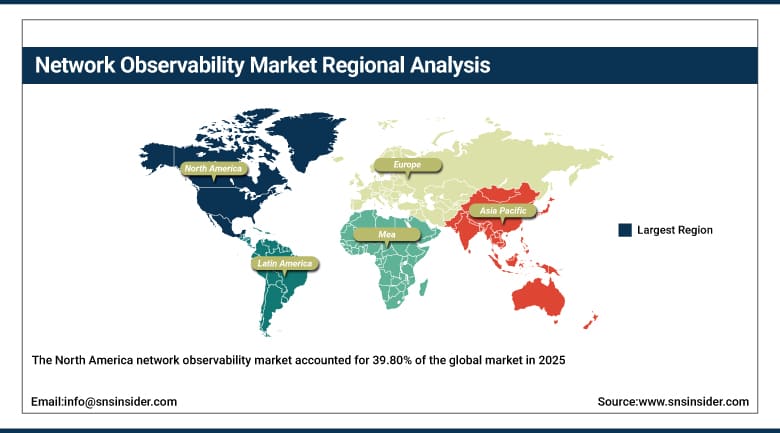
The North America network observability market accounted for 39.80% of the global market in 2025, driven by widespread adoption of cloud computing, hybrid IT infrastructure, artificial intelligence, and advanced network monitoring solutions. Furthermore, the United States accounted for 79.95% of the North America network observability market in 2025, supported by the strong presence of leading technology companies, large-scale enterprise digital transformation, and early adoption of cloud-native networking technologies.
Growing adoption of hybrid and multi-cloud environments, increasing demand for real-time network visibility, rising concerns over cybersecurity threats, and expanding investments in AI-powered network monitoring are driving market growth across the region. In addition, increasing deployment of 5G networks, software-defined networking (SDN), AIOps platforms, and cloud-native applications is accelerating the adoption of network observability solutions, supporting continued market growth in the United States and across North America.
Get Customized Report as Per Your Business Requirement - Enquiry Now
Europe Network Observability Market Insights
Europe remains a key region in the network observability market due to its advanced digital infrastructure, widespread cloud adoption, and strong focus on cybersecurity, network resilience, and regulatory compliance. Germany accounted for 21.50% of the Europe network observability market in 2025, supported by its robust industrial base, high adoption of Industry 4.0 technologies, and increasing deployment of cloud-native and hybrid IT environments.
The growth of the network observability market in Europe is driven by rising demand for real-time network visibility, increasing adoption of hybrid and multi-cloud infrastructure, and growing investments in AI-powered monitoring and automation solutions. Furthermore, expanding 5G deployments, digital transformation initiatives, and the adoption of network observability platforms across manufacturing, BFSI, healthcare, telecommunications, and government sectors are expected to support sustained market growth over the forecast period.
Asia Pacific Network Observability Market Insights
The Asia-Pacific network observability market is expected to register the highest CAGR during the forecast period, driven by rapid digital transformation, expanding cloud infrastructure, and increasing adoption of hybrid and multi-cloud networking environments. Enterprises across the region are investing in AI-powered network observability platforms, real-time network analytics, and automated monitoring solutions to improve network performance, strengthen cybersecurity, and ensure uninterrupted digital operations. China accounted for 42.80% of the Asia-Pacific network observability market in 2025, supported by its large enterprise base, rapid expansion of cloud data centres, and significant investments in digital infrastructure and next-generation networking technologies.
Growing deployment of 5G networks, increasing adoption of software-defined networking (SDN), rising investments in smart manufacturing, and government initiatives supporting digital transformation are creating significant growth opportunities across the region. Furthermore, expanding use of cloud-native applications, edge computing, Internet of Things (IoT), and AI-driven network management solutions is expected to accelerate the adoption of network observability platforms throughout the forecast period.
Middle East & Africa and Latin America Insights
Middle East & Africa and Latin America are emerging markets for the network observability market, driven by accelerating digital transformation, expanding cloud adoption, and increasing investments in modern network infrastructure across both regions. Organizations are deploying network observability platforms to gain real-time visibility into hybrid and multi-cloud environments, optimize network performance, strengthen cybersecurity, and ensure uninterrupted digital services. Saudi Arabia accounted for 29.50% of the Middle East & Africa network observability market in 2025, supported by national digital transformation initiatives and growing investments in cloud infrastructure, while Brazil represented 38.50% of the Latin America network observability market due to its expanding enterprise IT ecosystem and increasing adoption of cloud and AI-driven network management solutions.
Growing investments in 5G deployment, software-defined networking (SDN), edge computing, and digital infrastructure modernization are creating significant growth opportunities across both regions. In addition, rising demand for AI-powered network analytics, increasing adoption of hybrid IT environments, and the need for proactive network monitoring and cybersecurity are expected to support steady growth of the network observability market throughout the forecast period.
Growth Driver: Rising adoption of hybrid and multi-cloud infrastructure driving demand for real-time network observability solutions
The growing adoption of hybrid and multi-cloud infrastructure has become a key factor driving the demand for network observability solutions across enterprises. Organizations are increasingly deploying network observability platforms to gain real-time visibility into complex network environments, optimize application performance, detect anomalies proactively, and ensure reliable digital operations. The rapid expansion of cloud-native applications, distributed networks, and remote connectivity is further accelerating market growth.
The increasing implementation of artificial intelligence-driven network analytics, rising demand for automated network monitoring, and continuous growth of software-defined networking (SDN) and 5G infrastructure are further supporting the network observability market. Additionally, growing investments in digital transformation, expanding edge computing deployments, and increasing emphasis on cybersecurity, operational resilience, and uninterrupted network performance are expected to drive sustained market growth over the forecast period.
Restraints: High implementation costs, integration complexity, and compatibility challenges with legacy network infrastructure may restrain network observability market growth
High implementation costs and integration complexity remain major challenges for the network observability market. Deploying network observability platforms often requires significant investments in monitoring infrastructure, telemetry collection, analytics platforms, and skilled personnel, making adoption costly for small and medium-sized enterprises. In addition, compatibility issues with legacy network infrastructure, proprietary systems, and heterogeneous IT environments can delay implementation and increase deployment complexity.
Furthermore, organizations must address challenges related to processing large volumes of telemetry data, integrating multiple monitoring tools, and maintaining visibility across hybrid and multi-cloud environments while complying with evolving cybersecurity and data governance requirements. The availability of alternative network monitoring and performance management solutions, along with concerns over operational complexity and return on investment, may further restrain the growth of the network observability market during the forecast period.
Opportunities: Growing adoption of hybrid and multi-cloud infrastructure, AI-powered network analytics, and automated network observability solutions
The increasing adoption of hybrid and multi-cloud infrastructure presents significant growth opportunities for the network observability market. Organizations are deploying advanced network observability platforms to gain real-time visibility into distributed networks, optimize application performance, strengthen cybersecurity, and ensure uninterrupted digital operations. Continuous advancements in artificial intelligence, machine learning, automated root cause analysis, and predictive network analytics are further expanding the capabilities of network observability solutions.
In addition, rising investments in digital transformation, expanding deployment of 5G networks, edge computing, and software-defined networking (SDN) are creating new opportunities for market participants. Growing demand for unified observability across cloud, on-premise, and hybrid environments, increasing adoption of AIOps platforms, and continuous innovation in real-time network analytics are expected to support the long-term growth of the network observability market.
Recent Developments
-
2026: Cisco enhanced its ThousandEyes platform with AI-powered network observability capabilities, improving end-to-end visibility across hybrid, cloud, and Internet-connected networks.
-
2025: Datadog expanded its Network Performance Monitoring platform with AI-driven root cause analysis and enhanced network flow visibility for hybrid cloud environments
-
2025: Dynatrace introduced advanced AI-powered network observability features, enabling automated anomaly detection and real-time dependency mapping across distributed applications.
-
2024: IBM strengthened its Instana Observability platform with enhanced network monitoring and OpenTelemetry support to improve visibility across cloud-native and hybrid infrastructures.
Network Observability Market Key Players
-
Island Technology Inc.
-
Talon Cyber Security
-
Palo Alto Networks, Inc.
-
Microsoft Corporation
-
Google LLC
-
Cisco Systems, Inc.
-
Menlo Security, Inc.
-
Netskope, Inc.
-
Cloudflare, Inc.
-
Broadcom Inc. (Symantec)
-
Zscaler, Inc.
-
Forcepoint LLC
-
BlackBerry Limited
-
HP Inc.
-
IBM Corporation
-
Red Access GmbH
-
Seraphic Security
-
Opera Limited.
Network Observability Market Report Scope:
| Report Attributes | Details |
|---|---|
| Market Size in 2025 | USD 3.30 Billion |
| Market Size by 2035 | USD 10.65 Billion |
| CAGR | CAGR of 13.43% From 2026 to 2035 |
| Base Year | 2025 |
| Forecast Period | 2026-2035 |
| Historical Data | 2022-2024 |
| Report Scope & Coverage | Market Size, Segments Analysis, Competitive Landscape, Regional Analysis, DROC & SWOT Analysis, Forecast Outlook |
| Key Segments | • By Offering Type (Observability Platforms and Software, Observability Services) • By Deployment Model (Cloud-Based Deployment, Hybrid Deployment, On-Premise Deployment) • By Data Type Observed (Infrastructure and Machine Data, Application Telemetry Data, Network Flow and Traffic Data, End-User Experience Data) • By Application (Application Performance Monitoring, Infrastructure and Server Monitoring, Network Observability, Security and Compliance Monitoring, Business Transaction Monitoring) • By Industry Vertical (Information Technology and Telecommunications, Banking Financial Services and Insurance, Healthcare and Life Sciences, Manufacturing and Industrial Operations, Retail and Ecommerce) |
| Regional Analysis/Coverage | North America (US, Canada, Mexico), Europe (Germany, France, UK, Italy, Spain, Poland, Russia, Rest of Europe]), Asia Pacific (China, India, Japan, South Korea, Australia, ASEAN Countries, Rest of Asia Pacific), Middle East & Africa UAE, Saudi Arabia, Qatar, South Africa, Rest of Middle East & Africa], Latin America (Brazil, Argentina, Colombia, Rest of Latin America) |
| Company Profiles | Island Technology Inc., Talon Cyber Security, Palo Alto Networks, Inc., Citrix Systems, Inc., Microsoft Corporation, Google LLC, Cisco Systems, Inc., Menlo Security, Inc., Netskope, Inc., Cloudflare, Inc., Proofpoint, Inc., Broadcom Inc. (Symantec), Zscaler, Inc., Forcepoint LLC, BlackBerry Limited, HP Inc., IBM Corporation, Red Access GmbH, Seraphic Security, Opera Limited. |

Frequently Asked Questions
The network observability market was valued at USD 3.03 billion in 2025.
The Observability Platforms and Software segment dominated the market in 2025 with a 72.40% share.
North America dominated the network observability market in 2025 with a 39.80% share.
