
Non-Phthalate Plasticizers Market Report Scope & Overview:
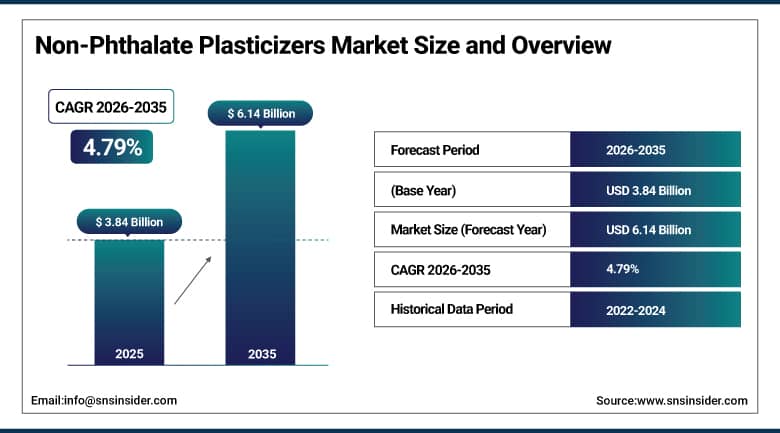
The Non-Phthalate Plasticizers Market size was USD 3.84 Billion in 2025 and is expected to reach USD 6.14 Billion by 2035, growing at a CAGR of 4.79% from 2026–2035.
The non-phthalate plasticizers market is growing steadily owing to increasing regulations against the conventional phthalate plasticizers and increasing preference for safe and eco-friendly alternatives. Health concerns related to phthalates have resulted in manufacturers replacing their conventional plasticizers with non-phthalates for use in flooring, wall coverings, wires and cables, consumer goods, and medical applications. Growth of the construction and automotive industries is adding to the demand for flexible PVC with non-phthalate plasticizers. Product innovation and performance, in addition to sustainability initiatives, are driving the market growth.
Backed by this trend, the European Chemicals Agency has added 14 phthalates to the REACH Authorisation List, and other phthalates such as DEHP, DBP, BBP, and DIBP have been regulated across various consumer and industrial end-use products, resulting in rapid replacement of phthalates with their alternatives. In addition, the consumption of plasticizers in Mainland China makes up for more than 50% of global consumption. In addition, South and Southeast Asia remain among the fastest growing consumption markets owing to rapid urbanization and infrastructural developments.
To Get More Information On Non-Phthalate Plasticizers Market - Request Free Sample Report
Non-Phthalate Plasticizers Market Trends
- Increasing regulatory restrictions on phthalate plasticizers driving the adoption of safer non-phthalate alternatives across consumer products and industrial applications.
- Growing demand from the construction industry for flexible PVC products such as flooring, roofing membranes, cables, and pipes using non-phthalate plasticizers.
- Rising adoption in medical devices and healthcare products due to stringent safety requirements and increasing preference for low-toxicity materials.
- Expanding use in automotive and electrical & electronics industries to meet sustainability goals while maintaining material flexibility, durability, and performance.
- Continuous development of bio-based and high-performance non-phthalate plasticizers offering improved environmental profiles, enhanced compatibility, and compliance with global environmental regulations.
The U.S. Non-Phthalate Plasticizers Market Outlook
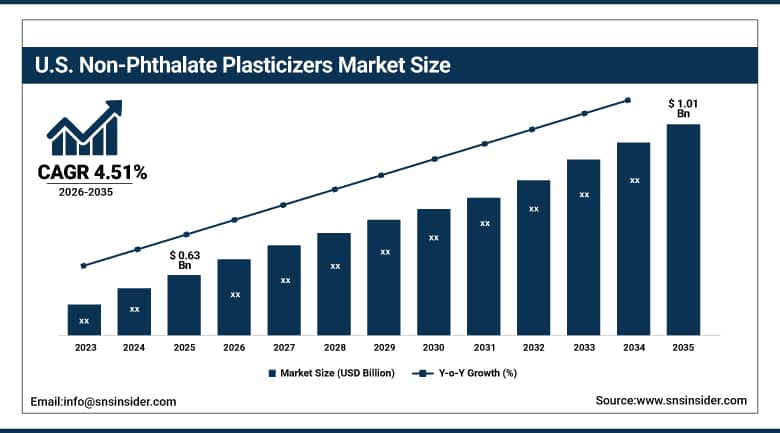
The U.S. Non-Phthalate Plasticizers Market is estimated at approximately USD 0.63 Billion in 2025. It is expected to reach approximately USD 1.01 Billion by 2035, at a CAGR of around 4.51%.
The United States holds a leading position in the North American non-phthalate plasticizers market due to its well-established manufacturing base, significant demand from end-use industries, and increasing regulatory measures aimed at reducing phthalate use. The U.S. government has implemented strict regulations through the Toxic Substances Control Act (TSCA), driving industries to switch to non-phthalate alternatives to comply with safety standards. Key market players including BASF, Eastman Chemical, and ExxonMobil Chemical have significant domestic presence. Growing consumer awareness about health risks associated with phthalates keeps reinforcing demand for non-toxic alternatives in construction, automotive, and consumer goods.
In January 2024, Perstorp introduced Pevalen Pro 100, a non-phthalate plasticizer derived from 100% renewable carbon using mass balance principles. This innovation lowers the carbon footprint by around 80% compared to fossil-based alternatives, improving the environmental profile of flexible PVC applications while maintaining high performance. In March 2023, BASF launched Ecoflex EL 1165, a non-phthalate plasticizer with low odor and migration properties, ideal for food packaging, toys, and medical devices.
Non-Phthalate Plasticizers Market Segment Analysis
-
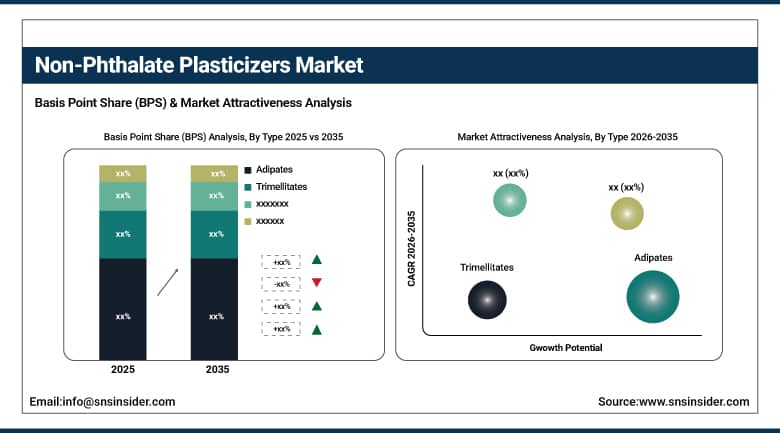
By Type, adipates segment dominated the non-phthalate plasticizers market in 2025 with 39% share; Trimellitates segment is the fastest growing segment.
-
By Application, flooring & wall coverings segment dominated the market in 2025 with 33% share; Wires & Cables segment is the fastest growing segment.
By Type, adipates segment dominates the non-phthalate plasticizers market, trimellitates segment expected to grow fastest
Adipates formed the largest segment in the non-phthalate plasticizers market owing to their superior flexibility, low temperature properties, and compatibility with numerous types of polymers. They are widely used in applications where strength, softness, and improved processability are required. The advantage that they possess when compared with other phthalates in terms of safety has led to greater usage of adipates in consumer goods, medical applications, and construction products. Moreover, the trend towards safe and environmentally benign additives has bolstered the demand and maintained the dominance of the segment in the market.
Trimellitates constituted the fastest growing segment due to the rising need for superior plasticizers that can withstand high temperatures and difficult conditions of operation. The chemicals display high thermal stability, low volatility, and longevity, which enables them to be employed in tough industrial and electrical applications. Growing application of Trimellitates in automotive and electronic equipment as well as cable production is further boosting their market share.
By Application, flooring & wall coverings segment dominates the non-phthalate plasticizers market, wires & cables segment expected to grow fastest
The Flooring & Wall Coverings segment dominated the Non-phthalate Plasticizers Market due to extensive use of flexible PVC materials in residential, commercial, and industrial construction projects. Non-phthalate plasticizers improve flexibility, durability, and product lifespan while meeting evolving environmental and safety standards. Growing urbanization, infrastructure development, and renovation activities have significantly increased demand for high-quality flooring and wall covering solutions. Additionally, rising consumer preference for sustainable building materials has further strengthened the adoption of non-phthalate plasticizers in this application segment.
The Wires & Cables segment is the fastest growing due to increasing investments in power transmission, telecommunications infrastructure, renewable energy projects, and industrial automation systems. Non-phthalate plasticizers are widely used to enhance flexibility, insulation performance, and durability of cable materials while meeting stringent environmental regulations. Growing electrification initiatives, expansion of data networks, and rising demand for high-performance electrical components are accelerating adoption. Continuous advancements in cable technology and increasing focus on safety standards further support rapid segment growth.
Regional Analysis
|
Region |
Major Country |
Share within Region, 2025 (%) |
|---|---|---|
|
North America |
United States |
82.5% |
|
Europe |
Germany |
24.6% |
|
Asia Pacific |
China |
40.6% |
|
Middle East & Africa |
UAE |
22.8% |
|
Latin America |
Brazil |
43.8% |
Asia Pacific Non-Phthalate Plasticizers Market Insights
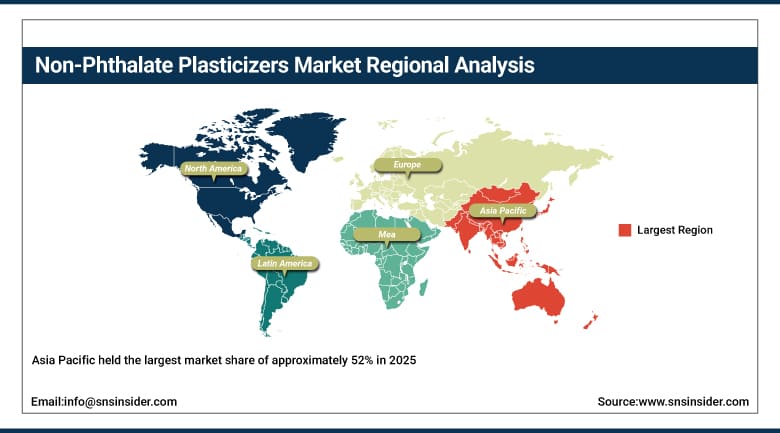
Asia Pacific held the largest market share of approximately 52% in 2025 and is also the fastest-growing regional market for non-phthalate plasticizers. Favorable industrial growth, expansion of manufacturing base, and an increasing number of end-user industries searching for safer substitutes drive this dual leadership. China and India are among the largest plastic manufacturing regions globally and are substantial growth drivers for automotive, construction, and consumer goods industries where non-phthalate plasticizers are used.
China accounts for approximately 40.6% of Asia Pacific revenue. Growing domestic regulatory enforcement of phthalate restrictions is accelerating substitution toward DOTP and other non-phthalate alternatives. As Asia Pacific's manufacturing base keeps expanding and health regulations keep strengthening, this dual leadership in size and growth should continue.
Get Customized Report as Per Your Business Requirement - Enquiry Now
North America Non-Phthalate Plasticizers Market Insights
North America held a significant market share in 2025. Stringent regulatory standards and a rising demand for environment-friendly products drive this regional position. The EPA has continuously put stringent restrictions on phthalates, and North America has been among the forefront of environmental awareness and TSCA enforcement. Manufacturers have been transitioning to non-toxic, safer substitutes including non-phthalate plasticizers across construction, automotive, and consumer goods.
The United States accounts for approximately 82.5% of North American revenue. High consumer health-consciousness and regulatory compliance requirements keep reinforcing domestic non-phthalate plasticizer adoption. Strong investment in sustainable packaging and eco-friendly consumer goods by major U.S. brands also supports non-phthalate market growth. The growing adoption of electric vehicles is additionally creating new demand for high-performance, phthalate-free wire and cable insulation. This combination of regulatory pressure, sustainability goals, and consumer awareness keeps North America a key regional market.
Europe Non-Phthalate Plasticizers Market Insights
Europe represents a meaningful non-phthalate plasticizers market, shaped by REACH regulations that have restricted multiple phthalate plasticizers including DEHP, DBP, and BBP in consumer articles. Germany leads the regional market, backed by strong chemical manufacturing and consumer goods production. France and the UK contribute meaningful demand through their own expanding regulatory compliance needs.
Germany accounts for approximately 24.6% of European revenue. EU SVHC (Substance of Very High Concern) restrictions on phthalates continue driving substitution across all major application categories. Growing European demand for REACH-compliant, certified non-phthalate alternatives is creating meaningful market expansion for producers that can supply with appropriate regulatory documentation. This regulatory environment should keep reinforcing strong European demand for certified non-phthalate alternatives.
MEA & Latin America Non-Phthalate Plasticizers Market Insights
The UAE leads MEA revenue at approximately 22.8%. Growing construction and consumer goods manufacturing both support regional non-phthalate plasticizer demand. Saudi Arabia is also expanding its chemical and plastics manufacturing capacity.
Brazil leads Latin American revenue at approximately 43.8%. Expanding automotive, construction, and consumer goods manufacturing all drive regional demand. Mexico and Argentina contribute secondary demand through their own growing plastics manufacturing sectors.
Market Dynamics
Growth Drivers: Growing awareness of health and environmental risks driving non-phthalate demand
The increasing concern about health risks associated with phthalates including endocrine disruption, reproductive problems, and carcinogenicity has greatly helped increase the demand for non-phthalate plasticizers. The use of phthalates in plastic for flexibility has resulted in adverse impacts that have led to consumers, regulatory authorities, and manufacturers raising alarms. Regulatory measures are being implemented or proposed by governmental organizations all over the world to regulate the use of phthalates in consumer goods, especially toys, medical equipment, and food packaging.
There is an increasing trend in the search for safer substitutes in sectors with high volume plastics including automotive, construction, medical, and consumer goods. Consumers and companies can satisfy the regulatory requirements by using non-phthalate plasticizers which are becoming the choice alternative in such a case. REACH authorization for DEHP and SVHC phthalates in Europe will continue to provide near term regulatory impetus for substitution. This should continue to be a significant driver of the forecast period as awareness and regulation pressures increase around the world.
Restraints: Higher production costs limiting competitiveness vs. traditional phthalates
One of the key concerns is that non-phthalate substitutes are relatively more expensive to produce than traditional phthalates. Non-phthalate plasticizers need specific materials and a more complicated manufacturing process than the traditional ones; therefore, they are relatively expensive for manufacturers. This makes the non-phthalate substitutes less appealing in price-sensitive markets such as low-cost consumer products.
For this reason, some sectors may be inclined to use phthalates because of their lower cost and delay the penetration of alternative options in the market. In other words, until the production scale increases and raw material prices get normalized, the additional cost of non-phthalate substitutes remains an important barrier in the market.
Opportunities: Increasing regulatory support and consumer demand creating market opportunities
Increasing regulatory support and rising consumer demand for safer and eco-friendly products are creating significant growth opportunities. Governments in the U.S. and Europe are strengthening regulations to limit harmful chemicals including phthalates in consumer products. This regulatory environment has encouraged manufacturers to seek safer alternatives, creating strong market opportunity.
Consumer preferences are shifting toward non-toxic and environmentally friendly products, leading to increased adoption of non-phthalate alternatives. Bio-based non-phthalate plasticizers derived from renewable feedstocks represent a particularly attractive opportunity in premium applications. The growing circular economy push is also incentivizing manufacturers to develop non-phthalate plasticizers that improve end-of-life recyclability of PVC products. As regulatory pressure and consumer awareness keep intensifying, this opportunity should keep expanding through the forecast period.
Recent Developments:
-
2024: Perstorp introduced Pevalen Pro 100 in January 2024, a non-phthalate plasticizer derived from 100% renewable carbon using mass balance principles, lowering carbon footprint by approximately 80% versus fossil-based alternatives.
-
2023: BASF launched Ecoflex EL 1165 in March 2023, a non-phthalate plasticizer with low odor and migration properties ideal for food packaging, toys, and medical devices.
-
2024: Evonik Industries expanded its ELATUR CH non-phthalate plasticizer for specialty medical device and food packaging applications, responding to growing REACH regulation compliance demand from European manufacturers.
Non-Phthalate Plasticizers Market Key Players are:
-
BASF SE
-
Eastman Chemical Company
-
Evonik Industries AG
-
LG Chem
-
ExxonMobil Chemical
-
UPC Technology Corporation
-
Shandong Hongxin Chemical Co., Ltd.
-
Nan Ya Plastics Corporation
-
KLJ Group
-
Perstorp Holding AB
-
Adeka Corporation
-
Bluesail Chemical Group
-
Valtris Specialty Chemicals
-
Deza a.s.
-
Polynt Group
-
Hanwha Solutions
-
Indo Nippon Chemical Co., Ltd.
-
Mitsubishi Chemical Corporation
-
Vertellus Holdings LLC
-
Oxea GmbH
Non-Phthalate Plasticizers Market Report Scope:
| Report Attributes | Details |
|---|---|
| Market Size in 2025 | USD 3.84 Billion |
| Market Size by 2035 | USD 6.14 Billion |
| CAGR | CAGR of 4.79% From 2026 to 2035 |
| Base Year | 2025 |
| Forecast Period | 2026-2035 |
| Historical Data | 2022-2024 |
| Report Scope & Coverage | Market Size, Segments Analysis, Competitive Landscape, Regional Analysis, DROC & SWOT Analysis, Forecast Outlook |
| Key Segments | • By Type (Adipates, Trimellitates, Benzoates, Epoxies, Others) • By Application (Flooring & Wall Coverings, Wires & Cables, Films & Sheets, Coated Fabrics, Consumer Goods, Others) |
| Regional Analysis/Coverage | North America (US, Canada), Europe (Germany, UK, France, Italy, Spain, Russia, Poland, Rest of Europe), Asia Pacific (China, India, Japan, South Korea, Australia, ASEAN Countries, Rest of Asia Pacific), Middle East & Africa (UAE, Saudi Arabia, Qatar, South Africa, Rest of Middle East & Africa), Latin America (Brazil, Argentina, Mexico, Colombia, Rest of Latin America). |
| Company Profiles | BASF SE, Eastman Chemical Company, Evonik Industries AG, LG Chem, ExxonMobil Chemical, UPC Technology Corporation, Shandong Hongxin Chemical Co., Ltd., Nan Ya Plastics Corporation, KLJ Group, Perstorp Holding AB, Adeka Corporation, Bluesail Chemical Group, Valtris Specialty Chemicals, Deza a.s., Polynt Group, Hanwha Solutions, Indo Nippon Chemical Co., Ltd., Mitsubishi Chemical Corporation, Vertellus Holdings LLC, and Oxea GmbH |

Frequently Asked Questions
The Non-Phthalate Plasticizers Market was valued at USD 3.84 Billion in 2025.
The Non-Phthalate Plasticizers Market is expected to grow at a CAGR of 4.79% from 2026 to 2035.
Growing awareness of phthalate health and environmental risks, tightening global regulations, and rising consumer demand for non-toxic products are the primary growth factors.
The Adipates segment dominated the Non-Phthalate Plasticizers Market.
Asia Pacific dominated the Non-Phthalate Plasticizers Market.
