
Smart Flooring Market Report Scope and Overview:
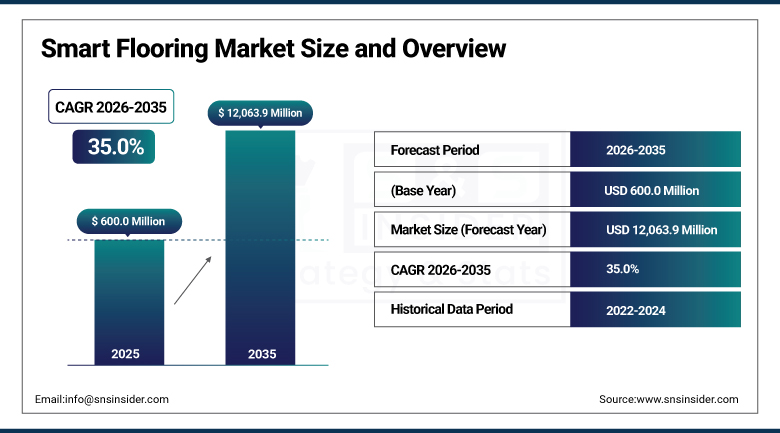
The Smart Flooring Market size was valued at USD 600.0 Million in 2025 and is projected to reach USD 12,063.9 Million by 2035, registering a CAGR of 35.0% from 2026 to 2035.
Smart, or intelligent, flooring integrates pressure sensors, LED modules, wireless communication chips, and energy-harvesting materials into flooring structures for intelligent monitoring and interactive applications, deployable as an integrated sensor and microelectronics underlay beneath carpet, PVC, laminate, or other conventional flooring surfaces. Market estimates for this category vary considerably across independent research sources, reflecting genuinely different scope boundaries different firms apply, ranging from niche high-technology sensor-embedded flooring specifically to a broader category including basic connected and heated flooring systems. This momentum stems from sharp declines in IoT sensor prices, government-backed green-building mandates, and the post-pandemic shift toward touch-free occupancy analytics, as corporates increasingly value granular foot-traffic data that feeds directly into HVAC optimization and real-time space-management dashboards.
More than 42% of newly developed smart commercial buildings in 2025 incorporated sensor-enabled flooring systems for occupancy tracking and energy optimization, reflecting how quickly the technology has moved from experimental pilot deployment into standard specification for new commercial construction seeking genuinely data-driven building management capability.
To Get more information On Smart Flooring Market - Request Free Sample Report
Smart Flooring Market Trends
-
Innovations combining kinetic and solar energy continue maximizing power generation and sustainability, with modern tiles capturing footsteps while integrating solar cells for continuous energy production.
-
Growing integration of artificial intelligence and IoT continues enabling predictive maintenance, automation, and real-time occupancy tracking across commercial building deployments.
-
Rising adoption of fall detection and sensor-based healthcare monitoring continues expanding smart flooring applications across hospitals and senior care facilities.
-
Cloud-based flooring management platforms and wireless monitoring technologies continue receiving extensive commercial deployment investment.
-
Advancements in antimicrobial coatings, recyclable flooring materials, and predictive maintenance software continue supporting broader connected building ecosystem integration.
US Smart Flooring Market Size Outlook
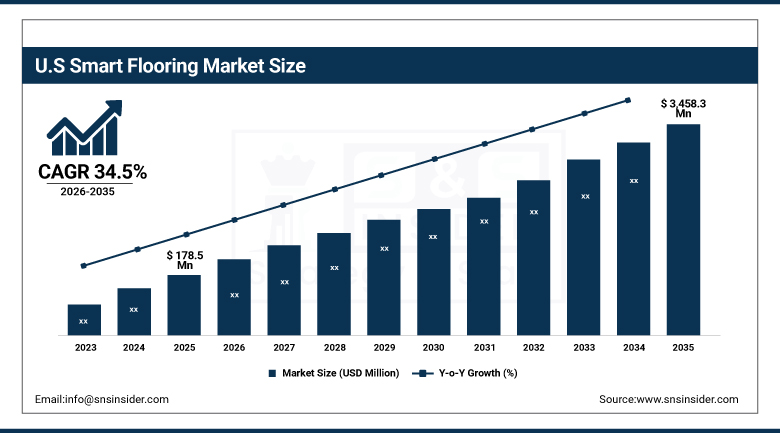
The US Smart Flooring Market was valued at approximately USD 178.5 Million in 2025 and is projected to reach approximately USD 3,458.3 Million by 2035, registering a CAGR of approximately 34.5% from 2026 to 2035.
Domestic demand in the U.S. was driven by the increasing adoption of smart building solutions and significant investments in infrastructure upgrades during the period under review. Advanced IoT ecosystem availability and favorable regulation helped boost domestic market growth, while urban luxury residential projects were driving the market adoption with their increased emphasis on sustainable living and aesthetically pleasing, technologically advanced interiors. Increased healthcare vertical adoption for patient monitoring and fall detection applications was increasing the scope of the domestic addressable market way beyond its commercial building occupancy tracking origins.
Scanalytics continued expanding its pressure-sensitive smart flooring and occupancy analytics platform throughout 2025, targeting commercial building operators and retailers seeking granular foot-traffic data capable of feeding directly into HVAC optimization and real-time space-management systems across American commercial real estate portfolios.
Smart Flooring Market Segment Analysis
-
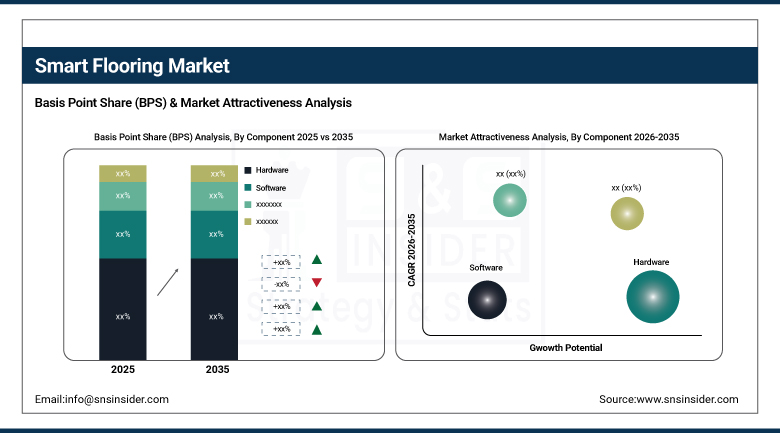
By Component, Hardware led the market with the largest share in 2025, while Software was the fastest-growing component, tracking rising demand for AI-driven analytics and building management integration.
-
By Technology, Sensor-Embedded Floor Tiles led the market with the largest share in 2025, while Energy-Harvesting Flooring was the fastest-growing technology.
-
By End User, Commercial led the market with the largest share in 2025, while Residential was the fastest-growing end user, tracking a projected 12.3% CAGR.
-
By Application, Occupancy and Space-Utilisation Analytics led the market with the largest share in 2025, while Gaming and Sports was the fastest-growing application.
By Component, Hardware led the market, Software grew fastest
The Hardware segment dominated the market, reflecting the substantial engineering investment required for pressure sensors, LED modules, wireless communication chips, and energy-harvesting materials that form the physical foundation of every smart flooring installation. That combination of foundational sensor and microelectronics infrastructure kept hardware the largest single component category across virtually every smart flooring deployment this market covers.
Software is recording the fastest growth among components during the forecast period. Growing integration of artificial intelligence and IoT continues enabling predictive maintenance, automation, and real-time occupancy tracking, and rising demand for cloud-based flooring management platforms and wireless monitoring technologies continues expanding this component category's growth rate well ahead of the broader, still-dominant hardware segment.
By Technology, Sensor-Embedded Floor Tiles led the market, Energy-Harvesting Flooring grew fastest
Sensor-Embedded Floor Tiles held the largest technology share in 2025, reflecting this format's established role as the most mature and widely deployed smart flooring technology across commercial occupancy tracking and space-utilization analytics applications. That combination of proven reliability and broad commercial adoption kept sensor-embedded tiles the dominant technology category by a considerable margin over emerging alternative formats.
Energy-Harvesting Flooring is recording accelerated growth among technology categories during the forecast period. Innovations combining kinetic and solar energy continue maximizing power generation and sustainability, as modern tiles capturing footsteps while integrating solar cells enable continuous energy production, off-grid storage, and support for e-mobility solutions, keeping this technology's growth rate climbing ahead of the broader, still-dominant sensor-embedded tile category.
By End User, Commercial led the market, Residential grew fastest
The Commercial segment dominated end-user revenue, driven by increasing adoption in healthcare and commercial spaces where granular occupancy data feeds directly into HVAC optimization and real-time space-management systems. That combination of genuine operational value and established building management integration kept commercial applications the market's largest end-user category by a considerable margin.
The Residential segment is expected to be the fastest-growing end-user category, with a CAGR of approximately 12.3% during the forecast period. Increasing adoption of smart home technologies and rising consumer awareness continues driving this growth, as smart flooring systems get integrated into modern homes to enhance comfort, safety, and energy efficiency, with technological advancements and decreasing costs continuing to make these solutions more genuinely accessible to mainstream residential buyers.
By Application, Occupancy and Space-Utilisation Analytics led the market, Gaming and Sports grew fastest
Occupancy and Space-Utilisation Analytics dominated application-level revenue, as corporates increasingly value granular foot-traffic data that feeds directly into HVAC optimization and real-time space-management dashboards. That combination of genuine operational cost savings and building management integration kept this application category the market's largest by a considerable margin over emerging alternative use cases.
Gaming and Sports is anticipated to register the highest CAGR among applications during the forecast period, due to growing adoption of interactive smart floors for physical gaming and entertainment. As consumer entertainment venues and fitness facilities increasingly deploy interactive flooring for genuinely engaging, physically active gaming experiences, that novel application category's growth rate keeps climbing ahead of the broader, more established analytics-focused application segments.
Regional Analysis
|
Region |
Major Country |
Share within Region, 2025 (%) |
|
North America |
United States |
80.65% |
|
Europe |
Germany |
23.85% |
|
Asia Pacific |
China |
31.20% |
|
Middle East and Africa |
UAE |
26.60% |
|
Latin America |
Brazil |
34.15% |
North America Smart Flooring Market Insights
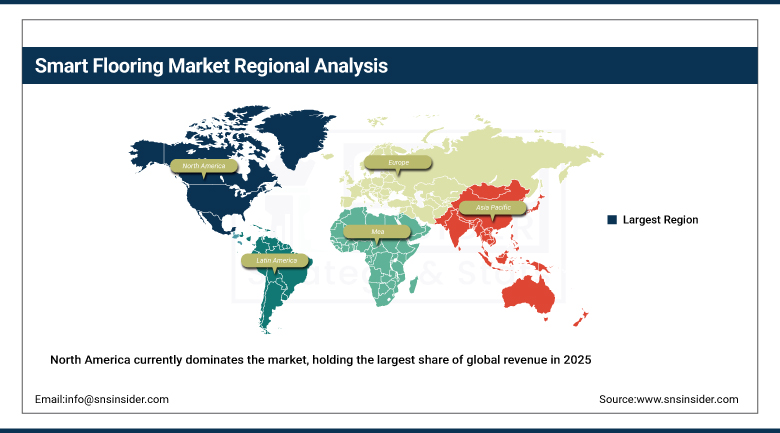
North America currently dominates the market, holding the largest share of global revenue in 2025, due to high adoption of IoT-integrated building solutions, strong infrastructure investments, and increasing demand for smart homes and healthcare applications. The presence of advanced IoT ecosystems and favorable regulatory frameworks continued reinforcing this dominant regional position throughout the year.
The United States accounted for roughly 80.65% of regional revenue, anchored by strong adoption of smart building technologies and high investment in infrastructure modernization. Canada added further regional demand through its own growing smart building sector, and that combined strength kept North America the largest addressable market for smart flooring vendors through the forecast period.
Get Customized Report as per Your Business Requirement - Enquiry Now
Europe Smart Flooring Market Insights
Europe held a meaningful share of global revenue, supported by continued steady growth driven by growing smart city investments and urbanization initiatives across the region's major economies. Rising government-backed green-building mandates continued reinforcing demand for energy-efficient, sensor-enabled flooring solutions throughout the continent.
Germany led demand at roughly 23.85% of European revenue, supported by its substantial commercial construction and smart building technology adoption. The UK and France contributed substantial additional demand, and continued European regulatory emphasis on green building certification should keep regional demand climbing through the forecast period.
Asia Pacific Smart Flooring Market Insights
Asia Pacific is projected to witness the highest CAGR among all regions tracked in this report, supported by rapid smart building adoption across the region's largest economies. China, Japan, and India continued leading regional market growth, with rapid urbanization and expanding commercial construction activity keeping the region's growth trajectory well ahead of every other region tracked in this report.
China led the pack, supported by its massive commercial construction base and rapidly growing smart building technology adoption. Japan and India contributed meaningful additional demand, with both countries' expanding smart city infrastructure investment continuing to reinforce Asia Pacific's position as the fastest-growing market tracked in this report.
MEA and Latin America Smart Flooring Market Insights
The Middle East and Africa and Latin America both showed steady growth, driven by increasing smart city investments and urbanization initiatives across both areas. As these markets continued developing modern commercial and residential building infrastructure, smart flooring adoption grew correspondingly from a considerably smaller base than in more mature markets.
The UAE led Middle East and Africa demand, supported by substantial smart city investment tied to the region's continued urban development agenda. Saudi Arabia contributed further demand through its own smart infrastructure programs. In Latin America, Brazil accounted for the largest share of regional revenue, with growing commercial construction continuing to anchor regional demand for smart flooring.
Market Dynamics
Growth Drivers: IoT Sensor Cost Decline and Green Building Mandate Growth
This momentum stems from sharp declines in IoT sensor prices, government-backed green-building mandates, and the post-pandemic shift toward touch-free occupancy analytics. The smart flooring market is driven by increasing demand for IoT-enabled building solutions, rising adoption of smart homes, and advancements in sensor technology that continue lowering the technical and cost barriers to widespread adoption.
Increasing adoption of IoT-enabled home automation, rising demand for sensor-based healthcare solutions, advancements in energy-harvesting flooring, and growing applications in retail and commercial spaces continue reinforcing this driver. Government initiatives for smart infrastructure and sustainability continue further accelerating market growth, and that combination of genuine cost-efficiency improvement and expanding regulatory support is exactly what keeps demand climbing at such a rapid, sustained pace across virtually every major building category.
Restraints: High Installation Costs and Retrofit Complexity
High installation costs remain a genuine constraint on faster market-wide adoption, particularly for retrofitting existing buildings not originally designed for integrated sensor and microelectronics flooring infrastructure. That cost profile has kept the most sophisticated smart flooring installations concentrated among new construction and well-resourced building modernization projects.
The technical complexity of integrating smart flooring systems with existing building management and HVAC control platforms continues posing genuine engineering challenges, as older buildings often require meaningful electrical and structural modification to support sensor-embedded flooring installation. That integration burden keeps full-building smart flooring deployment a genuinely multi-year undertaking for many facility operators.
Opportunities: Healthcare Monitoring Expansion and Energy-Harvesting Technology Commercialization
The increase in demand for healthcare sensors is an actual business opportunity, as the increasing demand for the fall detection technology keeps adding up to the range of smart flooring applications in hospitals and nursing care homes. Companies that offer reliable and clinically proven fall-detection and monitoring flooring technology can capitalize on this market opportunity, as the need for safe and secure technology-driven infrastructure has become a priority for healthcare organizations.
The second opportunity in the market exists in the continued improvement in the energy harvesting floors technology, which has been noted as the fastest-growing segment of the flooring technology category. The commercial viability of this technology, which involves harvesting of energy from footfall movements, while meeting the sustainability agenda makes this application one to capitalize on.
Recent Developments:
-
2025: Pavegen continued expanding its kinetic energy-harvesting flooring technology, targeting transportation hubs and public infrastructure customers seeking sustainable, foot-traffic-powered energy generation capability.
-
2025: Tarkett continued advancing its sensor-integrated commercial flooring product line, targeting building operators seeking occupancy analytics and HVAC optimization capability across large-scale commercial real estate portfolios.
-
2024: Future-Shape continued expanding its SensFloor pressure-sensing underlay technology, targeting healthcare and senior care facility operators seeking fall-detection and patient-monitoring capability integrated directly into flooring infrastructure.
Smart Flooring Companies are:
-
Tarkett S.A.
-
Scanalytics, Inc.
-
Mohawk Industries, Inc.
-
Interface, Inc.
-
Pavegen Systems Ltd.
-
MariCare Oy
-
Technis SA
-
Wixalia
-
Smart Step (American Pro Marketing LLC)
-
Shaw Industries Group, Inc.
-
Forbo Holding AG
-
Gerflor Group
-
Milliken & Company
-
Beaulieu International Group
-
Congoleum Corporation
-
Balta Group NV
-
Amorim Cork Flooring
-
Interactive Wear AG
Smart Flooring Market Report Scope:
| Report Attributes | Details |
|---|---|
| Market Size in 2025 | USD 600 Million |
| Market Size by 2035 | USD 12,063.9 Million |
| CAGR | CAGR of 35% From 2026 to 2035 |
| Base Year | 2025 |
| Forecast Period | 2026-2035 |
| Historical Data | 2022-2024 |
| Report Scope & Coverage | Market Size, Segments Analysis, Competitive Landscape, Regional Analysis, DROC & SWOT Analysis, Forecast Outlook |
| Key Segments | • by Component (Hardware and Software) • by Technology (Sensor-Embedded Floor Tiles, Energy-Harvesting Flooring, Smart Heated Flooring, and Others) • by End User (Commercial, Residential, Industrial and Logistics, and Others) • by Application (Occupancy and Space-Utilisation Analytics, HVAC and Energy Management, Gaming and Sports, and Others) |
| Regional Analysis/Coverage | North America (US, Canada, Mexico), Europe (Eastern Europe [Poland, Romania, Hungary, Turkey, Rest of Eastern Europe] Western Europe] Germany, France, UK, Italy, Spain, Netherlands, Switzerland, Austria, Rest of Western Europe]), Asia Pacific (China, India, Japan, South Korea, Vietnam, Singapore, Australia, Rest of Asia Pacific), Middle East & Africa (Middle East [UAE, Egypt, Saudi Arabia, Qatar, Rest of Middle East], Africa [Nigeria, South Africa, Rest of Africa], Latin America (Brazil, Argentina, Colombia, Rest of Latin America) |
| Company Profiles | Tarkett S.A., Future-Shape GmbH, Scanalytics, Inc., Mohawk Industries, Inc., Interface, Inc., Pavegen Systems Ltd., Energy Floors B.V., MariCare Oy, Technis SA, Wixali, Smart Step (American Pro Marketing LLC), Shaw Industries Group, Inc., Forbo Holding AG, Gerflor Group, Milliken & Company, Beaulieu International Group, Congoleum Corporation, Balta Group NV, Amorim Cork Flooring, Interactive Wear AG |

Frequently Asked Questions
The Smart Flooring Market is expected to grow at a CAGR of approximately 35.0% from 2026 to 2035, based on triangulated secondary research estimates.
The major growth factor is sharp declines in IoT sensor prices, government-backed green-building mandates, and the post-pandemic shift toward touch-free occupancy analytics.
The Hardware segment dominated the Smart Flooring Market by component, reflecting the foundational role of sensors, LED modules, and energy-harvesting materials in 2025.
North America dominated the Smart Flooring Market in 2025, supported by high adoption of IoT-integrated building solutions and strong infrastructure investment.
The Smart Flooring Market was valued at approximately USD 600.0 Million in 2025, based on triangulation across multiple independent research sources; estimates vary considerably given genuinely different scope definitions applied across different firms.
