
Organoid Biobanking Market Report Scope & Overview:
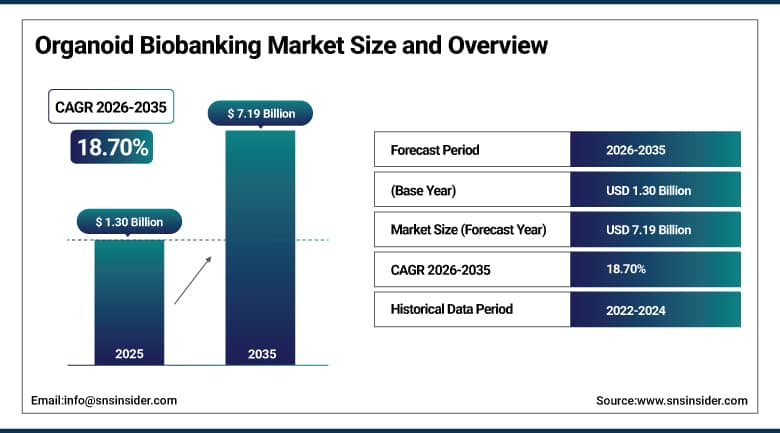
Organoid Biobanking Market was valued at USD 1.30 billion in 2025 and is expected to reach USD 7.19 billion by 2035, growing at a CAGR of 18.70% from 2026-2035.
The Organoid Biobanking Market is witnessing rapid growth due to increasing demand for advanced biological models that support drug discovery, disease research, and personalized medicine. The organoid biobanks facilitate the long-term preservation and systematic storage of patient-derived as well as tissue-specific organoids for use in research and clinical applications. Increasing usage of precision medicine, cancer studies, and regenerative medicine is propelling the demand for quality organoid biobanks. Furthermore, increased investment in drug discovery and development research, developments in stem cell and 3D cultures techniques, as well as growing collaborations between academia and health care establishments are propelling market growth.
In July 2024, NIH awarded approximately $31 million over five years to four Translational Centers for Microphysiological Systems to advance human-relevant models for drug development.
To Get More Information On Organoid Biobanking Market - Request Free Sample Report
Organoid Biobanking Market Trends
-
Rising demand for personalized medicine is driving adoption of organoid biobanks for storing patient-specific models used in disease research and therapeutic development.
-
Increasing use of patient-derived organoids in drug discovery is expanding demand for standardized biobanking solutions supporting long-term preservation and sample accessibility.
-
Growing prevalence of cancer and chronic diseases is accelerating collection and storage of disease-specific organoid samples for research and precision medicine applications.
-
Advancements in cryopreservation technologies are improving organoid viability, recovery, reproducibility, and long-term storage capabilities across specialized biobanking facilities.
-
Increasing investments in regenerative medicine and organoid research are encouraging development of specialized infrastructure for standardized organoid collection, characterization, and preservation.
U.S. Organoid Biobanking Market Outlook
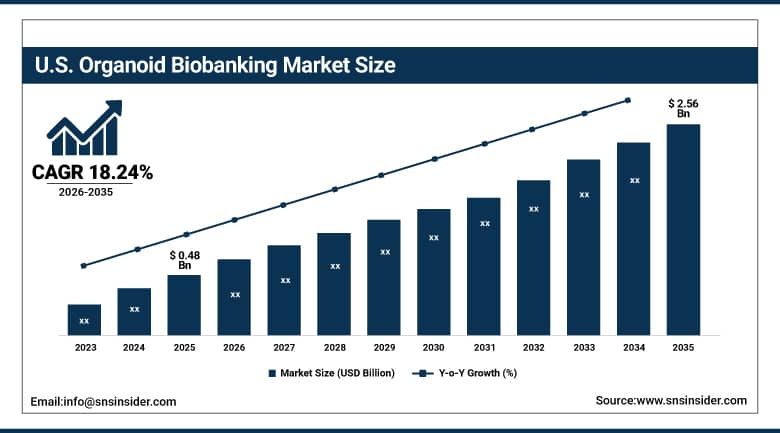
U.S. Organoid Biobanking Market was valued at USD 0.48 billion in 2025 and is expected to reach USD 2.56 billion by 2035, growing at a CAGR of 18.24% from 2026-2035.
The U.S. Organoid Biobanking Market is witnessing rapid growth due to increasing demand for patient-derived biological models in drug discovery, disease modeling, and personalized medicine. The increased use of organoids for cancer research and precision medicine is fueling the need for more organized biobank systems that can help preserve samples in the long run and facilitate research. Also, higher investment by the pharmaceuticals and biotech companies, as well as research and healthcare institutions, will aid in market growth. Progress in technologies such as stem cell technologies, 3D cell culture, cryopreservation, and organoid technology is helping in creating better quality biobanks. Increased collaboration and demand for standard biological resources are boosting adoption in the U.S.
NIH's All of Us Research Program aims to enroll at least 1 million participants, creating a large-scale research resource for understanding relationships among genetics, environment, lifestyle, and health.
Organoid Biobanking Market Segment Analysis
-
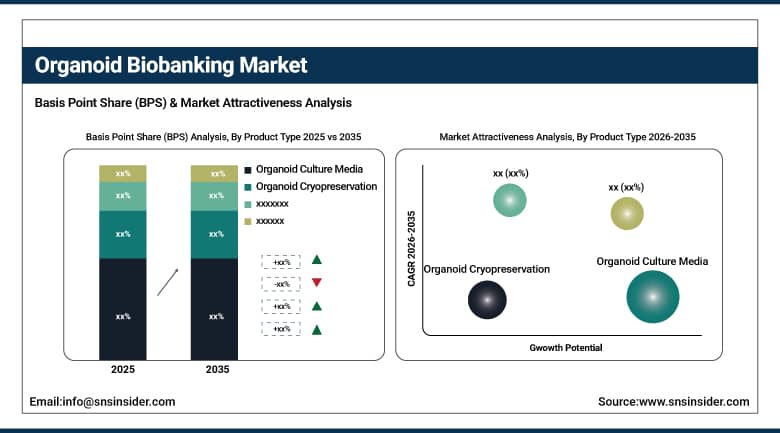
By Product Type, Organoid Culture Media dominated the Organoid Biobanking Market with 37% share in 2025; Cryopreservation Media & Reagents is expected to grow at the fastest CAGR of 20.66% from 2026–2035.
-
By Application, Cancer Research dominated the Organoid Biobanking Market with 31% share in 2025; Personalized Medicine is expected to grow at the fastest CAGR of 21.72% from 2026–2035.
-
By End User, Pharmaceutical & Biotechnology Companies dominated the Organoid Biobanking Market with 46% share in 2025; Hospitals & Clinics are expected to grow at the fastest CAGR of 20.78% from 2026–2035.
-
By Sample Type, Tumor Organoids dominated the Organoid Biobanking Market with 39% share in 2025; Stem Cell Organoids are expected to grow at the fastest CAGR of 19.38% from 2026–2035.
By Product Type, Organoid Culture Media dominate the organoid biobanking market, Cryopreservation Media & Reagents grows fastest.
Organoid Culture Media segment dominated the Organoid Biobanking Market with the highest revenue share of about 37% in 2025 owing to its importance in the survival, development, and stability of organoids. Quality culture media are necessary during the process of establishing and growing the organoids. The rising interest in organoid studies, biobanking, and the need for biological models contribute even more to media usage worldwide.
Cryopreservation Media & Reagents segment is expected to grow at the fastest CAGR of 20.66% from 2026-2035 due to the increasing need for storing organoid samples over an extended period of time. Cryopreservation allows scientists to keep useful biological models for further use in research without ongoing cultivation. Increased development of biobanks, research on personalized medicine, and applications within pharmacology will facilitate its use in the near future.
By Application, Cancer Research dominates the organoid biobanking market, Personalized Medicine grows fastest.
Cancer Research segment dominated the Organoid Biobanking Market with the highest revenue share of about 31% in 2025 because of the increasing applications of organoids in tumor modeling, drug testing, mechanism understanding, and treatment response assessment. Cancer organoids stored in biobanks contain the unique features of tumors belonging to patients and can be used again as research models. Increased investment in cancer research is another factor boosting global demand.
Personalized Medicine segment is expected to grow at the fastest CAGR of 21.72% from 2026-2035 because of the increased need for patient-specific disease models and tailored therapies. Organoids biobanking allows for the storage of patient-specific material to perform drug screening and treatment response analysis. The use of precision medicine, cancer treatments, and advancements in organoid technology is likely to spur the expansion of personalized medicine.
By End User, Pharmaceutical & Biotechnology Companies dominate the organoid biobanking market, Hospitals & Clinics grow fastest.
Pharmaceutical & Biotechnology Companies segment dominated the Organoid Biobanking Market with the highest revenue share of about 46% in 2025 Because of the high usage of biobanked organoids for drug discovery, toxicology tests, disease modeling, and therapy developments. Such organizations need reliable biological models from patient samples for their studies. The growing trend in spending on pharmaceutical research and development also drives the adoption of such technology.
Hospitals & Clinics segment is expected to grow at the fastest CAGR of 20.78% from 2026-2035 due to the increasing usage of patient-derived organoids for the purpose of treatment, disease diagnosis, and personalized therapies. There is an increasing collaboration between hospitals and research organizations/biobanks in order to store patient samples. The development of precision medicine, cancer research, and translation of organoid technologies is likely to drive their usage worldwide.
By Sample Type, Tumor Organoids dominate the organoid biobanking market, Stem Cell Organoids grow fastest.
Tumor Organoids segment dominated the Organoid Biobanking Market with the highest revenue share of about 39% in 2025 The rise in demands for personalized cancer models is a result of increasing applications of these tumor models in drug discovery, study of tumor biology, biomarker discovery, and drug response. These tumor organoids retain many features of the patient’s tumor, which makes them useful for research purposes.
Stem Cell Organoids segment is expected to grow at the fastest CAGR of 19.38% from 2026-2035 due to their increasing usage in regenerative medicine, developmental biology, disease modeling, and drug discovery. Stem cells can form various kinds of organoids, offering a versatile platform for exploring human organs and diseases. The rising trend in stem cell research, biobanking initiatives, and development of organoid cultivation techniques will help increase their use worldwide.
Regional Analysis
|
Region |
Major Country |
Share within Region, 2025 (%) |
|---|---|---|
|
North America |
United States |
91.5% |
|
Europe |
Germany |
23.5% |
|
Asia Pacific |
China |
36.0% |
|
Middle East & Africa |
UAE |
18.0% |
|
Latin America |
Brazil |
34.0% |
North America Organoid Biobanking Market Insights
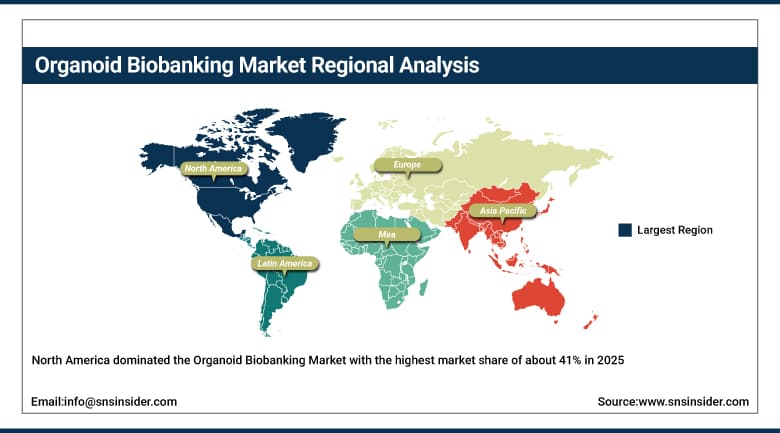
North America dominated the Organoid Biobanking Market with the highest market share of about 41% in 2025, fueled by developments in biomedical research, presence of a robust pharmaceutical and biotech industry, and growing demand for personalized medicines. There have been major investments in drug discovery, regenerative medicine, cancer research, and organoids that have been bolstered by existing biobanks and research institutions.
The U.S. Organoid Biobanking Market accounted for a market share of 91.5%, backed by sophisticated biomedical research, a robust pharmaceutical industry, and high demand for individualized medicine. Increased spending on drug discovery, cancer research, regenerative medicine, and organoids is propelling its uptake. The presence of solid biobanking facilities, scientific institutions, and substantial investment in life science innovations is helping to bolster its market growth.
Get Customized Report as Per Your Business Requirement - Enquiry Now
Europe Organoid Biobanking Market Insights
Europe Organoid Biobanking Market is witnessing steady growth, supported by advancements in biomedical research, rising pharmaceutical and biotechnology industries, and increased use of personalized medicine. Rising investments in the areas of drug discovery, disease modeling, regenerative medicine, and organoids have been helping boost the demand. Existing research organizations, biobanking facilities, collaboration in research projects, and support for life sciences initiatives are among those factors which have helped boost organoid biobanking in Europe.
The Germany Organoid Biobanking Market accounted for a market share of 23.5%, due to the advances made in biomedical research, pharmaceutical capacities, and personalized medicine. Increasing amounts of money invested in organoids for drug discovery, disease modeling, and regenerative medicine have been boosting demand. Research facilities, biotechnology collaboration, biobanking capabilities, and government-sponsored life sciences research projects are aiding in the advancement of applications of organoids in biobanking in Germany.
Asia Pacific Organoid Biobanking Market Insights
Asia Pacific is expected to grow at the fastest CAGR of about 19.80% from 2026–2035, Supported by an increase in biotechnological research, pharmaceutical investments, and personalized medicine. The growth in healthcare infrastructure, the need for sophisticated biological models, government encouragement towards innovation in life sciences, and application in drug discovery, disease modeling, and regenerative medicine is contributing to rapid organoid biobanking acceptance in the region.
The China Organoid Biobanking Market accounted for a market share of 36.0%, backed up by developments in biotechnology and pharmaceuticals R&D, increasing personalization in medical research, and an increasing trend towards organoid technology. Increasing usage in areas of drug discovery, cancer research, and disease modeling is causing a rise in demand. Developments in biotechnological innovations and pharmaceutical investments are causing increased growth in organoid biobanking development in China.
Middle East & Africa and Latin America Organoid Biobanking Market Insights
The Middle East & Africa and Latin America Organoid Biobanking Market It is slowly developing owing to increased investment in biotechnology, pharmaceutical research, and personalized medicine. With advancements in infrastructure for healthcare facilities, collaborations in research, and advanced use of organoids, there are prospects for the region to develop its market. There are also government programs for research in life sciences, increasing requirements for disease models, and drug discovery and regenerative medicine applications.
The UAE Organoid Biobanking Market accounted for a market share of 18.0%, These include more investment in biotechnology, healthcare research and development, and interest in personalized medicine. Advances in healthcare infrastructure along with advances in biological models provide additional scope for this purpose. In addition, government policies encouraging research and development in life science, investments in drug discovery, disease modeling, and regenerative medicine are further helping develop organoid biobanking technologies in the UAE.
Market Dynamics
Growth Drivers: Growing demand for personalized medicine and advanced disease models is accelerating adoption of organoid biobanking solutions globally
Increasing demand for personalized medicine and advanced human disease models is significantly driving the Organoid Biobanking Market. Organoid biobanks store patient-derived and tissue-specific organoids for prolonged use in scientific studies, allowing pharmaceutical firms, universities, and healthcare scientists to have access to biologically realistic models in the study of drugs and diseases. Organoids can replicate certain features of human tissues better than ordinary cells in terms of structural and functional features, and that is why the importance of organoids is growing because of increased research in oncology, regenerative medicine, and precision medicine. Organoid biobanks allow scientists to keep diverse collections of organoids for retesting and long-term studies. In addition, increasing investments into stem cell research and 3D culturing promote demand for organoid biobanks.
Restraints: High storage costs and technically demanding preservation processes can limit widespread adoption of organoid biobanking infrastructure
High infrastructure and operating costs remain significant challenges for the Organoid Biobanking Market. The establishment of organoid biobanks involves the use of special cryopreservation systems, storage conditions, laboratory equipment, culture facilities, quality control measures, and qualified manpower. The preservation of viable organoids during freezing, storage, thawing, and propagation processes might involve highly controlled procedures as well as special preservation media. The continuous monitoring of storage conditions and the integrity of samples would make the operations more demanding. Research organizations that have limited resources would find it hard to invest in such infrastructure, especially where large collections of organoids are involved. Other costs related to sample characterization, data management, documentation, and regulatory compliance could add to the cost burden.
Opportunities: Growing precision medicine research creates significant opportunities for patient-specific organoid biobanks and personalized treatment development
The increasing focus on precision medicine is creating substantial opportunities for organoid biobanking providers. Organoid libraries established from patient sources will allow for the storage of models corresponding to varying diseases, different genetic backgrounds and therapy sensitivities, allowing researchers to perform patient-specific drug testing and research on various illnesses. Organoids derived from a patient’s tumor in oncology research will help test for sensitivity and resistance of the cancerous tissue, as well as offer valuable models in the study of biomarkers. Organoids can be paired with genomic, clinical and molecular information to enhance their scientific value. Pharmaceutical companies will have access to these valuable sources to perform drug screens on patient samples and discover responders.
Recent Developments:
2026 –Crown Bioscience expanded its living organoid biobank and OrganoidXplore service, offering more than 250 characterized PDO and PDXO models with molecular profiles for large-scale oncology screening.
2026 –Bruker announced a majority investment in MIMETAS, combining organ-on-chip and organoid technologies with multiomics, spatial biology, and imaging capabilities to advance human-relevant drug development.
2026 –InSphero acquired DOPPL SA and its Gri3D technology, strengthening its organoid portfolio and expanding scalable 3D human-model capabilities for drug discovery and safety testing.
2025 –MIMETAS and industry partners launched IAMPS to advance organoid and microphysiological-system adoption, standardization, regulatory acceptance, tissue access, and European biobanking capabilities
Organoid Biobanking Market key players are:
-
Crown Bioscience
-
STEMCELL Technologies
-
Hubrecht Organoid Biobank
-
DefiniGEN Limited
-
Cellesce Ltd.
-
InSphero AG
-
MIMETAS B.V.
-
BioIVT
-
REPROCELL Inc.
-
Organoid Sciences
-
Champions Oncology
-
Ximbio
-
Thermo Fisher Scientific Inc.
-
Corning Incorporated
-
Merck KGaA
-
Bio-Techne Corporation
-
CN Bio Innovations Ltd.
-
Newcells Biotech Ltd.
-
TissUse GmbH
-
Charles River Laboratories International, Inc.
Organoid Biobanking Market Report Scope:
| Report Attributes | Details |
|---|---|
| Market Size in 2025 | USD 1.30 Billion |
| Market Size by 2035 | USD 7.19 Billion |
| CAGR | CAGR of 18.70% From 2026 to 2035 |
| Base Year | 2025 |
| Forecast Period | 2026-2035 |
| Historical Data | 2022-2024 |
| Report Scope & Coverage | Market Size, Segments Analysis, Competitive Landscape, Regional Analysis, DROC & SWOT Analysis, Forecast Outlook |
| Key Segments | • By Product Type (Organoid Culture Media, Organoid Kits, Organoid Cryopreservation, Others) • By Application (Cancer Research, Disease Modeling, Drug Discovery and Development, Personalized Medicine, Regenerative Medicine, Others) • By End User (Pharmaceutical & Biotechnology Companies, Academic & Research Institutes, Hospitals & Clinics, Other End Users) • By Sample Type (Tumor Organoids, Stem Cell Organoids, Tissue-Specific Organoids, Others) |
| Regional Analysis/Coverage | North America (US, Canada), Europe (Germany, UK, France, Italy, Spain, Russia, Poland, Rest of Europe), Asia Pacific (China, India, Japan, South Korea, Australia, ASEAN Countries, Rest of Asia Pacific), Middle East & Africa (UAE, Saudi Arabia, Qatar, South Africa, Rest of Middle East & Africa), Latin America (Brazil, Argentina, Mexico, Colombia, Rest of Latin America). |
| Company Profiles | Crown Bioscience, STEMCELL Technologies, Hubrecht Organoid Biobank, DefiniGEN Limited, Cellesce Ltd., InSphero AG, MIMETAS B.V., BioIVT, REPROCELL Inc., Organoid Sciences, Champions Oncology, Ximbio, Thermo Fisher Scientific Inc., Corning Incorporated, Merck KGaA, Bio-Techne Corporation, CN Bio Innovations Ltd., Newcells Biotech Ltd., TissUse GmbH, and Charles River Laboratories International, Inc. |

Frequently Asked Questions
The Organoid Biobanking Market is expected to grow at a CAGR of 18.70% from 2026 to 2035.
The Organoid Biobanking Market was valued at USD 1.30 billion in 2025.
The major growth factor is rising demand for personalized medicine and advanced drug discovery, driving adoption of organoid biobanks for patient-specific disease modeling, drug screening, biomarker discovery, and precision therapies.
The Organoid Culture Media segment dominated the Organoid Biobanking Market in 2025.
North America dominated the Organoid Biobanking Market in 2025.
