
Package on Package (PoP) Market Report Scope & Overview:
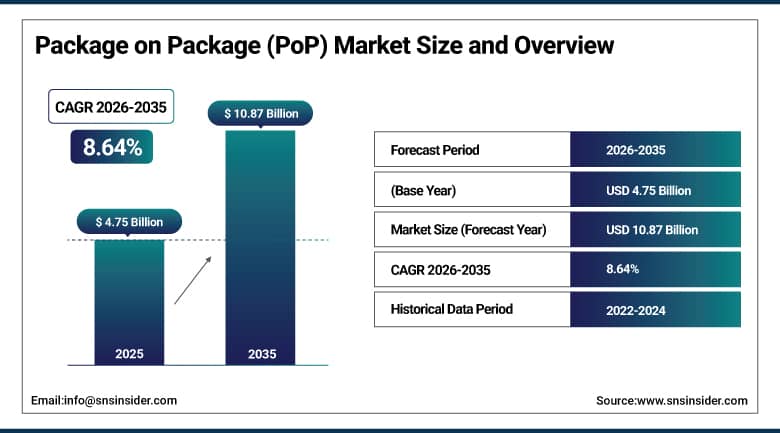
The Package on Package (PoP) Market size was valued at USD 4.75 billion in 2025 and is expected to reach USD 10.87 billion by 2035, growing at a CAGR of 8.64% from 2026–2035.
The package on package (PoP) market is witnessing steady growth in the global market owing to increasing demand for high performance semiconductor packaging solutions. Rising adoption of smartphones and wearable electronics is supporting market expansion. Expanding 5G and advanced computing applications are driving packaging demand. Manufacturers are focusing on miniaturization and higher integration density solutions. Growing adoption of hybrid PoP architectures is improving device efficiency. Increasing emphasis on compact and energy efficient electronics is further accelerating market adoption.
As per the World Semiconductor Trade Statistics 2025 report by World Semiconductor Trade Statistics and the Semiconductor Industry Association, annual unit shipment of semiconductors in the world crossed the mark of 1 trillion integrated circuits and advanced packaging contributed for more than 50% of performance improvements in next generation semiconductors. According to the U.S. CHIPS and Science Act Implementation Update reports and Manufacturing Data from SEMI industry association, more than 70% of state-of-the-art mobile processors have started employing 3D and advanced stacking approaches, such as Package on Package (PoP).
To Get More Information On Package on Package (PoP) Market - Request Free Sample Report
Package on Package (PoP) Market Trends
-
The increased use of smartphones, tablets, and wearables will increase the demand for small-size Package on Package semiconductor integration technology.
-
Increased usage of 5G systems and AI-based electronic devices will increase the demand for higher bandwidths and effective stacked semiconductor chips.
-
There is an increasing focus on miniaturization in consumer electronics which will drive demand for vertical integration of memory and logic components.
-
The expanding scope of cloud computing and edge computing will increase demand for semiconductor packaging solutions that provide high-speed connectivity.
-
Innovations in semiconductor manufacturing will improve the efficiency and performance of PoP technologies.
-
Digital transformation will increase the demand for energy-efficient and high computational power electronic device architecture.
U.S. Package on Package (PoP) Market Size Outlook
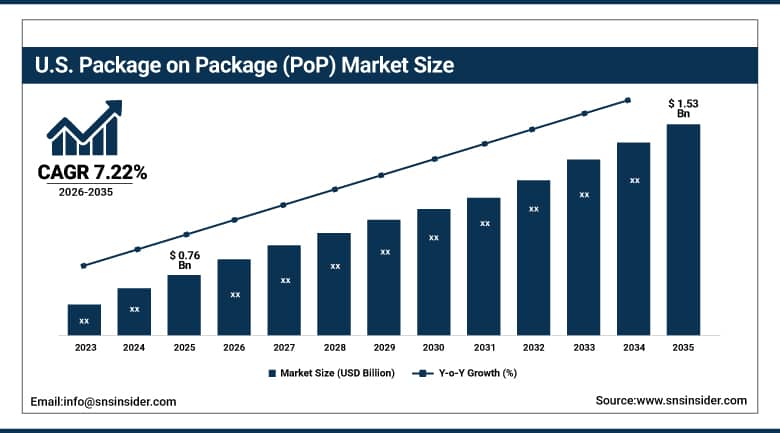
The U.S. Package on Package (PoP) Market was valued at USD 0.76 billion in 2025 and is expected to reach around USD 1.53 billion by 2035, growing at a CAGR of 7.22% from 2026–2035.
The U.S. package on package (PoP) market is growing steadily owing to strong demand from advanced semiconductor packaging solutions. Increasing adoption of smartphones and high-performance computing devices is supporting market expansion. Rising penetration of 5G infrastructure and AI chips is driving advanced packaging demand. Growth in consumer electronics manufacturing is further increasing PoP usage across devices. Manufacturers are focusing on miniaturization and high-density integration technologies. Advancements in chip stacking and thermal management are improving performance efficiency.
In accordance with the indicators from the U.S. Department of Commerce and SEMI World Fab Forecast 2025, advanced packaging solutions have taken up more than 40% of global semiconductor packaging capacity increases, and a large number of the pilot lines for heterogeneous integration and 3D integration are based in the United States. In terms of the U.S. CHIPS and Science Act implementation plan, there are multiple research projects funded by the government focused on node integration below 10 nanometers and interconnect systems.
Package on Package (PoP) Market Segment Analysis
-
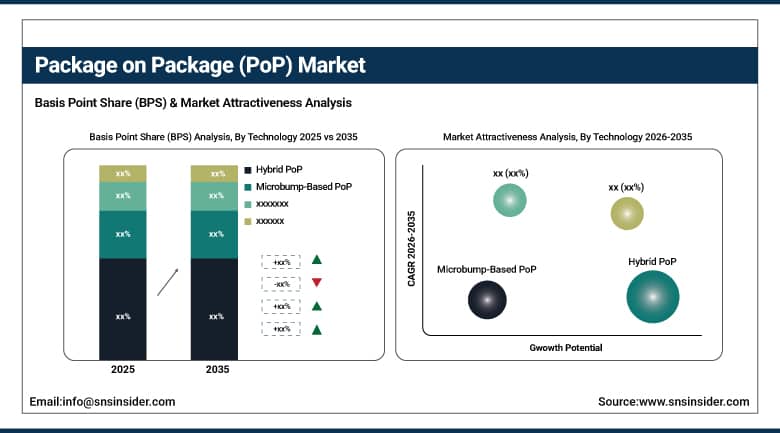
By Technology, hybrid PoP dominated the market with 46.72% share in 2025; while microbump-based PoP is the fastest growing segment with CAGR of 12.31% during 2026 to 2035.
-
By Component Type, dram dominated the market with 51.38% share in 2025; while flash is the fastest growing segment with CAGR of 11.61% during 2026 to 2035.
-
By Application, Smartphones dominated the market with 54.62% share in 2025; while Automotive electronics is the fastest growing segment with CAGR of 14.79% during 2026 to 2035.
-
By End-Use Industry, consumer electronics dominated the market with 60.28% share in 2025; while healthcare is the fastest growing segment with CAGR of 15.67% during 2026 to 2035.
By Technology, hybrid PoP dominated the package on package (PoP) market, while microbump-based PoP is the fastest growing segment.
The Hybrid PoP segment had the dominated revenue share in the package on package (PoP) market in 2025 due to its widespread use in mobile phones and consumer electronics. It provides high electrical performance and stable stacking capability. It is favored by manufacturers because of its cost-effectiveness and well-established manufacturing process. The high demand for portable devices also helps in its adoption. Due to its established integration capabilities, it is considered as the ideal solution in memory and logic applications all over the world.
The Microbump-Based PoP segment will experience the fastest growth during 2026-2035 owing to the rising demand for high bandwidth and low power semiconductor solutions. It provides higher interconnect density and performance for signals. Its rising adoption in advanced computing and 5G devices helps in its growth. Its continuous development in chip scaling technology makes it more efficient. Rising demand for miniaturization in electronics further drives its adoption. Its compatibility with future-generation package-on-package solutions drives its growth in the long run.
By Component Type, DRAM dominated the package on package (PoP) market, while flash is the fastest growing segment.
The DRAM segment was the largest contributor to package on package (PoP) market in terms of revenue share in 2025. It was fueled by growing integration of DRAM in smart phones, tablets, and computing devices that needed fast memory. Higher demand for memory solutions offering higher bandwidth and lower latency in small form factor devices further added to its dominance. Its growing adoption in advanced mobile processors and multi-layer stacking further bolstered its leadership.
The Flash segment is poised to be the fastest growing segment from 2026 to 2035 owing to rising need for high-capacity non-volatile memory solutions. Its growing applications in smart phones, automotive electronics, and IoT products further fueled its growth. Its growing demand for higher data access speed, power efficient memory, and integration of storage in advanced packaging further bolstered its adoption. Growing innovations in NAND flash technology further enhanced its penetration in future generation PoP architectures.
By Application, smartphones dominated the package on package (PoP) market, while automotive electronics is the fastest growing segment.
Smartphones Segment was the major segment in the package on package (PoP) market and accounted for the highest revenue share in 2025. It is due to large-scale production of smartphones globally and consistent demand for small and efficient devices. Increased use of advanced processors, memory and 5G enabled smartphones will increase the utilization of PoP technology. PoP architecture is preferred by manufacturers for saving space, increased bandwidth and electrical performance.
Automotive Electronics Segment held the fastest growth rate in terms of Compound Annual Growth Rate (CAGR) from 2026 to 2035. This is attributed to increased demand for electric vehicles, ADAS, and connected cars. High reliability requirement in semiconductors packages for automotive electronics is driving the adoption of PoP technology. Growing need for digital cockpit and infotainment systems is also increasing the growth of this segment.
By End-Use Industry, consumer electronics dominated the package on package (PoP) market, while healthcare is the fastest growing segment.
The Consumer Electronics segment led the PoP market in terms of revenue share in 2025. The lead was attributed to high demand for smartphones, tablets, and wearables that need highly efficient semiconductor packing. Adoption of advanced chip technology for consumer electronics leads to increased integration density. Also, frequent upgrading of products and high electronics consumption worldwide contribute to its market leadership position and steady demand within consumer-oriented applications.
Healthcare sector is anticipated to record the fastest CAGR from 2026 to 2035 due to growing adoption of advanced healthcare electronics and portable diagnostic equipment. Increased usage of health monitoring devices and implantable medical equipment is resulting in increased demand for reliable packaging technology. Establishment of digital healthcare framework and remote patient monitoring systems is further adding to growth of the sector. Innovation in the field of medical semiconductor applications is boosting the adoption of PoP technology within healthcare applications.
Regional Analysis
|
Region |
Major Country |
Share within Region, 2025(%) |
|---|---|---|
|
North America |
United States |
70.25% |
|
Europe |
Germany |
25.80% |
|
Asia Pacific |
China |
43.50% |
|
Middle East & Africa |
UAE |
15.20% |
|
Latin America |
Brazil |
45.80% |
North America Package on Package (PoP) Market Insights.
North America package on package (PoP) market is experiencing steady growth in 2025 owing to strong demand from advanced semiconductor packaging and electronics industries. The region benefits from strong R&D infrastructure and high adoption of premium electronic devices. Increasing use of high-performance computing and AI chips is improving packaging efficiency. Expansion of 5G and data center ecosystems is driving semiconductor integration demand. Strong focus on advanced chip design and innovation is further supporting market growth.
As per the information from the U.S. Semiconductor Industry Association and updates on the implementation of the CHIPS and Science Act, the United States represents 12% of the total world's capacity for semiconductors manufacturing by 2025 where advanced packaging gets more funding from the government via various research and development and manufacturing incentive programs. According to the U.S. Department of Commerce assessment of semiconductor supply chains, package on package advanced packaging is extensively used in mobile computing and AI hardware, and more than 70% of advanced mobile processors are using stacking packaging designs.
Get Customized Report as Per Your Business Requirement - Enquiry Now
Europe Package on Package (PoP) Market Insights.
Europe package on package (PoP) market is characterized by stable growth in 2025 owing to strong automotive electronics and industrial semiconductor demand. Key countries include Germany, France, United Kingdom, and Italy. Rising adoption of electric vehicles and advanced driver assistance systems is driving PoP usage in automotive electronics. Increasing focus on energy efficient devices is boosting semiconductor integration. Expansion of industrial automation and smart manufacturing is further supporting market growth. Strong regulatory emphasis on technological sovereignty is encouraging semiconductor investments.
According to European Semiconductor Industry Association and European Commission’s 2025 Digital Economy and Society indicators, the share of semiconductors manufacturing capacity from Europe is about 9–10% of the world total, with advanced packaging being increasingly emphasized in the framework of the EU Chips Act. According to JRC assessment of the value chain of semiconductors, more than 70% of electronics manufacturing companies in the EU use third-party advanced packaging and assembly services, including PoP solutions. Eurostat ICT manufacturing statistics indicates that more than 80% of semiconductors consumed in Europe is imported.
Asia Pacific Package on Package (PoP) Market Insights.
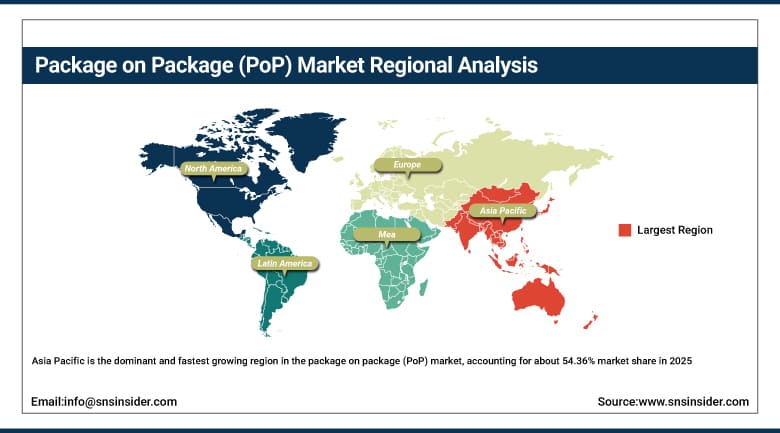
Asia Pacific is the dominant and fastest growing region in the package on package (PoP) market, accounting for about 54.36% market share in 2025 and registering a CAGR of about 9.68% during 2026–2035. Rapid expansion of semiconductor manufacturing hubs and electronics production is driving strong demand across China, Japan, South Korea, Taiwan, and India. Growing smartphone penetration and consumer electronics demand are boosting packaging requirements. Rising adoption of advanced nodes and miniaturized devices is further accelerating market growth. Expansion of OSAT and foundry ecosystems is strengthening regional dominance.
According to the World Semiconductor Trade Statistics and SEMI industry capacity surveys 2025, the percentage of semiconductor fabrication capacity in the Asia Pacific is above 75%, where Taiwan, South Korea, China, and Japan are the main players of the advanced packaging industry value chain. According to the United States Geological Survey and OECD semiconductor value chain analysis, the use of advanced packaging technology such as PoP and 3D integration has increased due to the percentage of chiplet architecture exceeding 20% in new high-performance computer architecture designs.
Middle East & Africa and Latin America Package on Package (PoP) Market Insights.
The Middle East & Africa along with Latin America regions are witnessing steady growth due to rising digitalization and expanding electronics consumption. Key contributing countries include Brazil, Mexico, UAE, Saudi Arabia, and South Africa. Increasing adoption of consumer electronics and telecommunications devices is driving PoP demand. Growth in industrial digitization and smart infrastructure projects is further supporting market expansion. Rising investments in technology ecosystems are improving semiconductor adoption across these emerging regions.
As per the ITU ICT Development Index of the International Telecommunication Union and digital connectivity figures from United Nations DESA, mobile broadband penetration is above 90% in Latin America and around 70% in certain regions of the Middle East; however, in Sub-Saharan Africa, it hovers around 30-40%.
Market Dynamics
Growth Drivers: Rising demand for high density semiconductor integration in advanced electronic devices
Increasing adoption of smartphone, tablet, and wearable electronics has increased the need for smaller and high-performance packaging technologies. The PoP technology allows vertical integration of logic and memory components. It improves speed, area efficiency, and power consumption. Growing adoption of 5G-enabled smartphones and AI enabled devices has been aiding the adoption of advanced packaging technology. Rising innovations in consumer electronics have further driven the demand for high bandwidth and miniaturization. The semiconductor industry is striving to improve integration density and heat dissipation. Growing digitization has further spurred the demand for advanced PoP technology.
According to USGS Mineral Commodity Summaries 2025 and Semiconductor Industry Association production indices, there is continuous growth of advanced semiconductor packaging technologies, with over 90% of cutting-edge logic semiconductors being produced using less than 10 nm process nodes and utilizing advanced packaging techniques. According to ITRS Successor roadmaps and JEDEC standards, package on package is extensively used in mobile processor units, where more than 70% of top-quality smartphones have multi-level memory-logic stacks production.
Restraints: High manufacturing complexity and thermal management challenges in advanced PoP architectures
Increased complexity associated with Package-on-Package results in various production difficulties. Accurate die alignment is dependent on sophisticated technologies and strict process control. Heat generation will be challenging as a result of vertical arrangement of parts. Reliability of devices and performance stability might be affected. High sensitivity to defects will increase risks and costs of production. Advanced test and inspection tools should be used for quality control. Poor scalability in cost-sensitive applications limits adoption. The problem of balancing performance, yield, and heat generation remains relevant for semiconductor manufacturers.
Opportunities: Growing adoption of advanced packaging in AI, 5G, and high-performance computing applications
The rapid development of artificial intelligence, 5G, and cloud computing technologies has led to a growing demand for semiconductor packages that can meet such needs. The PoP package allows for effective integration of memory chips and processors, which are essential for achieving fast computational speeds. The growing data traffic and real-time analysis have necessitated an increased bandwidth. PoP helps provide compact and energy-efficient designs that are necessary for future electronics. Investments in data centers and edge computing also make the adoption of PoP easier. The continuous improvement in semiconductor technology is promoting the adoption of PoP in high performance applications.
According to the U.S. Department of Commerce implementation update on the CHIPS and Science Act and the SEMI industry manufacturing indicators, there has been an effort towards capacity building of advanced packaging capabilities for more than 20 supported fabrication and advanced packaging projects in the USA as of 2025. In line with the ITRS reports and IEEE standards on packaging technologies, the demand for heterogeneous integration and 3D integration packaging capabilities, such as Package-on-Package technology, is increasing as a necessity for the development of AI chips that have transistors density above 100 billion transistors per chip.
Recent Developments
-
2026: ASE Technology Holding expands advanced packaging and testing capacity driven by AI and high-performance computing demand.
-
2025: Samsung Electronics advances Taylor, Texas semiconductor fabrication facility construction targeting next-generation logic and AI chip production.
-
2025: Amkor Technology expands Arizona advanced packaging campus construction supporting US-based AI semiconductor supply chain localization efforts.
-
2024: TSMC increased CoWoS advanced packaging capacity expansion in Taiwan to address surging AI accelerator chip demand.
Package on Package (PoP) Companies are:
-
TSMC
-
Samsung Electronics
-
Intel
-
Amkor Technology
-
JCET Group
-
Tongfu Microelectronics
-
Huatian Technology
-
UTAC Holdings
-
Nepes Corporation
-
ChipMOS Technologies
-
King Yuan Electronics
-
Chipbond Technology
-
SK hynix
-
Micron Technology
-
Ibiden
-
Shinko Electric Industries
-
Unimicron Technology
-
Samsung Electro-Mechanics
Package on Package (PoP) Market Report Scope:
| Report Attributes | Details |
|---|---|
| Market Size in 2025 | USD 4.75 Billion |
| Market Size by 2035 | USD 10.87 Billion |
| CAGR | CAGR of 8.64% From 2026 to 2035 |
| Base Year | 2025 |
| Forecast Period | 2026-2035 |
| Historical Data | 2022-2024 |
| Report Scope & Coverage | Market Size, Segments Analysis, Competitive Landscape, Regional Analysis, DROC & SWOT Analysis, Forecast Outlook |
| Key Segments | • By Technology (Hybrid PoP Dominating, Microbump-Based PoP, TSV-Based PoP, Wire Bond-Based PoP) • By Component Type (DRAM Dominating, Flash, Mixed Memory) • By Application (Smartphones Dominating, Tablets, Wearable Devices, Automotive Electronics, Industrial Electronics, Others) • By End-Use Industry (Telecommunications, Healthcare, Consumer Electronics, Others) |
| Regional Analysis/Coverage | North America (US, Canada), Europe (Germany, UK, France, Italy, Spain, Russia, Poland, Rest of Europe), Asia Pacific (China, India, Japan, South Korea, Australia, ASEAN Countries, Rest of Asia Pacific), Middle East & Africa (UAE, Saudi Arabia, Qatar, South Africa, Rest of Middle East & Africa), Latin America (Brazil, Argentina, Mexico, Colombia, Rest of Latin America). |
| Company Profiles | TSMC, Samsung Electronics, Intel, ASE Technology Holding, Amkor Technology, JCET Group, Tongfu Microelectronics, Huatian Technology, Powertech Technology Inc., UTAC Holdings, Nepes Corporation, ChipMOS Technologies, King Yuan Electronics, Chipbond Technology, SK hynix, Micron Technology, Ibiden, Shinko Electric Industries, Unimicron Technology, Samsung Electro-Mechanics |

Frequently Asked Questions
The package on package (PoP) market is expected to grow at a CAGR of 8.64% from 2026 to 2035.
The package on package (PoP) market was valued at USD 4.75 billion in 2025.
The Major growth factors include increasing demand for high performance semiconductor packaging solutions, rising adoption of smartphones and wearable devices, expansion of 5G and AI enabled electronics, growing focus on miniaturization and high-density integration, and increasing use of advanced stacking technologies such as hybrid PoP and microbump based PoP in next generation electronics.
