
Porcine Vaccines Market Report Scope & Overview:
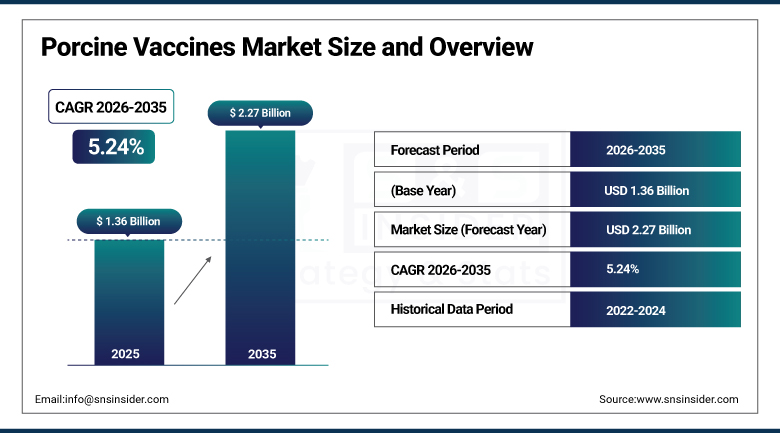
The Porcine Vaccines Market was valued at USD 1.36 Billion in 2025 and is projected to reach USD 2.27 Billion by 2035, expanding at a CAGR of 5.24% during the forecast period 2026–2035.
The porcine vaccines market keeps growing, mainly because commercial swine production is on the rise. More pigs means more disease risks, so there’s real pressure to focus on preventive healthcare in countries that produce a lot of pork. For pig producers, vaccination isn’t just helpful—it’s become a must for managing herd health. It cuts down on deaths, improves how efficiently animals turn feed into meat, and saves money by keeping big outbreaks, like PCV2, PRRS, Mycoplasma hyopneumoniae, and swine flu, in check. People everywhere want better quality pork, and governments keep tightening biosecurity rules to stop disease before it spreads.
On the tech side, things are moving fast. Companies are rolling out recombinant and vector-based vaccines, nucleic-acid options, better antigen design, and smarter ways to deliver shots. Vaccine makers keep pouring money into newer, broader vaccines—ones that handle more pathogens and don’t need as many doses. Just recently, in May 2025, the USDA announced fresh funding to help the country prepare for animal disease threats. They’re boosting support for tracking foreign diseases, stepping up veterinary diagnostics, and strengthening biosecurity for livestock nationwide.
To Get more information On Porcine Vaccines Market - Request Free Sample Report
Porcine Vaccines Market Trends
-
Increasing adoption of recombinant and next-generation veterinary vaccine technologies.
-
Growing investments in precision livestock health monitoring and biosecurity.
-
Rising commercialization of nucleic-acid veterinary vaccine platforms globally.
-
Expansion of disease surveillance supporting preventive swine vaccination programs.
-
AI-assisted livestock health analytics improving vaccination planning and disease control.
The U.S. Porcine Vaccines Market Size Outlook
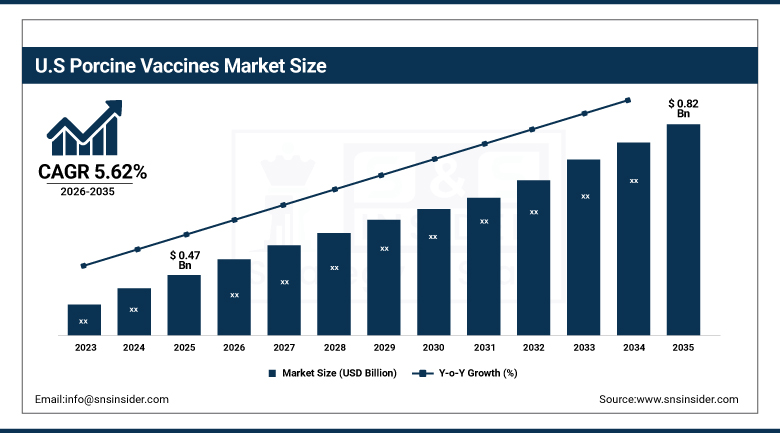
The U.S. Porcine Vaccines Market was valued at USD 0.47 billion in 2025 and is expected to reach approximately USD 0.82 billion by 2035, expanding at a CAGR of 5.62% during 2026–2035.
The U.S. dominates the North American porcine vaccine market, and honestly, it’s easy to see why. With a massive commercial swine industry and some of the best veterinary support around, the country puts real muscle into keeping diseases out of its huge pork operations. Big farms don’t take chances—they stick to strict vaccination plans to protect their herds from respiratory and reproductive problems and make sure their pork meets export standards. But it doesn’t stop with just following routines. Companies in the U.S. keep pushing forward, investing in better vaccines, building state-of-the-art diagnostic labs, using genetic tools to track disease, and rolling out smarter management systems for their livestock.
As technology progresses, more is at hand on farms to manage, control and produce safely. Farms are employing the internet for monitoring livestock, leveraging data and artificial intelligence to track overall herd health, pinpoint diseases earlier with smart technological measures, and carefully managing everything from vaccination to facility cleaning right down to the day, ensuring the U.S. Pig is prepared. This expanded level of data and surveillance was solidified Jan. 1, 2025, when the National Pork Board broadened producers' knowledge and tools, especially for swine disease detection and prevention, bio-security procedures, herd management.
Porcine Vaccines Market Segmentation Analysis
-
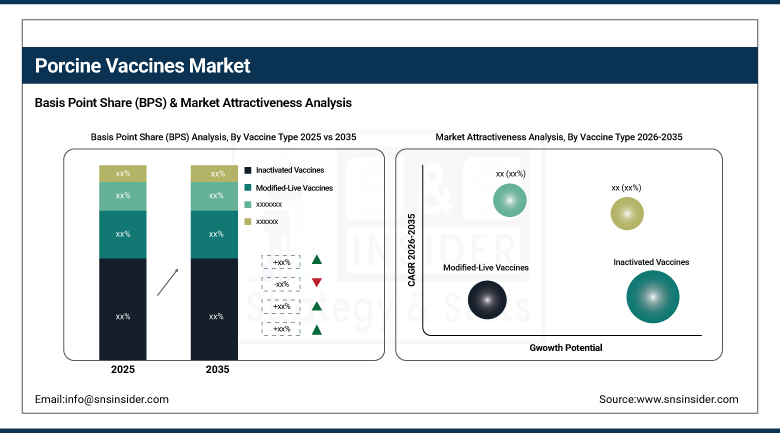
By Vaccine Type, inactivated vaccines dominated the market with 31.00% share in 2025, while subunit & nucleic-acid vaccines are projected to witness the fastest growth with 9.99% CAGR during the forecast period.
-
By Disease Type, porcine circovirus type 2 dominated the market with 25.00% share in 2025, while porcine reproductive & respiratory syndrome is projected to witness the fastest growth with 6.16% CAGR during the forecast period.
-
By Route of Administration, intramuscular dominated the market with 66.00% share in 2025, while intradermal is projected to witness the fastest growth with 8.55% CAGR during the forecast period.
-
By End User, commercial pig farms dominated the market with 54.00% share in 2025, while Breeding Farms & Genetic Companies are projected to witness the fastest growth with 5.81% CAGR during the forecast period.
By Vaccine Type, inactivated vaccines dominated, while subunit & nucleic-acid vaccines grows fastest.
The inactivation method accounted for 31.00% of the pig vaccines market in 2025 and holds first place among vaccine types owing to extensive reputation regarding safety, availability, and familiarity with intensive swine farming. The inactivation method is generally employed in herd management plans to avoid viral and bacterial pathogens whereas also curbing transmission risk through vaccines; efficacy with vaccine programs drives their effectiveness on ground and also their approval by relevant authority. In 2025 Zoetis kept growing its biological products by investing in new vaccine ideas and herd health solutions helping to manage diseases in commercial pork production.
Subunit & nucleic-acid vaccines are expected to grow the fastest with a CAGR of 9.99% from 2026 to 2035 because of progress in veterinary biotechnology, molecular immunology and precise antigen creation. These new vaccines provide safety, focused immune reactions and more options against new types of pathogens compared to old methods. More money is being put into DNA-. Rna-based vaccines for animals and more people are interested, in fast-response vaccine technologies. In 2026 Ceva Santé Animale kept building research partnerships focused on veterinary vaccine technologies and better ways to vaccinate food-producing animals.
By Disease Type, porcine circovirus type 2 dominated, while porcine reproductive & respiratory syndrome grows fastest.
Porcine circovirus type 2 (PCV2) made up 25.00% of market revenue in 2025 because of its ongoing economic impact on commercial pig production around the world. PCV2 infections are linked to growth performance, weaker immunity, higher chances of secondary infections and big productivity losses which is why vaccination is a standard part of managing pig herds. Ongoing monitoring programs, vaccination advice and the success of available PCV2 vaccines have led to very high rates of vaccination. In 2025 Boehringer Ingelheim Animal Health kept supporting swine disease prevention programs by expanding veterinary training and offering more commercial vaccines that target major diseases in pig production.
Porcine reproductive & respiratory syndrome (PRRS) is expected to have the CAGR of 6.16% during the forecast period because of the way the disease keeps changing the large economic pressure it creates and the growing number of cases in swine-producing areas around the world. PRRS is still one of the infectious diseases to deal with when it comes to reproductive issues and breathing problems, which is why there is a lot of focus on better vaccine technologies. In 2025 companies in the industry worked together on research projects that aimed to create better PRRS vaccines and use better methods to watch for diseases at the molecular level to help improve immunity, in pig herds and control outbreaks.
By Route of Administration, intramuscular dominated, while intradermal grows fastest.
Intramuscular administration had the share of 66.00% in 2025 because it has proven clinical effectiveness, clear vaccination guidelines and works with most pig vaccines available on the market. Veterinary professionals and people who raise pigs still choose delivery because it gives strong immune responses makes it easy to give the right amount of medicine and is approved by many regulations for different types of vaccines. In 2025 several companies that make veterinary tools expanded their automated ways to vaccinate animals. These new technologies help make injections more accurate treat animals better and save time when giving vaccines to a lot of animals at once.
Intradermal administration is expected to grow the most with a CAGR of 8.55% until 2035. This is because more people want needle- ways to give vaccines better care for animals and stronger immune reactions using less vaccine. Intradermal methods cause harm to the skin lower the chance of spreading germs and keep workers safer while helping to vaccinate a lot of animals quickly. More improvements in needle- tools and precise ways to give vaccines will help more pig farms use these methods. In 2026 HIPRA kept pushing for needle- intradermal vaccination methods for pigs. They helped make vaccination faster and better for biosecurity, in pig farming.
Regional Analysis
|
Region |
Major Country |
Share within Region, 2025 (%) |
|---|---|---|
|
North America |
United States |
89.00% |
|
Europe |
Germany |
25.00% |
|
Asia Pacific |
China |
24.00% |
|
Middle East & Africa |
UAE |
8.00% |
|
Latin America |
Brazil |
4.00% |
North America Porcine Vaccines Market Insights
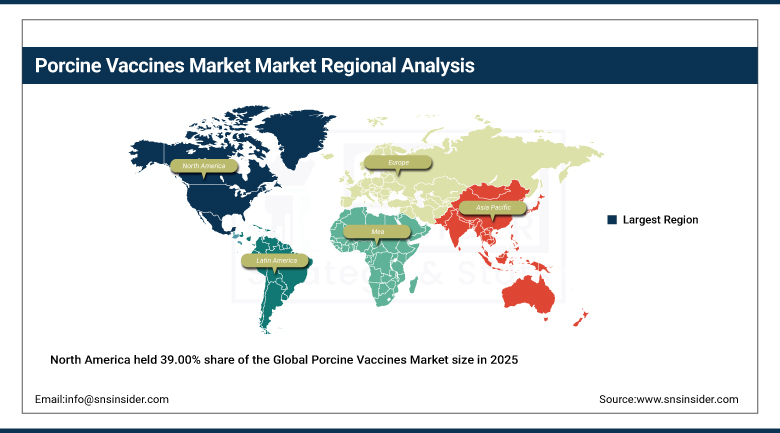
North America held 39.00% share of the Global Porcine Vaccines Market size in 2025, due to highly industrialized pork sector, predominant veterinary preventative health management, and continued investments in surveillance of animal diseases, along with the implementation of best practices like comprehensive vaccination programs by swine commercial producers across US and Canada targeting most economic related infectious porcine diseases like porcine reproductive and respiratory syndrome (PRRS), porcine circovirus type 2, Mycoplasma hyopneumoniae, and swine flu to increase herd yield and optimize operational efficiencies. In 2025, USDA sustained in enhancement of National Animal Health Laboratory Network (NAHLN) through expanded support of animal diseases surveillance and veterinarian diagnostic functions across the US.
Get Customized Report as per Your Business Requirement - Enquiry Now
Europe Porcine Vaccines Market Insights
Europe remains the most mature porcine market for animal vaccines, underpinned by a highly controlled animal health infrastructure that has disease monitoring systems and an organized commercial swine base in place. For countries such as Germany, Spain, Denmark, France, and the Netherlands that host significant commercial pig populations, preventative vaccine strategies have been fundamental in herd management. Growing scrutiny by governments over increasing the use of antimicrobials for food animals is boosting the demand for herd-health vaccines that strengthen immunity while maintaining productivity. In 2025 The European Agency for the Evaluation of Medicines (EMEA) in its continuing work on implementing antimicrobials stewardship best practices supported programs to enhance animal prevention efforts to boost vaccination.
Asia Pacific Porcine Vaccines Market Insights
The Asia Pacific porcine vaccine market is poised to grow the fastest with a CAGR of 5.67% from the forecast period attributed to increasing commercial swine farming, increased consumption of pork and governmental efforts aimed at boosting livestock disease control. Countries like China, Vietnam, India, South Korea, Japan, and Southeast Asia are investing in veterinary infrastructure, disease surveillance systems and commercial biosecurity following recurring episodes of high-priority swine diseases. By 2025, the Ministry of Agriculture and Rural Affairs of China continued implementing tighter national swine disease surveillance, control and vaccination programs to enhance the nation's biosecurity and maintain stable pork supplies subsequent to disease control action.
Middle East & Africa and Latin America Porcine Vaccines Market Insights
The Middle Eastern and African region is gradually growing as a result of enhancements within veterinary infrastructure for livestock, increasing investment into commercial swine farming enterprises, growing adoption in the field of infectious diseases prevention through the use of biologics and initiatives by national authorities across countries like Saudi Arabia, UAE & South Africa are working towards promoting the use of biologics within these geographies while working toward enhancing livestock biosecurity by supporting more robust animal health measures and livestock disease prevention programs, thereby supporting the domestic and international trade of various swine related agricultural goods including animal health biologics .
This trend towards supporting animal health is likely to continue over the coming period with advancements occurring within the commercial and professional application of livestock disease surveillance, better and stronger veterinary infrastructure & logistical capabilities (including cold chain solutions for animal vaccines) and a consistent increase in the application of technology for sustainable, large scale livestock management. In 2025 Brazil's Ministry of agriculture & livestock (MAPA) was working on solidifying various initiatives geared towards strengthening national animal health surveillance as well as the ongoing efforts in promoting the development & propagation of livestock disease prevention solutions to bolster the growth of commercial swine and enhance the export capabilities of the South American nation.
Growth Drivers: Increasing occurrence of swine infections will expand preventive vaccination.
The growing occurrence of economically important swine infectious diseases continued to be among the potentest growth drivers for the Porcine Vaccines Market. Diseases such as Porcine Reproductive & Respiratory Syndrome (PRRS), Porcine Circovirus Type 2 (PCV2), Mycoplasma hyopneumoniae, swine influenza caused production losses through poor growth, fertility failure and mortality along with high vet expenses. While swine production becoming progressively intensive, producers aimed for preventive vaccination instead of reactionary disease management to enable the herd sustain performance & abide by nation & global animal health rules. In 2025, the OIE continued endorsing stringent animal disease monitoring vaccination and biosecurity to strengthen livestock health resistance and scale down global impact of trans boundary animal diseases.
Restraints: Rapid mutation rates of viruses, cost high in the development and the market is unable to grow.
Despite the optimistic long-term market potential for veterinary vaccines, challenges persist, including the fast evolution of viral pathogens and the high cost of developing next generation veterinary vaccines. Viruses such as the PRRS virus possess a large degree of genetic variation and as a result, current veterinary vaccine formulations have shorter useful lifetimes and constant research is needed to ensure ongoing efficacy against increasingly dominant strains. The United States Department of Agriculture maintained funding of collaborative research projects during the 2025 calendar year that aimed to increase preparedness against emerging livestock diseases by advancing the field of veterinary biologic research and diagnostic technology.
Opportunities: Use of recombinant and precision veterinary vaccine technologies to enable future growth.
Significant market opportunities for producers of next generation porcine vaccine technologies are being created as a result of rapid advances in veterinary biotechnology. Utilising recombinant/vector/nucleic acid/antigen precision engineering and needle free delivery platforms will result in greater efficacy, breadth of pathogen coverage and safety profiles. In this model genomic data and artificial intelligence enabled predictions will be mapped to precision livestock farming for application such as producer-defined vaccines depending on herd conditions in 2026. HIPRA began ramping up engagement activities around implementation of high-tech swine immunization, focused on precision vaccination platforms, refinement to intradermal technologies and further applications in the commercial swine herd market.
Recent Developments
-
2026: Zoetis expanded its swine vaccine innovation efforts by advancing research into next-generation biologics and integrated herd health solutions designed to improve disease prevention across commercial pig production.
-
2025: Boehringer Ingelheim Animal Health continued strengthening its global swine health portfolio through expanded veterinary education programs and disease prevention initiatives supporting commercial pork producers.
-
2025: HIPRA continued expanding adoption of its needle-free intradermal vaccination technologies for swine, supporting improved vaccination efficiency, animal welfare, and farm biosecurity.
-
2025: Merck Animal Health enhanced its livestock disease management initiatives through continued investment in veterinary vaccines, digital monitoring technologies, and precision animal health solutions for commercial swine production.
Porcine Vaccines Market Key Players are:
-
Elanco Animal Health Incorporated
-
Ceva Santé Animale
-
HIPRA
-
Phibro Animal Health Corporation
-
Virbac S.A.
-
Vaxxinova International B.V.
-
Biogénesis Bagó S.A.
-
IDT Biologika GmbH
-
Hester Biosciences Limited
-
Indian Immunologicals Limited
-
Biovac Ltd.
-
KM Biologics Co., Ltd.
-
FATRO S.p.A.
-
Laboratorios Calier S.A.
-
Harbin Veterinary Research Institute
-
Ringpu (Tianjin) Bio-Pharmacy Co., Ltd.
-
ChengDu Tecbond Biological Products Co., Ltd
Porcine Vaccines Market Report Scope:
| Report Attributes | Details |
|---|---|
| Market Size in 2025 | USD 1.36 Billion |
| Market Size by 2035 | USD 2.27 Billion |
| CAGR | CAGR of 5.24% From 2026 to 2035 |
| Base Year | 2025 |
| Forecast Period | 2026-2035 |
| Historical Data | 2022-2024 |
| Report Scope & Coverage | Market Size, Segments Analysis, Competitive Landscape, Regional Analysis, DROC & SWOT Analysis, Forecast Outlook |
| Key Segments | • By Vaccine Type (Inactivated Vaccines, Modified-Live Vaccines, Recombinant & Vector-Based Vaccines, Subunit & Nucleic-Acid Vaccines, Autogenous & Other Vaccines) • By Disease Type (Porcine Circovirus Type 2, Porcine Reproductive & Respiratory Syndrome, Mycoplasma hyopneumoniae, Swine Influenza, Others) • By Route of Administration (Intramuscular, Oral, Intradermal, Intranasal, Others) • By End User (Commercial Pig Farms, Breeding Farms & Genetic Companies, Veterinary Hospitals & Clinics, Government Vaccination Programs, Others) |
| Regional Analysis/Coverage | North America (US, Canada), Europe (Germany, UK, France, Italy, Spain, Russia, Poland, Rest of Europe), Asia Pacific (China, India, Japan, South Korea, Australia, ASEAN Countries, Rest of Asia Pacific), Middle East & Africa (UAE, Saudi Arabia, Qatar, South Africa, Rest of Middle East & Africa), Latin America (Brazil, Argentina, Mexico, Colombia, Rest of Latin America). |
| Company Profiles | Zoetis Inc., Merck Animal Health, Boehringer Ingelheim Animal Health, Elanco Animal Health Incorporated, Ceva Santé Animale, HIPRA, Phibro Animal Health Corporation, Virbac S.A., Vaxxinova International B.V., Biogénesis Bagó S.A., IDT Biologika GmbH, Hester Biosciences Limited, Indian Immunologicals Limited, Biovac Ltd., KM Biologics Co., Ltd., FATRO S.p.A., Laboratorios Calier S.A., Harbin Veterinary Research Institute, Ringpu (Tianjin) Bio-Pharmacy Co., Ltd., ChengDu Tecbond Biological Products Co., Ltd. |
Frequently Asked Questions
The market is projected to reach USD 2.27 Billion by 2035.
The market is anticipated to expand at a CAGR of 5.24% during the forecast period.
North America dominated the global Porcine Vaccines Market in 2025 with a 39.00% revenue share.
Inactivated Vaccines accounted for the largest revenue share of 31.00% in 2025.
