
Poultry Market Report Scope & Overview:
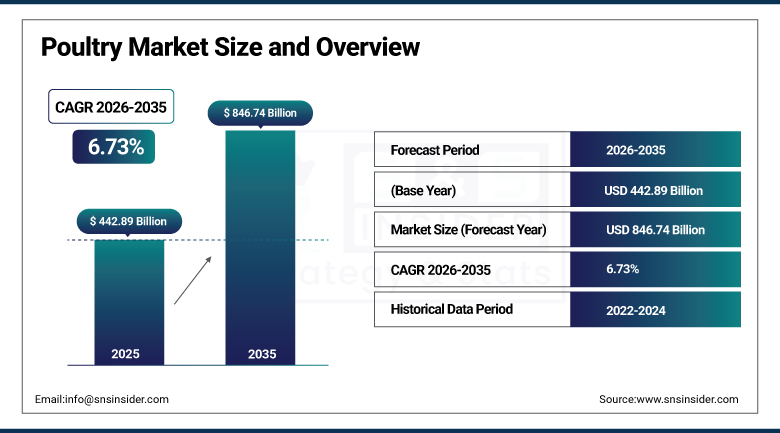
The Poultry Market was valued at USD 442.89 billion in 2025 and is projected to reach USD 846.74 billion by 2035, expanding at a CAGR of 6.73% during the forecast period 2026–2035.
The market growth will be driven by the trends of urbanization, changing dietary practices and disposable income levels, as well as the preference for cost effective, protein rich food products. Advances in breeding practices, feeding, disease control and processing technology have led to higher productivity in the organized poultry sector. The market growth will also be propelled by the rising demand for processed and ready-to-cook poultry meat along with the surge in quick service restaurants, supermarkets and online grocery stores. Exports, livestock development efforts and biosecurity will also boost the global poultry industry performance.
In 2025, JBS announced an investment of USD 70 million in Paraguay through the acquisition and upgrading of its chicken processing plant Pollos Amanecer to increase its number of processed chickens to 100,000 birds per day. This means more poultry exports from Paraguay from hatcheries, feed mills and production plant.
To Get more information On Poultry Market - Request Free Sample Report
Poultry Market Trends
-
Increasing demand for high-protein and affordable poultry products is driving investments in poultry production, processing capacity, and integrated farming operations to meet rising global consumption.
-
Growing adoption of automation, precision farming, and advanced biosecurity technologies is improving poultry productivity, animal health monitoring, feed efficiency, and overall operational performance.
-
Rising investments in poultry processing infrastructure and export-oriented production are expanding global supply chains, as demonstrated by JBS's investment to modernize and expand poultry processing capacity in Paraguay.
-
Expanding consumer preference for value-added and ready-to-cook poultry products is encouraging manufacturers to diversify product portfolios and strengthen distribution through supermarkets, food service, and e-commerce channels.
-
Increasing focus on sustainable poultry farming and integrated production systems is promoting investments in modern hatcheries, feed mills, environmentally efficient production facilities, and resource optimization to improve long-term industry competitiveness.
U.S. Poultry Market Outlook
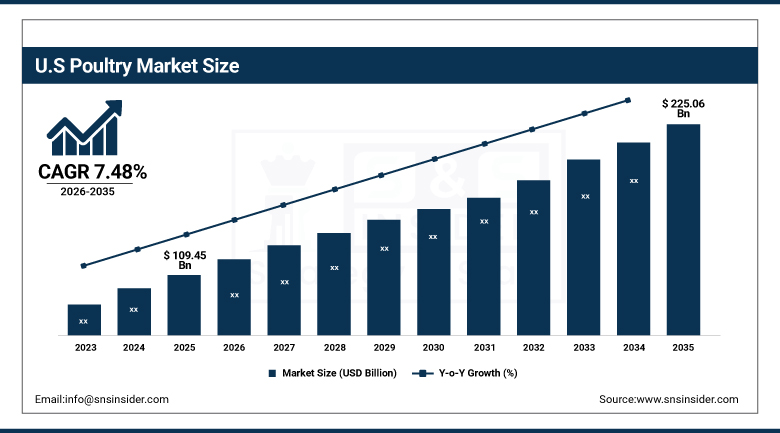
The U.S. Poultry Market was valued at USD 109.45 billion in 2025 and is projected to reach USD 225.06 billion by 2035, expanding at a CAGR of 7.48% during the forecast period.
The U.S. market is witnessing constant growth due to investments in poultry processing plants, automation equipment and logistics management. The increasing demand in the food service industry, the growth of consumption of ready-to-cook poultry, and advancements in poultry breeding and nutrition are the factors that favor market growth. Growing poultry production in Canada, improvements in the product processing and increased demand for quality poultry among consumers are factors contributing to the growth of the regional market.
In 2025, Tyson Foods agreed to buy a former Cargill turkey processing plant in Arkansas. “This deal shows a trend of efficiently leveraging existing poultry processing capacities in an effort to increase production efficiency, strengthen local supply chains and satisfy the needs of consumers while saving money on capital investments amid high prices for feedstock.
Poultry Market Segment Analysis
-
By Product Type, Meat dominated the Poultry Market with a 74.60% share in 2025, while Eggs are the fastest-growing product type segment with a CAGR of 7.46% from 2026–2035.
-
By Nature, Organic dominated the Poultry Market with an 86.70% share in 2025, while Conventional is the fastest-growing nature segment with a CAGR of 10.91% from 2026–2035.
-
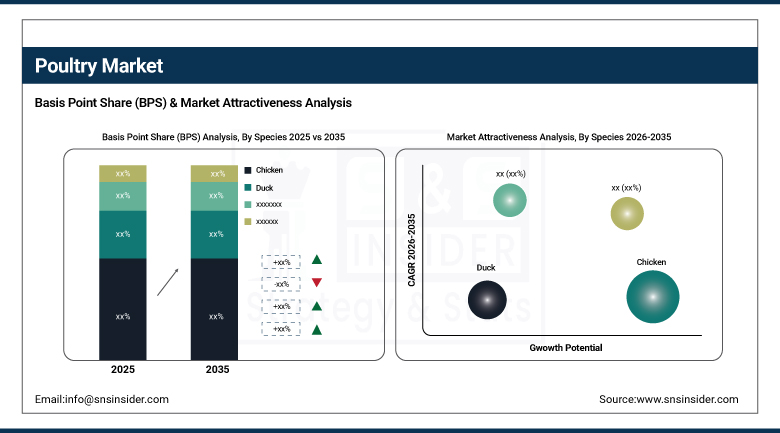
By Species, Chicken dominated the Poultry Market with a 69.80% share in 2025, while Duck is the fastest-growing species segment with a CAGR of 7.78% from 2026–2035.
-
By Distribution Channel, B2B dominated the Poultry Market with a 31.20% share in 2025, while Online Retail is the fastest-growing distribution channel segment with a CAGR of 11.39% from 2026–2035.
By Product Type, Meat dominated the Poultry Market, while Eggs are expected to register the fastest CAGR during the forecast period 2026–2035
Meat segment dominated the poultry market with 74.60% share in 2025. The dominance of this industry is attributed to the growing global demand for chicken, turkey and duck meat, as they are cheap and rich in proteins. Growth of the market is attributed to the rising consumption of fresh, frozen and processed poultry products, and expansion of quick service restaurants and food retail chains. The production process and cold storage have been improved to make poultry meat easily accessible and affordable around the world.
Eggs segment is projected to grow at the fastest CAGR of 7.46% during 2026–2035. Growth is driven by increasing consumer demand for healthy and high protein foods and increasing demand for eggs in household and food processing applications. The segment growth is expected to be driven by increasing awareness about health benefits of eggs and growing demand for value-added and fortified egg products.
By Nature, Organic dominated the Poultry Market, while Conventional is expected to register the fastest CAGR during the forecast period 2026–2035
Organic segment dominated poultry market by revenue share of 86.70% in 2025. The dominance of this segment is maintained due to commercial poultry farming, efficient production methods and high demand from the consumers for economical poultry meat and eggs. Large poultry farms still enjoy economies of scale, sophisticated breeding practices and well-developed supply chain management. Increase in production efficiency, large scale distribution networks and accessibility through supermarkets, food service providers and retail establishments are helping to augment the growth of the market. Investments in processing facilities and quality control processes help to maintain the segment’s dominance in the global markets.
Conventional segment is anticipated to grow at the fastest CAGR of 10.91% during the forecast period. The growth in this segment will be propelled by increasing consumer demand for high quality poultry products produced with the best farming standards. The growing awareness of people towards food safety, sustainability and clean label products is pushing producers to improve their certified poultry production. Retailers are giving more space on their shelves to premium poultry products, and the government is promoting sustainable agriculture. Organic feed production, disease control and farm management technology improvements are increasing productivity.
By Species, Chicken dominated the Poultry Market, while Duck is expected to register the fastest CAGR during the forecast period 2026–2035
Chicken segment dominated the poultry market with a revenue share of 69.80% in 2025. Chicken takes a leading place in the market because this kind of poultry meat is the most popular in the world due to its affordability and nutritional value. Commercial farming, efficient ratio between the feed and growth of birds, and short cycles of production help to produce more chicken to satisfy the growing demand. Moreover, the market is growing due to the increasing consumption of chicken in restaurants, fast food chains, institutional catering and retail trade. Regular improvements in poultry genetics, disease prevention, processing and cold chain help to ensure production and distribution of chicken on a global scale.
Duck meat is projected to be the fastest growing meat type among the segments analyzed. The CAGR of duck will be 7.78% in 2026-2035. The increasing trend towards premium foods, popularity of Asian cuisine and the increasing need for specialty meat products contribute to the market development of duck meat. The diversification of protein sources by people is driven by increasing incomes and evolving consumer preferences, moving beyond traditional types of poultry meat. Breeding and nutrition of ducks and production of ducks in commercial farms.
By Distribution Channel, B2B dominated the Poultry Market, while Online Retail is expected to register the fastest CAGR during the forecast period 2026–2035
B2B market dominated poultry market in terms of revenue generation and held 31.20% market share in 2025. This segment continues to have the largest market share due to high buying by food processing plants, hotels, restaurants, institutional canteens and catering services. Long-term supply contracts for poultry produce between producers and commercial buyers ensure a steady flow of product and a constant demand. The B2B sales in the poultry market are driven by the growth of the food processing industry and increasing consumption of poultry items in the hospitality and food service segments.
Online Retail segment is expected to witness the fastest CAGR of 11.39% during the forecast period. The growth of the online sales of poultry produce is being driven by the rising trend towards online grocery shopping, door-step delivery services and the convenience provided by these means. Better logistics such as cold chain and online payment system ensure easy access to products and build consumer trust. Retailers have begun to offer subscription services, same-day delivery and personalized promotional schemes to woo consumers. Growing adoption of smartphones and internet connection and changing consumer behavior are expected to drive the online sales of poultry products globally during the forecast.
Regional Analysis
|
Region |
Major Country |
Share within Region, 2025 (%) |
|---|---|---|
|
North America |
United States |
82.71% |
|
Europe |
United Kingdom |
31.18% |
|
Asia Pacific |
China |
36.94% |
|
Middle East & Africa |
UAE |
25.11% |
|
Latin America |
Brazil |
46.27% |
North America Poultry Market Insights
The North American regional market is expected to grow at the fastest CAGR of 8.32% during the forecast period from 2026 to 2035. This can be attributed to rising consumption of poultry products, well developed infrastructure for poultry production, rising demand for protein-based food items and presence of key players in the poultry industry. The US remains a major player with a large number of poultry farms, advanced processing facilities, growing domestic demand and investment aimed at enhancing production efficiency.
U.S. poultry market expansion continues due to rising chicken meat and processed poultry product consumption in the food and retail sectors. This is driven by technology developments in the poultry farming industry and processing units as well as a focus towards sustainability in the production. The steady growth is also reflected by the increasing consumption of poultry in Canada, and the growth of commercial farming and investment in poultry production systems. The regional expansion is expected during the forecast period, owing to the increasing demand for affordable animal protein, production capabilities, and advanced technologies for poultry management.
Europe Poultry Market Insights
Europe was among the major contributors to the poultry market in 2025 owing to the presence of a well-established ecosystem of poultry production, sophisticated processing facilities, and high demand for poultry products. This is due to the application of advanced agricultural techniques, stringent food safety measures, and increasing use of sustainable practices of poultry production. Some of the countries that play a significant role in driving the growth of the region are the United Kingdom, Germany, France, Italy, and Spain.
Increasing preference for organic and responsible poultry production owing to consumers' growing inclination towards healthier and sustainable products is driving the demand in the European poultry market. Adoption of modern breeding methods, automation, and efficient logistics management are leading to an increase in the production efficiency in Europe. Increasing adoption of animal welfare practices, alternative feeding, and environmentally sustainable practices of poultry farming is likely to drive the growth of the market during the forecast period.
Asia Pacific Poultry Market Insights
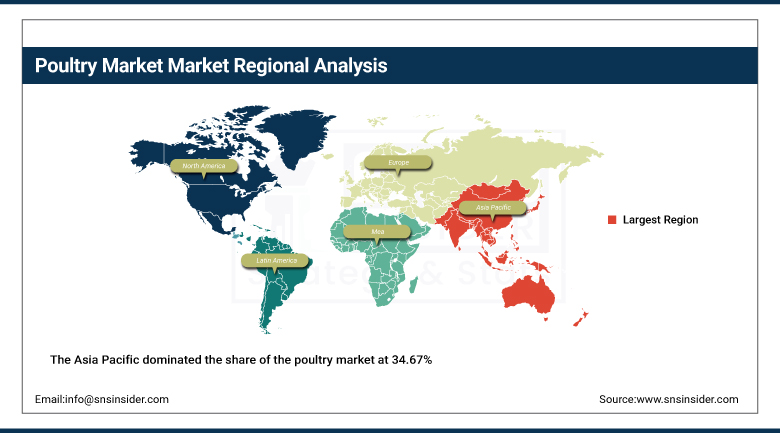
The Asia Pacific dominated the share of the poultry market at 34.67%. Some of the factors influencing the growth of the poultry market in the region include the increase in the population, rise in disposable income, urbanization, and the need for cheap sources of proteins. The Chinese segment is a key player in the market within the region, which is attributed to increased poultry production, processing, and consumption of the same. Countries such as India, Japan, and Southeastern nations have witnessed an increase in poultry consumption due to change in diets and investment in poultry farming.
Advanced use of poultry technology, automated farming and effective measures in managing poultry diseases have been seen in Asia Pacific, making the production process more efficient. Investments in cold storage system, processed poultry foods, and organized retail trade have played a role in driving the market forward in the region. Despite the disease outbreaks and fluctuating cost of feed in the region, food security programs and modernization of poultry production is bound to propel the market.
Get Customized Report as per Your Business Requirement - Enquiry Now
Middle East & Africa and Latin America Poultry Market Insights
Latin America and Middle East & Africa are emerging regions for poultry products, facilitated by rising meat consumption, increasing capacity for poultry farming and rising investments in food security projects. In Latin America, Brazil emerges as one of the major contributors to the market, owing to the high capacity for poultry farming and exports in the country and also because of the efficient processing capacity in the country. Rising demand for frozen and processed poultry products presents new avenues for growth in the region.
In the case of the Middle East & Africa poultry market, rising population, increasing reliance on local food production and various government programs aimed at building the domestic poultry chain are some of the factors that will help boost the market in coming years. Investments in advanced farming systems and poultry production capacity in countries in the region is taking place as a measure of improving food security and reducing import dependency. However, problems like fluctuating feed costs, inadequate infrastructure and problems in managing disease may hinder growth in certain markets.
Market Dynamics
Growth Drivers: Rising demand for affordable animal protein and expansion of poultry production driving market growth
The global demand for products made from chicken has risen due to the growth in population, changing dietary habits of people, and increasing consumer preference for cost-effective sources of high-quality animal proteins. Chicken meat and eggs are used by many people all around the world due to their nutritional value and cost-effectiveness, not to mention that there are various uses for these products. Investments in the poultry industry, new breeds of chickens, efficient use of feeds, and modern processing facilities are driving the growth of the market in both developed and emerging markets. Various government support programs aimed at encouraging livestock production and poultry farming also boost industry growth.
Such technological innovations like automation on farms, use of artificial intelligence technology, precision feeding systems, and better disease control strategies allow improving the efficiency of production and increase it. The rising popularity of various biosecurity measures, climatically controlled housing conditions, and modern processing methods also help producers expand their production capabilities and reduce losses. Increased consumption of processed chicken meat and ready-to-cook meals will positively impact the growth of the poultry market.
Restraints: Disease outbreaks, rising feed costs, and regulatory challenges affecting market growth
There are some challenges facing the production process within the poultry industry because of escalating feed costs, avian diseases, and regulatory requirements. Rising prices of basic feed items like corn and soybean may cause increased cost of production. Avian diseases such as avian influenza can lead to supply chain interruptions as well as increased cost of production. Small and medium-scale poultry farms have problems integrating new farming technology because of the high capital involved and lack of funds.
Apart from that, stringent regulation requirements about antibiotics usage, sustainability, and animal welfare make it difficult for poultry producers to meet compliance requirements. Other factors that might impact market growth include supply chain interruption, labor shortages, and consumers' perception about animal protein consumption. These challenges keep affecting production efficiency and profitability despite the escalating demand for poultry products worldwide.
Opportunities: Expansion of sustainable poultry farming and technology-driven production solutions
There are ample growth opportunities in the poultry market because of increased use of sustainable practices, digitization, and improved production techniques. Companies are spending a lot of resources on developing advanced farming solutions, automation and data collection technologies and systems for managing resources and improving the health status of animals. Premium markets are emerging with increased demand for organic poultry products that do not include any antibiotics in them.
Some of the emerging markets for the poultry industry are Asia Pacific, Latin America, and Middle East & Africa because of growing consumption of proteins, urbanization, increased disposable income levels and poultry production. Companies are spending money on modernizing the processing facilities, cold storage chains and e-commerce delivery channels for better market access. Increasing focus on food security, sustainable agriculture and advanced poultry production systems will lead to increased use of poultry solutions in the coming years.
Recent Developments:
-
2025: John Bean Technologies completed the acquisition of Marel hf., forming JBT Marel Corporation and strengthening its position in automated poultry processing solutions. The merger combines advanced processing, chilling, freezing, robotics, and digital tracking technologies to support the industry’s shift toward full-line automation.
-
2025: Novonesis finalized the €1.5 billion acquisition of dsm-firmenich’s share in the Feed Enzyme Alliance, expanding its animal nutrition portfolio. The integration strengthens access to enzymes and probiotics that improve poultry gut health, feed efficiency, and overall production performance.
-
2026: China’s chicken meat exports increased significantly due to government support, subsidies, and expansion by large integrated poultry producers. Rising processing capacity and strong production volumes helped China strengthen its position in global poultry trade and meet growing international protein demand.
-
2025: JBS subsidiary Seara Alimentos expanded its poultry operations through acquisitions of Pico Paco Ltda. and Céu Azul Alimentos Ltda. in Brazil. The strategic investments strengthen JBS’s poultry processing capabilities, supply chain integration, and market presence in the regional poultry industry.
Poultry Market key players are:
-
Tyson Foods, Inc.
-
JBS S.A.
-
BRF S.A.
-
Cargill Incorporated
-
WH Group Limited
-
Pilgrim’s Pride Corporation
-
Sanderson Farms, Inc.
-
Perdue Farms Inc.
-
Charoen Pokphand Foods PCL (CP Foods)
-
Wen’s Food Group
-
Koch Foods Inc.
-
Industrias Bachoco S.A.B. de C.V.
-
Mountaire Farms
-
Foster Farms
-
Wayne-Sanderson Farms
-
Maple Leaf Foods Inc.
-
LDC (Lambert Dodard Chancereul)
-
Plukon Food Group
-
PHW-Gruppe
-
New Hope Liuhe Co., Ltd.
Poultry Market Report Scope:
|
Report Attributes |
Details |
|---|---|
|
Market Size in 2025 |
USD 442.89 Billion |
|
Market Size by 2035 |
USD 846.74 Billion |
|
CAGR |
CAGR of 6.73% From 2026 to 2035 |
|
Base Year |
2025 |
|
Forecast Period |
2026-2035 |
|
Historical Data |
2022-2024 |
|
Report Scope & Coverage |
Market Size, Segments Analysis, Competitive Landscape, Regional Analysis, DROC & SWOT Analysis, Forecast Outlook |
|
Key Segments |
• By Species (Chicken, Turkey, Duck, Others) |
|
Regional Analysis/Coverage |
North America (US, Canada), Europe (Germany, UK, France, Italy, Spain, Russia, Poland, Rest of Europe), Asia Pacific (China, India, Japan, South Korea, Australia, ASEAN Countries, Rest of Asia Pacific), Middle East & Africa (UAE, Saudi Arabia, Qatar, South Africa, Rest of Middle East & Africa), Latin America (Brazil, Argentina, Mexico, Colombia, Rest of Latin America). |
|
Company Profiles |
Tyson Foods, Inc., JBS S.A., BRF S.A., Cargill Incorporated, WH Group Limited, Pilgrim’s Pride Corporation, Sanderson Farms, Inc., Perdue Farms Inc., Charoen Pokphand Foods PCL (CP Foods), Wen’s Food Group, Koch Foods Inc., Industrias Bachoco S.A.B. de C.V., Mountaire Farms, Foster Farms, Wayne-Sanderson Farms, Maple Leaf Foods Inc., LDC (Lambert Dodard Chancereul), Plukon Food Group, PHW-Gruppe, New Hope Liuhe Co., Ltd. |

Frequently Asked Questions
The major growth factor driving the Poultry Market is increasing global demand for affordable animal protein, rising poultry consumption, and expansion of commercial poultry farming.
