
Precision Fermentation Market Report Scope & Overview:
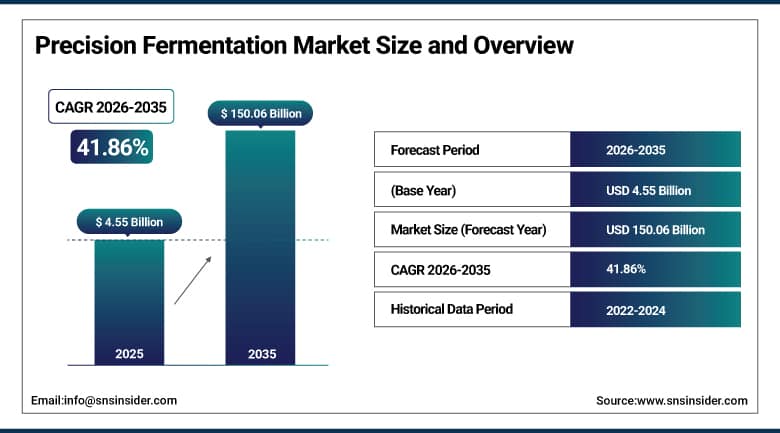
The Precision Fermentation Market was valued at USD 4.55 billion in 2025 and is expected to reach USD 150.06 billion by 2035, growing at a CAGR of 41.86% from 2026–2035.
The precision fermentation market is growing rapidly across the globe due to the rising demands for sustainable sources of proteins. Growing application of precision fermentation-based whey, casein, egg protein, and specialty lipids is aiding in the growth of the market within the foods & beverages industry. Growing investments in biotechnology firms and microbial engineering technology are aiding in speeding up innovation within precision fermentation ingredients. Rising preference among consumers for meat and dairy alternatives is aiding the growth of the market.
Policy interventions including but not limited to the Bioeconomy Executive Order in the US, Renewable Fuel Standard (RFS) in the US, Green Deal in Europe, and National Bio-Energy Mission in India have resulted in massive spending on renewable fuels and sustainable biotechnology innovations, thereby increasing the global demand for precision fermentation technologies. Precision fermentation technologies have been embraced across numerous sectors because of the rising importance of sustainable protein manufacturing, sustainable manufacturing processes, and bio-based ingredients due to regulatory policies and biotechnology funding programs.
To Get More Information On Precision Fermentation Market - Request Free Sample Report
Precision Fermentation Market Trends
-
Investments through venture capital funding, alongside government subsidies, are accelerating the acceptance of microbial fermentation technology.
-
The scope has evolved from soy proteins to whey, casein, egg proteins, heme, and specialty lipids.
-
Yeast has been widely utilized, but genetically engineered microorganisms and microalgae are rapidly gaining popularity as fermentation techniques.
-
Medication, cosmetic, and non-food sectors have started employing precision fermentation technology in multiple areas.
-
With ESG goals in mind, precision fermentation is more sustainable, with a lower carbon emission process than traditional protein production from animals.
The US Precision Fermentation Market Size Outlook
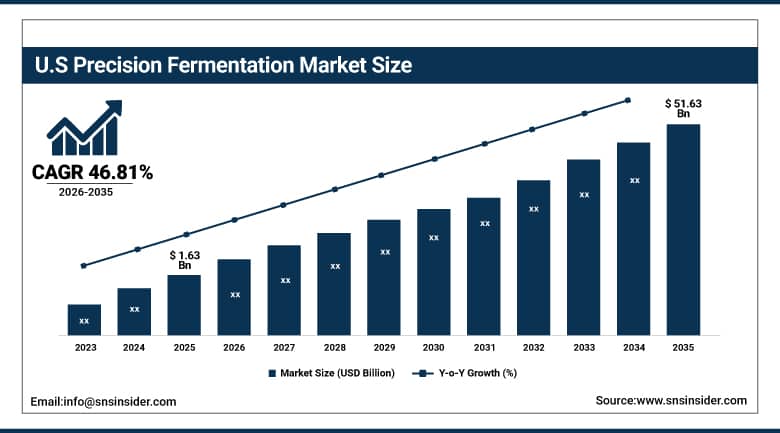
The US Precision Fermentation Market was valued at USD 1.63 billion in 2025 and is expected to reach around USD 51.63 billion by 2035, growing at a CAGR of 46.81% from 2026–2035.
US precision fermentation is considered to be one of the most advanced worldwide due to its considerable investment in biotech research. The increasing number of food and beverage products such as meat and dairy alternatives is aiding in the expansion of the market in the US. Among the major companies in this industry are Ginkgo Bioworks, Motif FoodWorks, and The EVERY Company. All these companies have focused on scaling and sustainability of their precision fermentation protein products.
TurtleTree Labs, which is a precision fermentation company from the United States, scaled up its commercial partnerships and capacity in 2025 to drive faster adoption of whey proteins without using any animals across all food and drink markets worldwide. The company enhanced its working relationships with leading consumer brands and produced more precision-fermented proteins for their use in sustainable milk alternatives.
Precision Fermentation Market Segment Analysis
-
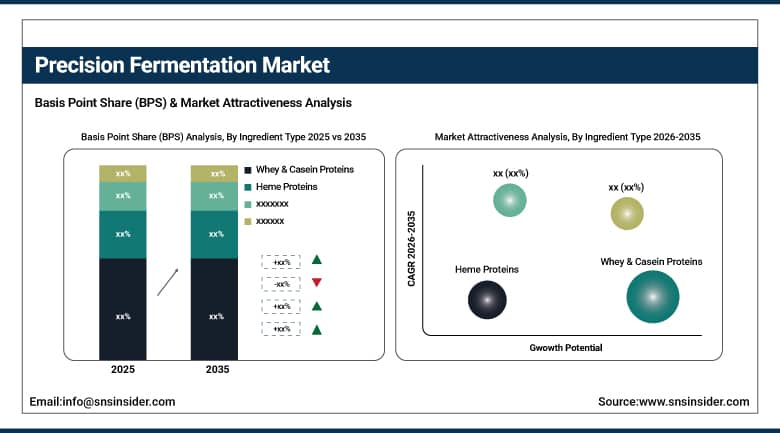
By Ingredient Type, whey & casein proteins segment dominated the precision fermentation market with 28.79% share in 2025, while heme proteins is the fastest growing segment.
-
By Microorganism, yeast segment dominated the precision fermentation market with 32.85% share in 2025, while genetically engineered microbes are the fastest growing segment.
-
By Application, dairy alternatives segment dominated the precision fermentation market with 50.63% share in 2025; meat and seafood are fastest growing CAGR segment.
-
By End User, food manufacturers dominated the precision fermentation market with 45.86% share in 2025, while biotechnology manufacturers are the fastest growing segment.
By Ingredient Type, whey & casein proteins segment dominate the precision fermentation market, while heme proteins are the fastest-growing segment.
Whey & casein were the major revenue-generators for the precision fermentation market in 2025 owing to growing demand for plant-based dairy products and sustainable sources of protein around the world. The growing trend of consumption of lactose-free, vegan, and environment-friendly food products is driving the demand for precision fermentation proteins. Significant investments made by food technology firms and alternative protein producers are contributing to the segment domination.
The heme proteins are projected to show maximum growth rates between 2026 and 2035 owing to increasing demand for plant-based meat products having better taste, texture, and similar meat characteristics. Growing investments and consumer acceptance towards alternative meats will drive their growth globally.
By Microorganism, yeast segment dominates the precision fermentation market, while genetically engineered microbes are the fastest-growing segment.
In 2025, yeast segment was the leading player in the market due to its highly efficient and scalable nature that helped in the production process. Yeast-based systems have excellent capabilities in producing proteins, cost-effectiveness, and easy acceptance from regulatory agencies for both food and biotechnology use. The growing adoption in the production of proteins, enzymes, and specialty ingredients will help maintain the dominance of this segment.
The genetically engineered microbes segment was predicted to exhibit the highest CAGR from 2026 to 2035 because of innovations in technologies such as synthetic biology and strain optimization technology. Genetically modified microorganisms have greater yield efficiency and customization capabilities, which help in manufacturing next-generation food products and pharmaceuticals.
By Application, dairy alternatives segment dominates the precision fermentation market, while meat and seafood are the fastest-growing segment.
The dairy alternatives segment dominates the precision fermentation market, driven by strong demand for animal-free dairy proteins such as whey and casein, along with increasing adoption of sustainable and clean-label food products. The segment benefits from rising consumer preference for lactose-free nutrition, plant-based dairy substitutes, and scalable fermentation technologies that replicate traditional dairy functionality.
Meat and seafood are expected to be the fastest-growing application segment in the precision fermentation market during the forecast period 2026–2035, supported by rising demand for sustainable protein sources and innovation in animal-free meat analogs. Advancements in cellular and microbial fermentation technologies are enabling the production of high-quality protein structures that closely mimic conventional meat and seafood products.
By End User, food manufacturers segment dominates the precision fermentation market, while biotechnology manufacturers are the fastest-growing segment.
Food producers segment accounted for a major share in the precision fermentation market in 2025 owing to growing inclusion of sustainable and animal-free ingredients into food products. With the growing need for alternative proteins and functional ingredients in addition to environmentally friendly food manufacturing, more and more food processors around the globe are adopting the technology.
Biotechnology manufacturers segment is estimated to have the highest CAGR between 2026 and 2035 due to the growing emphasis on synthetic biology, microbial engineering, and large-scale fermentation operations. The growing use of precision fermentation technologies in pharma, industrial biotechnology, and specialty ingredients production is fueling its growth in this segment.
Regional Analysis
|
Region |
Major Country |
Share within Region, 2025(%) |
|---|---|---|
|
North America |
United States |
84.73% |
|
Europe |
Germany |
35.84% |
|
Asia Pacific |
China |
31.74% |
|
Middle East & Africa |
UAE |
16.49% |
|
Latin America |
Brazil |
37.23% |
North America Precision Fermentation Market Insights
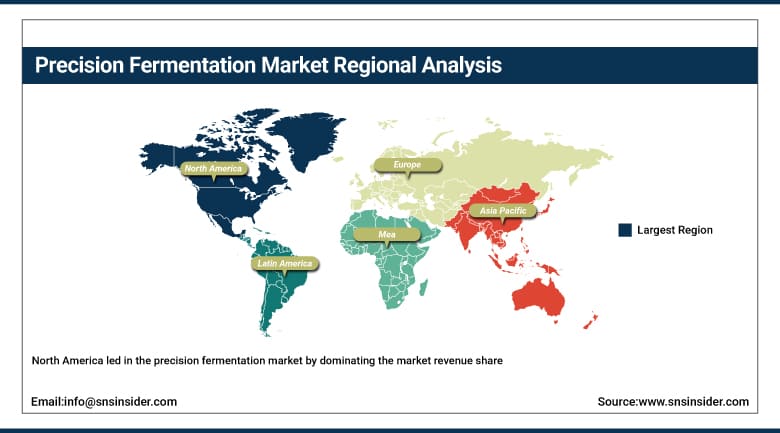
North America led in the precision fermentation market by dominating the market revenue share, which was estimated at around 42.31% during 2025. The strong biotechnology investments, growth in alternative protein production, and synthetic biology innovations in both the United States and Canada were significant reasons for North America’s market dominance. Growth in the need for dairy and animal-free protein alternatives as well as bio-based ingredients is driving the commercialization of precision fermentation products in the North American region.
To further back up the market supremacy of North America, it must be noted that executive orders, such as the US Bioeconomy Executive Order, have encouraged investments in precision fermentation technology. Furthermore, consumer interest in sustainable nutrition coupled with increased collaborations between biotechnology companies and large food industry players is increasing the use of precision fermentation.
Get Customized Report as Per Your Business Requirement - Enquiry Now
Europe Precision Fermentation Market Insights
The European continent is believed to be one of the most critical regions in the global precision fermentation market due to the high demand for sustainable proteins, alternatives dairy products, and bio-based foods in Europe. Countries like Germany, UK, France, Netherlands, and Italy have made significant contributions to the growth of the market by making more investment into biotechnology, synthetic biology, and sustainable food processing techniques. An increased inclination towards meat-free and eco-friendly products among consumers is pushing forward the acceptance of precision fermentation techniques.
Speaking about driving factors, the EU Green Deal and other bioeconomy policies announced by the European Commission are significantly boosting the investments in sustainable biotechnology as well as alternative protein production. Governments' support for food innovation, carbon neutrality, and novel fermentation technology is making the Precision Fermentation market grow at a strong pace in Europe.
Asia Pacific Precision Fermentation Market Insights
The Asia Pacific segment is projected to expand at the highest CAGR of about 43.83% from 2026–2035 due to the increase in investments in biotechnological innovation, alternative protein production, and sustainable food production in China, India, Japan, Singapore, and southeast Asia. The growing need for animal-free dairy products, functional food ingredients, and precision-fermented proteins is driving the commercialization of the fermentation technology within the region. The establishment of food tech startups, synthetic biology research, and fermentation facilities will continue to drive market growth in the region during the forecast period.
In this regard, the biotech innovations in China and the bioeconomy programs in India are increasing investments in precision fermentation research and sustainable protein manufacturing facilities. The government efforts towards food security, clean label nutrition, and the adoption of advanced biotechnology are driving market expansion in Asia Pacific.
Middle East & Africa and Latin America Precision Fermentation Market Insights
Middle East & Africa and Latin America regions have been experiencing consistent growth in the Precision Fermentation market owing to the rising investments in biotechnological innovations, sustainable food production, and alternative proteins. Some countries that are leading market growth in the MEA region include the UAE, Saudi Arabia, and South Africa, owing to their increased emphasis on food security, biotechnology innovation, and sustainable nutrition solutions. On the other hand, some leading countries that are fostering market growth in Latin America include Brazil and Mexico through investments in food technology and alternative protein manufacturing processes.
Further contributing, initiatives from Saudi Arabia, including its Vision 2030, and the biotechnology innovations in the UAE are promoting significant investments in sustainable food technology and precision fermentation technologies in the MEA region. The expansion in the bioeconomy programs and the modernization of food processing sectors in Brazil is also fuelling market growth in the Latin American region.
Market Dynamics
Growth Drivers: Rising demand for sustainable proteins and animal-free ingredients is accelerating adoption of precision fermentation technologies globally.
The rising consumer awareness and concern about sustainability in terms of environmental protection and cruelty-free and clean-label food are driving the demand for fermented-based ingredients. Many food manufacturing and biotech firms are focusing on developing innovative fermentation technology to create nutritionally superior and eco-friendly alternatives to animal-derived products. In addition, there is increasing attention on reducing greenhouse gas emission, water usage, and land utilization related to meat production using animals.
Restraints: High production costs and availability of low-cost conventional protein alternatives are limiting large-scale adoption of precision fermentation products globally.
Animal-derived protein sources and traditional food ingredients still continue to be more economical and accessible than precision-fermented proteins in several markets. Consumers and producers in economically disadvantaged countries have a greater preference for cheaper conventional foods, making it difficult to popularize costly precision-fermented products in such regions. Lack of awareness about precision-fermented proteins and sustainable biotechnological solutions among consumers is another hurdle preventing market entry into developing countries.
Opportunities: Rising advancements in synthetic biology and sustainable food technologies are creating significant opportunities for the precision fermentation market globally.
The development of technological advancements in microbial engineering, strain improvement, and fermentation process automation has widened the scope of business possibilities offered by precision fermentation technologies. Many businesses are becoming more inclined to manufacture more advanced animal protein-free proteins, specialty enzymes, functional lipids, and biobased ingredients with enhanced nutritional content, scalability, and manufacturing efficiency. The rising use of AI and automated fermentation processes has increased efficiency and cut down production costs.
Recent Developments
-
2026: Perfect Day increased its commercial manufacturing capabilities for animal-free whey protein in collaboration with strategic manufacturing partners, catering to the increasing worldwide demands for sustainable dairy products and precision-fermented nutritional ingredients in the food industry.
-
2025: Ginkgo Bioworks increased the scope of its artificial intelligence and microbial engineering technology platform and launched several biotechnology collaborations targeting precision fermentation, alternative proteins, and ingredient manufacturing, furthering its bioeconomy commercialization pipeline around the globe.
-
2025: Motif FoodWorks advanced the development of food ingredients and functional proteins using precision fermentation that could enhance the flavour and mouthfeel in plant-based foods, as well as expanded commercialization partnerships with food manufacturing companies worldwide.
-
2026: Formo increased its precision fermentation-based cheese and dairy ingredient line-up in European markets, bolstering production capacities and promoting the commercialization of sustainable dairy products without animals through biotechnology innovations and regulatory advancements.
Precision Fermentation Market Key Players are:
-
Perfect Day
-
Ginkgo Bioworks
-
Motif FoodWorks
-
Formo
-
TurtleTree Labs
-
Change Foods
-
The EVERY Company
-
New Culture
-
Remilk
-
Imagindairy
-
Eden Brew
-
Helaina
-
Clara Foods
-
Solar Biotech
-
Nourish Ingredients
-
Biomilq
-
MycoTechnology
-
Fermify
-
QL AG
Precision Fermentation Market Report Scope:
| Report Attributes | Details |
|---|---|
| Market Size in 2025 | USD 4.55 Billion |
| Market Size by 2035 | USD 150.06 Billion |
| CAGR | CAGR of 41.86% From 2026 to 2035 |
| Base Year | 2025 |
| Forecast Period | 2026-2035 |
| Historical Data | 2022-2024 |
| Report Scope & Coverage | Market Size, Segments Analysis, Competitive Landscape, Regional Analysis, DROC & SWOT Analysis, Forecast Outlook |
| Key Segments | • By Ingredient Type (Whey & Casein Proteins, Egg Proteins, Enzymes, Heme Proteins, Specialty Lipids, Vitamins & Nutraceuticals, Others), • By Microorganism (Yeast, Bacteria, Fungi, Microalgae, Genetically Engineered Microbes, Others), • By Application (Meat and Seafood, Dairy Alternatives, Egg Alternatives, Processed Food and Beverages, Skincare and Haircare Products, and Others), • By End User (Food Manufacturers, Biotechnology Companies, Pharmaceutical Companies, Nutraceutical Manufacturers, Research Institutes, Others) |
| Regional Analysis/Coverage | North America (US, Canada), Europe (Germany, UK, France, Italy, Spain, Russia, Poland, Rest of Europe), Asia Pacific (China, India, Japan, South Korea, Australia, ASEAN Countries, Rest of Asia Pacific), Middle East & Africa (UAE, Saudi Arabia, Qatar, South Africa, Rest of Middle East & Africa), Latin America (Brazil, Argentina, Mexico, Colombia, Rest of Latin America). |
| Company Profiles | Perfect Day, Ginkgo Bioworks, Motif FoodWorks, Formo, TurtleTree Labs, Change Foods, The EVERY Company, New Culture, Remilk, Imagindairy, Eden Brew, Helaina, Clara Foods, Solar Biotech, Nourish Ingredients, Biomilq, MycoTechnology, Fermify, QL AG, Better Dairy. |
Frequently Asked Questions
North America dominated the Precision Fermentation market in 2025.
The dairy alternatives segment dominated the Precision Fermentation market in 2025.
The major growth factor is the rising demand for alternative proteins and sustainable food solutions, supported by increasing investments in biotechnology, consumer preference for dairy and meat substitutes, and government incentives for low-carbon food technologies.
The Precision Fermentation market was valued at USD 4.55 billion in 2025.
The Precision Fermentation market is expected to grow at a CAGR of 41.86% from 2026 to 2035.
