
Printed Circuit Board Assembly Market Report Scope and Overview:
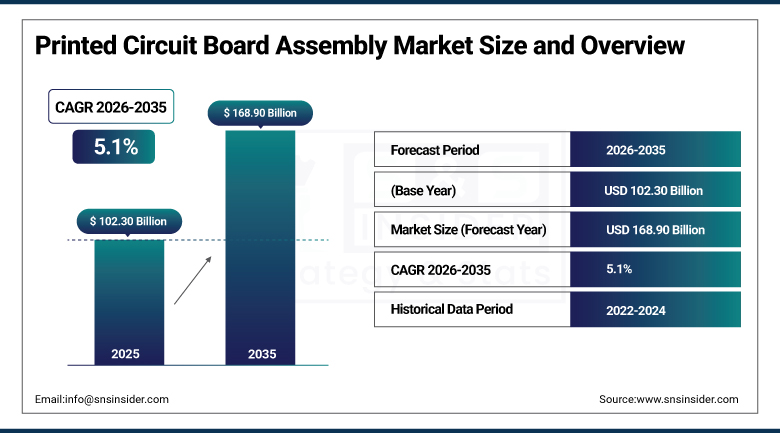
The Printed Circuit Board Assembly Market size was valued at USD 102.30 Billion in 2025 and is projected to reach USD 168.90 Billion by 2035, registering a CAGR of 5.1% from 2026 to 2035.
The Printed Circuit Board Assembly Market is driving the growth of electronics manufacturing around the world by offering the services of placing components, soldering, and testing in order to convert bare PCBs to completed assemblies. The market is experiencing an increase in demand for high density interconnect assemblies, surface mount technology, use of automated optical inspection and robotics in assembly, and the requirements of telecommunication, aerospace, defense, and medical device manufacturers. A lot of development is taking place in power electronics for electric vehicles, data center hardware, and 5G infrastructure assembly, in view of the fact that many contract manufacturers and original equipment manufacturers are investing in advanced high mix manufacturing lines which can handle complex and compact board designs.
Sanmina has been further enhancing its capability of high density interconnect assembly through 2025, and winning a multi-year contract for motherboard manufacturing from a North American hyperscale data center operator for advanced 28 layer board assembly.
To Get more information On Printed Circuit Board Assembly Market - Request Free Sample Report
Printed Circuit Board Assembly Market Trends
-
Growing adoption of high-density interconnect assembly continues enabling smaller, more powerful boards for compact consumer and automotive devices.
-
Rising integration of automated optical inspection and robotics continues improving assembly precision while reducing defect rates on production lines.
-
Increasing demand for flexible and rigid-flex PCB assemblies continues supporting miniaturized, foldable, and wearable electronic device designs.
-
Expanding electric vehicle power electronics production continues driving demand for thermally robust, high-power PCB assembly capacity.
-
Growing reshoring and near-shoring of electronics manufacturing continues strengthening domestic PCB assembly capability across defense and aerospace supply chains.
U.S. Printed Circuit Board Assembly Market Size Outlook
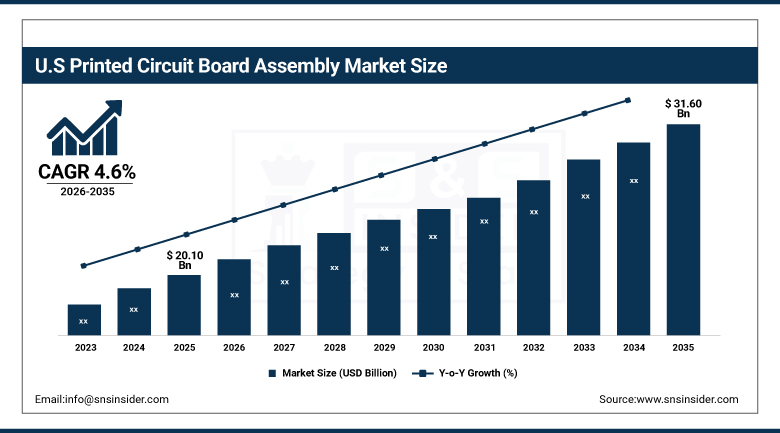
The U.S. Printed Circuit Board Assembly Market was valued at approximately USD 20.10 Billion in 2025 and is projected to reach approximately USD 31.60 Billion by 2035, registering a CAGR of approximately 4.6% from 2026 to 2035.
The United States demand continued owing to strong aerospace, defense, and medical electronics spending, reshoring incentives under federal manufacturing initiatives, and a deep concentration of leading contract manufacturers and design engineering talent. Rising deployment of high-reliability assembly capacity by domestic electronics manufacturing services providers continued reinforcing the country's position as both a premium-quality hub and a genuine innovation leader for high-density interconnect and mixed-technology board assembly. Growing adoption across electric vehicle power electronics, data center hardware, and 5G telecommunications infrastructure added further layers of sustained domestic demand well beyond the technology's traditional defense and industrial use cases.
Jabil expanded its Guadalajara and Monterrey, Mexico campuses throughout 2025 to support high-mix printed circuit board assembly for cloud infrastructure and AI server customers serving North American hyperscale data center operators.
Printed Circuit Board Assembly Market Segment Analysis
-
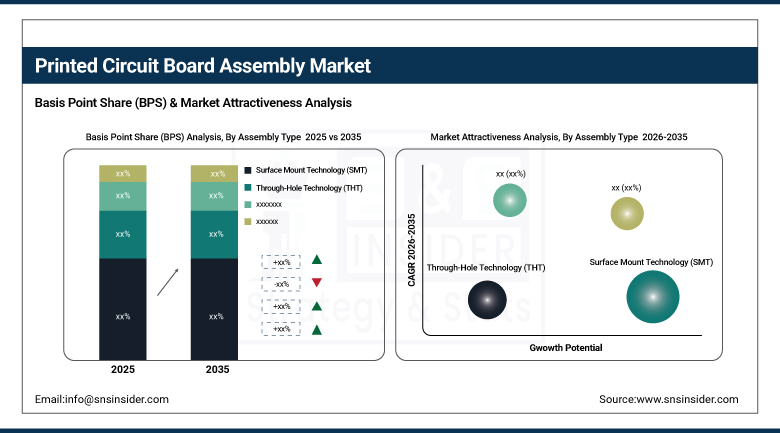
By Assembly Type, SMT dominated the Printed Circuit Board Assembly Market with a 66.00% share in 2025, while Mixed Technology is the fastest-growing assembly type segment with a CAGR of 5.80% from 2026–2035.
-
By PCB Type, Multilayer dominated the market with a 41.00% share in 2025, while Flexible/Rigid-Flex is the fastest-growing PCB type segment with a CAGR of 7.20% from 2026–2035.
-
By Component Type, Active Components dominated the market with a 53.00% share in 2025, while Electromechanical Components are the fastest-growing component type segment with a CAGR of 6.30% from 2026–2035.
-
By Application, Consumer Electronics dominated the market with a 36.00% share in 2025, while Automotive is the fastest-growing application segment with a CAGR of 7.00% from 2026–2035.
By Assembly Type, SMT Leads While Mixed Technology Grows Fastest
The SMT segment dominated the Printed Circuit Board Assembly Market in 2025 owing to its compatibility with high-density component placement, automated production lines, and compact consumer and automotive device designs. Contract manufacturers favor surface mount technology for its higher throughput, lower labor requirements, and superior support for miniaturized, high-pin-count components across smartphones, wearables, and computing hardware. Continuous investment in faster, more precise pick-and-place equipment and reflow soldering systems has further strengthened SMT’s position as the dominant assembly technology across virtually every major electronics end market tracked in this report.
The Mixed Technology segment is the fastest growing in the Printed Circuit Board Assembly Market owing to rising demand from aerospace, defense, and industrial customers requiring both surface mount density and through-hole ruggedness on the same board. Assemblers increasingly combine SMT and THT processes to meet stringent reliability standards for connectors, power components, and mechanically stressed assemblies. Growing defense modernization spending and industrial automation investment continue accelerating adoption of mixed-technology assembly lines capable of handling both process types within a single production run.
By PCB Type, Multilayer Dominates While Flexible/Rigid-Flex Records Fastest Growth
The Multilayer segment dominated the Printed Circuit Board Assembly Market in 2025 due to its ability to support the complex routing, signal integrity, and component density required by smartphones, servers, and advanced automotive electronics. Multilayer boards remain the standard choice for original equipment manufacturers seeking to pack greater functionality into shrinking device footprints. Continued growth in data center, telecommunications, and computing hardware complexity has kept multilayer assemblies the largest overall contributor to global market revenue.
The Flexible/Rigid-Flex segment is the fastest growing in the Printed Circuit Board Assembly Market owing to rising demand for foldable, wearable, and space-constrained electronic device designs across consumer and medical applications. Designers increasingly favor flexible and rigid-flex assemblies for their ability to conform to compact enclosures while reducing interconnect points and overall assembly weight. Growing adoption of flexible boards in foldable smartphones, medical wearables, and automotive sensor modules continues driving accelerated growth in this segment.
By Component Type, Active Components Lead While Electromechanical Grows Fastest
The Active Components segment dominated the Printed Circuit Board Assembly Market in 2025 due to sustained demand for processors, memory modules, and power management integrated circuits across virtually every electronics end market. Rising board complexity and functional integration have kept active component placement the largest single cost and revenue driver within the overall assembly process. Continued semiconductor content growth per device has further reinforced this segment’s dominant position across the market.
The Electromechanical Components segment is the fastest growing in the Printed Circuit Board Assembly Market owing to rising integration of connectors, relays, and switches in electric vehicle power electronics and industrial automation equipment. Growing vehicle electrification and factory automation investment continue driving demand for ruggedized electromechanical assembly capability. Expanding use of sensors and actuators in robotics and smart manufacturing systems continues accelerating growth in this component category.
By Application, Consumer Electronics Dominates While Automotive Emerges as Fastest-Growing
The Consumer Electronics segment dominated the Printed Circuit Board Assembly Market in 2025 due to sustained global demand for smartphones, laptops, wearables, and smart home devices requiring high-volume, cost-efficient assembly capacity. Contract manufacturers continue prioritizing consumer electronics production lines given their scale and recurring replacement cycles. Sustained global smartphone and computing device shipment volumes have kept this application the largest overall revenue contributor across the market.
The Automotive segment is the fastest growing in the Printed Circuit Board Assembly Market owing to rapid electric vehicle adoption and rising electronic content per vehicle across power electronics, driver assistance systems, and infotainment platforms. Automakers and tier-one suppliers increasingly demand thermally robust, high-reliability board assemblies capable of withstanding harsh automotive operating environments. Accelerating global electric vehicle production continues driving sustained growth in automotive-grade PCB assembly demand.
Regional Analysis
|
Region |
Major Country |
Share within Region, 2025 (%) |
|---|---|---|
|
North America |
United States |
82.00% |
|
Europe |
Germany |
26.30% |
|
Asia Pacific |
China |
41.50% |
|
Middle East and Africa |
UAE |
24.80% |
|
Latin America |
Brazil |
36.20% |
North America Printed Circuit Board Assembly Market Insights
North America accounted for a notable market share in 2025. Sustained aerospace, defense, and medical electronics spending, reshoring incentives under federal manufacturing initiatives, and a deep concentration of leading contract manufacturers and design engineering talent continued reinforcing the region’s strong position. Growing deployment of high-reliability assembly capacity across data center, telecommunications, and electric vehicle power electronics applications further strengthened North America’s standing as a premium-quality, innovation-driven market tracked in this report, with continued federal manufacturing incentives expected to sustain domestic capacity investment through the forecast period.
The United States anchored by sustained defense, aerospace, and data center demand alongside substantial domestic contract manufacturing capability. Canada and Mexico added further regional demand through near-shoring initiatives and growing high-mix assembly investment, and that combined strength kept the continent a resilient, premium-value addressable market for printed circuit board assembly vendors through the forecast period, with continued reshoring investment expected to sustain regional demand.
Europe Printed Circuit Board Assembly Market Insights
Europe held a meaningful share of global revenue, supported by strong automotive, industrial, and aerospace electronics demand and continued investment in advanced manufacturing capability across the region’s major economies. Regulatory momentum around supply chain resilience and semiconductor sovereignty continued shaping regional investment priorities without meaningfully slowing commercialization across the continent, while sustained automotive electrification investment kept the region among the more resilient printed circuit board assembly markets tracked in this report.
Germany growth is supported by its substantial automotive and industrial manufacturing base. The UK and France contributed substantial additional demand, and continued European investment in automotive electrification and defense modernization should keep regional demand for printed circuit board assembly technology climbing steadily through the forecast period.
Asia Pacific Printed Circuit Board Assembly Market Insights
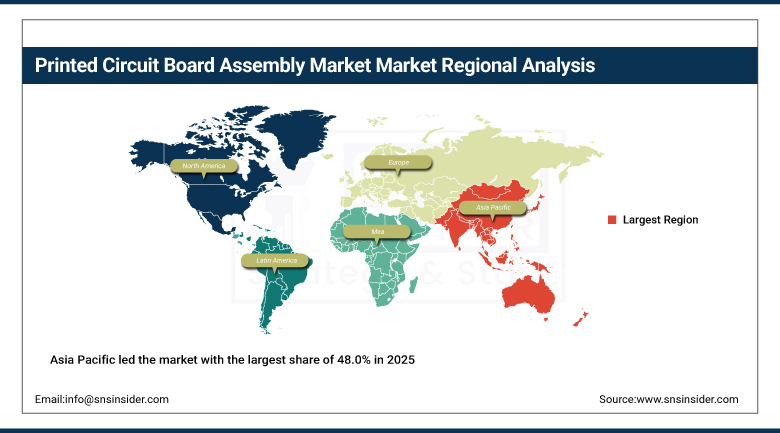
Asia Pacific led the market with the largest share of 48.0% in 2025 and is also advancing at the fastest pace among all regions tracked in this report, registering a CAGR of 6.8% from 2026 to 2035, driven by concentrated electronics manufacturing capacity, expanding consumer electronics and electric vehicle production, and growing government-backed investment in domestic semiconductor and assembly capability across the region’s largest economies. That combination of manufacturing scale and sustained downstream demand across smartphones, computing hardware, and automotive electronics kept the region’s growth trajectory well ahead of every other region tracked in this report.
China led the pack, supported by its substantial domestic electronics manufacturing base and rapid expansion of consumer electronics and automotive production. Taiwan and South Korea contributed meaningful additional demand, with India’s expanding electronics manufacturing sector and Japan’s advanced assembly technology both reinforcing the region’s position as the largest and fastest-growing printed circuit board assembly market tracked in this report.
Get Customized Report as per Your Business Requirement - Enquiry Now
MEA and Latin America Printed Circuit Board Assembly Market Insights
The Middle East and Africa and Latin America both showed steady growth, driven by expanding electronics manufacturing investment, growing government focus on industrial diversification, and rising demand for domestic assembly capability across both regions. As these markets continued building out modern electronics manufacturing infrastructure, printed circuit board assembly capability proved a genuinely valuable way to capture value-added production that had traditionally been concentrated in more established manufacturing hubs.
The UAE led Middle East and Africa demand, supported by the country’s growing electronics manufacturing investment and diversification initiatives. Saudi Arabia contributed further demand through its own industrial diversification programs. In Latin America, Brazil accounted for the largest share of regional revenue, with growing near-shoring and domestic electronics manufacturing investment continuing to anchor regional demand for printed circuit board assembly capability.
Market Dynamics
Growth Drivers: Rising Electronics Manufacturing Complexity and Electric Vehicle Adoption
The industry is driven by rising demand for high-density interconnect assemblies, expanding adoption of surface mount technology across consumer and automotive electronics, increasing integration of automated optical inspection and robotics on assembly lines, and growing electronic content per vehicle amid accelerating electric vehicle production. As devices continue shrinking while gaining functionality, the need for precise, high-throughput assembly capability continues driving sustained adoption of advanced PCB assembly technology across virtually every major electronics end market.
Rising electric vehicle production continues reinforcing this driver, as power electronics, battery management systems, and driver assistance platforms require thermally robust, high-reliability board assemblies far beyond traditional automotive electronics content. Growing telecommunications infrastructure investment tied to 5G and fiber network expansion continues defining a further layer of sustained demand, and that combination of automotive electrification and telecommunications infrastructure spending is exactly what keeps overall demand climbing at such a steady, sustained pace.
Restraints: Component Supply Chain Volatility and High Capital Equipment Costs
Ongoing volatility in semiconductor and electronic component supply chains continues posing a genuine restraint on faster market-wide expansion, particularly for smaller contract manufacturers without the inventory buffers and supplier relationships that established electronics manufacturing services providers can maintain. That exposure has kept some production timelines and cost structures more unpredictable than customers and OEMs would prefer.
The substantial capital investment required for advanced pick-and-place equipment, automated optical inspection systems, and cleanroom-grade production facilities continues posing a further restraint, as smaller assemblers face genuine barriers to competing for high-reliability aerospace, defense, and medical contracts. That cost profile keeps premium, high-mix assembly capacity concentrated among a comparatively small number of well-capitalized global contract manufacturers.
Opportunities: Reshoring Initiatives and Advanced Driver Assistance System Expansion
Rising reshoring and near-shoring investment represents a genuinely significant opportunity, as governments and OEMs increasingly prioritize domestic and regionally proximate assembly capability to reduce geopolitical and logistics risk. Vendors positioned early in high-reliability, defense-qualified assembly capacity stand to capture meaningful share as customers continue diversifying production away from concentrated single-region supply chains.
Expanding advanced driver assistance system and electric vehicle power electronics production offers a second substantial opportunity, as automakers continue increasing electronic content per vehicle across sensing, power management, and connectivity applications. Vendors with proven, automotive-qualified assembly technology stand to capture meaningful share as global electric vehicle production continues scaling across established and emerging automotive manufacturing markets alike.
Recent Developments:
-
2025: Sanmina secured a five-year, USD 420 million motherboard manufacturing contract with a North American hyperscale data center operator, covering advanced 28-layer, high-density board production for cloud infrastructure customers.
-
2025: Pegatron earmarked USD 150 million to expand its Vietnamese assembly capacity, targeting production of eight million laptop motherboards by mid-2026 as customers diversify manufacturing away from China.
Printed Circuit Board Assembly Companies are:
-
Hon Hai Precision Industry Co., Ltd. (Foxconn Technology Group)
-
Flex Ltd.
-
Sanmina Corporation
-
Celestica Inc.
-
Benchmark Electronics, Inc.
-
TTM Technologies, Inc.
-
Pegatron Corporation
-
Compal Electronics, Inc.
-
Kimball Electronics, Inc.
-
Zollner Elektronik AG
-
Creation Technologies
-
Fabrinet
-
Universal Scientific Industrial (USI) Co., Ltd.
-
Plexus Corp.
-
Cicor Technologies Ltd.
-
Key Tronic Corporation
-
New Kinpo Group
-
Venture Corporation Limited
Printed Circuit Board Assembly Market Report Scope:
| Report Attributes | Details |
|---|---|
| Market Size in 2025 | USD 102.30 Billion |
| Market Size by 2035 | USD 168.90 Billion |
| CAGR | CAGR of 5.1% From 2026 to 2035 |
| Base Year | 2025 |
| Forecast Period | 2026-2035 |
| Historical Data | 2022-2024 |
| Report Scope & Coverage | Market Size, Segments Analysis, Competitive Landscape, Regional Analysis, DROC & SWOT Analysis, Forecast Outlook |
| Key Segments | • By Assembly Type (Surface Mount Technology (SMT), Through-Hole Technology (THT), Mixed Technology), • By PCB Type (Single-Sided, Double-Sided, Multilayer, Flexible/Rigid-Flex), • By Component Type (Active Components, Passive Components, Electromechanical Components), • By Application (Consumer Electronics, Automotive, Telecommunications, Industrial, Aerospace & Defense, Medical Devices) |
| Regional Analysis/Coverage | North America (US, Canada), Europe (Germany, UK, France, Italy, Spain, Russia, Poland, Rest of Europe), Asia Pacific (China, India, Japan, South Korea, Australia, ASEAN Countries, Rest of Asia Pacific), Middle East & Africa (UAE, Saudi Arabia, Qatar, South Africa, Rest of Middle East & Africa), Latin America (Brazil, Argentina, Mexico, Colombia, Rest of Latin America). |
| Company Profiles | Hon Hai Precision Industry Co., Ltd. (Foxconn Technology Group), Jabil Inc., Flex Ltd., Sanmina Corporation, Celestica Inc., Benchmark Electronics, Inc., TTM Technologies, Inc., Wistron Corporation, Pegatron Corporation, Compal Electronics, Inc., Kimball Electronics, Inc., Zollner Elektronik AG, Creation Technologies, Fabrinet, Universal Scientific Industrial (USI) Co., Ltd., Plexus Corp., Cicor Technologies Ltd., Key Tronic Corporation, New Kinpo Group, Venture Corporation Limited |
Frequently Asked Questions
The major growth factor is rising demand for high-density interconnect assemblies, growing electric vehicle production, and expanding telecommunications infrastructure investment.
The SMT segment dominated the Printed Circuit Board Assembly Market by assembly type, representing the largest share of revenue in 2025.
Asia Pacific dominated the Printed Circuit Board Assembly Market in 2025, holding an estimated 48.0% share of total global market revenue.
Key opportunities include automotive electronics, flexible PCBs, advanced manufacturing, miniaturization, and growing demand for high-density electronic assemblies.
