
Route Optimization Software Market Report Scope & Overview:
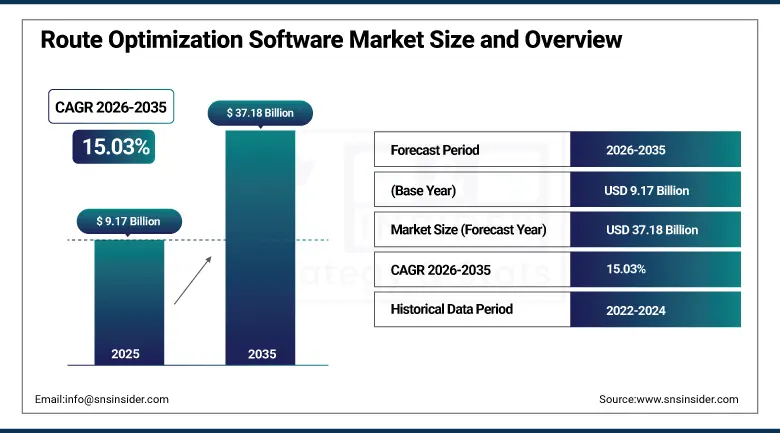
The Route Optimization Software Market was valued at USD 9.17 Billion in 2025 and is expected to reach USD 37.18 Billion by 2035, growing at a CAGR of 15.03% from 2026 to 2035.
The Route Optimization Software Market continues to grow due to the rise of e-commerce, incorporation of artificial intelligence, and chronic shortage of drivers that have been changing the logistics equation and promoting the worldwide uptake of route planning automation. The cloud-based technologies continue reducing the time of deployment, while 5G technologies are allowing subsecond recalculation of traffic flows, cutting the number of unnecessary miles and expenses associated with overtime driving. The low emission zones, integration of telematics and AI, and national initiatives of developing smart logistics continue increasing the demand, as the fleets need to conform to the environmental goals and work force restrictions.
Apex Route Analytics launched a modular software update in April 2025 featuring predictive modeling capable of forecasting urban congestion forty-eight hours in advance, enabling proactive route scheduling that lets fleet operators adjust delivery plans before congestion actually materializes on the road network.
Market Size and Forecast
-
Market Size in 2026E: USD 10.55 Billion
-
Market Size by 2035: USD 37.18 Billion
-
CAGR: 15.03% from 2026 to 2035
-
Fastest Growing Region: Asia Pacific
-
Largest Region: North America
To Get more information On Route Optimization Software Market - Request Free Sample Report
Route Optimization Software Market Trends
-
Cloud-native platforms continue accelerating deployment times while 5G connectivity enables sub-second traffic recalculations.
-
Commercial offerings increasingly bundle predictive maintenance and driver safety analytics into unified last-mile orchestration platforms.
-
Low-emission zone mandates and national smart-logistics programs continue amplifying demand for compliant route planning.
-
On-demand food delivery fleets require routing algorithms capable of handling dynamic order batching within sub-thirty-minute windows.
-
Persistent driver shortages continue pushing logistics operators toward automated, AI-driven route planning to maximize existing fleet capacity.
United States Route Optimization Software Market Outlook
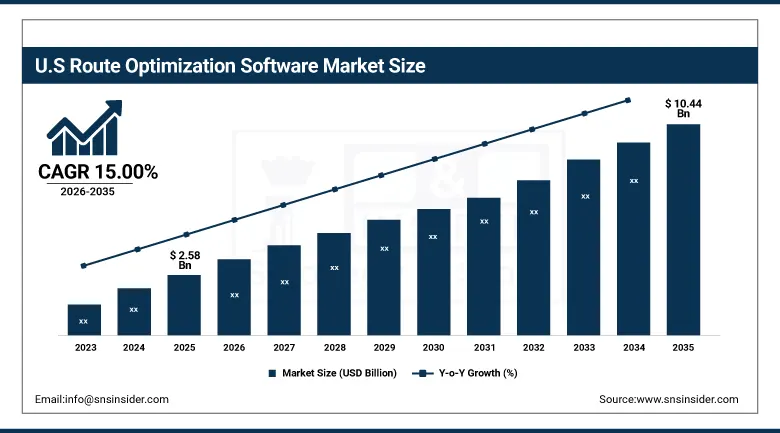
The United States Route Optimization Software Market was valued at USD 2.58 Billion in 2025 and is expected to reach USD 10.44 Billion by 2035, growing at a CAGR of 15.00% from 2026 to 2035.
The U.S. retained its dominance in the North American market of route optimization software because of dense carrier ecosystems and high maturity of vehicle path optimization in the country’s biggest logistics regions. The consistent rise of the e-commerce industry and the ever-increasing shortage of drivers further modified the economy of logistics, driving the implementation of automated routing engines and thus securing the leadership of the country in terms of demand for this technology.
Trimble, based in Westminster, Colorado, teamed up with one of the biggest manufacturers of electric vehicles in March 2025 to take into account battery range restrictions and queuing at charging stations in its route optimization platform.
Route Optimization Software Market Segment Analysis
-
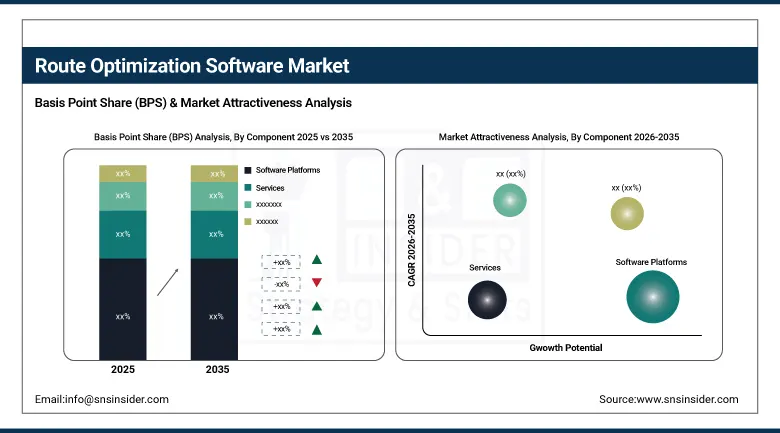
By Component, the Software Platforms segment held approximately 60.00% share in 2025, while the Services segment is the fastest growing, with a CAGR of approximately 14.60%.
-
By Industry Vertical, the Retail FMCG segment held approximately 30.10% share in 2025, while the On-Demand Food Delivery segment is the fastest growing, with a CAGR of approximately 15.60%.
-
By Organization Size, the Large Enterprises segment held approximately 61.00% share in 2025, while the SMEs segment is the fastest growing.
-
By Deployment Mode, the Cloud segment held approximately 65.70% share in 2025, while the same segment is also the fastest growing.
-
By Functionality, the Outbound segment held the largest share in 2025, while the Inbound segment is the fastest growing.
By Component, Software Platforms led the market, Services grew fastest
The Software Platforms segment dominated the component category in 2025, holding approximately 60.00% of total revenue, reflecting enterprise preference for integrated logistics route software over point solutions. That combination of comprehensive functionality and platform consolidation keeps software platforms firmly at the top of the broader component segmentation across nearly every major route optimization deployment worldwide.
The Services segment, including consulting, integration, and managed optimization, is projected to grow at the fastest CAGR of approximately 14.60% during the forecast period, as mid-market fleets increasingly seek turnkey delivery route planning deployments. Rising demand for managed implementation support continues pushing this component category's growth rate ahead of the broader component segmentation.
By Industry Vertical, Retail FMCG led the market, On-Demand Food Delivery grew fastest
The Retail FMCG segment held the largest industry vertical share in 2025, at approximately 30.10%, driven by omnichannel fulfillment complexity and last-mile optimization tool adoption across large-scale consumer goods distribution networks. That sustained retail and consumer goods logistics complexity keeps this industry vertical category firmly at the center of overall route optimization software demand across nearly every major regional market worldwide.
The On-Demand Food Delivery segment is projected to grow at the fastest CAGR of approximately 15.60% during the forecast period, where fleet routing algorithms must handle dynamic order batching and sub-thirty-minute delivery windows that few other logistics categories demand. Rising consumer expectations for rapid delivery continues pushing this industry vertical category's growth rate ahead of the broader industry vertical segmentation.
By Organization Size, Large Enterprises led the market, SMEs grew fastest
The Large Enterprises segment held the largest organization size share in 2025, at approximately 61.00%, anchored by substantial fleet operations that continue justifying comprehensive route optimization platform investment across their extensive logistics networks. That scale advantage keeps large enterprises firmly at the top of the broader organization size segmentation across nearly every major route optimization software deployment worldwide.
The SMEs segment is projected to grow at the fastest CAGR during the forecast period, as increasingly affordable cloud-based subscription models continue lowering the barrier to entry for smaller fleet operators previously priced out of sophisticated route planning technology. Rising availability of accessible, scalable route optimization tools continues pushing this organization size category's growth rate ahead of the broader organization size segmentation.
By Deployment Mode, Cloud led the market and grew fastest
The Cloud segment dominated the deployment mode category in 2025, holding approximately 65.70% of total revenue, and is also projected to grow at the fastest rate through 2035, as cloud-native platforms continue accelerating deployment times while offering scalability and flexibility that on-premises alternatives cannot match. That dual leadership and fastest-growth position reflects how comprehensively cloud deployment continues displacing legacy on-premises architecture across the broader deployment mode segmentation.
On-premises deployment continues holding a meaningful share of the installed base, particularly among large enterprises with substantial existing IT infrastructure investment and specific data control requirements. That established infrastructure base keeps on-premises deployment relevant even as the broader deployment mode segmentation continues shifting decisively toward cloud-native architecture.
By Functionality, Outbound led the market, Inbound grew fastest
The Outbound segment held the largest functionality share in 2025, anchored by delivery and last-mile distribution route planning that continues representing the primary use case for route optimization software across nearly every major logistics operation. That established outbound logistics focus keeps this functionality category firmly at the top of the broader functionality segmentation across the majority of current route optimization software deployments.
The Inbound segment is projected to grow at the fastest CAGR during the forecast period, as manufacturers and distributors increasingly apply route optimization principles to supply-side logistics, including raw material collection and inbound freight consolidation. Rising demand for end-to-end supply chain optimization continues pushing this functionality category's growth rate ahead of the broader functionality segmentation.
Regional Insights
|
Region |
Major Country |
Share within Region, 2025 (%) |
|---|---|---|
|
North America |
United States |
85.20% |
|
Europe |
Germany |
27.50% |
|
Asia Pacific |
China |
36.30% |
|
Middle East & Africa |
UAE |
26.60% |
|
Latin America |
Brazil |
37.40% |
North America Route Optimization Software Market Insights
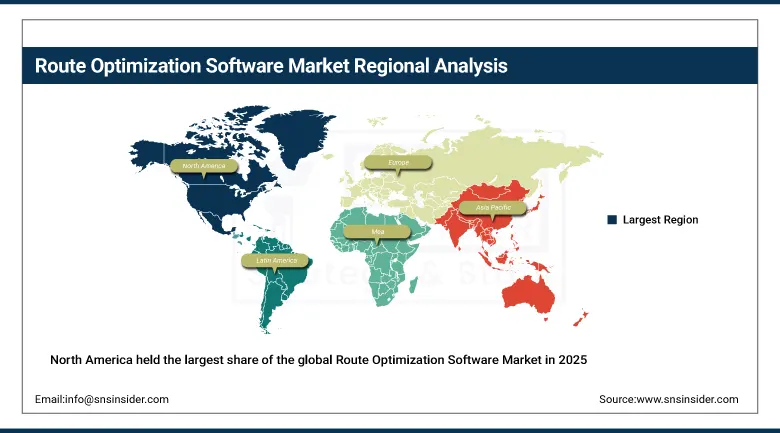
North America held the largest share of the global Route Optimization Software Market in 2025, at approximately 35.20%, bolstered by dense carrier ecosystems and advanced vehicle path optimization maturity across the region's largest logistics markets. Continued driver shortage pressure and e-commerce growth kept the region firmly ahead of every other region in this market throughout the year.
The United States accounted for roughly 85.20% of regional revenue, reflecting its concentration of leading route optimization software developers and downstream logistics and retail customers. Canada contributed a smaller but steadily growing share of regional revenue, supported by its own expanding logistics automation adoption, keeping North America firmly ahead of every other region in this market.
Get Customized Report as per Your Business Requirement - Enquiry Now
Europe Route Optimization Software Market Insights
Europe held a substantial share of the global Route Optimization Software Market in 2025, supported by low-emission zone mandates and stringent environmental regulation that continue amplifying demand for compliant route planning technology across the continent. Germany accounted for roughly 27.50% of regional revenue, supported by its concentration of logistics operators and industrial manufacturing companies.
France, the United Kingdom, and the Netherlands followed a broadly similar trajectory, as continued environmental regulation and smart-logistics program investment extended route optimization software adoption across the continent's largest logistics markets. Continued regulatory emphasis on emissions reduction is expected to keep supporting steady European demand through the remainder of the forecast period.
Asia Pacific Route Optimization Software Market Insights
Asia Pacific was the fastest-growing region in the global Route Optimization Software Market, driven by rapid e-commerce expansion, growing on-demand delivery culture, and expanding logistics infrastructure investment across the region's largest and most populous economies. Rising smartphone penetration and digital payment adoption continued driving regional demand at a pace considerably faster than more mature Western markets.
China accounted for roughly 36.30% of regional revenue, supported by its massive e-commerce and food delivery ecosystem and expanding domestic logistics technology development. India and Southeast Asian markets contributed significant additional regional demand through their own rapidly growing on-demand delivery sectors, reinforcing Asia Pacific's position as the clear growth leader in this market.
MEA & Latin America Route Optimization Software Market Insights
Adoption of Route Optimization Software saw consistent growth within the Middle East and Africa region in 2025, owing to increased investments in logistics infrastructure and e-commerce adoption among the Gulf nations. The UAE made up for about 26.60% of total regional revenue on account of increased logistics automation plans and demand from enterprises for automated route planning.
Latin America region saw growth at a similar level, with Brazil accounting for around 37.40% of regional revenue on account of increasing adoption of e-commerce and food delivery services in the country. The other two Latin American countries, i.e., Mexico and Argentina, were following a similar path.
Growth Drivers: E-commerce expansion and persistent driver shortages
Continuous e-commerce growth, artificial intelligence integration, and persistent driver shortages continue reshaping logistics economics, spurring global adoption of automated route-planning engines. Cloud-native platforms continue accelerating deployment times, while 5G connectivity enables sub-second traffic recalculations that slash idle miles and overtime costs across nearly every major fleet operation worldwide.
Low-emission zone mandates, telematics-AI convergence, and national smart-logistics programs continue amplifying demand as fleets seek to comply with environmental targets and labor constraints simultaneously. Commercial offerings increasingly bundling predictive maintenance, driver safety analytics, and vehicle-agnostic optimization features continue turning route software into a genuine control tower for last-mile orchestration, reinforcing structural demand growth across the broader market.
Restraints: Integration complexity and algorithm differentiation pressure
The route optimization software market exhibits medium concentration, with the top five vendors collectively holding an estimated thirty-two to thirty-eight percent revenue share, while a long tail of specialized and regional players continues serving niche verticals. That moderately fragmented competitive field continues requiring vendors to differentiate on algorithm sophistication, integration depth, and vertical expertise rather than scale alone.
Integrating route optimization software with existing fleet management, telematics, and enterprise resource planning systems continues requiring genuine technical expertise that can complicate deployment timelines for organizations lacking dedicated IT resources. That integration complexity continues concentrating the most sophisticated deployments among organizations with adequate technical implementation capability.
Opportunities: Electric vehicle routing integration and SME market expansion
Growing need to integrate battery-range constraints and charging infrastructure queues directly into route optimization platforms presents substantial opportunity for vendors positioned to serve fleets transitioning to electric vehicles. Vendors capable of delivering genuinely EV-aware routing capability stand to capture a growing share of demand as commercial fleet electrification continues accelerating.
An additional important source of growth would be in expanding cloud-based subscription models that allow smaller companies to use the services at low prices, which are affordable to them. The vendors who can develop such products will see increased revenues from the SMEs in the coming years till 2035.
Recent Developments:
-
2025: Descartes Systems Group continued expanding its route planning and logistics software portfolio, strengthening its position serving enterprise customers requiring integrated last-mile delivery and fleet management capability.
-
2025: Samsara continued advancing its connected fleet management platform, integrating AI-driven route optimization with its broader telematics and driver safety analytics offerings for commercial fleet customers.
Route Optimization Software Market key players are:
-
Oracle Corporation
-
SAP SE
-
Trimble Inc.
-
Descartes Systems Group Inc.
-
Routific Solutions Inc.
-
Route4Me, Inc.
-
Geotab Inc.
-
Omnitracs, LLC
-
Samsara Inc.
-
Apex Route Analytics
-
Verizon Connect
-
WorkWave, LLC
-
OptimoRoute, Inc.
-
Circuit
-
Locus.sh
-
Bringg Delivery Technologies Ltd.
-
Shipsy Private Limited
-
LogiNext Solutions Pvt. Ltd.
Route Optimization Software Market Report Scope:
| Report Attributes | Details |
|---|---|
| Market Size in 2025 | USD 9.17 Billion |
| Market Size by 2035 | USD 37.18 Billion |
| CAGR | CAGR of 15.03% From 2026 to 2035 |
| Base Year | 2025 |
| Forecast Period | 2026-2035 |
| Historical Data | 2022-2024 |
| Report Scope & Coverage | Market Size, Segments Analysis, Competitive Landscape, Regional Analysis, DROC & SWOT Analysis, Forecast Outlook |
| Key Segments | • By Component (Software Platforms, Services) • By Industry Vertical (Retail FMCG, On-Demand Food Delivery) • By Organization Size (Large Enterprises, SMEs) • By Deployment Mode (Cloud, On-Premises) • By Functionality (Outbound, Inbound) |
| Regional Analysis/Coverage | North America (US, Canada), Europe (Germany, UK, France, Italy, Spain, Russia, Poland, Rest of Europe), Asia Pacific (China, India, Japan, South Korea, Australia, ASEAN Countries, Rest of Asia Pacific), Middle East & Africa (UAE, Saudi Arabia, Qatar, South Africa, Rest of Middle East & Africa), Latin America (Brazil, Argentina, Mexico, Colombia, Rest of Latin America). |
| Company Profiles | Oracle Corporation, SAP SE, Trimble Inc., Descartes Systems Group Inc., PTV Group, Routific Solutions Inc., Route4Me, Inc., Geotab Inc., Omnitracs, LLC, Samsara Inc., Apex Route Analytics, Verizon Connect, WorkWave, LLC, OptimoRoute, Inc., Onfleet, Inc., Circuit, Locus.sh, Bringg Delivery Technologies Ltd., Shipsy Private Limited, LogiNext Solutions Pvt. Ltd. |

Frequently Asked Questions
The Route Optimization Software Market is expected to grow at a CAGR of 15.03% from 2026 to 2035.
The Route Optimization Software Market was valued at USD 9.17 Billion in 2025.
Continuous e-commerce growth combined with artificial intelligence integration and persistent driver shortages is the major growth factor.
The Software Platforms segment held approximately 60.00% share in 2025.
North America held the largest share of the Route Optimization Software Market in 2025, at approximately 35.20%, while Asia Pacific was the fastest-growing region.
