
Semiconductor Chip Ecosystem Market Report Scope & Overview:
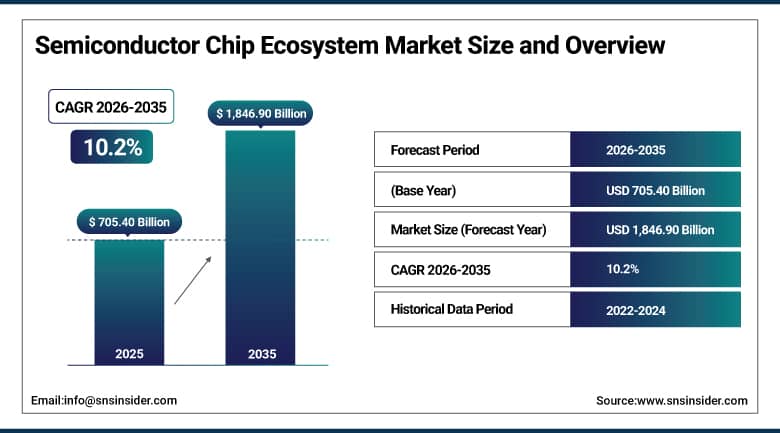
The Semiconductor Chip Ecosystem Market size was valued at USD 705.40 Billion in 2025 and is expected to reach USD 1,846.90 Billion by 2035, growing at a CAGR of 10.2% from 2026–2035.
The semiconductor chip ecosystem spans the full value chain that turns a circuit design into a finished chip inside a finished product: electronic design automation software and licensable semiconductor IP at the front end, fabless chip companies and integrated device manufacturers that own the underlying designs, pure-play foundries and IDM fabs that physically manufacture wafers, and outsourced semiconductor assembly and test providers that package and validate finished die before they reach a circuit board. No single company touches every layer of this chain, which is precisely why the ecosystem framing matters: a shortage or capacity constraint at any one layer, whether it is advanced packaging substrates, EUV lithography tool availability, or high-bandwidth memory supply, can bottleneck output across the entire downstream chain regardless of how much capacity exists elsewhere.
In mid-2026, TSMC committed an additional USD 100 Billion to its Arizona operations, lifting its total declared U.S. investment to USD 265 Billion and making it the largest single foreign direct investment commitment in U.S. history, intended to support at least four more sub-2nm fabs alongside dedicated advanced packaging facilities.
To Get More Information On Semiconductor Chip Ecosystem Market - Request Free Sample Report
Semiconductor Chip Ecosystem Market Trends
-
AI accelerators & data centers: Surging GPU demand is driving capex and advanced-node capacity toward computing.
-
Advanced packaging: Technologies such as CoWoS, SoIC, and hybrid bonding are becoming critical to performance, increasing demand for packaging capacity.
-
Reshoring & friend-shoring: The U.S. CHIPS Act, EU Chips Act, and India’s semiconductor mission are reshaping global fab locations, despite project delays.
-
Fabless-foundry model: Rising design complexity and fab costs are accelerating the shift from IDMs to outsourced manufacturing.
-
HBM demand: AI-driven server demand is tightening HBM supply, with leading suppliers largely sold out through 2026.
U.S. Semiconductor Chip Ecosystem Market Size Outlook
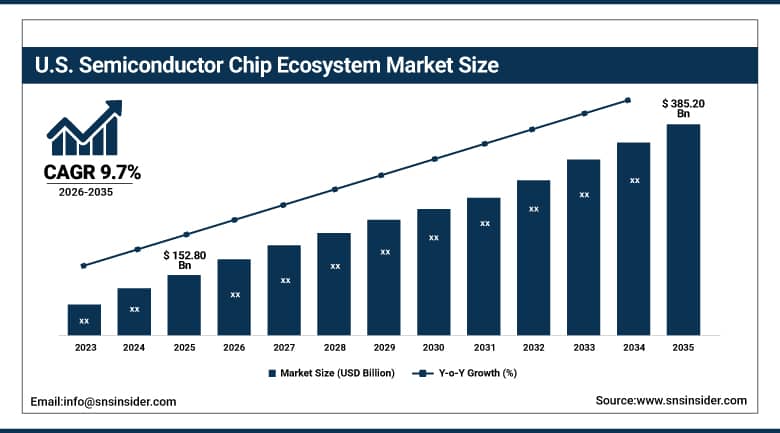
The U.S. Semiconductor Chip Ecosystem Market was valued at approximately USD 152.80 Billion in 2025 and is expected to reach approximately USD 385.20 Billion by 2035, growing at a CAGR of approximately 9.7%.
The United States anchors the design and intellectual-property layer of the global ecosystem, home to leading fabless companies including NVIDIA, Qualcomm, and Broadcom, alongside the two dominant EDA software providers, Synopsys and Cadence Design Systems, that nearly every chip designer worldwide depends on. That design-side dominance has historically coexisted with comparatively limited domestic wafer fabrication capacity, a gap the CHIPS and Science Act was written to close, though execution across several flagship projects has proven slower than initial announcements suggested.
TSMC's Fab 21 Phase 1 in Arizona began 4-nanometer production in the first half of 2025 and is now fully operational, supplying advanced chips to key customers including Apple and NVIDIA, while TSMC's mid-2026 pledge of an additional USD 100 Billion signaled confidence in scaling that footprint toward twelve total U.S. semiconductor and packaging facilities.
Semiconductor Chip Ecosystem Market Segment Analysis
-
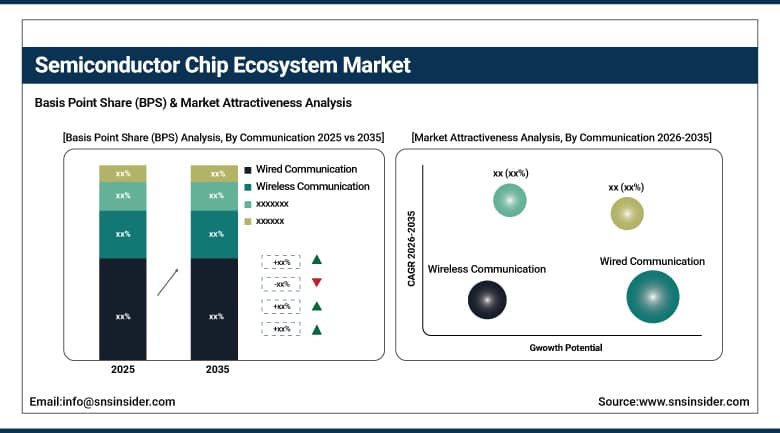
By Communication, the Wired Communication segment dominated the Semiconductor Chip Ecosystem Market with approximately 54.20% share in 2025, while the Wireless Communication segment is the fastest growing with a CAGR of approximately 12.8%.
-
By Application, the Consumer Electronics segment dominated the Semiconductor Chip Ecosystem Market with approximately 29.65% share in 2025, while the Healthcare Equipment segment is the fastest growing with a CAGR of approximately 13.9%.
-
By Types of Companies, the Fabless Chip Companies segment dominated the Semiconductor Chip Ecosystem Market with approximately 27.40% share in 2025, while the Chip Intellectual Property (IP) Cores segment is the fastest growing with a CAGR of approximately 14.6%.
By Communication, Wired dominates, Wireless grows fastest
Wired communication held the largest share of the communication segment in 2025, underpinned by sustained buildout of data-center networking, optical transport, and enterprise switching infrastructure that each depend on high-speed wired connectivity chips to move ever-larger volumes of AI training and inference traffic. That infrastructure-heavy demand base has kept wired communication the most revenue-dense segment even as unit shipments in wireless devices remain far higher.
Wireless communication is growing fastest as 5G network densification, IoT device proliferation, and next-generation Wi-Fi standards continue expanding the number of connectivity chips required per device and per network node. Smartphone replacement cycles alone no longer explain most of this growth; the addition of cellular and short-range wireless connectivity to industrial sensors, wearables, and vehicles is pulling wireless communication chip demand well ahead of the broader market's growth rate.
By Application, Consumer Electronics dominates, Healthcare Equipment grows fastest
Consumer electronics held the largest application share in 2025, reflecting the sheer unit volume of smartphones, PCs, wearables, and smart-home devices that each require dozens of individual chips spanning application processors, memory, power management, and connectivity silicon. That volume advantage has made consumer electronics the most mature and best-understood demand driver in the ecosystem, even as its growth rate has moderated relative to newer application categories.
Healthcare equipment is growing fastest as diagnostic imaging systems, wearable patient monitors, and implantable devices increasingly rely on specialized low-power analog and mixed-signal chips, a category that has historically been a smaller share of overall demand but is scaling quickly as remote patient monitoring and connected medical devices become mainstream. Chip suppliers with established automotive-grade and industrial-grade reliability credentials are finding healthcare a natural adjacent market to expand into.
By Types of Companies, Fabless dominates, Chip IP Cores grow fastest
Fabless chip companies held the largest share of the types-of-companies segment in 2025, a position built on capturing the highest-margin layer of the ecosystem, chip architecture and system design, while outsourcing the capital-intensive burden of building and operating leading-edge fabs entirely to third-party foundries. Companies including NVIDIA, Qualcomm, and Broadcom exemplify this model, and their continued expansion into AI accelerators, custom silicon, and connectivity chips has kept the fabless segment's revenue base growing faster than the ecosystem's manufacturing-heavy segments even before accounting for its outsized share.
Chip intellectual property cores are growing fastest as more design teams license pre-verified processor cores, interconnect fabrics, and interface IP rather than building every functional block from scratch, a shift that shortens design cycles and lowers the barrier to entry for new fabless entrants. Providers such as Arm continue capturing a growing share of design starts as chip complexity rises faster than in-house design teams can reasonably keep pace with.
Regional Analysis
|
Region |
Major Country |
Share within Region, 2025 (%) |
|
North America |
United States |
85.0% |
|
Europe |
Germany |
26.0% |
|
Asia Pacific |
Taiwan |
40.0% |
|
Latin America |
Brazil |
34.0% |
|
Middle East & Africa |
UAE |
32.0% |
Asia Pacific Semiconductor Chip Ecosystem Market Insights
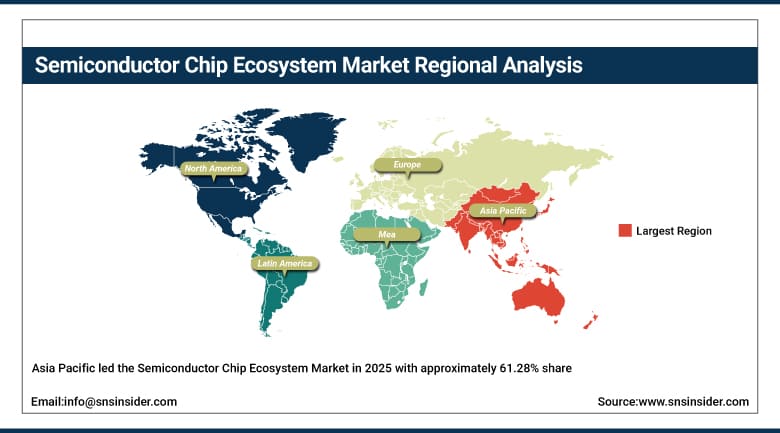
Asia Pacific led the Semiconductor Chip Ecosystem Market in 2025 with approximately 61.28% share, anchored by Taiwan's TSMC, which alone accounted for roughly 70% of global foundry revenue in 2025, alongside South Korea's Samsung and SK hynix in memory and foundry, and mainland China's rapidly scaling domestic capacity led by SMIC. The region's concentration reflects decades of accumulated manufacturing expertise, dense supplier networks, and government-backed investment that remain difficult for other regions to replicate even with substantial incentive programs of their own.
China continues expanding domestic capacity at mature and, increasingly, sub-10nm nodes despite continued restrictions on access to leading-edge lithography equipment, while Japan and South Korea deepen investment in materials, equipment, and memory manufacturing that underpin the broader regional supply chain. India's semiconductor mission is drawing early-stage fab and packaging investment commitments, positioning the country as an emerging back-end and assembly hub within the region.
Get Customized Report as Per Your Business Requirement - Enquiry Now
North America Semiconductor Chip Ecosystem Market Insights
North America is expected to register the fastest regional growth through 2035, growing at a CAGR of approximately 12.6%, propelled by CHIPS Act-backed fab construction, sustained hyperscaler capital spending on AI infrastructure, and continued dominance in chip design, electronic design automation software, and semiconductor intellectual property. The United States anchors this growth, home to the world's leading fabless companies and EDA vendors alongside a rapidly expanding domestic wafer fabrication footprint from TSMC, Samsung, Intel, and Texas Instruments.
Canada contributes a smaller but growing share through semiconductor research institutions and a handful of specialized chip design firms, while Mexico's role remains concentrated in electronics assembly and back-end packaging that feeds North American supply chains rather than front-end wafer fabrication. Cross-border investment ties much of North American capacity planning together, with U.S. design output increasingly paired with regional back-end assembly capacity.
Europe Semiconductor Chip Ecosystem Market Insights
Europe represents a technically specialized segment of the global ecosystem, anchored by the Netherlands' ASML, the sole global supplier of extreme ultraviolet lithography systems that every leading-edge fab in the world depends on, and Germany's strong position in automotive and industrial power semiconductors. The EU Chips Act continues channeling public and private capital toward expanding regional manufacturing capacity, though Europe's overall share of global wafer output remains modest relative to Asia Pacific.
Germany and France contribute the bulk of regional fab investment activity, including Intel's paused but not cancelled Magdeburg project and ongoing expansion at existing European fabs, while the United Kingdom's contribution centers more on chip design, compound semiconductor research, and specialized IP development than on high-volume manufacturing. EU-level funding continues reinforcing research and equipment supply activity across the broader region.
MEA & Latin America Semiconductor Chip Ecosystem Market Insights
The Middle East and Africa host a smaller but strategically emerging share of the semiconductor chip ecosystem market, with the UAE and Saudi Arabia both directing sovereign investment toward chip design, AI infrastructure, and early-stage manufacturing partnerships as part of broader economic diversification strategies. Growth elsewhere in the region remains tied closely to the pace of national technology investment programs rather than any existing domestic fabrication base.
Latin America remains an early-stage market for the ecosystem, with Brazil showing the most visible activity given its existing electronics assembly base and growing interest in semiconductor design incentives. Argentina, Mexico, and Colombia are following developments in more advanced markets, with Mexico's role concentrated primarily in electronics assembly and back-end packaging tied to North American supply chains.
Market Dynamics
Growth Drivers: AI infrastructure buildout and government-backed manufacturing investment fueling adoption
Sustained AI infrastructure buildout is one of the clearest forces behind rising ecosystem-wide investment, as hyperscale cloud providers and AI developers commit tens of billions of dollars annually to GPUs, AI accelerators, and the high-bandwidth memory and advanced packaging capacity needed to support them. That demand is reinforced by broader digitalization across automotive, industrial automation, and connected devices, each adding incremental chip content per unit even outside the AI-specific demand pool.
Government-backed manufacturing investment adds a second major driver, as the U.S. CHIPS Act, the EU Chips Act, India's semiconductor mission, and similar programs in Japan and South Korea continue committing public capital alongside private investment to expand domestic fabrication capacity. TSMC's, Samsung's, and Intel's continued willingness to expand declared U.S. investment commitments through 2026 reflects growing confidence that this policy support will translate into a durable, revenue-generating domestic customer base rather than remaining a one-time incentive-driven build-out.
Restraints: Capital intensity and geopolitical export controls limiting near-term flexibility
The sheer capital intensity of leading-edge fab construction remains a genuine restraint, since a single advanced logic fab can now cost tens of billions of dollars and multiple years to bring to volume production, a burden that has pushed several flagship CHIPS Act-backed projects, including fabs from TSMC, Intel, and Samsung, two to three years behind their original announced timelines. That extended construction and ramp cycle strains both government incentive budgets and the patience of investors tracking return on these commitments.
Geopolitical export controls and supply concentration remain a fundamental restraint as well, since restrictions on advanced lithography equipment and AI chip exports to certain markets continue reshaping where companies can sell, source, and manufacture. That concentration, with roughly 70% of global foundry revenue tied to a single company operating primarily from one region, leaves the broader ecosystem structurally exposed to any disruption at that single point of concentration.
Opportunities: Advanced packaging and edge AI silicon opening new growth avenues
Advanced packaging and chiplet-based design represent a genuine near-term commercial opportunity, letting chip companies combine specialized dies from different process nodes into a single package rather than requiring every function to be fabricated on one monolithic leading-edge die. OSAT providers and foundries that build strong advanced-packaging capacity, including chip-on-wafer-on-substrate and hybrid bonding, are positioned to capture disproportionate value as this approach becomes standard practice for AI accelerators and high-performance computing chips.
Edge AI and automotive semiconductor content represent a second significant opportunity, as on-device AI processing in smartphones, PCs, and vehicles drives meaningfully higher chip content per unit than prior device generations required. Companies building strong positions in automotive-grade power semiconductors, sensors, and edge AI silicon are positioned to capture commercial revenue that scales with unit growth in electric and increasingly autonomous vehicles, independent of the data-center-specific AI investment cycle.
Recent Developments:
-
Mid-2026: TSMC committed an additional USD 100 Billion to its Arizona operations, bringing its total declared U.S. investment to USD 265 Billion, the largest single foreign direct investment commitment in U.S. history, to support additional sub-2nm fabs and advanced packaging facilities.
-
July 2026: Intel Foundry completed its RAMP-C program, supporting validated prototypes, design enablement, and ecosystem readiness for advanced domestic semiconductor manufacturing in the United States.
-
June 2026: NVIDIA and TSMC expanded their collaboration to apply AI across semiconductor design and manufacturing, including computational lithography, process simulation, automated defect inspection, and fab operations optimization.
-
February 2026: Samsung's Taylor, Texas fab completed shell construction and obtained a temporary certificate of occupancy for a portion of the site, with 2026 HBM4 production already reported sold out.
Semiconductor Chip Ecosystem Companies are:
-
Taiwan Semiconductor Manufacturing Company Limited (TSMC)
-
Intel Corporation
-
SK hynix Inc.
-
Micron Technology, Inc.
-
NVIDIA Corporation
-
Broadcom Inc.
-
Texas Instruments Incorporated
-
GlobalFoundries Inc.
-
United Microelectronics Corporation (UMC)
-
Semiconductor Manufacturing International Corporation (SMIC)
-
ASE Technology Holding Co., Ltd.
-
Amkor Technology, Inc.
-
ASML Holding N.V.
-
Applied Materials, Inc.
-
Synopsys, Inc.
-
Cadence Design Systems, Inc.
-
Arm Holdings plc
Semiconductor Chip Ecosystem Market Report Scope:
| Report Attributes | Details |
|---|---|
| Market Size in 2025 | USD 705.40 Billion |
| Market Size by 2035 | USD 1,846.90 Billion |
| CAGR | CAGR of 10.2% From 2026 to 2035 |
| Base Year | 2025 |
| Forecast Period | 2026-2035 |
| Historical Data | 2022-2024 |
| Report Scope & Coverage | Market Size, Segments Analysis, Competitive Landscape, Regional Analysis, DROC & SWOT Analysis, Forecast Outlook |
| Key Segments | • By Communication (Wired Communication, Wireless Communication) • By Application (Consumer Electronics, Automotive, Healthcare Equipment, Space Satellites, Industrial) • By Types of Companies (Chip Intellectual Property (IP) Cores, Electronic Design Automation (EDA) Tools, Specialized Materials, Wafer Fab Equipment (WFE) Manufacturers, Fabless Chip Companies, Integrated Device Manufacturers (IDMs), Chip Foundries) |
| Regional Analysis/Coverage | North America (US, Canada), Europe (Germany, UK, France, Italy, Spain, Russia, Poland, Rest of Europe), Asia Pacific (China, India, Japan, South Korea, Australia, ASEAN Countries, Rest of Asia Pacific), Middle East & Africa (UAE, Saudi Arabia, Qatar, South Africa, Rest of Middle East & Africa), Latin America (Brazil, Argentina, Mexico, Colombia, Rest of Latin America). |
| Company Profiles | Taiwan Semiconductor Manufacturing Company Limited (TSMC), Samsung Electronics Co., Ltd., Intel Corporation, SK hynix Inc., Micron Technology, Inc., NVIDIA Corporation, Qualcomm Incorporated, Broadcom Inc., Texas Instruments Incorporated, GlobalFoundries Inc., United Microelectronics Corporation (UMC), Semiconductor Manufacturing International Corporation (SMIC), ASE Technology Holding Co., Ltd., Amkor Technology, Inc., ASML Holding N.V., Applied Materials, Inc., Synopsys, Inc., Cadence Design Systems, Inc., Arm Holdings plc. |

Frequently Asked Questions
Key players in the Semiconductor Chip Ecosystem Market include Taiwan Semiconductor Manufacturing Company Limited (TSMC), Samsung Electronics Co., Ltd., Intel Corporation, SK hynix Inc., and NVIDIA Corporation, among others.
Key opportunities in the Semiconductor Chip Ecosystem Market include expanding advanced packaging and chiplet-based design capacity and capturing higher automotive and edge AI semiconductor content per unit.
The market is driven by sustained AI infrastructure buildout and government-backed manufacturing investment programs, including the U.S. CHIPS Act and the EU Chips Act, that continue expanding domestic fabrication capacity.
The Fabless Chip Companies segment dominated the Semiconductor Chip Ecosystem Market, accounting for approximately 27.40% market share.
The Asia Pacific region dominated the Semiconductor Chip Ecosystem Market in 2025 with approximately 61.28% share, driven by Taiwan's, South Korea's, and China's concentrated manufacturing base and dense supplier ecosystem.
