
Memory Interface Chip Market Report Scope and Overview:
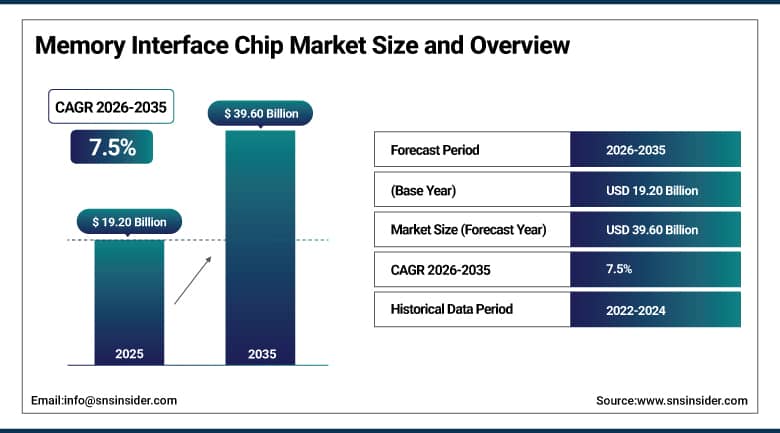
The Memory Interface Chip Market size was valued at USD 19.20 Billion in 2025 and is projected to reach USD 39.60 Billion by 2035, registering a CAGR of 7.5% from 2026 to 2035.
The Memory Interface Chip Market is enabling reliable, high-speed communication between server processors and increasingly dense memory modules by providing registering clock driver, data buffer, and power management chipsets essential to modern DDR5 and HBM memory architectures. The market is characterized by rising adoption of registering clock driver and data buffer chips in hyperscale data centers, growing demand for higher-bandwidth GDDR and HBM interface solutions supporting AI accelerator platforms, and expanding integration of advanced memory interface chips into automotive and telecommunications equipment. Significant growth is being witnessed in generative AI server deployment, cloud infrastructure expansion, and high-performance computing systems, considering that hyperscalers and server OEMs are investing heavily in memory interface technology capable of supporting increasingly dense, high-speed memory configurations.
Montage Technology began volume shipments of its DDR5 Registering Clock Driver and Data Buffer chipset throughout 2025, supporting next-generation server memory modules for hyperscale AI data center deployments.
To Get More Information On Memory Interface Chip Market - Request Free Sample Report
Memory Interface Chip Market Trends
-
Growing adoption of DDR5 registering clock driver and data buffer chips continues expanding capacity requirements across hyperscale data centers.
-
Rising demand for higher-bandwidth GDDR and HBM interface solutions continues supporting AI accelerator and high-performance graphics platforms.
-
Increasing integration of advanced memory interface chips into automotive electronics continues broadening demand beyond traditional server applications.
-
Expanding generative AI server deployment continues driving sustained capital investment toward higher-density memory module interface technology.
-
Growing adoption of power management integrated interface chipsets continues improving energy efficiency across dense server memory configurations.
U.S. Memory Interface Chip Market Size Outlook
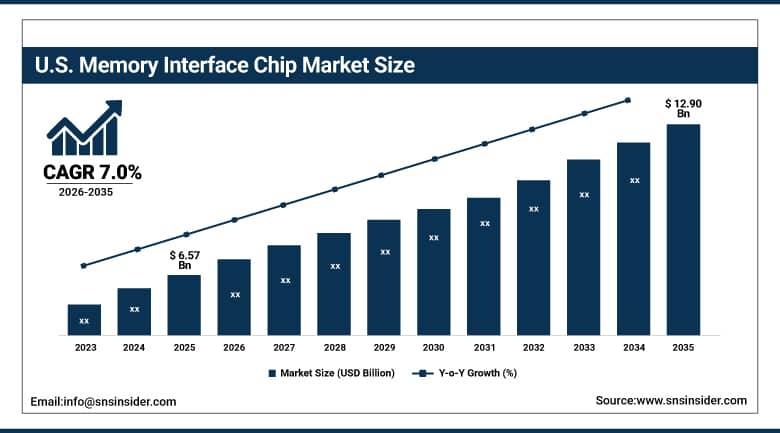
The U.S. Memory Interface Chip Market was valued at approximately USD 6.57 Billion in 2025 and is projected to reach approximately USD 12.90 Billion by 2035, registering a CAGR of approximately 7.0% from 2026 to 2035.
Demand across the United States continued to be shaped by aggressive hyperscale cloud provider expansion, sustained investment in AI and machine learning infrastructure, and government initiatives supporting domestic digital infrastructure and semiconductor manufacturing under the CHIPS Act. Rising deployment of DDR5 registering clock driver and data buffer chips by domestic cloud service providers continued reinforcing the country's position as both the largest and one of the most innovation-driven markets tracked in this report. Growing adoption across generative AI training clusters, enterprise IT infrastructure, and high-performance computing systems added further layers of sustained domestic demand well beyond the technology's original personal computing use case.
Rambus introduced its GDDR7 memory interface chip solution throughout 2025, engineered to deliver higher bandwidth for AI accelerator and high-performance graphics applications serving U.S.-based hyperscale and enterprise customers.
Memory Interface Chip Market Segment Analysis
-
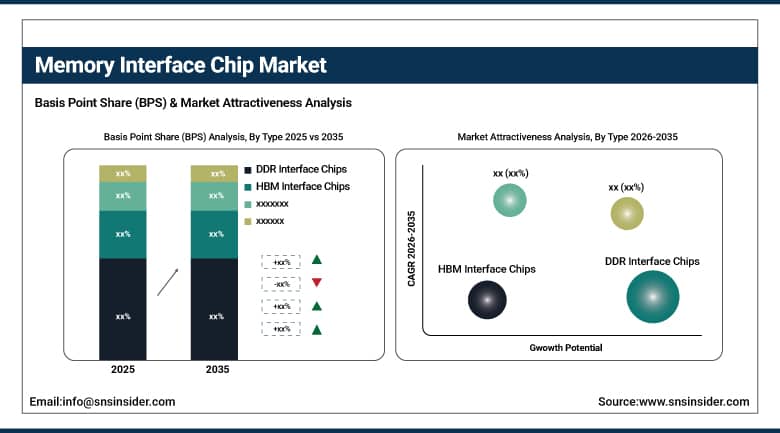
By Type, DDR Interface Chips dominated the Memory Interface Chip Market with a 38.00% share in 2025, while HBM Interface Chips is the fastest-growing type segment with a CAGR of 10.20% from 2026–2035.
-
By Application, Data Centers & Servers dominated the market with a 47.00% share in 2025, while Automotive is the fastest-growing application segment with a CAGR of 9.40% from 2026–2035.
-
By Packaging Type, BGA dominated the market with a 52.00% share in 2025, while LGA is the fastest-growing packaging type segment with a CAGR of 8.30% from 2026–2035.
-
By End-User, OEMs dominated the market with an 81.00% share in 2025, while Aftermarket is the fastest-growing end-user segment with a CAGR of 8.10% from 2026–2035.
By Type, DDR Interface Chips Lead While HBM Grows Fastest
The DDR Interface Chips segment dominated the Memory Interface Chip Market in 2025 owing to its established maturity, broad server compatibility, and widespread deployment of registering clock driver and data buffer chips across mainstream enterprise and hyperscale data center infrastructure. Server OEMs continue relying on DDR interface chips for their proven reliability and mature qualification across established memory module architectures. Continued volume deployment across enterprise and hyperscale server infrastructure has kept DDR interface chips the largest single revenue contributor within the market tracked in this report.
The HBM Interface Chips segment is the fastest growing in the Memory Interface Chip Market owing to surging demand for AI accelerator and GPU platforms requiring maximum memory bandwidth for generative AI training and inference workloads. Chip designers increasingly prioritize HBM interface development to support increasingly large AI model deployments. Growing hyperscaler investment in AI infrastructure continues accelerating demand for HBM-compatible interface chip technology across leading semiconductor suppliers.
By Application, Data Centers & Servers Dominate While Automotive Records Fastest Growth
The Data Centers & Servers segment dominated the Memory Interface Chip Market in 2025 due to sustained hyperscale cloud provider demand for registering clock driver and data buffer chips supporting increasingly dense DDR5 memory module configurations. Cloud providers continue prioritizing server-class memory interface deployment given the segment’s scale and recurring AI infrastructure refresh cycles. Sustained global data center capacity expansion has kept this application the largest overall revenue contributor across the market.
The Automotive segment is the fastest growing in the Memory Interface Chip Market owing to rising adoption of centralized compute domains and advanced driver assistance systems requiring reliable, high-speed memory interface technology. Automakers increasingly demand memory interface chip integration to support autonomous driving and infotainment compute requirements. Accelerating global vehicle electrification and autonomous driving development continues driving sustained growth in automotive-oriented memory interface chip demand.
By Packaging Type, BGA Leads While LGA Grows Fastest
The BGA segment dominated the Memory Interface Chip Market in 2025 due to its favorable balance of thermal performance, signal integrity, and compatibility with high-density server memory module designs. Module manufacturers continue favoring BGA packaging for its proven reliability across established DDR interface chip architectures. Sustained enterprise and hyperscale server production has kept this packaging type the largest overall revenue contributor across the market.
The LGA segment is the fastest growing in the Memory Interface Chip Market owing to rising demand for higher pin-count, lower-profile packaging solutions in increasingly dense next-generation server memory modules. Module designers increasingly favor LGA packaging to optimize signal integrity for higher-speed interface chip applications. Growing adoption of next-generation memory module standards continues accelerating demand for LGA-packaged memory interface chips across the industry.
By End-User, OEMs Lead While Aftermarket Grows Fastest
The OEMs segment dominated the Memory Interface Chip Market in 2025 due to sustained original equipment manufacturer demand for memory interface chips integrated directly into new server, consumer, and automotive electronic products. OEMs continue driving the majority of memory interface chip procurement given their central role in system-level product development. Continued global server and electronics production growth has kept this end-user segment the largest overall contributor to market revenue.
The Aftermarket segment is the fastest growing in the Memory Interface Chip Market owing to rising demand for memory module upgrade and replacement components in data center refresh and server maintenance applications. Service providers increasingly source compatible memory interface chips to extend server infrastructure service life. Growing focus on data center memory capacity upgrades continues driving accelerated growth in aftermarket memory interface chip demand.
Regional Analysis:
|
Region |
Major Country |
Share within Region, 2025 (%) |
|---|---|---|
|
North America |
United States |
90.00% |
|
Europe |
Germany |
23.50% |
|
Asia Pacific |
China |
36.00% |
|
Middle East and Africa |
Israel |
27.50% |
|
Latin America |
Brazil |
29.50% |
North America Memory Interface Chip Market Insights
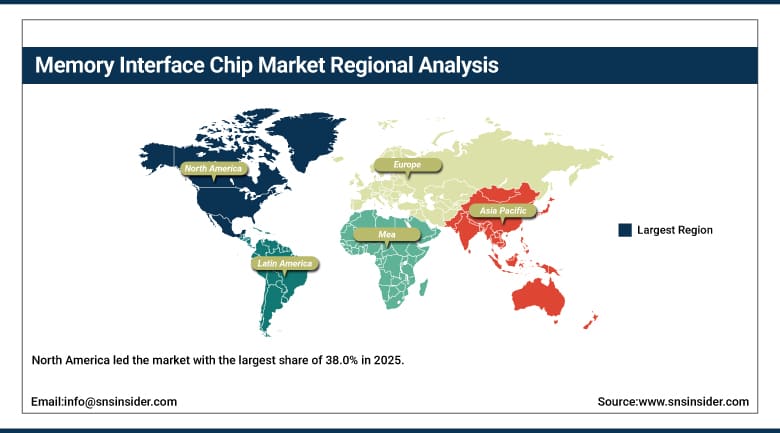
North America led the market with the largest share of 38.0% in 2025. Aggressive hyperscale cloud provider expansion, sustained investment in AI and machine learning infrastructure, and government initiatives supporting domestic digital infrastructure under the CHIPS Act continued reinforcing the region’s dominant position. Growing deployment of DDR5 registering clock driver and data buffer chips across data center, automotive, and AI accelerator applications further strengthened North America’s standing as both the largest and one of the most innovation-driven markets tracked in this report, with continued hyperscaler capital expenditure expected to sustain regional demand through the forecast period.
The United States anchored by its concentration of leading hyperscale cloud providers and substantial AI infrastructure investment. Canada added further regional demand through its own growing data center investment, and that combined strength kept the continent the largest addressable market for memory interface chip vendors through the forecast period, with continued generative AI infrastructure buildout expected to sustain regional demand.
Get Customized Report as Per Your Business Requirement - Enquiry Now
Europe Memory Interface Chip Market Insights
Europe held a meaningful share of global revenue, supported by growing sovereign AI infrastructure investment and continued expansion of enterprise data center capability across the region’s major economies. Regulatory momentum around European Chips Act-backed semiconductor investment continued shaping regional development priorities without meaningfully slowing commercialization across the continent, while sustained automotive and industrial computing demand kept the region among the more resilient memory interface chip markets tracked in this report.
Germany led demand of European revenue, supported by planned sovereign AI computing investment and its substantial automotive and industrial semiconductor demand base. The UK and France contributed additional demand, and continued European investment in sovereign AI infrastructure should keep regional demand for memory interface chip technology climbing steadily through the forecast period.
Asia Pacific Memory Interface Chip Market Insights
Asia Pacific is advancing at the fastest pace among all regions tracked in this report, registering a CAGR of 9.5% from 2026 to 2035, driven by expanding fabless chip design activity, growing domestic memory manufacturing capability, and sustained government-backed investment in advanced semiconductor technology across the region’s largest economies. That combination of manufacturing scale and genuine downstream demand across data centers, consumer electronics, and automotive electronics kept the region’s growth trajectory well ahead of every other region tracked in this report, with government semiconductor investment programs adding a further, sustained layer of demand.
China led the pack, supported by its rapidly expanding domestic memory interface chip design ecosystem and substantial government investment in indigenous semiconductor capability. Taiwan and South Korea contributed meaningful additional demand, with China’s expanding fabless design sector and Taiwan’s advanced foundry-adjacent design ecosystem both reinforcing the region’s position as the fastest-growing memory interface chip market tracked in this report, while Japan added further steady regional contribution.
MEA and Latin America Memory Interface Chip Market Insights
The Middle East and Africa and Latin America both showed steady growth, driven by expanding data center infrastructure investment, growing government focus on digital transformation initiatives, and rising enterprise demand for high-performance computing capability across both regions. As these markets continued building out modern data center infrastructure, memory interface chip technology proved a genuinely valuable enabler of increasingly capable, locally hosted enterprise computing environments.
Middle East and Africa demand, supported by the regions established semiconductor design presence and substantial multinational research and development investment. Saudi Arabia and the UAE contributed further demand through large-scale data center announcements. In Latin America, Brazil accounted for the largest share of regional revenue, with growing cloud computing and data center investment continuing to anchor regional demand for memory interface chip technology.
Market Dynamics
Growth Drivers: Rising Hyperscale Data Center Investment and AI Accelerator Deployment
The industry is driven by rising adoption of DDR5 registering clock driver and data buffer chips in hyperscale data centers, growing demand for higher-bandwidth GDDR and HBM interface solutions supporting AI accelerator platforms, expanding integration of advanced memory interface chips into automotive electronics, and increasing generative AI server deployment. As hyperscalers and server OEMs continue prioritizing maximum memory bandwidth and reliability, the need for expanded memory interface chip capacity continues driving sustained investment across the industry.
Rising generative AI infrastructure buildout continues reinforcing this driver, as AI training and inference workloads require increasingly dense, high-speed memory module configurations supported by advanced interface chip technology. Growing automotive demand for centralized compute domains continues defining a further layer of sustained demand, and that combination of AI infrastructure investment and automotive semiconductor content growth is exactly what keeps overall demand climbing at such a steady, sustained pace.
Restraints: Design Complexity and Signal Integrity Engineering Challenges
The substantial engineering effort required to design and validate memory interface chips capable of maintaining signal integrity at increasingly high data rates continues posing a genuine restraint on faster market-wide expansion, particularly for smaller chip designers without the design resources that established memory interface chip suppliers can commit. That complexity has kept advanced interface chip development concentrated among a comparatively small number of well-resourced design teams.
Ongoing dependence on a limited number of qualified memory interface chip suppliers continues posing a further restraint, as server OEMs face genuine supply chain concentration risk when sourcing critical registering clock driver and data buffer components. Standardization complexity across evolving JEDEC memory module specifications in certain deployment scenarios keeps some qualification timelines more administratively complicated than mature interface chip generations ever required.
Opportunities: HBM Interface Expansion and Automotive Compute Platform Growth
Rising HBM interface chip demand represents a genuinely significant opportunity, as AI accelerator and GPU designers increasingly require specialized interface technology to support maximum memory bandwidth for generative AI workloads. Vendors positioned early in HBM-compatible interface chip technology stand to capture meaningful share as this capability continues expanding from traditional server DDR applications into broader AI accelerator architectures.
Expanding automotive centralized compute adoption offers a second substantial opportunity, as vehicles increasingly consolidate sensor fusion and autonomous driving workloads onto platforms requiring reliable, high-speed memory interface technology. Vendors with proven, automotive-qualified memory interface chip technology stand to capture meaningful share as global autonomous vehicle development continues scaling across established and emerging automotive markets alike.
Recent Developments:
-
2026: Renesas Electronics introduced its third-generation DDR5 MRDIMM chipset solutions, supporting speeds of up to 16,000 MT/s for AI data centers, cloud infrastructure, and HPC applications.
-
2026: Rambus introduced a complete DDR5 9600 client memory module chipset for CUDIMM, CQDIMM, and CSODIMM form factors, targeting AI PCs, gaming, and content-creation workloads.
Memory Interface Chip Companies are:
-
Montage Technology Co., Ltd.
-
Renesas Electronics Corporation
-
Samsung Electronics Co., Ltd.
-
SK Hynix Inc.
-
Texas Instruments Incorporated
-
Analog Devices, Inc.
-
Diodes Incorporated
-
onsemi (ON Semiconductor Corporation)
-
STMicroelectronics N.V.
-
Infineon Technologies AG
-
NXP Semiconductors N.V.
-
Microchip Technology Incorporated
-
Etron Technology, Inc.
-
Alchip Technologies, Limited
-
GigaDevice Semiconductor Inc.
-
Cadence Design Systems, Inc.
-
Synopsys, Inc.
-
Marvell Technology, Inc.
Memory Interface Chip Market Report Scope:
| Report Attributes | Details |
|---|---|
| Market Size in 2025 | USD 19.20 Billion |
| Market Size by 2035 | USD 39.60 Billion |
| CAGR | CAGR of 7.5% From 2026 to 2035 |
| Base Year | 2025 |
| Forecast Period | 2026-2035 |
| Historical Data | 2022-2024 |
| Report Scope & Coverage | Market Size, Segments Analysis, Competitive Landscape, Regional Analysis, DROC & SWOT Analysis, Forecast Outlook |
| Key Segments | • By Type (DDR Interface Chips, LPDDR Interface Chips, GDDR Interface Chips, HBM Interface Chips, Others) • By Application (Data Centers & Servers, Consumer Electronics, Automotive, Telecommunications, Industrial) • By Packaging Type (BGA, LGA, TQFP, QFN) • By End-User (OEMs, Aftermarket) |
| Regional Analysis/Coverage | North America (US, Canada), Europe (Germany, UK, France, Italy, Spain, Russia, Poland, Rest of Europe), Asia Pacific (China, India, Japan, South Korea, Australia, ASEAN Countries, Rest of Asia Pacific), Middle East & Africa (UAE, Saudi Arabia, Qatar, South Africa, Rest of Middle East & Africa), Latin America (Brazil, Argentina, Mexico, Colombia, Rest of Latin America). |
| Company Profiles | Rambus Inc., Montage Technology Co., Ltd., Renesas Electronics Corporation, Samsung Electronics Co., Ltd., SK Hynix Inc., Micron Technology, Inc., Texas Instruments Incorporated, Analog Devices, Inc., Diodes Incorporated, onsemi (ON Semiconductor Corporation), STMicroelectronics N.V., Infineon Technologies AG, NXP Semiconductors N.V., Microchip Technology Incorporated, Etron Technology, Inc., Alchip Technologies, Limited, GigaDevice Semiconductor Inc., Cadence Design Systems, Inc., Synopsys, Inc., Marvell Technology, Inc. |

Frequently Asked Questions
The major growth factor is rising hyperscale data center investment, growing AI accelerator deployment, and expanding adoption of DDR5 and HBM memory interface technology.
The DDR Interface Chips segment dominated the Memory Interface Chip Market by type, representing the largest share of revenue in 2025.
North America dominated the Memory Interface Chip Market in 2025, holding an estimated 38.0% share of total global market revenue.
