
Smart Energy Market Report Scope & Overview:
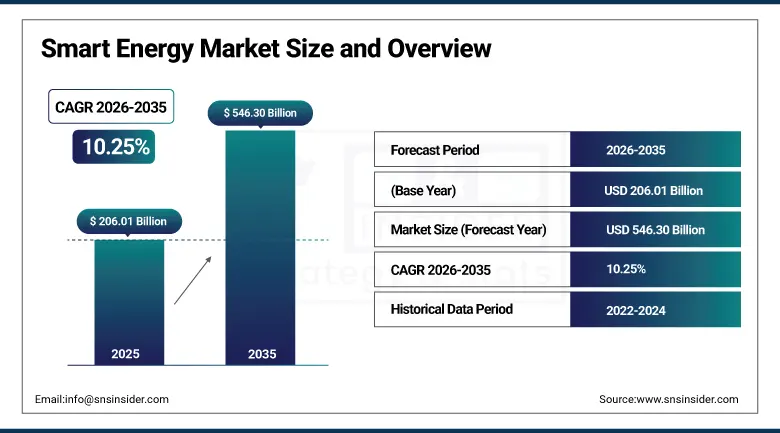
The Smart Energy Market size was valued at USD 206.01 Billion in 2025 and is projected to reach USD 546.30 Billion by 2035, expanding at a CAGR of 10.25% during the forecast period 2026–2035.
There have been impressive growth trends recorded in the global smart energy market because of the increased focus on investments in grid upgrades, renewable energy incorporation, digitalization of electricity grids, and intelligent energy management technologies. Governments, energy utilities, and energy companies are increasingly relying on AMI, grid analytics using artificial intelligence, DERMS, and energy platforms enabled by cloud technology to enhance resilience, efficiency, and energy security of their electricity grids. Electrification, decarburization goals, increasing use of distributed renewable energy, and adoption of electric cars are also contributing to investments in smart grid ecosystems. The continuous improvements in grid optimization using AI technology, Internet of Things, and energy analytics are likely to boost commercialization opportunities in the future.
To Get more information On Smart Energy Market - Request Free Sample Report
Smart Energy Market Trends
- Rapid deployment of AI-enabled smart grid management and predictive energy analytics platforms.
- Increasing investments in Advanced Metering Infrastructure (AMI) and smart electricity meters.
- Rising integration of distributed renewable energy resources into intelligent grid networks.
- Growing commercialization of cloud-based energy management and demand response solutions.
- Expansion of EV charging infrastructure integrated with smart energy management systems.
U.S. Smart Energy Market Size Outlook
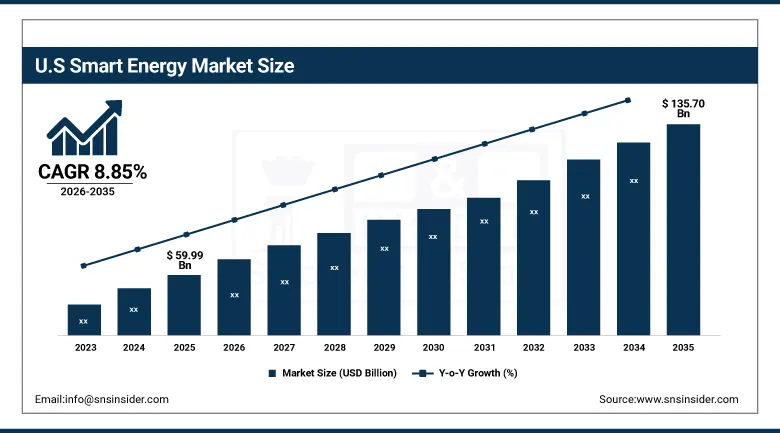
The U.S. Smart Energy Market was valued at USD 59.99 billion in 2025 and is expected to reach approximately USD 135.70 billion by 2035, expanding at a CAGR of 8.85% during 2026–2035.
The USA will keep its leadership in the market of smart energy due to heavy investments in grid modernization, renewables installation, advanced metering infrastructure development, and digitalization of utilities. American electric utilities are increasingly adopting AI-powered grid management platforms, intelligent substations, distributed energy resources management systems, and real-time energy analytics to increase grid reliability and efficiency. The increased share of renewable electricity, the fast growth of battery energy storage systems, growing infrastructure for EVs charging, and supportive federal policy for enhancing grid reliability are contributing to the adoption in utilities, commercial, industrial, and transportation sectors. Cloud-based energy management platforms, predictive maintenance, and intelligent demand response systems can positively affect the future growth prospects of the U.S. smart energy market.
Smart Energy Market Segment Analysis
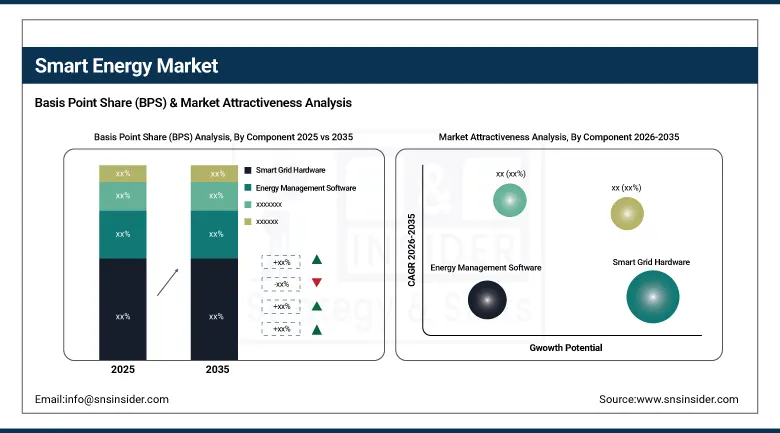
- By Component, smart grid hardware dominated the market with 34.00% share in 2025, while energy management software is projected to witness the fastest growth with 13.04% CAGR during the forecast period.
- By Technology, advanced metering infrastructure dominated the market with 31.00% share in 2025, while AI-based grid optimization is projected to witness the fastest growth with 15.15% CAGR during the forecast period.
- By Application, grid modernization dominated the market with 32.00% share in 2025, while EV charging & smart mobility energy management is projected to witness the fastest growth with 13.47% CAGR during the forecast period.
- By End User Industry, utilities dominated the market with 42.00% share in 2025, while transportation & EV infrastructure is projected to witness the fastest growth with 16.03% CAGR during the forecast period.
By Component, smart grid hardware dominated, while energy management software fastest growth.
Smart grid hardware was identified as the major contributor with a market share of 34.00% in 2025 due to the increased installation of intelligent substations, smart transformers, communication infrastructure, sensors, and power electronics facilitating the development of digital grids globally. The utilities keep investing significantly in grid infrastructures that support the incorporation of renewables, distributed energy resources (DER), and monitoring. Growing financial support from governments in making the electricity infrastructures resilient, together with upgrading of old infrastructures and advancements in grid connectivity, will increase business opportunities for smart grid hardware in the developed and developing electricity markets.
The energy management software market is expected to experience the highest CAGR of 13.04% during 2026–2035 owing to the widespread use of automated distribution management systems, automated fault detection technology, self-healing grids, and advanced AI control operations by utilities to enhance grid efficiency. Utilities are using the automation system solutions to minimize the outage times, increase the reliability of the grid, optimize the use of assets, and integrate renewable generation sources in the grid network. Digitalization of the grid networks and increased investments in predictive maintenance solutions, intelligent substations, and control platforms will drive adoption going forward.
By Technology, advanced metering infrastructure dominated, while AI-based grid optimization fastest growth.
Advanced metering infrastructure (AMI) accounted for the maximum market share of 31.00% in 2025 as power utilities globally are increasingly replacing traditional electric meters with two-way communicating smart meters. With AMI solutions, utilities can achieve precise billing, remote meter management, outage management, demand analysis, and better customer engagement along with large-scale digital utility transformation. Government programs for smart grids, regulations for increased energy efficiency, and higher investments in digital electricity infrastructure are promoting the use of advanced metering technologies in residential, commercial, and industrial electricity grids.
AI-based grid optimization is poised to witness the fastest growth rate (CAGR) of 15.15% over the forecast period due to growing use of artificial intelligence technology for predictive grid analysis, automated load balancing, renewable energy forecasts, and operational decisions on real-time basis. Artificial intelligence algorithms are being used by utilities to enhance grid transmission, detect failure in equipment, minimize technical losses, and optimize distributed energy resources. Adoption of machine learning, digital twin, and grid intelligence platforms on cloud is boosting the commercialization of AI-powered smart energy management systems.
By Application, grid modernization dominated, while EV charging & smart mobility energy management fastest growth.
The grid modernization segment was responsible for the highest market share of 32.00% in 2025 due to continual efforts made by utilities towards enhancing aging electricity transmission and distribution networks with digitally integrated smart electricity grids. Advanced automation techniques, IoT-based monitoring systems, and reliable communication infrastructure will help in making the utilities more reliable and capable enough to cope with the increased generation of renewable energy. Government initiatives towards building grid resilience and increased demand for electricity will provide even greater support in terms of investment towards such comprehensive modernization efforts.
The EV charging & smart mobility energy management segment is likely to register the highest growth rate (CAGR) of 13.47% during the forecasted period due to the growing trend of adoption of electric vehicles all around the world. Such smart technology like intelligent charging of vehicles, smart load balancing techniques, vehicle-to-grid integration, and the implementation of AI-driven charging management solutions are becoming an inevitable part of the efforts towards keeping the grid stable amid increased transportation electrification.
Regional Analysis
|
Region |
Major Country |
Share within Region, 2025 (%) |
|---|---|---|
|
North America |
United States |
91.00% |
|
Europe |
Germany |
28.00% |
|
Asia Pacific |
China |
31.00% |
|
Middle East & Africa |
UAE |
5.00% |
|
Latin America |
Brazil |
4.00% |
North America Smart Energy Market Insights
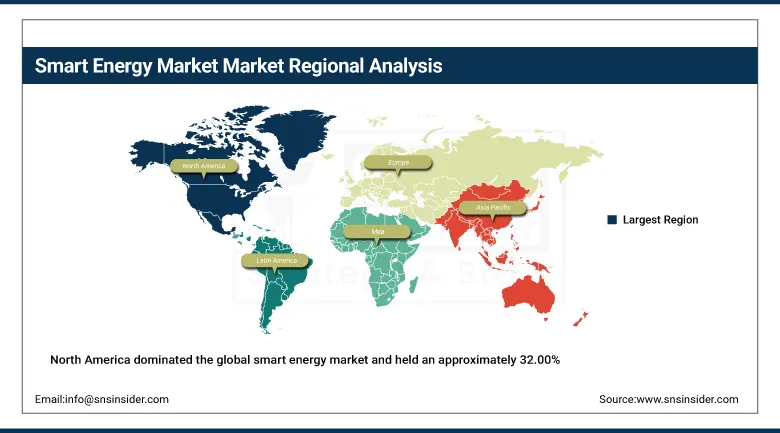
North America dominated the global smart energy market and held an approximately 32.00% share of the revenue generated in 2025. The regional dominance can be attributed to the significant amount of money invested in the development of smart grids, AMI, renewable energy incorporation, and digitalization of utilities in the United States and Canada. The utilities in this region are still implementing AI-driven grid management platforms, intelligent substations, demand response technologies, and real-time monitoring systems to improve the grid's resilience and efficiency.
Favorable regulations, replacement of old electricity infrastructures, electrification, and deployment of distributed energy resources will continue to drive the dominance of North America in the global smart energy industry. The U.S. Department of Energy kept increasing the GRIP investment in order to modernize the transmission grid, automate the grid, and incorporate clean energy into the grid in various states.
Get Customized Report as per Your Business Requirement - Enquiry Now
Europe Smart Energy Market Insights
Europe presented backed up by aggressive decarburization programs, renewable power generation, and digital transformation of power grids. Countries such as Germany, France, the UK, Italy, and the Scandinavian economies have been investing in smart meters, digital substations, decentralized energy management systems, and grid automation. Due to the fast-growing generation of renewable power, energy storage systems, and electricity grid interconnections, the need for innovative energy management systems has become increasingly necessary. The support provided by the European energy transition policy framework will offer future prospects for the providers of smart energy solutions in Europe. The European Commission went on with the electricity market reforms in favor of grid flexibility, renewable power generation, and digital transformation of the energy infrastructure.
Asia Pacific Smart Energy Market Insights
The Asia Pacific region will have the highest CAGR of 13.01% for the forecast period on account of urbanization, rising electricity requirements, increased usage of renewable energy and growing investments by governments for digital grid infrastructure. Countries like China, Japan, India, South Korea and Australia are rapidly implementing advanced metering infrastructure, AI-based grid optimization solutions, distributed energy resources management and intelligent transmission system technologies.
The ongoing development of EV charging infrastructure, smart city projects, battery storage installations and digitalization in industry applications is further contributing towards demand in the region. Sizable investments by governments and utilities have made Asia Pacific the fastest-growing region in the world. China's National Energy Administration further extended its support towards the adoption of smart grid and digital power infrastructure in the country.
Middle East & Africa and Latin America Smart Energy Market Insights
Middle East & Africa fueled by rising investments in smart cities initiatives, deployment of renewable energy sources, and improvements in the power grid network in the UAE, Saudi Arabia, and South Africa. Power companies use intelligent meters, automated substations, and digital energy grid systems to increase efficiency and ensure energy security. Initiatives of governments towards development of sustainable infrastructure keep pushing the adoption of smart energy solutions in the region.
Latin America driven by the modernization of utility infrastructure, growth in renewable energy production, and implementation of intelligent metering systems in Brazil, Mexico, Chile, and Argentina. Investments in distributed energy solutions, smart grids, and EV charging infrastructure drive the growth of the market in the region. Rising demand for energy management and resilience of the electricity grid is expected to create opportunities for smart energy solutions vendors in the forecast period. Smart grid strategy of Dubai electricity and water authority (DEWA) keeps growing.
Market Dynamics
Growth Drivers: Increasing grid modernization fostering deployment of smart energy solutions.
Fast modernization of electricity infrastructure and renewable energy integration are some of the main factors that are greatly boosting growth in the smart energy market at the global level. Investments made by utilities in advanced metering infrastructure, digital substations, smart grids, DERMS, and intelligent grid analysis with the help of artificial intelligence (AI) are on the rise. With growing usage of solar energy, wind energy, battery energy storage systems, and distributed generation, there is an increasing need for grid management solutions that can manage dynamic energy flows in real time. U.S. Department of Energy's Grid Deployment Office continues to make more investments in building robust and resilient transmission infrastructure and integrating clean energy into U.S. electric grid.
Restraints: High infrastructure investment costs issues continue to be hurdles to market growth.
Despite solid growth potential, the smart energy market faces difficulties due to high costs of investment and increasing risks of cyber-attacks. Installation of advanced metering infrastructure, intelligent substations, communication infrastructures, cloud-based energy management systems, and grid automation technologies needs substantial financial investments, especially for companies that use aged transmission and distribution grid infrastructure. Besides, increased digital connectivity means increased vulnerability to cyber-attacks on critical energy infrastructure. Difficulties in integrating old grid infrastructure with new digital technology solutions further prolongs the process and raises the cost of projects, especially in developing countries with no budget for modernization. The U.S. Cyber security and Infrastructure Security Agency (CISA) kept issuing guidelines regarding cyber security of operational technology and critical energy infrastructure.
Opportunities: Opportunities for growth arise in relation to AI-based energy management.
Increased implementation of artificial intelligence, cloud computing technology, distributed energy resources, and intelligent energy management solutions offers numerous opportunities for the global smart energy market. The application of AI-based predictive maintenance solutions, automated demand response systems, digital twins, and grid optimization platforms by utilities is becoming widespread to optimize the performance and increase the utilization of renewable energy. Growing installation of electric vehicle charging stations, battery energy storage systems, virtual power plants, and decentralized electricity generation increases the need for intelligent energy management solutions. Continued development of digital utility and intelligent grid ecosystem is anticipated to present many business opportunities during the forecast period. Schneider Electric enhanced digital energy management solution enabled by AI on its EcoStruxure platform.
Recent Developments
- January 2026: Schneider Electric expanded its EcoStruxure Grid portfolio by introducing advanced AI-enabled grid management and predictive analytics capabilities to improve utility resilience, renewable energy integration, and operational efficiency across digital electricity networks.
- 2026: Siemens AG enhanced its Gridscale X software portfolio with additional AI-powered applications for grid planning, asset performance management, and distributed energy resource integration, supporting utilities in accelerating digital grid transformation.
- 2025: Hitachi Energy strengthened its digital energy portfolio through expanded deployment of Lumada Asset Performance Management solutions, enabling utilities to optimize grid reliability, predictive maintenance, and renewable energy integration using advanced analytics.
- 2025: ABB announced further enhancements to its digital energy management and smart grid automation solutions, enabling utilities to improve distribution network efficiency, integrate renewable generation, and support grid decarburization initiatives.
Smart Energy Companies are:
- Schneider Electric SE
- Siemens AG
- ABB Ltd.
- GE Vernova Inc
- Hitachi Energy Ltd.
- Eaton Corporation plc
- Honeywell International Inc.
- Itron Inc.
- Landis+Gyr Group AG
- Cisco Systems, Inc.
- Oracle Corporation
- IBM Corporation
- Mitsubishi Electric Corporation
- Toshiba Corporation
- S&C Electric Company
- Siemens Energy AG
- Kamstrup A/S
- Trilliant Holdings, Inc.
- Wipro Limited
- Huawei Technologies Co., Ltd.
Smart Energy Market Report Scope:
| Report Attributes | Details |
|---|---|
| Market Size in 2025 | USD 206.01 Billion |
| Market Size by 2035 | USD 546.30 Billion |
| CAGR | CAGR of 10.25% From 2026 to 2035 |
| Base Year | 2025 |
| Forecast Period | 2026-2035 |
| Historical Data | 2022-2024 |
| Report Scope & Coverage | Market Size, Segments Analysis, Competitive Landscape, Regional Analysis, DROC & SWOT Analysis, Forecast Outlook |
| Key Segments | • By Component (Smart Grid Hardware, Smart Meters & AMI Infrastructure, Energy Management Software, Grid Automation & Control Systems, Others) • By Technology (Advanced Metering Infrastructure, Demand Response & Load Management, DERMS & Distributed Energy Platforms, AI-Based Grid Optimization, Others) • By Application (Grid Modernization, Renewable Energy Integration, Energy Efficiency & Building Optimization, EV Charging & Smart Mobility Energy Management, Others) • By End User Industry (Utilities, Commercial Buildings, Industrial Facilities, Residential Users, Transportation & EV Infrastructure, Others) |
| Regional Analysis/Coverage | North America (US, Canada), Europe (Germany, UK, France, Italy, Spain, Russia, Poland, Rest of Europe), Asia Pacific (China, India, Japan, South Korea, Australia, ASEAN Countries, Rest of Asia Pacific), Middle East & Africa (UAE, Saudi Arabia, Qatar, South Africa, Rest of Middle East & Africa), Latin America (Brazil, Argentina, Mexico, Colombia, Rest of Latin America). |
| Company Profiles | Schneider Electric SE, Siemens AG, ABB Ltd., GE Vernova Inc., Hitachi Energy Ltd., Eaton Corporation plc, Honeywell International Inc., Itron Inc., Landis+Gyr Group AG, Cisco Systems, Inc., Oracle Corporation, IBM Corporation, Mitsubishi Electric Corporation, Toshiba Corporation, S&C Electric Company, Siemens Energy AG, Kamstrup A/S, Trilliant Holdings, Inc., Wipro Limited, Huawei Technologies Co., Ltd. |

Frequently Asked Questions
The Smart Energy Market was valued at USD 206.01 Billion in 2025.
Smart Grid Hardware accounted for the largest market share of 34.00% in 2025.
