
Smart Street Lighting Market Report Scope & Overview:
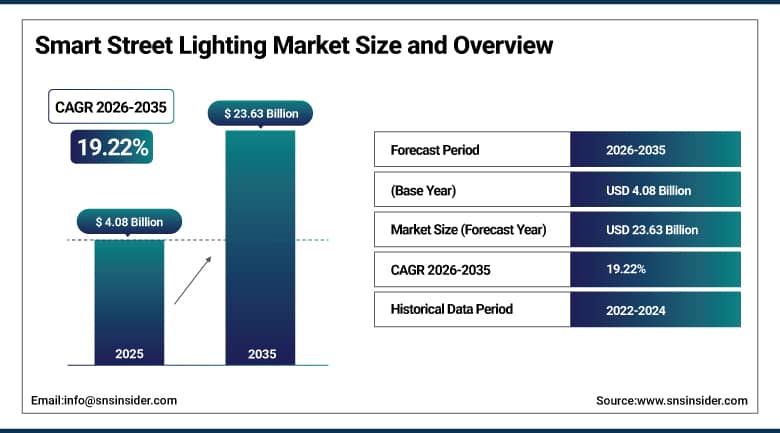
The Smart Street Lighting Market size was valued at USD 4.08 billion in 2025 and is expected to reach USD 23.63 billion by 2035, growing at a CAGR of 19.22% from 2026–2035.
The smart street lighting market is witnessing significant growth in the global market due to rising demand for energy efficient and connected urban infrastructure systems. Increasing adoption of IoT enabled lighting solutions and smart city initiatives is driving strong market expansion. Growing focus on reducing energy consumption and operational costs is further supporting large scale deployment. Expansion of intelligent transportation systems and smart mobility networks is significantly boosting usage. Rapid advancements in NB-IoT, sensors, and cloud-based control platforms are strengthening demand for advanced smart street lighting solutions worldwide.
New York State’s Smart Street Lighting NY program has replaced over 500,000 LED streetlights, achieving 3% annual electricity demand reduction and cutting maintenance costs via smart controls. DOE notes LED streetlights deliver 40–65% energy savings vs conventional lighting, enabling large municipal cost reductions.
To Get More Information On Smart Street Lighting Market - Request Free Sample Report
Smart Street Lighting Market Trends
-
The rapid implementation of IoT-powered smart street light systems ensures energy consumption reduction by 35%-45%.
-
The use of adaptive dimming and motion sensors leads to a cost-saving effect that amounts to 25%-40% in 2025 deployments.
-
The increase in mandates aimed at ensuring efficient lighting leads to an additional 60% of traditional systems being replaced with LED ones.
-
The incorporation of AI-based predictive analytics helps reduce outage times by approximately 50%.
-
As funding programs for smart cities expand, the number of urban deployments grows, with over 70% of urban projects incorporating smart lighting.
-
Energy saving measures contribute to incorporating renewable-powered street light systems, resulting in reduced emissions of CO2 by up to 30%.
U.S. Smart Street Lighting Market Size Outlook.
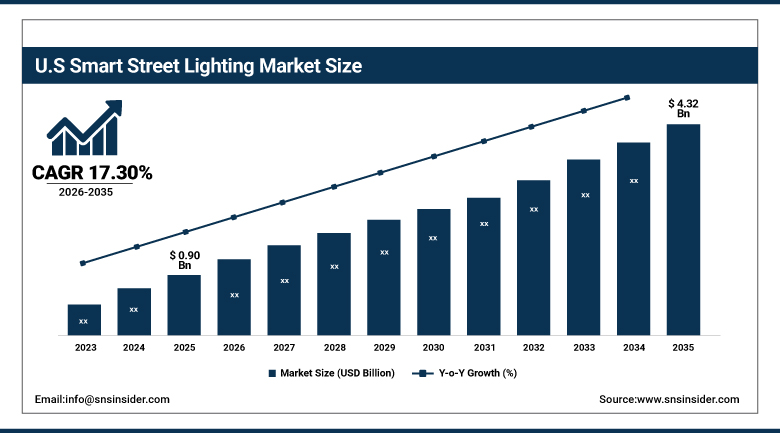
The U.S. Smart Street Lighting Market was valued at USD 0.90 billion in 2025 and is expected to reach around USD 4.32 billion by 2035, growing at a CAGR of 17.30% from 2026–2035.
The U.S. smart street lighting market is witnessing strong growth because of rapid adoption of connected and energy efficient urban lighting systems. Smart lighting usage in traffic management, public safety, and smart city infrastructure has been responsible for strong market expansion. Increasing investment in IoT enabled cities and digital infrastructure modernization has led to rising demand for advanced lighting solutions. Expanding deployment of NB-IoT based control systems and sensor integration is further supporting product adoption. Growing focus on energy savings and sustainability goals is strengthening market growth.
According to the U.S. Department of Energy, thanks to fast adoption of LEDs and increasing efficiency of outdoor light systems. In the DOE report Lighting Market Characterization, increased incorporation of intelligent lighting controls in the city infrastructure is mentioned. In this regard, smart lights are being installed by cities such as Los Angeles and Chicago using the IoT technology.
Smart Street Lighting Market Segment Analysis
-
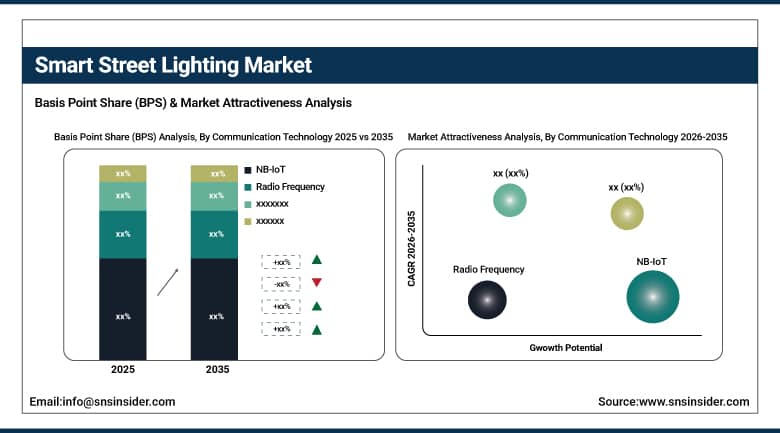
By Communication Technology, NB-IoT dominated the smart street lighting market with 34.20% share in 2025 and it is also fastest growing segment with CAGR of 22.83% during 2026 to 2035.
-
By Application, traffic optimization dominated the smart street lighting market with 44.85% share in 2025; while smart parking is the fastest growing segment with CAGR of 22.68% during 2026 to 2035.
-
By End-user, commercial dominated the smart street lighting market with 46.90% share in 2025; while industrial is the fastest growing segment with CAGR of 20.71% during 2026 to 2035.
By Communication Technology, NB-IoT dominates the Smart Street Lighting Market and is also the fastest growing segment.
The NB-IoT segment held the dominated market share in terms of revenue in the Smart Street Lighting Market in 2025. The high adoption rate of this segment is attributed to its extensive use in smart city infrastructure and municipal lighting projects. NB-IoT technology is known for its low power consumption, wide area network coverage, and effective connectivity that enables remote monitoring applications. Its cost-effectiveness and ease of integration with current mobile networks give it a significant advantage in this market space.
The NB-IoT segment will record the fastest Compound Annual Growth Rate during the forecast period, 2026 - 2035 owing to an increasing number of IoT-based smart city projects around the world. Increased demand for advanced lighting controls, predictive maintenance, and optimization of energy is propelling the growth of this segment. The deployment of 5G and LPWAN infrastructures is supporting increased adoption rates. Sustainable and cost-effective technologies are fueling their growth rates.
By Application, traffic optimization dominated the Smart Street Lighting Market, while smart parking is the fastest growing segment.
Traffic optimization emerged as a dominated segment in the Smart Street Lighting Market with the largest share in terms of revenue in 2025. This leadership was attributed to growing instances of urban congestion along with increased requirement for effective traffic management systems. The incorporation of smart sensors along with adaptive lighting helps improve road safety and reduce instances of accidents. The government's investment in developing smart cities and smart transportation systems adds to its leadership.
Smart parking is anticipated to be the fastest growing application segment in terms of CAGR between 2026 and 2035, owing to rapid urbanization and higher numbers of vehicles in metropolitan cities. The rising demand for real-time information about parking availability and reduction in traffic congestion boosts the use of smart parking solutions. IoT based sensors and mobile applications facilitate the easy identification and parking process.
By End-user, commercial dominated the Smart Street Lighting Market, while industrial is the fastest growing segment.
The Commercial segment held the dominated revenue share position in the Smart Street Lighting Market in 2025. The commercial segment holds the top position as it has been implemented in large numbers in urban infrastructures, highways, and public utility services. The implementation is being increased owing to growing use of the smart city concept and governmental funds for the same purpose. The high need for energy-efficient lighting, better security, and control systems is encouraging the adoption. Also, the financial capabilities of municipalities and infrastructural developers are helping maintain their leadership position in the market.
The Industrial segment will witness the fastest CAGR during the forecast period of 2026-2035. The growth of the industrial segment can be attributed to the growing use of the smart lighting concept in factories, logistic hubs, and industrial zones. The increasing need for optimizing energy and operating efficiency is pushing the use. Further, IoT-based monitoring systems help monitor and maintain the systems for long periods without any interruption. Growing automation and sustainability regulations are also driving the usage.
Regional Analysis
|
Region |
Major Country |
Share within Region, 2025(%) |
|---|---|---|
|
North America |
United States |
81.40% |
|
Europe |
Germany |
27.50% |
|
Asia Pacific |
China |
42.00 % |
|
Middle East & Africa |
UAE |
13.80% |
|
Latin America |
Brazil |
45.50% |
North America Smart Street Lighting Market Insights.
North America Smart Street Lighting Market is witnessing strong growth, supported by municipal modernization programs, smart-city investments, and increasing adoption of connected LED systems. Cities are upgrading aging lighting infrastructure with remote monitoring, automated dimming, and sensor-based controls to reduce energy consumption and maintenance costs. Integration with traffic management, environmental monitoring, and public safety systems is further expanding demand. Government sustainability initiatives and utility partnerships are also encouraging the transition toward intelligent, energy-efficient street lighting solutions across the region.
The U.S. DOE Municipal Solid-State Lighting Consortium supports LED transition across 500 municipalities, improving efficiency and monitoring systems. New York alone installed 286,000+ LED smart streetlights, targeting 500,000 under its state program, reducing electricity demand by 3% statewide. DOE research confirms connected systems improve energy accountability and maintenance efficiency. These initiatives highlight strong government-led decarbonization and smart city infrastructure modernization across North America.
Europe Smart Street Lighting Market Insights.
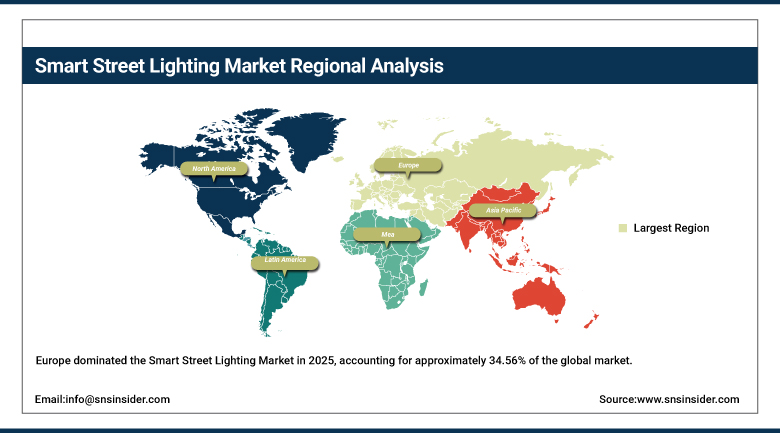
Europe dominated the Smart Street Lighting Market in 2025, accounting for approximately 34.56% of the global market. The region’s leadership is driven by widespread adoption of energy-efficient LED lighting, smart city initiatives, and increasing investments in connected urban infrastructure. Government regulations supporting energy conservation and carbon reduction further encourage deployment. Additionally, advanced IoT connectivity, intelligent traffic management, and remote lighting control systems are accelerating adoption across major European cities, strengthening the region’s position in the global smart street lighting market.
Eurostat reports that the EU has over 1.6 million km of road lighting infrastructure consuming about 35 TWh annually, making smart LED street lighting a key energy-efficiency driver across Europe. EU data shows renewables reached 25% of final energy use in 2024, supporting decarbonization goals. Smart lighting adoption is driven by EU Energy Efficiency Directive targets and municipal smart city upgrades.
Get Customized Report as Per Your Business Requirement - Enquiry Now
Asia Pacific Smart Street Lighting Market Insights.
The Asia Pacific region holds significant potential to record the fastest CAGR of 22.00% in the Smart Street Lighting Market in 2025. With strong market share and high growth rate, expansion is driven by rapid urbanization and smart city development programs. Key countries including China, India, Japan, and South Korea are heavily investing in intelligent lighting infrastructure. Rising adoption of IoT based systems is accelerating large scale deployment across cities and industrial corridors.
According to Singapore’s Land Transport Authority, conversion of over 110,000 streetlights into smart systems reduced public maintenance feedback by 80% and saved 4,200 man-hours annually. IEA reports over 60% of new Southeast Asia streetlights are solar-based, reflecting strong government-driven sustainable infrastructure push.
Middle East & Africa and Latin America Smart Street Lighting Market Insights.
Middle East & Africa and Latin America regions are expected to experience steady growth in the Smart Street Lighting Market till 2025 due to rapid urban infrastructure development. Countries such as UAE, Saudi Arabia, South Africa, Brazil, and Mexico are increasingly investing in smart city projects. Rising demand for energy efficient lighting and public safety systems is driving deployment across urban roads, highways, and municipal infrastructure networks.
According to the International Energy Agency, global lighting accounts for nearly 8% of total electricity consumption, with smart lighting significantly reducing energy usage. MEA smart lighting revenue is increasing due to large scale infrastructure investments and sustainability regulations. Latin America is gradually transitioning toward smart LED based street lighting systems supported by government initiatives, urban modernization programs, and growing focus on energy efficient public infrastructure development.
Market Dynamics
Growth Drivers: Smart city expansion and IoT enabled urban infrastructure driving large scale deployment of intelligent street lighting systems.
Rapid urbanization is accelerating demand for connected lighting networks across municipal roads and public infrastructure systems worldwide. Government investments in smart city initiatives are boosting adoption of energy efficient and automated lighting control solutions. Integration of sensors, wireless communication, and cloud platforms is enhancing real time monitoring and operational efficiency significantly.
According to the U.S. Department of Energy, use of LEDs in transportation and general illumination is on the increase, with LEDs accounting for nearly 48% of installations made as of 2020 and expected dominance in the future until 2035. Adoption of adaptive headlamps, ambient interiors, and smart cockpits inside automobiles increases demand for energy-efficient and connected light sources worldwide.
Restraints: Cybersecurity risks and data privacy concerns restricting full scale adoption of connected smart lighting infrastructure systems globally.
Dependence on continuous network connectivity increasing vulnerability to system failures and operational disruptions in smart lighting networks. Lack of standardized communication protocols creating interoperability issues between different smart lighting technologies and platforms. Limited technical expertise for maintenance and system management affecting long term operational efficiency of smart street lighting systems.
Opportunities: Advancements in artificial intelligence and data analytics enabling predictive maintenance and optimized energy usage in smart lighting systems.
Integration of 5G and NB-IoT technologies improving connectivity, efficiency, and real time control of street lighting networks. Rapid urban expansion in emerging economies is creating significant demand for cost effective and scalable smart lighting solutions. Increasing focus on sustainability and net zero targets is driving adoption of energy efficient and intelligent lighting technologies worldwide.
The Department of Energy has provided OLED displays that have a very high efficiency when it comes to illumination, offering 60 or even 85 lumens per watt in terms of efficacy. Furthermore, OLED display shipment volume in 2025 rose to 19.2% compared to its shipment volume in the previous year, while there was an increasing use of mini-LED in high-end displays.
Recent Developments
-
2026: Dimonoff advanced IoT-based smart lighting control systems integrating AI-driven automation cloud connectivity enabling municipalities optimize operations energy efficiency remote.
-
2025: GE Lighting expanded LED and connected lighting systems under Current Lighting Solutions ecosystem enabling municipalities deploy energy-efficient street lighting with digital monitoring automation sustainability-focused urban infrastructure upgrades across key markets.
-
2024: Lucy Group strengthened street lighting manufacturing capabilities advancing durable column designs energy-efficient solutions supporting municipal infrastructure modernization connected systems.
Smart Street Lighting Companies are:
-
Signify
-
ams OSRAM
-
Schneider Electric
-
Eaton
-
Legrand
-
Panasonic Holdings Corporation
-
Samsung Electronics
-
LG Electronics
-
Zumtobel Group
-
Itron
-
Schréder
-
Current Lighting Solutions
-
Cisco Systems
-
Ubicquia
-
Dimonoff
-
Tvilight
-
GE Lighting
-
Lucy Group
Smart Street Lighting Market Report Scope:
| Report Attributes | Details |
|---|---|
| Market Size in 2025 | USD 4.08 Billion |
| Market Size by 2035 | USD 23.63 Billion |
| CAGR | CAGR of 19.22% From 2026 to 2035 |
| Base Year | 2025 |
| Forecast Period | 2026-2035 |
| Historical Data | 2022-2024 |
| Report Scope & Coverage | Market Size, Segments Analysis, Competitive Landscape, Regional Analysis, DROC & SWOT Analysis, Forecast Outlook |
| Key Segments | By Communication Technology (NB-IoT, Powerline Communication, Radio Frequency, Others (Ultra-Narrowband, LoRa)) By Application (Environmental Monitoring, Traffic Optimization, Smart Parking, Others) By End-user (Commercial, Residential, Industrial) |
| Regional Analysis/Coverage | North America (US, Canada), Europe (Germany, UK, France, Italy, Spain, Russia, Poland, Rest of Europe), Asia Pacific (China, India, Japan, South Korea, Australia, ASEAN Countries, Rest of Asia Pacific), Middle East & Africa (UAE, Saudi Arabia, Qatar, South Africa, Rest of Middle East & Africa), Latin America (Brazil, Argentina, Mexico, Colombia, Rest of Latin America). |
| Company Profiles | Signify, Acuity Brands, ams OSRAM, Schneider Electric, Eaton, Hubbell Incorporated, Legrand, Panasonic Holdings Corporation, Samsung Electronics, LG Electronics, Zumtobel Group, Itron, Schréder, Current Lighting Solutions, Cisco Systems, Ubicquia, Dimonoff, Tvilight, GE Lighting, Lucy Group |
Frequently Asked Questions
The Smart Street Lighting Market is expected to grow at a CAGR of 19.22% from 2026 to 2035.
The Smart Street Lighting Market was valued at USD 4.08 billion in 2025.
Smart city expansion, IoT-enabled infrastructure, and energy efficiency mandates are driving global smart street lighting adoption.
NB-IoT dominated due to low power consumption, wide coverage, and strong suitability for large-scale smart city deployments.
Europe dominated the Smart Street Lighting Market due to advanced smart city infrastructure and high IoT adoption rates.
