
Smart Solar Inverter Connectivity Market Report Scope & Overview:
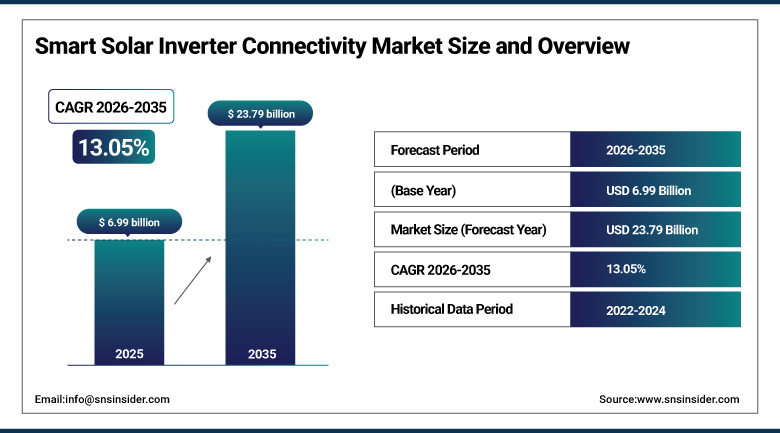
The Smart Solar Inverter Connectivity Market was valued at USD 6.99 Billion in 2025 and is expected to reach USD 23.79 Billion by 2035, growing at a CAGR of 13.05% from 2026–2035.
Among the major drivers for the growth of the smart solar inverter connectivity market on a global scale are the increasing implementation of solar photovoltaic systems, the increased implementation of renewable energy in the power grid, and the need for real-time monitoring and intelligent energy management. Increasing the implementation of smart inverters that have communication capability allows solar system operators to monitor their operation in a remote way, detect faults, increase energy production efficiency, and enhance the reliability of the systems. Moreover, the increasing use of energy storage systems, hybrid solar systems, and distributed energy resources requires connectivity between the inverters, energy storage systems, energy management platforms, and grid infrastructure.
Furthermore, the implementation of the Internet of Things, cloud-based monitoring, predictive maintenance driven by artificial intelligence, and digital energy management systems is contributing to the growth of the market. Finally, the governmental initiatives aimed at promoting the implementation of renewable energy, smart-grid transformation, rooftop solar systems, and grid-interactive inverters also contribute to the adoption of connected solar inverter solutions.
In March 2026, Zenergize announced a partnership with Infineon Technologies to develop silicon-carbide (SiC)-based solar inverter technology, supporting the development of higher-efficiency and more advanced inverter systems. The collaboration is expected to strengthen next-generation inverter capabilities, including improved power conversion performance and suitability for smart solar applications.
To Get more information Smart Solar Inverter Connectivity Market - Request Free Sample Report
Smart Solar Inverter Connectivity Market Trends
-
Increasing adoption of smart solar systems drives demand for connected inverters and remote monitoring.
-
AI-powered analytics improve fault detection, predictive maintenance, and energy optimization.
-
Integration with storage, EMS, DERMS, and VPP platforms strengthens grid management.
-
Automated monitoring and diagnostics improve solar system reliability and performance.
-
Smart-grid investments and renewable energy targets accelerate connected inverter adoption.
The U.S. Smart Solar Inverter Connectivity Market Outlook
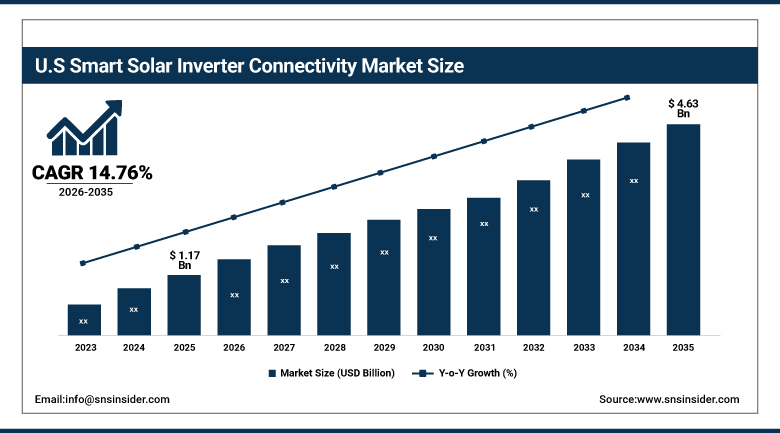
The U.S. Smart Solar Inverter Connectivity Market was valued at USD 1.17 Billion in 2025 and is expected to reach around USD 4.63 Billion by 2035, growing at a CAGR of 14.76% from 2026–2035.
The market for smart solar inverter connectivity in the United States holds much growth potential owing to the adoption of solar power, smart grids, and energy management technologies. The adoption of smart solar inverter connectivity solutions is becoming more common among consumers in residential, commercial, industrial, and utility sectors to help them monitor, diagnose, optimize and manage their energy use.
Connected inverters are now more relevant than ever for integrating solar power with battery storage, energy management systems, distributed energy resources, and grid technology. Furthermore, growing needs for AI-powered monitoring and maintenance, cloud analytics, and grid interactive capabilities are fueling market growth. Furthermore, increasing solar power installations, demand for energy independence, grid modernization, and distributed energy resources are propelling the adoption of smart solar inverter connectivity solutions in the United States.
In May 2026, Enphase Energy opened U.S. pre-orders for its IQ9S-3P commercial microinverter, a 548 VA GaN-based solution supporting solar panels up to 770 W and direct connection to three-phase 480Y/277 V grid configurations. The launch expands Enphase’s commercial inverter portfolio and strengthens demand for advanced, high-efficiency inverter technologies in the U.S. solar market.
Smart Solar Inverter Connectivity Market Segment Analysis
-
By Inverter Type, string inverters is dominant at 55.00% in 2025, while microinverters is the fastest-growing segment with a 16.11% CAGR during 2025–2035.
-
By Connectivity Technology, wired is dominant at 37.46% in 2025, while cellular / wide-area is the fastest-growing segment with a 20.28% CAGR during 2025–2035.
-
By Software, monitoring & telemetry dashboards is dominant at 40.00% in 2025, while DERMS / VPP integration is the fastest-growing segment with a 20.26% CAGR during 2025–2035.
-
By Application, residential is dominant at 34.27% in 2025 and is also the fastest-growing segment with a 14.33% CAGR during 2025–2035.
-
By Distribution Channel, direct sales is dominant at 51.74% in 2025, while online retail is the fastest-growing segment with a 20.16% CAGR during 2025–2035.
By Inverter Type, string inverters dominated the smart solar inverter connectivity market, while microinverters are expected to grow fastest.
String inverters dominated the market owing to their usage in various solar applications including residential, commercial, industrial, and utility-scale solar systems. Their affordability, effectiveness, simplicity of design and compatibility with large solar systems help sustain high demand in the market. The market segment is anticipated to remain dominant till 2035 while rising utilization of power electronics at the module level will favor other types of inverters.
Microinverters are estimated to record the highest growth in terms of inverter type over the forecast period. The use of microinverters is growing owing to their power optimization capability at the module level, improved monitoring, performance in partial shading conditions, and installation flexibility.
By Connectivity Technology, wired dominated the smart solar inverter connectivity market, while cellular / wide-area is expected to grow fastest.
Wired connectivity enjoyed dominance because of reliable data transfer, consistent communication, and adoption in the commercial, industrial, and utility-scale solar power plants. The wired connectivity type is especially preferred when there is a need for communication consistency between the inverters, monitoring solutions, energy management system, and the entire power grid. The market segment will continue dominating throughout the forecast period.
The fastest-growing segment is expected to be cellular/wide-area connectivity. With more geographical deployment of solar assets, remote monitoring needs, and cloud-based applications, there is high demand for wide-area connectivity. With wide-area connectivity, users can monitor and access the system remotely without the need for a local infrastructure.
By Software, monitoring & telemetry dashboards dominated the smart solar inverter connectivity market, while DERMS / VPP integration is expected to grow fastest.
Monitoring & telemetry dashboards occupied the top place because of rising demand for real-time monitoring of the generation, inverter performance, systems' conditions, and other factors. This category allows users to track the output of energy, discover possible problems, and manage systems remotely. The segment is anticipated to hold the leadership as the number of connected solar power plants continues to grow.
The fastest growing software segment will be DERMS / VPP Integration. Growing integration of distributed energy resources, batteries, demand response, and decentralized generation with grid management systems stimulates demand for such capabilities as DERMS and virtual power plants that allow connected solar assets to actively participate in power grid balance and energy optimization.
Regional Analysis
|
Region |
Major Country |
Share within Region, 2025(%) |
|---|---|---|
|
North America |
United States |
82.46% |
|
Europe |
Germany |
27.38% |
|
Asia Pacific |
China |
45.72% |
|
Middle East & Africa |
Saudi Arabia |
22.84% |
|
Latin America |
Brazil |
21.63% |
North America Smart Solar Inverter Connectivity Market Insights
The North American region is expected to be the fastest-growing in terms of the smart solar inverter connectivity market during the forecast period from 2025 to 2035, with a CAGR of 15.06%. The growth in the region will be driven by the rising installation of solar PV systems, grid modernization, battery storage systems, and increased usage of connected solar inverters. The USA will be the key market in the region due to the rising installation of solar PV systems in the residential, commercial, and utility sectors.
Europe Smart Solar Inverter Connectivity Market Insights
Europe will continue to be a significant market for smart solar inverters connectivity driven by high deployment of renewable energy sources, grid modernization, and rising penetration of distributed solar power generation. Germany is one of the key players from the region because of its well-developed industry of solar PV panels, ongoing deployments of residential and commercial solar PV, as well as widespread implementation of energy management solutions.
Asia Pacific Smart Solar Inverter Connectivity Market Insights
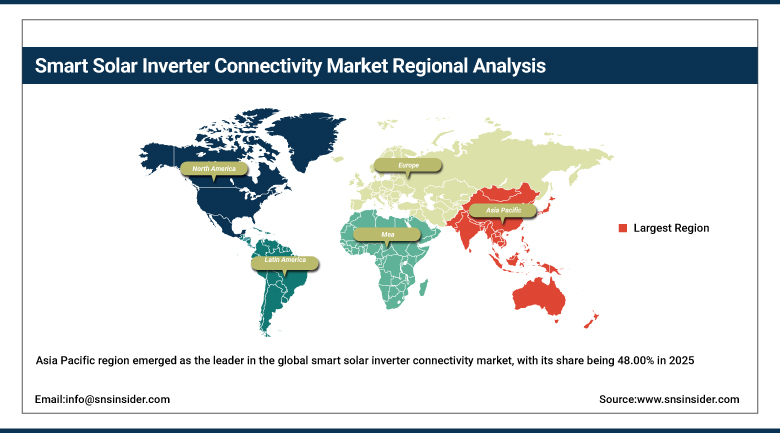
The Asia Pacific region emerged as the leader in the global smart solar inverter connectivity market, with its share being 48.00% in 2025. The leadership of the Asia Pacific region is due to its widespread use of solar photovoltaics, increasing infrastructure of distributed energy, and significant investment in renewable energy generation. The biggest contribution to the Asia Pacific region's share comes from China, which has a robust solar installation network, strong inverter manufacturing ecosystem, and continued grid development initiatives. Other markets in the Asia Pacific region that have contributed to market growth include India, Japan, Australia, and others.
Get Customized Report as per Your Business Requirement - Enquiry Now
Middle East & Africa and Latin America Smart Solar Inverter Connectivity Market Insights
Smart solar inverters have become important in the emerging markets of Middle East & Africa and Latin America on account of growing renewable energy investments, solar PV installations, grid developments, and distributed energy systems. Saudi Arabia can be considered an important player in the Middle East & Africa region owing to its extensive renewable energy installations and investments in solar energy infrastructure. Brazil stands out as an important market for solar inverters in Latin America owing to increasing distributed solar power installations and increased use of connected solar energy systems.
Market Dynamics
Growth Driver: Increasing adoption of connected solar systems and smart-grid infrastructure driving demand for smart solar inverter connectivity
The rising use of solar PV solutions along with smart-grid solutions is one of the primary reasons that are contributing to the rising demand for smart solar inverters. More and more individuals as well as organizations are choosing the connected inverter solution for ensuring real-time performance monitoring, diagnostics, fault detection, and energy management.
Additionally, the growing use of batteries and distributed energy resources, along with energy management solutions and cloud monitoring systems is also creating an increased demand for the connectivity of inverter technology. Artificial intelligence technology in the form of analytics and performance optimization is also contributing to the expansion of the market. Moreover, the rising focus on renewable energy and grid modernization is expected to increase the adoption of connected inverters.
Restraint: High implementation costs and complex integration with existing energy infrastructure hinder smart solar inverter connectivity adoption
High deployment costs and the difficulty of implementing connected inverter technologies into the current energy landscape can limit the market's expansion. Connected solar inverters can lead to the need for increased amounts of equipment for communication, monitoring systems, software, infrastructure for communication, and expertise, making the total cost of implementation even higher. This can lead to difficulties for small solar operators and less expensive setups.
Also, connecting connected inverters to old solar technology, energy management systems, battery storage technology, the grid itself, and various communication protocols can make the whole system more complicated. Problems associated with the possibility of compatibility problems, cybersecurity issues, data handling, and maintenance can be a barrier to the deployment process.
Opportunity: Growing adoption of AI-driven monitoring, energy storage, and distributed energy management creates new market opportunities
The adoption of AI-based monitoring systems and intelligent energy management solutions is creating substantial growth prospects for the global smart solar inverter connectivity market. The advanced connected inverter solutions are able to offer real-time performance analytics, automated fault detection, predictive maintenance, and energy optimization to help solar companies improve efficiencies and lower operating costs.
Moreover, growing deployment of battery energy storage systems, distributed energy resources, DERMS, and virtual power plants is creating a need for connected inverters that are capable of communicating with energy management and grid platforms. The growing spending on smart grid modernization and renewable energy integration is anticipated to generate further growth prospects for the market players.
Recent Developments
-
2026: Huawei expanded its smart PV portfolio with advanced inverter and digital energy management capabilities, strengthening connected solar monitoring, grid support, and intelligent asset management.
-
2026: Sungrow continued expanding its smart inverter portfolio with advanced grid-forming and energy management capabilities, supporting connected solar installations and grid integration.
-
2026: SMA Solar Technology strengthened its smart solar inverter and energy management portfolio, supporting real-time monitoring, system optimization, and grid-interactive solar applications.
-
2026: Enphase Energy expanded its microinverter portfolio with advanced connectivity and monitoring capabilities, improving module-level performance tracking and intelligent energy management for solar installations.
Smart Solar Inverter Connectivity Market key players are:
-
Huawei Technologies Co., Ltd.
-
Sungrow Power Supply Co., Ltd.
-
SMA Solar Technology AG
-
SolarEdge Technologies Inc.
-
Enphase Energy, Inc.
-
GoodWe
-
Growatt New Energy Technology Co., Ltd.
-
Ginlong Technologies
-
Fronius International GmbH
-
TMEIC
-
Sineng Electric Co., Ltd.
-
FIMER S.p.A.
-
Delta Electronics, Inc.
-
Schneider Electric SE
-
Siemens AG
-
Eaton Corporation plc
-
Power Electronics
-
Solplanet
-
SOFAR
-
KSTAR Science and Technology Co., Ltd.
Smart Solar Inverter Connectivity Market Report Scope:
| Report Attributes | Details |
|---|---|
| Market Size in 2025 | USD 6.99 Billion |
| Market Size by 2035 | USD 23.79 Billion |
| CAGR | CAGR of 13.05% From 2026 to 2035 |
| Base Year | 2025 |
| Forecast Period | 2026-2035 |
| Historical Data | 2022-2024 |
| Report Scope & Coverage | Market Size, Segments Analysis, Competitive Landscape, Regional Analysis, DROC & SWOT Analysis, Forecast Outlook |
| Key Segments | • By Inverter Type (String Inverters, Central Inverters, Microinverters, Optimizer-Based Architectures) • By Connectivity Technology (Wired, Wi-Fi, Bluetooth, Zigbee, Cellular / Wide-Area, Others) • By Software (Monitoring & Telemetry Dashboards, Remote O&M / Diagnostics / OTA Firmware, Energy Management Systems (EMS) / Optimizers, DERMS / VPP Integration, Predictive Maintenance, Cybersecurity) • By Application (Residential, Commercial, Industrial, Utility-Scale) • By Distribution Channel (Direct Sales, Distributors, Online Retail) |
| Regional Analysis/Coverage | North America (US, Canada), Europe (Germany, UK, France, Italy, Spain, Russia, Poland, Rest of Europe), Asia Pacific (China, India, Japan, South Korea, Australia, ASEAN Countries, Rest of Asia Pacific), Middle East & Africa (UAE, Saudi Arabia, Qatar, South Africa, Rest of Middle East & Africa), Latin America (Brazil, Argentina, Mexico, Colombia, Rest of Latin America) |
| Company Profiles | Huawei Technologies Co., Ltd.; Sungrow Power Supply Co., Ltd.; SMA Solar Technology AG; SolarEdge Technologies Inc.; Enphase Energy, Inc.; GoodWe; Growatt New Energy Technology Co., Ltd.; Ginlong Technologies; Fronius International GmbH; TMEIC; Sineng Electric Co., Ltd.; FIMER S.p.A.; Delta Electronics, Inc.; Schneider Electric SE; Siemens AG; Eaton Corporation plc; Power Electronics; Solplanet; SOFAR; KSTAR Science and Technology Co., Ltd. |
Frequently Asked Questions
The Smart Solar Inverter Connectivity market is expected to grow at a CAGR of 13.05% from 2026 to 2035.
The Smart Solar Inverter Connectivity market was valued at approximately USD 6.99 billion in 2025.
The market is driven by increasing solar PV deployment, growing adoption of connected inverters, smart-grid modernization, real-time monitoring, remote diagnostics, energy management, and integration of distributed energy resources.
String Inverters dominated the Smart Solar Inverter Connectivity market in 2025 with a 55.00% share.
Asia-Pacific dominated the Smart Solar Inverter Connectivity market in 2025 with a 48.00% share.
