
Hybrid Solar Panel Market Report Scope & Overview:
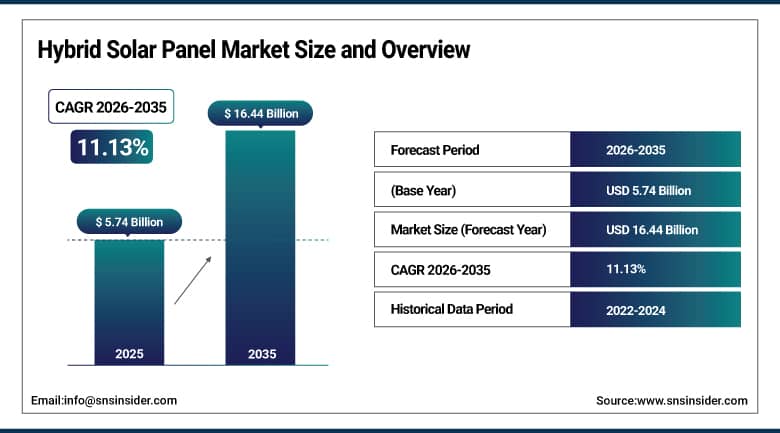
The Hybrid Solar Panel Market was valued at USD 5.74 billion in 2025 and is expected to reach USD 16.44 billion by 2035, growing at a CAGR of 11.13% from 2026–2035.
The hybrid solar panel market is being observed globally owing to the rising demand for hybrid solar energy solutions. These hybrid solar panels have been observed to be installed in homes, businesses, and utility-scale projects. Development in infrastructure using renewable energy sources has been driving market growth. Efficiency and performance of energy solutions have been boosted owing to the presence of solar storage technology. Investments are being made in hybrid solar solutions in order to reduce reliance on conventional energy solutions. Market growth is being driven by the rising demand for electricity and the growing focus on implementing clean energy policies. Energy security, stability, and cost-effective energy production have been fueling market growth.
The development of hybrid solar systems will be fueled by supportive renewable energy regulations and carbon reduction targets. Policies promoting net metering and distributed energy generation are encouraging adoption. North America is witnessing strong deployment due to advanced grid infrastructure and incentive programs such as the Investment Tax Credit (ITC). Asia-Pacific is emerging as the fastest growing region due to large-scale solar installations and strong manufacturing capabilities across China and India. Increased interest in battery energy storage systems (BESS) and smart grid technologies will further boost global adoption of hybrid solar systems.
To Get More Information On Hybrid Solar Panel Market - Request Free Sample Report
Hybrid Solar Panel Market Trends
-
Strengthening regulatory compliance requirements is driving demand for secure transparent and audit ready collection systems.
-
Increasing adoption of AI and machine learning is improving predictive analytics and recovery efficiency in debt collection processes.
-
Rising fintech expansion and digital lending platforms is increasing demand for automated debt collection software solutions globally.
-
Integration of robotic process automation is reducing manual workload and improving operational efficiency in debt recovery workflows.
-
Expanding use of omnichannel communication tools is improving customer engagement and increasing debt recovery success rates.
-
Growth in cloud-based deployment models is enhancing scalability flexibility and reducing infrastructure costs for organizations.
Hybrid Solar Panel Market Size Outlook.
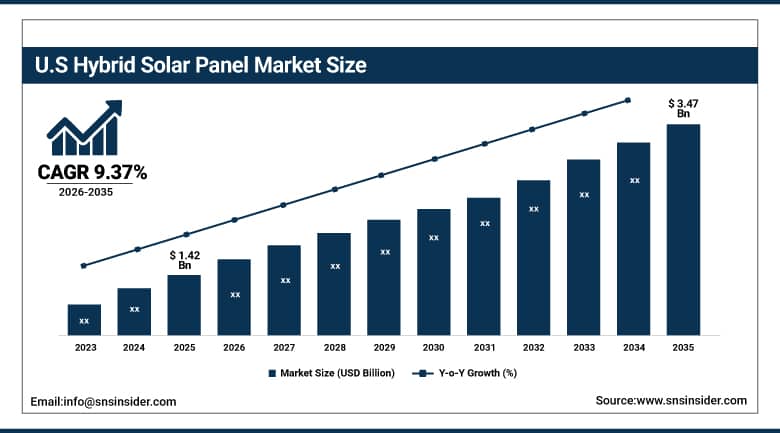
The United States Hybrid Solar Panel Market was valued at USD 1.42 billion in 2025 and is expected to reach around USD 3.47 billion by 2035, growing at a CAGR of 9.37% from 2026–2035.
The U.S. hybrid solar panels is growing at a robust rate due to the increased use of hybrid solar panels in combination with storage across the residential and commercial spaces. The growth in the market is mainly attributed to the increasing requirement of energy security and grid resilience in the US. The growing trend of installing rooftop solar panels along with battery storage has been adding to the development of the market. Rising prices of electricity and grid outages have led consumers to embrace hybrid solar systems. Innovation in the field of lithium-ion batteries and inverters has enhanced their efficiency and reliability.
Government tax rebates like ITC along with the government’s policies related to renewable energy act as important drivers that have helped create robust dynamics for the US hybrid solar panel market. The rise in demand for distributed energy systems is expected to drive the growth of this market. EVs and smart grids are additional drivers that are expected to boost the growth of this market. Strong focus on decarbonization and IRA investments are having a positive effect on the growth of the market. US is considered among the top markets for hybrid solar panel and battery energy storage system.
Hybrid Solar Panel Market Segment Analysis
-
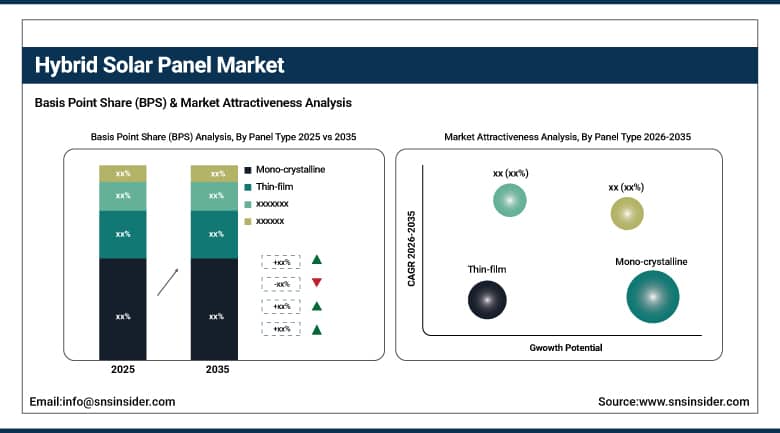
By Panel Type, mono-crystalline dominated the hybrid solar panel market with 52.40% share in 2025; while thin-film is the fastest growing segment.
-
By Battery Type, lithium-ion dominated the hybrid solar panel market with 56.40% share in 2025 and it is also fastest growing segment.
-
By Application, grid-tied dominated the hybrid solar panel market with 57.60% share in 2025; while off-grid is the fastest growing segment.
-
By End User, residential dominated the hybrid solar panel market with 44.90% share in 2025; while commercial is the fastest growing segment.
By Panel Type, mono-crystalline dominated the hybrid solar panel market, while thin-film is the fastest growing segment.
Mono-crystalline segment held the dominated revenue share in the hybrid solar panel market in 2025. The high efficiency and performance of the solar panel under limited space have made this segment popular among customers. Its high durability and long lifecycle enable it to be used in residential and commercial purposes. The popularity of rooftop solar panels and utility scale application further contribute to its dominance in the market.
Thin-film segment will grow at the fastest CAGR between 2026 - 2035 due to its lightweight, flexible structure, and low-cost production process. Thin films have the efficiency to operate effectively in low light and high temperatures. The growth in demand for large scale and off-grid solar power generation has increased its usage. Technological developments have improved its efficiency and commercial use globally.
By Battery Type, lithium-ion dominates the hybrid solar panel market and is also the fastest growing segment.
The Lithium-Ion segment was the dominated segment in the hybrid solar panel market in 2025, owing to its higher energy density, longevity, and charging efficiency than other forms of batteries. The Lithium-Ion batteries were known for their fast charging ability, lesser maintenance cost, and better integration with solar power integration systems. Moreover, wide use in residential and commercial energy storage systems was also an important factor driving its dominance in the market.
In terms of growth, it is likely to register the fastest CAGR during the forecast period from 2026 to 2035. This would be attributed to falling prices of the battery and technological advances in the energy storage system. Growth in adoption in the transportation sector, in the form of EVs, and renewable energy sources was contributing to the rising demand.
By Application, grid-tied dominated the hybrid solar panel market, while off-grid is the fastest growing segment.
Grid tied held the dominated position in terms of revenue share in the hybrid solar panel market during the forecast period 2026-2035 because of its effective interlink with the existing electrical grids. The market segment derives support from net metering policies and cost efficiency over off-grid systems. Its extensive use across both residential as well as utility scale and commercial projects makes it even more dominant. Stable grid connection provides a stable source of power generation and utilization, thus making it preferred worldwide.
Off-grid segment is projected to exhibit the fastest growth CAGR from 2026-2035 because of the increasing need for electricity among rural and remote locations. Rising installations in places with poor or no electrical grids are propelling adoption. Growing advancements in battery storage systems and decreasing costs of solar panels are other factors aiding growth.
By End User, residential dominated the hybrid solar panel market, while commercial is the fastest growing segment.
Residential segment captured the dominated market revenue share in the hybrid solar panel market during 2025, owing to the increasing installation of rooftops and solar plus storage in residential applications. The increasing cost of electricity and frequent power cuts have motivated consumers to move toward hybrid solar panels. In addition to that, government initiatives and net metering programs have boosted their deployment. Other factors including ease of installation and cost savings make residential application more lucrative.
Commercial segment is expected to exhibit the fastest CAGR in the forecast period of 2026-2035, owing to the increasing adoption of large-scale rooftop solar panels across commercial establishments like office buildings, shopping malls, and industrial complexes. The increasing emphasis on minimizing energy costs while meeting sustainable development goals has been driving the demand for hybrid solar panels. Other factors include the rising commitment of corporations to their ESGs and renewables.
Regional Analysis:
|
Region |
Major Country |
Share within Region, 2025(%) |
|---|---|---|
|
North America |
United States |
72.40% |
|
Europe |
Germany |
23.80% |
|
Asia Pacific |
China |
21.90% |
|
Middle East & Africa |
UAE |
6.85% |
|
Latin America |
Brazil |
5.95% |
North America Hybrid Solar Panel Market Insights.
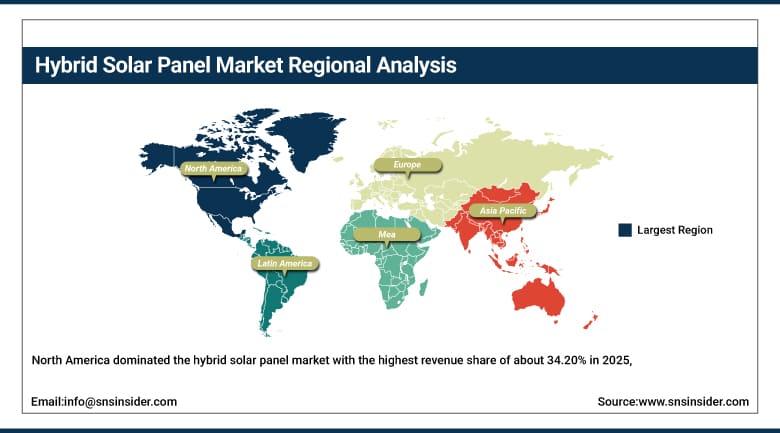
North America dominated the hybrid solar panel market with the highest revenue share of about 34.20% in 2025 due to strong renewable energy infrastructure and high adoption of solar plus storage systems. The region benefits from advanced smart grid networks, strong government incentives, and widespread rooftop solar installations across the United States and Canada. Presence of leading energy technology providers and high consumer awareness is further supporting market expansion steadily. Rising focus on energy independence, grid resilience, and decarbonization targets is accelerating hybrid solar deployment across residential and commercial sectors.
Recent developments indicate increasing installation of battery energy storage systems (BESS) integrated with solar PV across the United States. A large share of utilities and households are adopting hybrid solar solutions to reduce electricity costs and improve reliability. Strong policy support from federal and state level renewable programs is further pushing large scale adoption of hybrid solar technologies in North America.
Get Customized Report as Per Your Business Requirement - Enquiry Now
Europe Hybrid Solar Panel Market Insights.
European regions represent an already mature Hybrid Solar Panels Market with good regulatory backing for the use of alternative sources of energy. For the year 2025, the market share of Europe includes high penetration levels in both residential and commercial settings in Germany, France, UK, and Italy. Climate change regulations in the European Union and carbon-neutral ambitions are motivating more hybrid systems installations. Emphasis on energy efficiency and decentralized energy production is driving market growth.
Asia Pacific Hybrid Solar Panel Market Insights.
Asia Pacific holds a significant revenue share of about 10.60% in 2025 and is expected to grow at the fastest CAGR from 2026–2035 due to rapid industrialization and expanding renewable energy capacity. Growth is driven by rising electricity demand, increasing urbanization, and strong solar manufacturing ecosystems across China, India, Japan, and Southeast Asia. Government initiatives supporting clean energy transition and large scale solar projects are further accelerating market expansion significantly. Increasing adoption of battery storage and smart grid technologies is boosting hybrid solar deployment across the region steadily.
Middle East & Africa and Latin America Hybrid Solar Panel Market Insights.
Middle East & Africa region and Latin America are experiencing consistent expansion within the Hybrid Solar Panels market owing to increasing demand for energy and improvements within renewable technologies. Nations including UAE, Saudi Arabia, South Africa, Brazil, and Mexico have shown growing interest towards implementing solar energy plants in order to lower their dependence on traditional power generation methods. The growth of off grid and distributed energy generation methods has further added to the market growth.
The recent trend suggests growing application of hybrid solar system in commercial and industrial applications in the emerging markets. Rising demand for solar PV systems and BESS can be attributed to grid reliability issues and power cuts. The increase in decentralized energy sources and DERs will help fuel growth of sustainable energy solutions. Enhanced financial frameworks and PPP models are helping drive hybrid solar system adoption in emerging markets.
Market Dynamics:
Growth Drivers: Rising demand for integrated solar plus storage systems across residential and commercial sectors globally
Increased use of electricity and the use of renewable energy sources have led to the adoption of more solar hybrids. Due to the increasing number of residential rooftop systems combined with battery energy storage system (BESS) installations, energy supply and independence from the grid have improved. The adoption of solar PV battery storage systems in companies and industrial organizations has been due to cost efficiency. Favourable government policies such as net metering and tax rebates have been instrumental in the adoption of these systems. Increased advancements in lithium-ion batteries have played a significant role in their adoption.
Restraints: High initial installation cost and complex integration of hybrid solar energy storage systems
Initial cost involved in hybrid solar technologies with components such as solar PV panels and battery energy storage systems (BESS) is acting as a deterrent in price-sensitive areas. Installation of the battery energy storage system with conventional power systems needs skilled manpower. The maintenance and cost of replacing batteries also increase costs for consumers. Lack of awareness in developing countries and absence of standard infrastructures are also hindering adoption rates. In addition to grid compatibility problems, technical difficulties in optimizing the system also pose challenges to its adoption. Although there are savings in the long run, high initial cost is still one of the main constraints.
Opportunities: Expansion of smart grid infrastructure and increasing adoption of decentralized energy systems globally
With rapid advancement of smart grid and energy management systems technology, there are great opportunities arising for the hybrid solar energy system. The increasing trend of decentralized electricity generation through the use of solar PV systems and BESS will lead to increased energy independence. Investments in DERs and microgrids have been helpful in expanding the market. The increasing demand for off-grid power sources in remote locations provides more opportunities for the industry. Initiatives of the government for renewable energy and carbon neutrality have supported the application of solar energy technologies.
Recent Developments
-
2026: LONGi Green Energy Technology expanded high efficiency mono crystalline module production supporting advanced hybrid solar integration systems globally.
-
2026: Sungrow Power Supply strengthened battery energy storage systems (BESS) and hybrid solar inverter solutions for utility scale deployments worldwide.
-
2025: JinkoSolar enhanced its TOPCon based photovoltaic module portfolio supporting large scale hybrid solar plus storage applications across global markets.
-
2024: Canadian Solar expanded its utility scale hybrid solar projects and battery energy storage systems (BESS) across international renewable energy markets.
Hybrid Solar Panel Market Key Players are:
-
LONGi Green Energy Technology
-
JinkoSolar
-
Trina Solar
-
Canadian Solar
-
JA Solar
-
First Solar
-
SunPower
-
REC Group
-
Hanwha Q CELLS
-
Hyundai Energy Solutions
-
Huawei Digital Power
-
Sungrow Power Supply
-
Enphase Energy
-
SolarEdge Technologies
-
SMA Solar Technology
-
Schneider Electric
-
Panasonic Energy
-
LG Energy Solution
-
Tesla Energy
-
Risen Energy
Hybrid Solar Panel Market Report Scope:
| Report Attributes | Details |
|---|---|
| Market Size in 2025 | USD 5.74 Billion |
| Market Size by 2035 | USD 16.44 Billion |
| CAGR | CAGR of 11.13% From 2026 to 2035 |
| Base Year | 2025 |
| Forecast Period | 2026-2035 |
| Historical Data | 2022-2024 |
| Report Scope & Coverage | Market Size, Segments Analysis, Competitive Landscape, Regional Analysis, DROC & SWOT Analysis, Forecast Outlook |
| Key Segments | • By Panel Type (Mono-crystalline, Poly-crystalline, Thin-film) • By Battery Type (Lead-acid, Lithium-ion, Nickel-cadmium) • By Application (Grid-tied, Off-grid, Grid-connected with backup) • By End User (Residential, Commercial, Industrial) |
| Regional Analysis/Coverage | North America (US, Canada), Europe (Germany, UK, France, Italy, Spain, Russia, Poland, Rest of Europe), Asia Pacific (China, India, Japan, South Korea, Australia, ASEAN Countries, Rest of Asia Pacific), Middle East & Africa (UAE, Saudi Arabia, Qatar, South Africa, Rest of Middle East & Africa), Latin America (Brazil, Argentina, Mexico, Colombia, Rest of Latin America). |
| Company Profiles | LONGi Green Energy Technology, JinkoSolar, Trina Solar, Canadian Solar, JA Solar, First Solar, SunPower, REC Group, Hanwha Q CELLS, Hyundai Energy Solutions, Huawei Digital Power, Sungrow Power Supply, Enphase Energy, SolarEdge Technologies, SMA Solar Technology, Schneider Electric, Panasonic Energy, LG Energy Solution, Tesla Energy, Risen Energy |

Frequently Asked Questions
The hybrid solar panel market is expected to grow at a CAGR of 11.13% from 2026 to 2035.
The hybrid solar panel market was valued at USD 5.74 billion in 2025.
Rising demand for integrated solar plus storage systems, increasing electricity consumption, and supportive renewable energy policies are driving the market.
Lithium-ion segment dominated the market in 2025 due to high energy density, long lifecycle, and superior integration with solar plus storage systems.
North America dominated the market in 2025 due to strong renewable energy infrastructure, high adoption of solar plus storage, and supportive government incentives.
