
Perovskite Solar Cell Market Report Scope & Overview:
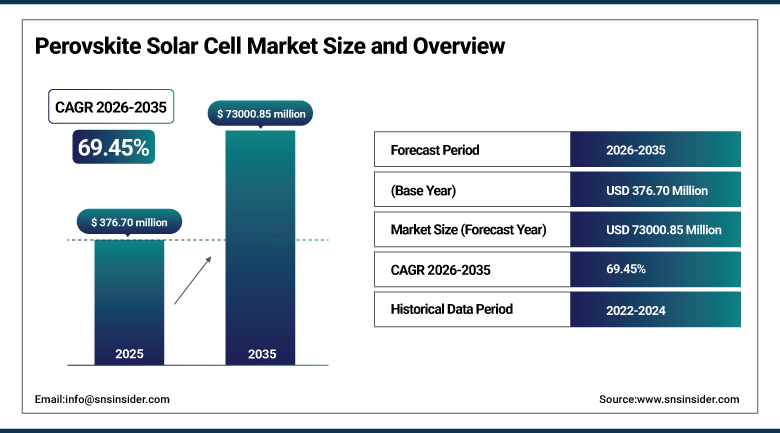
The Perovskite Solar Cell Market size was valued at USD 376.70 million in 2025 and is expected to reach USD 73000.85 million by 2035, growing at a CAGR of 69.45% from 2026-2035.
The Perovskite Solar Cell Market is experiencing rapid growth because of the high level of efficiency, lightweight nature, and flexible features of perovskite-based PV technology. The increasing demand for alternative energy sources and the development of new solar technologies are accelerating the development and commercialization process. There is a lot of potential in the use of perovskite solar cells in terms of improving energy conversion efficiency, reducing material usage, and flexibility of application in flexible and tandem solar cells. Moreover, the improvement in terms of stability, scalability, and production processes is facilitating the solution of some of the commercialization problems.
In 2026, NREL’s certified research-cell chart showed perovskite/silicon tandem cells exceeding 34% efficiency, highlighting their strong potential to outperform conventional silicon photovoltaic technologies.
To Get more information Perovskite Solar Cell Market - Request Free Sample Report
Perovskite Solar Cell Market Trends
-
Rising demand for high-efficiency photovoltaic technologies is driving adoption of perovskite solar cells across emerging renewable energy applications.
-
Increasing research and development investments are improving perovskite cell efficiency, stability, durability, and commercialization potential across photovoltaic applications.
-
Growing adoption of perovskite-silicon tandem solar cells is creating opportunities for higher-efficiency photovoltaic modules and next-generation solar technologies.
-
Increasing demand for lightweight, flexible, and semitransparent solar solutions is expanding perovskite applications across building-integrated and portable energy systems.
-
Advancements in scalable manufacturing techniques are supporting improvements in production efficiency, material utilization, device consistency, and commercialization of perovskite solar cells.
U.S. Perovskite Solar Cell Market Size Outlook
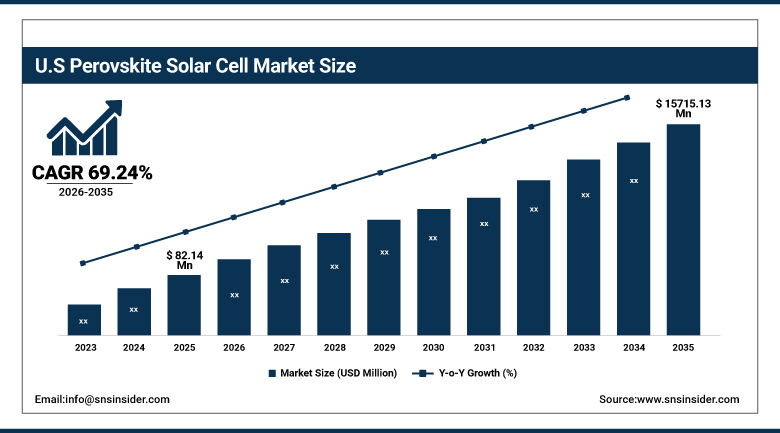
The U.S. Perovskite Solar Cell Market was valued at USD 82.14 million in 2025 and is expected to reach USD 15715.13 million by 2035, growing at a CAGR of 69.24% from 2026-2035.
The U.S. Perovskite Solar Cell Market is experiencing rapid growth on account of increased investment into next-generation photovoltaic technology and rising demand for high-efficiency renewable energy sources. The perovskite solar cells exhibit high efficiency, light weight, flexibility, and great potential for tandem applications, making them a suitable choice for next-generation solar power applications. Other drivers that are contributing to the growth of the market include increasing Research & Development activities, government backing for innovative technologies, and increased investments in production of next-generation solar cells. In addition, advancements in stability, scalability, and production methods have been helpful in addressing the issues related to commercialization, while the growing demand for lightweight and flexible photovoltaic products is creating profitable avenues for the U.S. market.
First Solar's U.S. manufacturing expansion includes investment in advanced thin-film PV technology and research infrastructure, strengthening domestic next-generation solar manufacturing capabilities.
Perovskite Solar Cell Market Segment Analysis
-
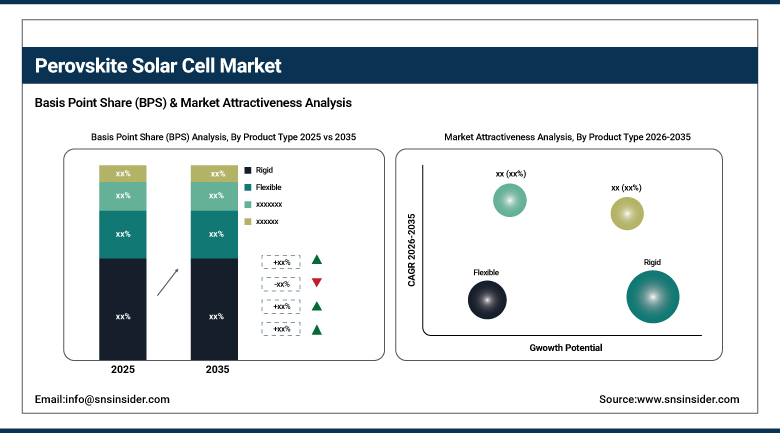
By Product Type, Rigid dominated the Perovskite Solar Cell Market with 64% share in 2025; Flexible is expected to grow at the fastest CAGR of 70.83% from 2026–2035.
-
By Application, Solar Panels dominated the Perovskite Solar Cell Market with 57% share in 2025; Building-Integrated Photovoltaics (BIPV) is expected to grow at the fastest CAGR of 71.42% from 2026–2035.
-
By End-use Industry, Commercial dominated the Perovskite Solar Cell Market with 44% share in 2025; Industrial is expected to grow at the fastest CAGR of 70.72% from 2026–2035.
By Product Type, Rigid dominates the perovskite solar cell market, Flexible grows fastest.
Rigid segment dominated the Perovskite Solar Cell Market with the highest revenue share of about 64% in 2025 owing to the proven manufacturing procedures, increased structural stability, durability, and applicability in mass production of solar modules. The rigid perovskite cells will be able to interface with existing photovoltaic technologies and will be highly dependable.
Flexible segment is expected to grow at the fastest CAGR of 70.83% from 2026-2035 Due to an increase in the demand for solar technology that is light-weight, flexible, and portable. Perovskite flexible solar cells can be integrated into curved surfaces, wearable devices, vehicles, and portable power systems. The advantages that flexible perovskite solar cells possess include their light-weight nature, roll-to-roll fabrication capability, and unconventional applications.
By Application, Solar Panels dominate the perovskite solar cell market, Building-Integrated Photovoltaics (BIPV) grows fastest.
Solar Panels segment dominated the Perovskite Solar Cell Market with the highest revenue share of about 57% in 2025 This is due to increased use of solar power generation systems, increase in investments in renewable sources of energy, and also compatibility with the current photovoltaics setup. Perovskite solar cells have high efficiency prospects, lightweight structure, and can be used for tandem use.
Building-Integrated Photovoltaics (BIPV) segment is expected to grow at the fastest CAGR of 71.42% from 2026-2035 Due to the rising need for energy-saving structures and incorporation of renewable energy sources. Perovskite solar cells may be integrated into windows, façades, rooftops, and other architectural surfaces. The flexibility, customization, and lightweight nature of perovskite solar cells help in developing attractive solar panels and conserving energy within buildings.
By End-use Industry, Commercial dominates the perovskite solar cell market, Industrial grows fastest.
Commercial segment dominated the Perovskite Solar Cell Market with the highest revenue share of about 44% in 2025 Due to the rising investment by companies into renewable energy, the rising cost of electricity, and the growing focus on cutting operational carbon emissions. Commercial establishments need distributed power that is both reliable and efficient, and the use of perovskite technology can help in achieving both those objectives.
Industrial segment is expected to grow at the fastest CAGR of 70.72% from 2026-2035 motivated by rising demand for electricity in industry, decarbonization goals, and renewable energy generation. The Perovskite Solar Energy System provides efficiency, lightweight modules, and chances to be installed over expansive roofs of industries. The increased focus on lowering energy costs and carbon emissions is anticipated to speed up industrial acceptance of Perovskite Solar Energy System.
Regional Analysis
|
Region |
Major Country |
Share within Region, 2025 (%) |
|---|---|---|
|
North America |
United States |
89.0% |
|
Europe |
Germany |
27.5% |
|
Asia Pacific |
China |
42.0% |
|
Middle East & Africa |
UAE |
24.0% |
|
Latin America |
Brazil |
43.0% |
North America Perovskite Solar Cell Market Insights
North America Perovskite Solar Cell Market is witnessing strong growth, backed by investments in next-generation photovoltaic technology, clean energy programs, and advanced solar research. The United States continues to play an important role owing to governmental support, funding for research, and increased focus on high-efficiency tandem solar cells. High demand for lightweight and flexible photovoltaics, commercialization activities, and enhanced stability of perovskites is aiding growth in the region's market.
The U.S. Perovskite Solar Cell Market accounted for a market share of 89.0%, With financial support from significant investments in photovoltaics and research into clean energy, in addition to the technological advances in solar cell manufacturing. It is being facilitated by the creation of highly efficient perovskite and perovskite silicon tandem cells. Moreover, government funding, growing attention towards renewable energy projects, research centers, and the growing demand for lightweight and flexible solar cells are adding to the strength of the United States.
Europe Perovskite Solar Cell Market Insights
Europe Perovskite Solar Cell Market is witnessing significant growth, Backed by robust research capability, clean energy goals, and rising investments in advanced photovoltaics technology. Nations like Germany, the UK, France, and Italy are working on perovskite research and commercialization. Rising need for high-efficiency solar energy, advances in perovskite-silicon tandem cell technology, policies favoring renewable energy, and declining CO2 emissions are driving investment in this technology.
The Germany Perovskite Solar Cell Market accounted for a market share of 27.5%, These include support from strong renewable energy initiatives, modern studies on photovoltaic, and investments in future solar cell technologies. The increased use of efficient perovskite and tandem cells will lead to greater reliance on solar energy. Additional reasons for this include government encouragement for clean energy, Germany’s advanced solar industry, research capabilities, and the emphasis on efficiency and reduced carbon dioxide emissions.
Asia Pacific Perovskite Solar Cell Market Insights
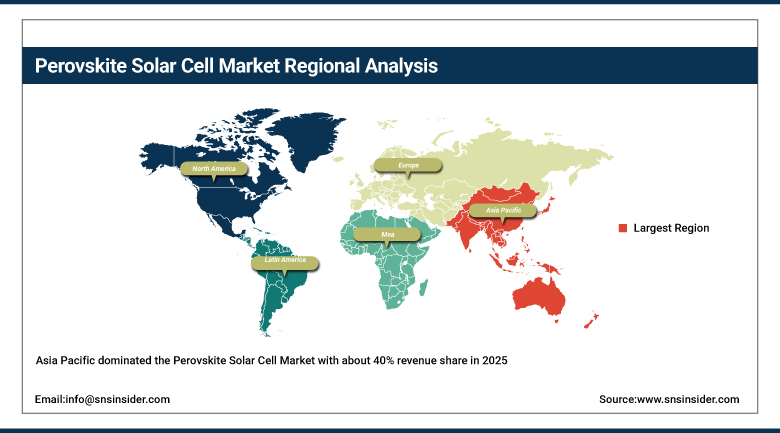
Asia Pacific dominated the Perovskite Solar Cell Market with about 40% revenue share in 2025, driven by strong solar investments, supportive government policies, expanding photovoltaic manufacturing, and advanced R&D activities. The region is also expected to register the fastest CAGR of about 70.78% during 2026–2035, supported by rising renewable energy targets, commercialization, tandem cell development, and increasing investments.
The China Perovskite Solar Cell Market accounted for a market share of 42.0%, backed up by significant investments made in the areas of renewable energy, photovoltaics research, and solar manufacturing facilities. High levels of development of perovskite and tandem solar cells with improved efficiency levels are boosting market penetration. Clean-energy technology policy support from the government, solar installations, manufacturing capability, and growing demand for energy-efficient photovoltaics are boosting the development of perovskite solar cells in China.
Get Customized Report as per Your Business Requirement - Enquiry Now
Middle East & Africa and Latin America Perovskite Solar Cell Market Insights
The Middle East & Africa and Latin America Perovskite Solar Cell Market is gradually expanding, backed by higher investments in renewable energy, ample availability of solar energy, and higher demand for efficient photovoltaics. Rising interest of the government in developing sources of energy that are clean, installation of more solar energy infrastructure, and diversification of energy sources is offering new prospects to perovskite solar cells.
The UAE Perovskite Solar Cell Market accounted for a market share of 24.0%, backed by continuous investments in renewable energy, solar power, and new-age photovoltaics. The rising demand for efficient solar power solutions has sparked an interest in perovskite cells. Government clean energy projects, availability of solar power resources, energy diversification projects, and investments in cutting-edge technology are also helping the growth and use of perovskite solar cells in the UAE.
Market Dynamics
Growth Drivers: Growing demand for high-efficiency renewable energy technologies is accelerating adoption of perovskite solar cells globally
Increasing demand for high-efficiency renewable energy technologies is significantly driving the Perovskite Solar Cell Market Perovskite solar cells have excellent light-absorption characteristics, high power conversion capabilities, and flexibility along with being lightweight. The ability of these solar cells to achieve high efficiencies from thin film absorbers makes them the perfect candidates for future solar power. The rising interest in renewable energy sources and also the efforts to reduce the dependence on fossil fuels have driven the development of highly efficient solar cells. Perovskites can also be combined with conventional solar cells made of silicon to increase their efficiency. The increased demand for efficient solar cells along with technological improvements has enabled the growth of this market.
Restraints: Limited long-term stability and degradation under environmental conditions remain major challenges for perovskite solar cell commercialization
Limited long-term stability remains one of the most significant challenges facing the Perovskite Solar Cell Market. Perovskite materials may degrade due to their sensitivity to moisture, oxygen, heat, UV radiation, and many other environmental factors that cause the devices to lose their performance during long periods of usage. Commercial modules for photovoltaic energy generation should provide good durability and high reliability in terms of stable output power. Researchers work on creating more durable and efficient materials and methods of protecting the device, but at this time, it is difficult to ensure the long-term stability of perovskites similar to traditional solar energy generation methods. Different material compositions and manufacturing conditions may also influence device performance and degradation rate.
Opportunities: Rapid development of perovskite-silicon tandem technologies creates significant opportunities for high-efficiency photovoltaic manufacturers globally
Rapid advancement of perovskite-silicon tandem technology presents significant opportunities for the Perovskite Solar Cell Market. In the case of tandem cells, the ability to absorb more of the solar spectrum is possible through the combination of the perovskite layer and the silicon absorber layer, allowing greater efficiency compared to traditional silicon-based technology. Growing demands for high efficiency modules have led to the improvement of tandem technologies, manufacturing process, scalability, and durability on the part of manufacturers and research organizations. It is possible for the current infrastructure of manufacturing of silicon photovoltaic to support the integration of perovskite layer, leading to commercialization and increased production. Suppliers that develop perovskite technology will see great market potential with the emergence of this technology.
Recent Developments:
-
2026: Oxford PV entered a patent licensing agreement with First Solar covering perovskite technology for the U.S. market, supporting broader commercialization of perovskite-on-silicon tandem solar cells.
-
2026: CubicPV was recognized by TIME among America’s Top GreenTech Companies for 2026, highlighting its work advancing perovskite-based tandem modules capable of substantially increasing solar energy output.
-
2025: Swift Solar continued advancing perovskite-silicon tandem technology, emphasizing commercialization pathways for high-efficiency modules and its strategy to combine silicon with next-generation perovskite materials.
-
2025: EneCoat Technologies achieved more than 30% conversion efficiency for a four-terminal perovskite-silicon tandem solar cell developed jointly with Toyota Motor Corporation.
Perovskite Solar Cell Companies are:
-
Oxford PV
-
Microquanta Semiconductor Co., Ltd.
-
Saule Technologies
-
Hanwha Q CELLS
-
CubicPV
-
EneCoat Technologies Co., Ltd.
-
G24 Power Ltd.
-
Panasonic Corporation
-
Tandem PV
-
GCL Technology Holdings
-
Solaronix SA
-
Heliatek GmbH
-
Toshiba Corporation
-
Sharp Corporation
-
P3C Technology and Solutions Pvt. Ltd.
-
Dyesol Limited
-
Sekisui Chemical Co., Ltd.
-
LONGi Green Energy Technology Co., Ltd.
Perovskite Solar Cell Market Report Scope:
| Report Attributes | Details |
|---|---|
| Market Size in 2025 | USD 376.70 Million |
| Market Size by 2035 | USD 73000.85 Million |
| CAGR | CAGR of 69.45% From 2026 to 2035 |
| Base Year | 2025 |
| Forecast Period | 2026-2035 |
| Historical Data | 2022-2024 |
| Report Scope & Coverage | Market Size, Segments Analysis, Competitive Landscape, Regional Analysis, DROC & SWOT Analysis, Forecast Outlook |
| Key Segments | • By Product Type (Flexible, Rigid) • By Application (Solar Panels, Building-Integrated Photovoltaics (BIPV), Smart Glass, Other Applications) • By End-use Industry (Residential, Commercial, Industrial) |
| Regional Analysis/Coverage | North America (US, Canada), Europe (Germany, UK, France, Italy, Spain, Russia, Poland, Rest of Europe), Asia Pacific (China, India, Japan, South Korea, Australia, ASEAN Countries, Rest of Asia Pacific), Middle East & Africa (UAE, Saudi Arabia, Qatar, South Africa, Rest of Middle East & Africa), Latin America (Brazil, Argentina, Mexico, Colombia, Rest of Latin America). |
| Company Profiles | Oxford PV, Microquanta Semiconductor Co., Ltd., Greatcell Energy, Saule Technologies, Hanwha Q CELLS, CubicPV, EneCoat Technologies Co., Ltd., Swift Solar, G24 Power Ltd., Panasonic Corporation, Tandem PV, GCL Technology Holdings, Solaronix SA, Heliatek GmbH, Toshiba Corporation, Sharp Corporation, P3C Technology and Solutions Pvt. Ltd., Dyesol Limited, Sekisui Chemical Co., Ltd., and LONGi Green Energy Technology Co., Ltd. |
Frequently Asked Questions
The Perovskite Solar Cell Market is expected to grow at a CAGR of 69.45% from 2026 to 2035.
The Perovskite Solar Cell Market was valued at USD 376.70 million in 2025.
The major growth factor driving the Perovskite Solar Cell Market is the rising demand for high-efficiency photovoltaic technologies, particularly perovskite-silicon tandem cells that can achieve higher efficiencies than conventional silicon solar cells.
The Rigid segment dominated the Perovskite Solar Cell Market in 2025.
Asia Pacific dominated the Perovskite Solar Cell Market in 2025.
