
Solar Street Lighting Market Report Scope & Overview:
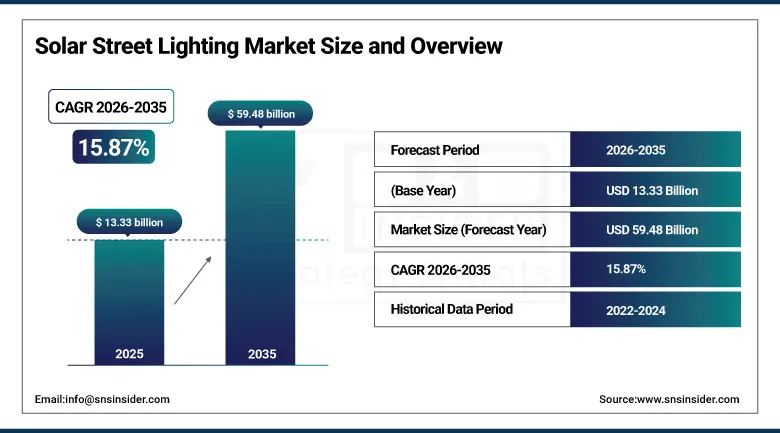
The Solar Street Lighting Market was valued at USD 13.33 billion in 2025 and is expected to reach USD 59.48 billion by 2035, growing at a CAGR of 15.87% from 2026–2035.
Solar street lighting represents the convergence of photovoltaic energy generation, advanced battery storage, and highly efficient LED illumination into self-contained outdoor lighting systems operating entirely independently of the electrical grid. These systems collect solar energy through integrated or remote panel assemblies during daylight hours and deliver precisely controlled illumination throughout the night using stored energy without any grid connection, utility billing, or cable installation that conventional street lighting demands. The technology's economics have transformed dramatically as photovoltaic module costs have fallen over 90% from 2010 levels, LED chip efficacy has more than doubled, and lithium iron phosphate battery energy density and cycle life have improved to the point where solar street lighting can deliver reliable illumination across multiple consecutive overcast days while maintaining the decades-long operational life that municipal infrastructure investment requires.
The market encompasses the complete system portfolio from integrated all-in-one solar street lights where solar panel, battery, LED fixture, and controller are contained in a single compact unit ideal for rapid deployment, through split-type configurations where a separate panel connects to a battery enclosure and LED luminaire for greater capacity and flexibility. Smart solar street lighting systems incorporating motion sensors, wireless connectivity, remote monitoring, fault diagnosis, and adaptive dimming algorithms represent the premium technology tier whose declining cost is progressively expanding smart feature adoption across municipal procurement programmes globally. The urgent need to extend public lighting access to the 775 million people globally without electricity, where solar street lighting represents the only economically viable public space illumination pathway, sustains a humanitarian demand driver alongside the commercial market for developed-economy smart city deployments.
The International Energy Agency's 2025 report confirming that over 775 million people globally still lack electricity access, the majority in sub-Saharan Africa and South Asia where grid extension economics are unfavourable, identifies solar street lighting as a critical infrastructure technology providing the only viable public space illumination pathway for populations where it improves safety, enables after-dark economic activity, and supports children's study in communal spaces.
Solar Street Lighting Market Size and Forecast
-
Market Size in 2026E: USD 15.45 Billion
-
Market Size by 2035: USD 59.48 Billion
-
CAGR: 15.87% from 2026 to 2035
-
Fastest Growing Region: Asia Pacific
-
Largest Region: Asia Pacific
To Get more information on Solar Street Lighting Market - Request Free Sample Report
Solar Street Lighting Market Trends
-
Rapid integration of IoT connectivity and smart city platform compatibility enabling remote monitoring of battery state, panel output, luminaire health, and energy metrics through centralised management dashboards that allow maintenance teams to dispatch resources proactively to failing systems before outage occurs.
-
Growing adoption of motion-adaptive dimming that adjusts output from standby to full brightness upon detecting pedestrians or vehicles, extending battery autonomy by 30 to 50% versus fixed full-output operation while maintaining immediate illumination response for pedestrian safety.
-
Increasing use of lithium iron phosphate battery chemistry with superior cycle life exceeding 2,000 deep discharge cycles, wider operating temperature range, and enhanced thermal stability that justifies the premium pricing declining through manufacturing scale as LED and panel costs continue falling.
-
Expanding smart city procurement in emerging economies specifying solar street lighting as the preferred technology for new district development where grid extension cost would exceed total solar system installation cost across extended urban and peri-urban deployment geographies.
-
Rising investment in solar street lighting systems integrating CCTV surveillance, air quality sensors, emergency call points, and wireless base stations that create multi-functional smart urban infrastructure nodes amortising solar system cost across multiple services.
U.S. Solar Street Lighting Market Outlook
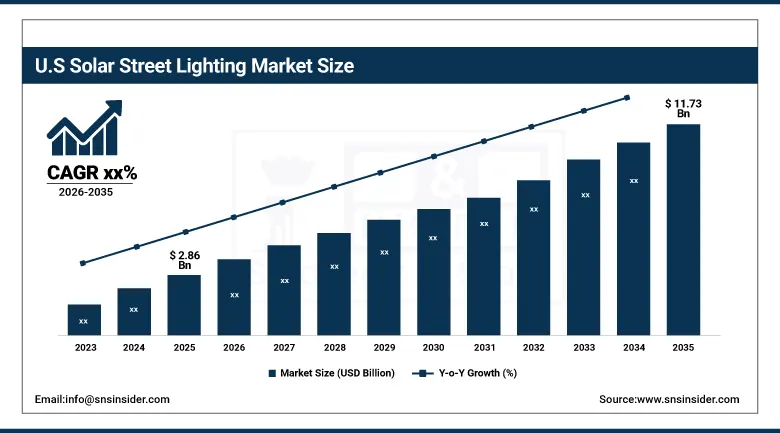
The U.S. Solar Street Lighting Market was valued at approximately USD 2.86 billion in 2025 and is expected to reach approximately USD 11.73 billion by 2035.
The United States solar street lighting market benefits from federal Investment Tax Credit applicability, state renewable portfolio standards creating municipal solar incentives, and infrastructure investment programmes allocating billions for transportation and smart city technology including solar street lighting as an eligible expenditure. The Department of Transportation's energy-efficient highway lighting programmes have encouraged state transportation departments to evaluate solar alternatives for highway interchange, rest stop, and rural road applications where electrical utility access would require expensive cable runs that solar systems eliminate entirely. The growing adoption of Greenshine New Energy, SEPCO, Fonroche Lighting America, and similar domestic solar street lighting suppliers in U.S. municipal procurement through Buy American provisions creates a domestic manufacturing development opportunity alongside Asian import competition.
The U.S. Department of Energy's analysis confirming LED solar street lighting can reduce municipal street lighting energy costs by 50 to 70% versus conventional high-pressure sodium grid-connected alternatives, while eliminating electricity billing entirely for solar-powered installations, provides the financial justification framework that municipal finance officers use to support capital budget allocation for solar street lighting programmes.
Solar Street Lighting Market Segment Analysis
-
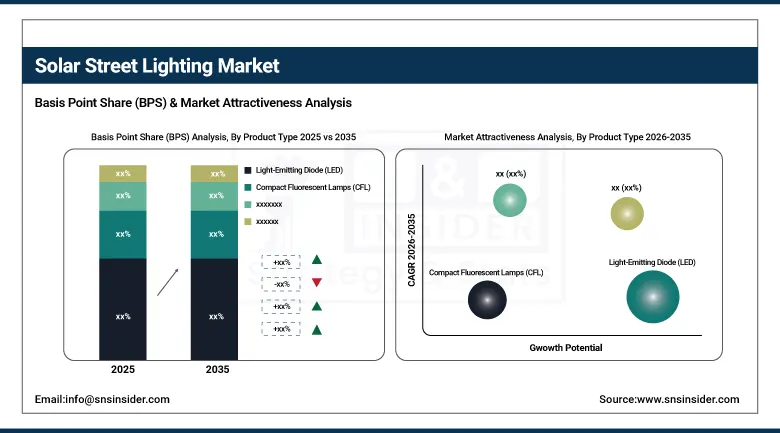
By Product Type, LED dominated with approximately 72.20% in 2025 through superior energy efficiency, lifespan exceeding 50,000 hours, low maintenance, and excellent colour rendering; CFL is the fastest-growing at a CAGR of 18.60% driven by its lower initial cost in budget-constrained markets where capital barriers are the primary adoption impediment.
-
By Connection Type, Standalone led with approximately 61.40% in 2025 through complete grid independence, ease of installation without cable infrastructure, and lower total installation cost; Grid Connected is the fastest-growing at a CAGR of 18.40% driven by smart city integration and urban deployments where grid backup provides reliability assurance during extended low-irradiance periods.
-
By Application, Urban Areas led with approximately 40.50% as the primary deployment environment for smart solar street lighting in high-visibility municipal infrastructure; Rural Areas is fastest-growing at a CAGR of 17.40% driven by off-grid electrification in developing economies and cost-competitive advantage over grid extension.
-
By End User, Commercial led through large-scale municipal, highway authority, and commercial developer procurement; Residential is growing as solar street lighting becomes accessible for community associations, gated development developers, and property owners seeking grid-free landscape lighting.
By Product Type, LED dominates, CFL is expected to grow fastest
LED retained the dominant position with approximately 72.20% of the Solar Street Lighting Market in 2025, reflecting its complete technical superiority across luminous efficacy reaching 200 lumens per watt versus 50 to 80 for CFL, operational lifespan exceeding 100,000 hours versus 8,000 to 15,000 for CFL, and instant-on capability without warm-up delay. LED's dramatically lower power consumption is particularly critical in solar street lighting where battery capacity and panel size are primary cost drivers, as lower wattage directly reduces required panel wattage and battery capacity for defined illumination levels, creating compounding system cost reductions that make LED economically rational regardless of higher luminaire purchase price.
CFL is the fastest-growing segment at a CAGR of 18.60% through 2035, reflecting base effect growth as basic solar street lighting systems using CFL technology are deployed in the most cost-constrained rural and developing market applications where absolute capital cost minimisation to reach the lowest-income municipal and community procurement budgets favours CFL's lower acquisition cost despite inferior long-term operating economics. Sub-Saharan African, South Asian, and Southeast Asian rural electrification programmes that prioritise reaching the maximum number of underlit communities within fixed development assistance budgets represent the primary CFL solar street lighting demand segment.
By Connection Type, Standalone dominates, Grid Connected is expected to grow fastest
Standalone systems retained the dominant position with approximately 61.40% of revenues in 2025, reflecting both the fundamental market opportunity in grid-absent locations and the operational independence advantage eliminating electricity billing, grid outage vulnerability, and utility network management complexity. Standalone systems can be installed anywhere solar irradiance is adequate without site preparation beyond mounting infrastructure, enabling rapid deployment in rural and peri-urban environments where trench excavation and cable installation would extend project timelines and costs to levels defeating solar street lighting's economic advantage.
Grid Connected systems are the fastest-growing at a CAGR of 18.40% through 2035, driven by smart city programme requirements for reliable continuous illumination that standalone battery systems cannot guarantee during extended cloud cover, combined with integration advantages for smart city monitoring platforms and the ability to draw supplemental grid power preventing battery depletion during anomalous low-irradiance conditions that safety-critical urban applications demand.
Regional Analysis
|
Region |
Major Country |
Share within Region, 2025 (%) |
|---|---|---|
|
North America |
United States |
83.4% |
|
Europe |
Germany |
24.2% |
|
Asia Pacific |
China |
52.8% |
|
Middle East & Africa |
UAE |
26.7% |
|
Latin America |
Brazil |
42.5% |
North America Solar Street Lighting Market Insights
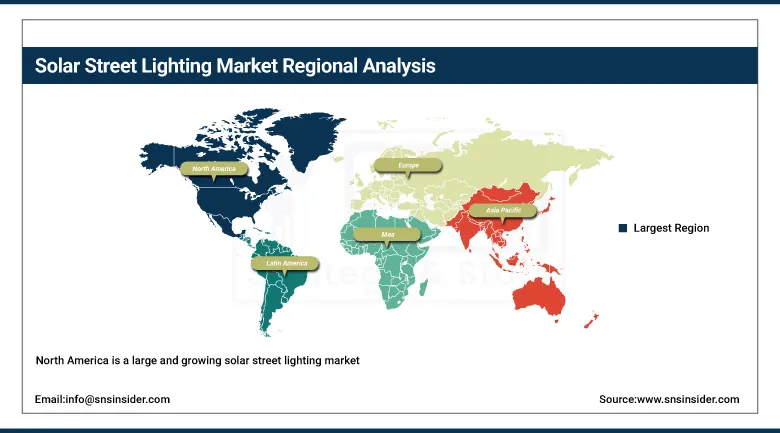
North America is a large and growing solar street lighting market with the United States accounting for approximately 83.4% of North American revenues, driven by federal renewable energy incentives, state clean energy mandates, municipal sustainability commitments, and the practical infrastructure economics that make solar street lighting increasingly competitive against grid-connected alternatives. The U.S. Bipartisan Infrastructure Law's provisions for rural broadband, transportation, and energy infrastructure create federal funding pathways that municipalities are using to finance solar street lighting deployments across highway corridors, rural community main streets, and park perimeters where grid connection costs would otherwise preclude public lighting investment.
Get Customized Report as per Your Business Requirement - Enquiry Now
Europe Solar Street Lighting Market Insights
Europe is a technically advanced solar street lighting market driven by EU Renewable Energy Directive targets, energy efficiency obligations reducing municipal street lighting energy consumption, and smart city investment programmes incorporating solar street lighting into integrated urban sustainability infrastructure. Germany accounts for approximately 24.2% of European revenues through strong municipal sustainability governance, high solar potential in southern states, and quality-focused procurement that favours premium LED solar systems with extended warranty coverage and smart monitoring features. The Nordic countries and southern European nations contribute additional market volume driven by their respective strong solar irradiance resources and progressive renewable energy infrastructure investment programmes.
Asia Pacific Solar Street Lighting Market Insights
Asia Pacific dominated the global Solar Street Lighting Market in 2025 with the largest regional revenue share, anchored by China's extraordinary scale as both the world's largest manufacturer and most significant deployer of solar street lighting, combined with India's National Smart Cities Mission and rural electrification programmes and Southeast Asian nations' rapidly expanding infrastructure investment. China accounts for approximately 52.8% of Asia Pacific revenues through domestic installation programmes driven by municipal carbon neutrality commitments, rural electrification initiatives, and the export manufacturing ecosystem supplying the majority of the world's solar street lighting components at the most competitive pricing through Chinese manufacturing scale.
MEA & Latin America Solar Street Lighting Market Insights
The Middle East and Africa and Latin America are high-growth solar street lighting markets where the combination of strong solar irradiance resources, limited or costly grid infrastructure in rural areas, and government development programmes prioritising public lighting access are creating large-scale deployment opportunities. UAE leads MEA revenues at approximately 26.7% through smart city infrastructure investment and premium commercial real estate development programmes. Brazil leads Latin American revenues at approximately 42.5% through its large territory with extensive rural areas lacking electrical infrastructure and government programmes supporting off-grid community lighting through rural electrification initiatives.
Market Dynamics
Growth Drivers: Plummeting solar panel and LED costs making solar street lighting lifecycle economics superior to grid-connected alternatives combined with government sustainable infrastructure mandates and global off-grid electrification urgency
The primary structural growth drivers are the extraordinary cost trajectory of solar street lighting components, where photovoltaic module prices have fallen over 90% since 2010 and LED luminaire costs over 70% in the same period creating system total costs that compete favourably with grid-connected alternatives on a 15-year lifecycle basis in most deployment contexts, combined with the growing number of government mandates for renewable energy in public infrastructure, carbon neutrality commitments creating priority for sustainable public lighting investment, and the humanitarian urgency of extending illumination access to 775 million people globally for whom solar street lighting represents the only viable public lighting pathway.
Restraints: Performance variability with seasonal solar irradiance creating reliability concerns in high-latitude regions, battery replacement lifecycle adding maintenance cost, and initial capital cost premium creating budget barriers in public procurement
A significant restraint is the reliability challenge that seasonal irradiance variation imposes on standalone battery-dependent systems in high-latitude regions and persistently cloudy climates, where systems sized for average conditions may experience battery depletion during consecutive low-irradiance days when reliable public lighting is most needed. Battery replacement represents a lifecycle cost that procurement evaluations often underestimate, with lithium iron phosphate packs requiring replacement every eight to twelve years at costs of 20 to 40% of original system price creating total ownership costs higher than simple purchase price comparisons suggest.
Opportunities: Smart solar street lighting as IoT urban infrastructure node, off-grid developing economy scale, and integrated EV charging creating dual-purpose urban infrastructure
The evolution of solar street lighting into multi-service smart urban infrastructure nodes incorporating EV charging, IoT sensor hosting, wireless communications relay, and environmental monitoring provides the most compelling value creation opportunity, as multiple co-located services collectively justify capital investment that illumination alone might not. Developing economy off-grid electrification represents an enormous solar street lighting deployment opportunity where international development finance, national government funding, and impact investment are creating aggregated procurement programmes capable of buying hundreds of thousands of units through competitive tender processes.
Recent Developments:
-
2025: Signify launched an expanded Philips solar street lighting range incorporating integrated LTE connectivity for smart city platform integration, adaptive motion-sensing dimming with 10-level output control, and lithium iron phosphate battery systems rated for 2,500 charge-discharge cycles for premium smart city deployments.
-
2025: Greenshine New Energy expanded its U.S. sales and installation infrastructure following strong demand in municipal highway corridor, parking facility, and park lighting applications under federal infrastructure bill-funded procurement, including significant highway interchange lighting contracts.
-
2025: LEADSUN launched its AE6 all-in-one solar street light incorporating a 48V lithium iron phosphate battery system with adaptive charging, 200W equivalent LED output, and IP66 weather resistance suitable for coastal and high-humidity deployment environments.
-
2025: The Indian government expanded its Smart Cities Mission procurement for solar street lighting to 50 additional tier-two cities, committing to over 300,000 smart solar LED street lights as part of the national clean energy infrastructure investment programme.
-
2025: Fonroche Lighting America secured a multi-year supply agreement with a major U.S. state transportation department for off-grid solar street lighting at rural highway rest areas, emergency call box locations, and bicycle trail corridors throughout the state highway system.
Solar Street Lighting Market Key Players
-
Greenshine New Energy
-
Bridgelux Inc.
-
LEADSUN
-
Solar Electric Power Company (SEPCO)
-
Anhui Longvolt Energy Co. Ltd.
-
BISOL Group
-
Fonroche Lighting America
-
Jinhua SunMaster Solar Lighting Co. Ltd.
-
Shenzhen Spark Optoelectronics S&T Co. Ltd.
-
Shenzhen Luxman Light Co. Ltd.
-
Signify (Philips Lighting)
-
Cree Lighting
-
OSRAM GmbH
-
Havells India Ltd.
-
Su-Kam Power Systems Ltd.
-
Omega Solar
-
Sunna Design
-
Sol Inc.
-
Urban Green Energy
-
Carmanah Technologies Corporation
Solar Street Lighting Market Report Scope:
| Report Attributes | Details |
|---|---|
| Market Size in 2025 | USD 13.33 Billion |
| Market Size by 2035 | USD 59.48 Billion |
| CAGR | CAGR of 15.87% From 2026 to 2035 |
| Base Year | 2025 |
| Forecast Period | 2026-2035 |
| Historical Data | 2022-2024 |
| Report Scope & Coverage | Market Size, Segments Analysis, Competitive Landscape, Regional Analysis, DROC & SWOT Analysis, Forecast Outlook |
| Key Segments | • By Product Type (Compact Fluorescent Lamps (CFL), Light-Emitting Diode (LED)) • By Connection Type (Standalone, Grid Connected) • By Application (Urban Areas, Rural Areas, Highways & Roads, Parks & Gardens) • By End User (Commercial, Residential, Industrial) |
| Regional Analysis/Coverage | North America (US, Canada, Mexico), Europe (Eastern Europe [Poland, Romania, Hungary, Turkey, Rest of Eastern Europe] Western Europe] Germany, France, UK, Italy, Spain, Netherlands, Switzerland, Austria, Rest of Western Europe]), Asia Pacific (China, India, Japan, South Korea, Vietnam, Singapore, Australia, Rest of Asia Pacific), Middle East & Africa (Middle East [UAE, Egypt, Saudi Arabia, Qatar, Rest of Middle East], Africa [Nigeria, South Africa, Rest of Africa], Latin America (Brazil, Argentina, Colombia, Rest of Latin America) |
| Company Profiles | Greenshine New Energy, Bridgelux Inc., LEADSUN, Solar Electric Power Company (SEPCO), Anhui Longvolt Energy Co. Ltd., BISOL Group, Fonroche Lighting America, Jinhua SunMaster Solar Lighting Co. Ltd., Shenzhen Spark Optoelectronics S&T Co. Ltd., Shenzhen Luxman Light Co. Ltd., Signify (Philips Lighting), Cree Lighting, OSRAM GmbH, Havells India Ltd., Su-Kam Power Systems Ltd., Omega Solar, Sunna Design, Sol Inc., Urban Green Energy, Carmanah Technologies Corporation |
Frequently Asked Questions
The Solar Street Lighting Market is expected to grow at a CAGR of 15.87% from 2026 to 2035.
The Solar Street Lighting Market was valued at USD 13.33 billion in 2025.
Plummeting solar panel and LED component costs making solar street lighting lifecycle economics superior to grid-connected alternatives combined with government renewable energy mandates, smart city programmes, and the urgent need to extend public lighting access to 775 million people globally without electricity.
LED dominated with approximately 72.20% of revenues in 2025.
Asia Pacific dominated the Solar Street Lighting Market in 2025.
