
Spatial Transcriptomics Market Report Scope & Overview:
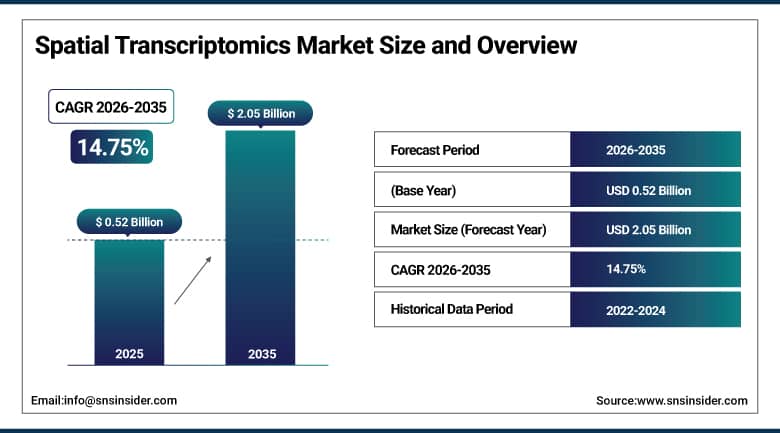
The Spatial Transcriptomics Market was valued at USD 0.52 Billion in 2025 and is expected to reach USD 2.05 Billion by 2035, growing at a CAGR of 14.75% from 2026 to 2035.
There is constant and steady growth of the spatial transcriptomics market due to increasing adoption of spatially resolved gene expression profiling across oncology, neuroscience, and immunology research, growing integration of single-cell and spatial multiomic workflows within pharmaceutical drug discovery pipelines, and continuous innovation in imaging-based and sequencing-based spatial platforms enabling higher plex, higher throughput, and subcellular resolution analysis. Techniques of spatial transcriptomics are becoming ever more commonly used in various academic laboratories, translational research facilities, and pharmaceutical companies in an attempt to analyze gene expression patterns inside the native structure of tissues, which is often not possible using conventional techniques of either bulk RNA sequencing or single-cell RNA sequencing since this way valuable spatial information is lost.
10x Genomics and Vizgen both advanced their spatial transcriptomics platforms in 2026, launching whole-transcriptome and MERFISH-based multiomic enhancements to meet growing researcher demand for higher-throughput, single-cell resolution tissue profiling amid expanding oncology and neuroscience research applications worldwide.
To Get More Information On Spatial Transcriptomics Market - Request Free Sample Report
Spatial Transcriptomics Market Trends:
-
Rising adoption of imaging-based in situ spatial platforms is accelerating single-cell resolution tissue mapping across oncology research.
-
Growing integration of spatial transcriptomics with single-cell sequencing is expanding multiomic tumor microenvironment characterization.
-
Increasing use of AI-powered image analysis and cell segmentation tools is improving spatial data interpretation speed and accuracy.
-
Expanding pharmaceutical adoption of spatial biology in biomarker discovery is strengthening translational and companion diagnostic research.
-
Strategic collaborations between platform developers and academic consortia are driving large-scale spatial tissue atlas initiatives worldwide.
U.S. Spatial Transcriptomics Market Outlook:
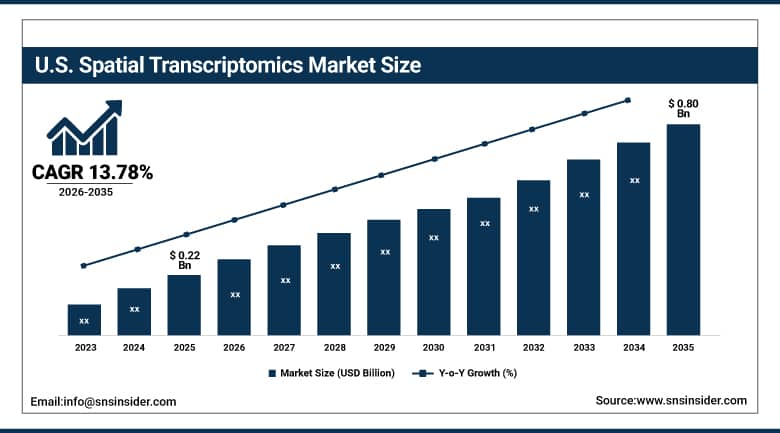
The U.S. Spatial Transcriptomics Market was valued at USD 0.22 Billion in 2025 and is projected to reach USD 0.80 Billion by 2035, growing at a CAGR of 13.78% during 2026–2035.
The leading academic medical centers, cancer research institutes, and biopharmaceutical organizations within the country continue to expand adoption of spatial transcriptomics platforms due to strong domestic genomics infrastructure, substantial federal and private research funding directed toward precision oncology, and growing use of spatially resolved tissue profiling in immuno-oncology and neurodegenerative disease research. The presence of leading platform developers headquartered domestically, alongside expanding translational research partnerships between hospitals and biotechnology companies, continues to reinforce sustained demand for advanced spatial transcriptomics instruments, consumables, and software across the country.
In 2026, 10x Genomics launched Atera, a new whole-transcriptome in situ spatial biology platform designed to deliver single-cell sensitivity at significantly greater imaging throughput than earlier instruments, strengthening its ability to serve U.S. academic and biopharmaceutical spatial biology customers.
Spatial Transcriptomics Market Segment Analysis:
-
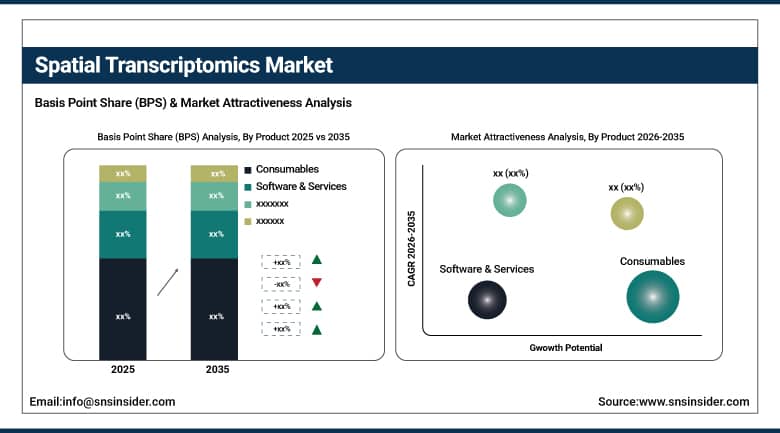
By Product, Consumables dominated the Spatial Transcriptomics Market with a 46.80% share in 2025, while Software & Services is the fastest-growing product segment with a CAGR of 17.60% from 2026–2035.
-
By Technology, Sequencing-based dominated the Spatial Transcriptomics Market with a 57.40% share in 2025, while Imaging-based is the fastest-growing technology segment with a CAGR of 16.85% from 2026–2035.
-
By Sample Type, Fresh Frozen dominated the Spatial Transcriptomics Market with a 53.90% share in 2025, while FFPE is the fastest-growing sample type segment with a CAGR of 16.10% from 2026–2035.
-
By End User, Academic & Research Institutes dominated the Spatial Transcriptomics Market with a 44.60% share in 2025, while Pharmaceutical & Biotechnology Companies is the fastest-growing end-user segment with a CAGR of 17.30% from 2026–2035.
By Product, Consumables led the market, while Software & Services is growing fastest.
The Consumables category emerged as the major player, contributing 46.80% of the market revenues in the Spatial Transcriptomics Market in 2025. The Consumables category comprises products such as reagent kits, probes, gene panels, and slides, which constitute the largest category in the product segment due to the repetitive nature of purchase required on a per-run basis as well as increasing number of spatial transcriptomics tests performed in academic and biopharmaceutical labs. With more and more research facilities upscaling the capacity to map tumor microenvironment and create multiple-tissue atlases, the requirement for validated and pre-designed consumable panels for use in sequencing as well as imaging-based systems increases continuously.
The Software & Services segment is expected to witness the highest CAGR of 17.60% during the forecast period 2026–2035. Growing complexity of spatial transcriptomics datasets, which combine high-resolution imaging, transcript-level expression data, and cell segmentation outputs, is driving strong demand for advanced bioinformatics platforms, cloud-based data storage, and AI-powered analysis tools capable of translating raw spatial data into actionable biological insight. Increasing outsourcing of spatial profiling experiments to core facilities and contract research organizations offering specialized data interpretation services is further accelerating adoption, as laboratories seek to overcome internal bioinformatics capacity constraints while scaling their spatial biology research programs.
By Technology, Sequencing-based led the market, while Imaging-based is growing fastest.
The Sequencing-based Segments led the Spatial Transcriptomics Market with a share of 57.40% of the total revenue generated in 2025. Sequencing-based spatial transcriptomics platforms are still the favorite of the researchers owing to the fact that they can provide whole-transcriptome gene expression data without the need for a prior defined set of genes, thereby facilitating unbiased discovery-based analysis of the tissue samples with varied application areas such as oncology, developmental biology, and neuroscience. These platforms' ability to be easily integrated with existing next generation sequencing technology available in most genomics core labs and continued development of the chemistry with better capturing and spatial resolution has led to their robust adoption.
The Imaging-based segment is expected to register the fastest CAGR of 16.85% during the forecast period 2026–2035. Growing demand for subcellular resolution, targeted gene panel analysis is driving strong adoption of imaging-based in situ platforms, which offer significantly faster turnaround times and higher single-cell spatial precision compared to sequencing-based approaches, making them well suited for clinically oriented translational research and biomarker validation studies. Continued expansion of validated, ready-to-use gene and protein panels, alongside growing integration of same-section multiomic RNA and protein detection capabilities, is further strengthening the competitive position of imaging-based platforms across oncology and immuno-oncology research applications.
By Sample Type, Fresh Frozen led the market, while FFPE is growing fastest.
The Fresh Frozen category held the largest market share of 53.90% in the year 2025 in terms of revenue contribution. Fresh frozen tissue samples serve as the most favored samples for spatial transcriptomics due to high-quality RNA preservation, compared with fixed tissue, which helps in achieving better accuracy in gene expression capture through sequencing as well as imaging-based approaches. This is owing to their wide usage in preclinical and academic laboratories where there is a well-established infrastructure for handling fresh tissues.
FFPE segment expected to record the highest growth at a CAGR of 16.10% during 2026-2035. Extensive availability of FFPE tissue blocks in hospital pathology units and biobanks, along with the continual developments in probe chemistry allowing effective RNA extraction from formalin fixed samples, are some of the major factors responsible for increasing demand for FFPE compatible spatial transcriptomics assays. Rising interest among pharma companies in the use of existing FFPE patient cohorts for biomarker and companion diagnostics discoveries is likely to augment the demand for FFPE compatible spatial transcriptomics kits and instruments in biopharmaceutical R&D programs.
By End User, Academic & Research Institutes led the market, while Pharmaceutical & Biotechnology Companies is growing fastest.
The Academic & Research Institutes segment dominated the Spatial Transcriptomics Market with a revenue share of 44.60% in 2025. Universities, research facilities that receive government grants, and private research centers continue to be the biggest segment of the end-users because of the crucial roles they play in the development of spatial biology techniques, basic tissue atlases, and government-funded diseases research programs in oncology, neuroscience, and developmental biology. Adequate and steady funding from the government for precision medicine, together with the increasing availability of core facilities infrastructure equipped with spatial transcriptomics equipment, still drives the adoption of these technologies globally.
The Pharmaceutical & Biotechnology Companies segment is expected to witness the fastest CAGR of 17.30% during the forecast period 2026–2035. As pharmaceutical and biotechnology firms increasingly adopt spatial transcriptomics in drug discovery and target identification at the early stages, the segment will gain further traction due to the need to understand disease mechanisms and tissue-specific effects of drugs prior to their entry into expensive clinical development. As providers of spatial transcriptomics platforms enter into strategic collaborations with biopharmaceutical firms to build large-scale spatial tissue atlases in oncology and immunology applications, the segment will be strengthened due to its outperformance relative to the overall market.
Regional Analysis:
|
Region |
Major Country |
Share within Region, 2025 (%) |
|---|---|---|
|
North America |
United States |
89.50% |
|
Europe |
Germany |
26.80% |
|
Asia Pacific |
China |
41.50% |
|
Middle East & Africa |
UAE |
27.30% |
|
Latin America |
Brazil |
36.40% |
North America Spatial Transcriptomics Market Insights
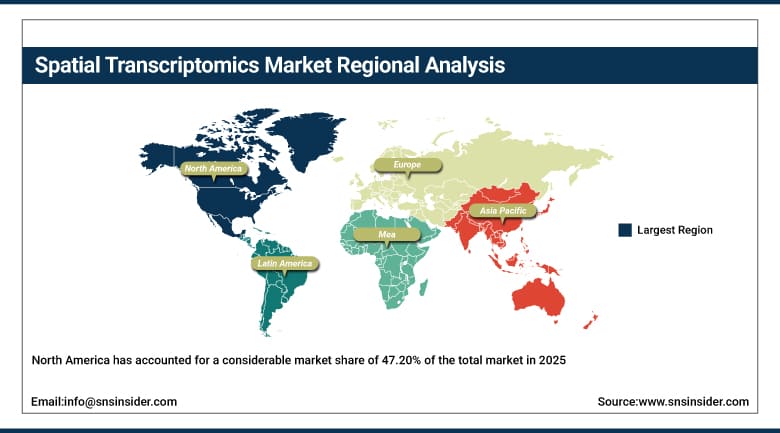
North America has accounted for a considerable market share of 47.20% of the total market in 2025 owing to the presence of a well-established genomics research environment in the region, the availability of major players in spatial biology platform development, and the ample amount of financial support provided by both public and private sectors for precision oncology and translational medicine research. The prevalence of various academic medical centers, coupled with an advanced environment for single-cell and spatial multiomics from discovery to translation, keeps driving the usage of spatial transcriptomics instruments, reagents, and software in the region.
The US was the leading country within the North America Spatial Transcriptomics Market in 2025 with a market share of 89.50% of the regional market, driven by strong domestic platform manufacturing presence, extensive federal research funding through agencies supporting precision oncology and rare disease research, and growing pharmaceutical company adoption of spatial biology in drug discovery pipelines. Canada is contributing to regional growth through its own expanding genomics research infrastructure and increasing academic adoption of spatial transcriptomics across cancer and neuroscience research programs.
Get Customized Report as Per Your Business Requirement - Enquiry Now
Europe Spatial Transcriptomics Market Insights
The Europe region was a major contributor to the Spatial Transcriptomics Market in 2025, expected to register comparatively higher growth for imaging-based in situ spatial platforms during the forecast period. This is attributed to the region's strong academic genomics research base, growing government investment in precision medicine and cancer research initiatives, and increasing adoption of spatial biology tools across leading university hospitals and translational research consortia pursuing broader biomedical research objectives across member states.
Germany is one of the major markets in Europe owing to its strong life sciences research infrastructure and presence of leading academic spatial biology research groups serving both domestic and international collaborators. Other countries such as the UK, France, and Switzerland, home to several prominent genomics research institutions, are also contributing to market growth through extensive spatial transcriptomics research funding and cross-border translational research collaboration.
Asia Pacific Spatial Transcriptomics Market Insights
The Asia Pacific Spatial Transcriptomics Market is expected to witness the fastest growth rate during the forecast period 2026–2035, registering a CAGR of 16.40%. The market growth is driven by rapidly expanding genomics research infrastructure, growing government investment in precision medicine and cancer genomics initiatives, and increasing academic and biopharmaceutical adoption of spatial biology platforms across the region's major and emerging research economies pursuing advanced biomedical research capabilities.
China is one of the main growth drivers in the Asia Pacific Spatial Transcriptomics Market, owing to its rapidly expanding genomics research ecosystem and substantial national investment in precision oncology and life sciences research infrastructure supporting both academic and biopharmaceutical customers. India and Japan, both major contributors to the region's growing genomics research base, are also supporting regional growth through expanding translational research capacity and increasing adoption of spatial transcriptomics in cancer and neuroscience research programs.
Middle East & Africa and Latin America Spatial Transcriptomics Market Insights
Middle East & Africa and Latin American regions are gradually expanding spatial transcriptomics adoption as genomics research investment grows across both regions, supported by increasing government focus on precision medicine research capacity and growing academic collaboration with established international spatial biology platform developers.
Brazil is set to be a prominent Latin American market fueled by its expanding academic genomics research base and growing government investment in cancer research infrastructure requiring advanced molecular profiling capabilities. The Middle East & Africa region has UAE and Saudi Arabia investing in modern genomics and precision medicine research infrastructure that is gradually increasing demand for spatial transcriptomics platforms across their expanding academic and clinical research sectors.
Market Dynamics:
Growth Drivers: Rising precision medicine adoption and spatial multiomics integration driving market growth
The rising integration of spatial transcriptomics into precision oncology, immunology, and neuroscience research, combined with growing pharmaceutical and biotechnology adoption of spatially resolved gene expression profiling in drug discovery, are among the primary drivers of the Spatial Transcriptomics Market. Spatial transcriptomics technologies provide researchers with the unique ability to preserve tissue architecture while capturing genome-wide gene expression data, enabling deeper understanding of tumor microenvironments, cellular heterogeneity, and disease progression mechanisms across virtually every major area of biomedical research, from cancer biology and neurodegeneration through developmental biology and infectious disease research.
Technological advancements in spatial biology instrumentation have significantly increased throughput and resolution, with recent platform innovations enabling whole-transcriptome profiling at single-cell sensitivity across substantially larger tissue areas than earlier-generation instruments. Rising adoption of same-section multiomic RNA and protein detection workflows, growing integration of AI-powered image analysis and cell segmentation tools, and continued academic and government research funding expanding spatial biology core facility infrastructure are further supporting demand across the forecast period, as spatial transcriptomics continues transitioning from a specialized research technique into a mainstream biomedical research tool.
Restraints: High instrument cost and complex data analysis requirements limiting market expansion
However, one of the key challenges that the market faces is the heavy capital expenditure involved in purchasing spatial transcriptomics technology and its consumables, something that makes the use of such products difficult for small academic research labs with limited budgets. In other words, one of the most sophisticated sequencing- and imaging-based platforms is accompanied by high capital investment as well as per-sample consumables costs.
Moreover, the considerable bioinformatics expertise and computational infrastructure required to process, analyze, and interpret complex spatial transcriptomics datasets directly impacts adoption timelines for research institutions lacking dedicated data science personnel. Besides, the high technical requirements in terms of optimizing tissue preparation protocols for different sample types, including fresh frozen and FFPE tissue, alongside variability in data quality across platforms, require considerable researcher training and standardization investment before generating reliable, reproducible results.
Opportunities: Expansion of clinical translation and AI-driven spatial analytics creating new growth avenues
The increasing need for spatially resolved biomarkers to support companion diagnostic development, the rise of large-scale collaborative spatial tissue atlas initiatives combining multiple research institutions, and greater emphasis on AI-driven spatial data analytics due to increased biotechnology funding will provide ample growth opportunities in the Spatial Transcriptomics Market. The need for translational research tools capable of bridging basic biology and clinical application will ensure future growth as precision medicine initiatives continue expanding worldwide.
There is great room for growth in the development of same-section spatial multiomics technologies that combine RNA, protein, and imaging datasets into one workflow. This type of technology saves scientists both time and money by removing the necessity to merge different sets of data collected through various techniques. With the growing genomics infrastructure in emerging markets of Asia Pacific and Latin America and the rise of governmental support for projects in precision medicine, there is significant scope for growth.
Recent Developments:
-
2025: 10x Genomics launched Xenium Protein, a same-section spatial multiomic workflow enabling simultaneous RNA and protein detection within a single automated Xenium platform run for immuno-oncology research applications.
-
2025: Akoya Biosciences introduced PhenoCode Human and Mouse FFPE Neurobiology Panels, expanding its PhenoCycler-Fusion platform menu to support neurodegenerative disease and neuroinflammation research applications.
-
2026: Vizgen unveiled enhancements to its MERSCOPE Ultra platform, including new MERSCOPE Add-On Genes and an expanded predesigned panel portfolio supporting spatial multiomic organoid research applications.
Spatial Transcriptomics Market Key Players are:
-
10x Genomics, Inc.
-
Bruker Corporation
-
Vizgen, Inc.
-
Akoya Biosciences, Inc.
-
Standard BioTools Inc.
-
Illumina, Inc.
-
Bio-Techne Corporation
-
Bio-Rad Laboratories, Inc.
-
Revvity, Inc.
-
Merck KGaA
-
Thermo Fisher Scientific Inc.
-
QIAGEN N.V.
-
Miltenyi Biotec B.V. & Co. KG
-
Curio Bioscience
-
Parse Biosciences
-
Resolve Biosciences GmbH
-
Lunaphore Technologies SA
-
Singular Genomics Systems, Inc.
-
S2 Genomics, Inc.
-
Canopy Biosciences, LLC
Spatial Transcriptomics Market Report Scope:
| Report Attributes | Details |
|---|---|
| Market Size in 2025 | USD 0.52 Billion |
| Market Size by 2035 | USD 2.05 Billion |
| CAGR | CAGR of 14.75% From 2026 to 2035 |
| Base Year | 2025 |
| Forecast Period | 2026-2035 |
| Historical Data | 2022-2024 |
| Report Scope & Coverage | Market Size, Segments Analysis, Competitive Landscape, Regional Analysis, DROC & SWOT Analysis, Forecast Outlook |
| Key Segments | • By Product (Consumables, Instruments, Software & Services) • By Technology (Sequencing-based, Imaging-based) • By Sample Type (Fresh Frozen, FFPE) • By End User (Academic & Research Institutes, Pharmaceutical & Biotechnology Companies, Hospitals & Diagnostic Laboratories) |
| Regional Analysis/Coverage | North America (US, Canada), Europe (Germany, France, UK, Italy, Spain, Russia, Poland, Rest of Europe]), Asia Pacific (China, India, Japan, South Korea, Australia, ASEAN Countries, Rest of Asia Pacific), Latin America (Brazil, Argentina, Mexico, Colombia, Rest of Latin America), Middle East & Africa (UAE, Saudi Arabia, Qatar, South Africa, Rest of Middle East & Africa) |
| Company Profiles | 10x Genomics, Inc., Bruker Corporation, Vizgen, Inc., Akoya Biosciences, Inc., Standard BioTools Inc., Illumina, Inc., Bio-Techne Corporation, Bio-Rad Laboratories, Inc., Revvity, Inc., Merck KGaA, Thermo Fisher Scientific Inc., QIAGEN N.V., Miltenyi Biotec B.V. & Co. KG, Curio Bioscience, Parse Biosciences, Resolve Biosciences GmbH, Lunaphore Technologies SA, Singular Genomics Systems, Inc., S2 Genomics, Inc., Canopy Biosciences, LLC |

Frequently Asked Questions
Key Players include 10x Genomics, Inc., Bruker Corporation, Vizgen, Inc., Akoya Biosciences, Inc., and Standard BioTools Inc., among others.
Key opportunities include expanding single-cell and spatial multi-omics research, increasing precision oncology applications, AI-driven spatial data analysis, and growing adoption in drug discovery and biomarker development.
The market is driven by rising integration of spatial transcriptomics into precision oncology and translational research, growing pharmaceutical and biotechnology adoption in drug discovery, and continued innovation in spatial biology platform technology.
The Academic & Research Institutes segment dominated the Spatial Transcriptomics Market in 2025, accounting for approximately 44.60% market share.
The North America region dominated the Spatial Transcriptomics Market in 2025 with a 47.20% market share, driven by strong genomics research infrastructure and substantial precision oncology research funding.
