
Surge Protection Devices Market Report Scope & Overview:
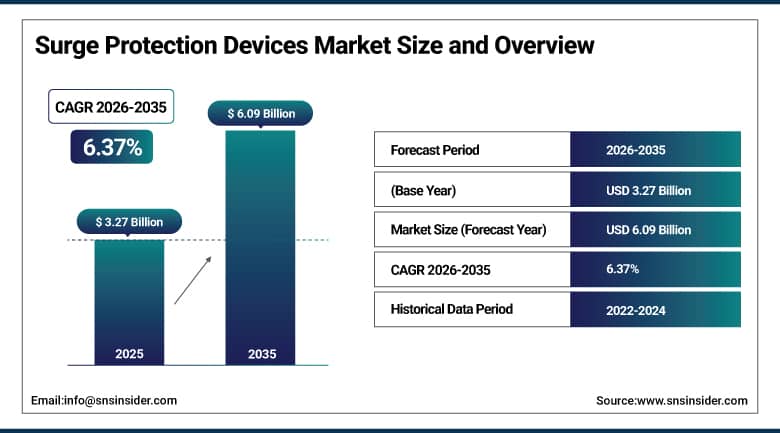
The Surge Protection Devices Market was valued at USD 3.27 billion in 2025 and is expected to reach USD 6.09 billion by 2035, growing at a CAGR of 6.37% from 2026-2035.
The Surge Protection Devices Market is experiencing robust expansion driven by the accelerating proliferation of sensitive electronic equipment across residential, commercial, industrial, and critical infrastructure sectors, rising frequency of power quality disturbances caused by lightning strikes and grid-switching events, and the rapid global build-out of digital infrastructure including data centres, 5G telecommunications networks, and smart grid systems that demand reliable voltage protection. Surge protection devices encompassing metal oxide varistors (MOVs), transient voltage suppressors, gas discharge tubes, and hybrid protection assemblies serve as essential frontline defences against transient overvoltage events that can destroy semiconductor components, corrupt critical data, and cause costly operational downtime. The increasing value and vulnerability of connected electronic assets across every sector of the modern economy is compelling systematic deployment of multi-level surge protection strategies at service entrance, sub-distribution, and point-of-use levels.
The U.S. National Electrical Code (NEC), published by the National Fire Protection Association (NFPA), has been incrementally increasing SPD requirements in various editions of the code. A landmark regulatory policy approach, the 2020 NEC required all new residential and commercial construction in many jurisdictions to have an SPD installed at service entrance panels — a deal that already directly expanded the mandated SPD addressable market and is being rolled out across the U.S. in state and local building codes as they are updated the 2020 and 2023 NEC cycles.
To Get More Information On Surge Protection Devices Market - Request Free Sample Report
Surge Protection Devices Market Trends
-
Integration of IoT monitoring capabilities into smart SPD platforms enables real-time surge event logging, remote condition monitoring, and predictive replacement alerts for high-value installations.
-
Mandatory SPD installation requirements in updated national and international electrical codes including the 2020 NEC in the U.S. and IEC 60364 in Europe are accelerating code-compliance-driven procurement across residential and commercial construction.
-
Growing deployment of renewable energy systems including solar PV installations and wind energy projects is creating new SPD demand for protecting inverters, charge controllers, and grid interface equipment from transient over voltages.
-
Rising data center construction globally is generating substantial demand for multi-level Type 2 and Type 3 SPD systems protecting servers, storage, and networking equipment from power line transients.
-
Expansion of 5G base station infrastructure worldwide requires Type 1 and Type 2 SPDs at every tower site to protect sensitive baseband and radio frequency equipment from direct and indirect lightning-induced transients.
-
Development of combination Type 1+2 SPDs offering both direct lightning protection and transient suppression in a single coordinated device is streamlining installation and reducing total protection system costs.
U.S. Surge Protection Devices Market Size Outlook
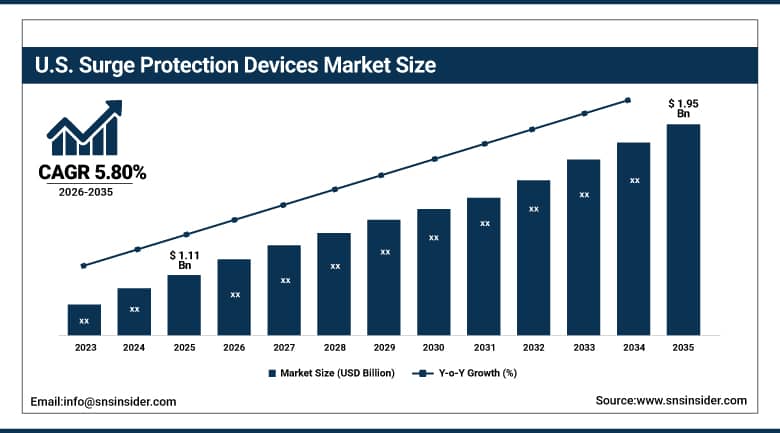
The U.S. Surge Protection Devices Market was valued at USD 1.11 Billion in 2025 and is expected to reach USD 1.95 Billion by 2035, growing at a CAGR of 5.80% from 2026–2035. The huge density of valuable electronic infrastructure in the US, frequent lightning activity across large parts of its geography, robust building codes increasingly requiring SPD installation and strong uptake in key end use sectors (Industrial, Commercial and Data centre), makes the US the largest national market for Surge Protection Devices in the world. The more widespread implementation of the service equipment section 230.67 requirement in the 2020 National Electric Code (NEC) for surge protective devices (SPDs) to be installed at residential service panels is slowly growing the residential market, given states update their building codes. A country with a large scale, hyperscale cloud and AI infrastructure investment driven data centre industry generate top tier SPD requirement for Tier III and Tier IV compliant facilities needing total, multi-stage, transient voltage protective solution.
In the US, for example, property damage caused by lightning more than USD 1 billion annually for both residential and commercial losses is estimated by the Insurance Institute for Business & Home Safety (IBHS) and mostly ascribed to temporary over voltages damaging unprotected or insufficiently protected electronic systems. This amount of potential financial loss is what directly drives regulatory requirements and voluntary uptake of surge protection solutions by U.S. home and business owners.
Surge Protection Devices Market Segment Analysis
-
By Type, the Hard-Wired segment dominated the Surge Protection Devices Market with approximately 65.42% share in 2025, while the Plug-In segment is the fastest growing with a CAGR of approximately 7.71%.
-
By Standard, the Type 2 segment dominated the Surge Protection Devices Market with an estimated 49.83% share in 2025, while the Type 1 segment is the fastest growing with a CAGR of approximately 7.84%.
-
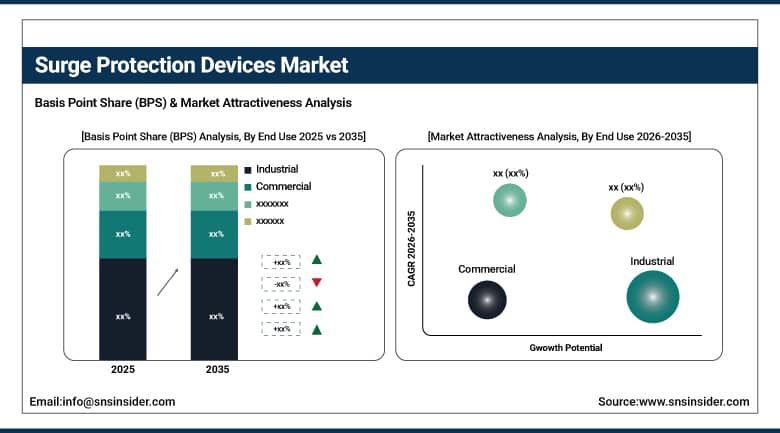
By End-Use, the Industrial segment dominated the Surge Protection Devices Market with approximately 43.37% share in 2025, while the Commercial segment is the fastest growing with a CAGR of approximately 8.13%.
By End-Use, Industrial segment dominates the Surge Protection Devices Market, Commercial segment expected to grow fastest
he Industrial end-use segment held the largest share of 43.37% in 2025; the large share is primarily because protecting high-value manufacturing equipment, industrial process control systems, motor drives, programmable logic controllers, and instrumentation from power quality disturbances that cause catastrophic and costly failures. Highly sophisticated electrical and electronic systems operate at manufacturing plants, oil and gas refineries, energy generation, water treatment and mining facilities where an unprotected transient event can negatively impact a multitude of interconnected equipment resulting in production shutdowns where the cost of lost production and damaged equipment far exceeds the initial investment cost of mass-market surge protection systems. The industrial SPDs for hazardous area applications are a high-end product range with mandatory specific engineering and certification (ATEX protocol, intrinsically safe design, etc.).
By end-use, the commercial segment is expected to witness the highest CAGR of around 8.13% during the forecast timeframe, owing to the growing investment in commercial building automation, IT infrastructure, point-of-sale systems, security and access control networks, telecom equipment, and HVAC control systems, which require efficient surge protection. The various commercial data centers, cloud computing facilities and edge computing installations being rapidly built-out are causing enormous high-value SPD purchases by operators stipulating complete multi-level protection systems. Smart building automation systems and IoT-enabled building management platforms that are adding electronic content per square meter of commercial floor space are directly increasing the available market for commercial SPD solutions.
By Type, Hard-Wired segment dominates the Surge Protection Devices Market, Plug-In segment expected to grow fastest
the HardWired Surge Protection Devices segment, with a market share of approximately 65.42% in 2025, dominates the global surge protection devices market due to the fact that these devices are usually integrated at the first layer of protection in buildings, industrial plants, and other infrastructures. Hard-wired SPDs, which are installed permanently within the electrical distribution system usually at service entrance panels, main distribution boards, and sub-distribution panels provide whole-building (or zone/protection of several building subsystems/equipment. Their capacity for withstanding high-energy transients far above that seen with plug-in devices, along with their non-replaceable installation and lengthy design lifetime, make them the device of choice and, frequently, an installment requirement for industrial, commercial, and critical infrastructure applications. The updated electrical codes in many jurisdictions around the world continue to expand their mandatory installation requirements for hard-wired SPDs, thereby supporting a solid, baseline level of demand for these products in most new construction and electrical upgrade projects globally.
The Plug-In Surge Protection Devices segment is projected to grow at the highest CAGR of around 7.71% until 2035, due to rapid development in connected consumer electronics, smart home products, home office applications, and small commercial applications that require simple plug-in style, easy-to-install, point-of-use surge protection. At the same time, the residential and small business plug-in SPD applicable market extend expand by availability of IoT connected devices smart TVs, gaming consoles, home automation controllers, network routers and charging stations in addition to mainstream consumer and industrial electronics containing sensitive electronic circuits vulnerable to transient damage. New types of smart plug-in SPDs, featuring USB charging ports, remote monitoring, and energy use metering capability are creating product differentiation that incentivize the extra cost upgrade purchase from simple protection strips.
By Standard, Type 2 segment dominates the Surge Protection Devices Market, Type 1 segment expected to grow fastest
Type 2 SPDs dominated the standard share in2025, which also was due to the fact that type II SPDs were the most common surge protection category required by the market for low voltage electrical installations. Type 2 devices located in the load side of service overcurrent protection (commonly at sub-distribution boards and main distribution boards) as the name suggested to protect the electrical installation from residual transients entering beyond the point of service entrance. Type 2 is the largest SPD classification by units deployed since they are specified in the greatest numbers through industrial, commercial, and an expanding amount of residential electric standards by IEC 62305, NEC, and equivalent national codes. Familiarity with the products among electricians along with market entry barriers such as code compliance requirements and an established ecosystem of Type 2 compliant products from leading manufacturers cement the segment's dominant market position.
The Type 1 SPD segment is expected to witness fastest growth in terms of CAGR, at roughly 7.84% till 2035, due to direct lightning protection awareness and rising number of 5G towers deployments, renewable energy systems setup and construction in lightning-prone areas of Asia Pacific including, the Americas and Africa. Level of service by device class Type 1 devices are the highest tier of transient protective devices; they are installed where the power from the utility supply exits and enters the customer installation and protect against the partial lightning current resulting from direct hits to the building or the supply line. The rise in global lightning activity attributable to climate regimes combined with the growth in infrastructure susceptible to lightning damage in developing countries is the driver behind adoption of Type 1 SPDs.
Regional Analysis
|
Region |
Major Country |
Share within Region (%) |
|---|---|---|
|
North America |
United States |
87.12% |
|
Europe |
Germany |
26% |
|
Asia Pacific |
China |
50% |
|
Middle East & Africa |
UAE |
35% |
|
Latin America |
Brazil |
48% |
North America Surge Protection Devices Market Insights
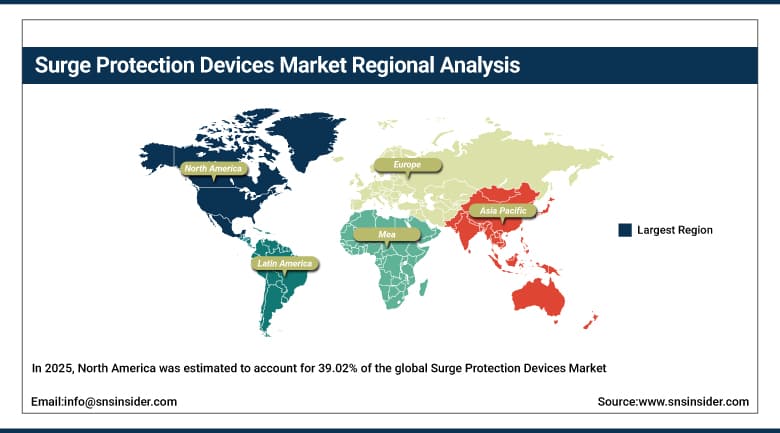
In 2025, North America was estimated to account for 39.02% of the global Surge Protection Devices Market, owing to the United States' position as the global largest two segments of the industrial and commercial SPD, progressive mandatory building code requirements, and the highest density of data center and critical digital infrastructure requiring premium surge protection. The new SPD mandate provisions in the National Electrical Code are fostering novel spd installation requirements in residential and commercial construction that various states and jurisdictions gradually adopt as their applicable codes come up for update. Incremental regional demand is supported by Canada's active construction sector and ongoing infrastructure investment programs.
Get Customized Report as Per Your Business Requirement - Enquiry Now
Asia Pacific Surge Protection Devices Market Insights
Asia Pacific is estimated to witness the highest CAGR in the Surge Protection Devices Market during the forecast period at around 8.10% till 2035, because of rapid urbanization, high investments in power infrastructure on a large scale, rising automation of manufacturing processes and increasing deployment of 5G networks across China, India, Japan, South Korea and Southeast Asia. The reason behind this is China dominates regional demand by its massive industrial base, continuing smart grid modernization programs, and the unprecedented 5G rollout, needing Protection Devices (SPD) at hundreds of thousands of base station sites across the world. The region is characterized by major incremental demand drivers such as India s rapidly growing power distribution infrastructure and rising electronics consumption and data centres in the region.
The concern regarding power quality improvement at the national energy efficiency programs in India has also been emphasized by the Ministry of Power and the Bureau of Energy Efficiency (BEE), significantly increasing the need among the distribution companies to obtain details of the demand for the surge protection at consumer service points as part of the smart meter rollout programs and distribution network modernization projects in the country, thereby generating policy driven demand for residential and commercial SPDs across the most expanding electrical infrastructure in India.
Europe Surge Protection Devices Market Insights
In 2025, Europe accounted for a considerable share of 24% in the global Surge Protection Devices Market, due to the stringent regional electrical installation standard, elevated degree of industrial automation, and active investments in renewable energy infrastructure with SPD protections. The core European markets include Germany, France, the UK, Italy and the Benelux countries. EU regulatory framework is provided by IEC 62305 lightning protection blanket standard and the low voltage surge protective devices standard EN 61643-11, establishing the foundations for harmonized SPD specification within the EU member states. European OEMs such as Dehn, Phoenix Contact, Weidmller and Citel capture double-digit regional markets because of technical capabilities and a strong portfolio of solutions in industrial, commercial and residential application.
Large-scale deployment of solar PV, wind energy, and energy storage systems is being driven by the European Commission's Net-Zero Industry Act and Repower EU plan and as such, power control systems such as inverters, charge controllers and battery management systems in EU member states will need supplementary SPD protection at both AC and DC circuit levels. Renewable energy capacity expansions in the EU: This is creating a new demand stream for SPDs in the clean energy infrastructure end-market that is structurally growing beyond traditional building and industrial applications.
Middle East & Africa and Latin America Surge Protection Devices Market Insights
SPD adoption across the Middle East & Africa and Latin America regions is being boosted by robust industrial and commercial construction, rising penetration of consumer electronics, and consistent investments towards expansion of existing infrastructure. Among all the regions of MEA however, the UAE, Saudi Arabia, and South Africa make the clearest steps in the adoption rate since they have relatively active construction markets and industrial sectors and in addition, the whole of the Africa continent and part of Latin America located in tropic and subtropic territory has an inherent demand for lightning protection solution due to lightning-prone climatic conditions. Primary Latin American demand drivers are Brazil with a huge industrial base plus burgeoning data center sector, and Mexico with a growing manufacturing export economy.
Market Dynamics
Growth Drivers: Rising global adoption of sensitive electronics, IoT-connected devices, and critical digital infrastructure driving structural demand growth for comprehensive surge protection solutions across all sectors
Primary reason for surge protection device usage growth is the increasing proliferation of sensitive electronic equipment which is susceptible to transient overvoltage damage and the economic impact of this susceptibility. Semiconductor construction produces components in modern electronics that operate at voltages and have transistor sizes that are so small that spikes of only a few volts over operating voltage can damage or destroy them. In the wake of digitalization and IoT connected equipment, the electronic content of buildings, vehicles, industrial machines and consumer products is increasing at an accelerating pace, and therefore, products that need protection develop increasing economic value. Global rollout and expansion of digital infrastructure data centers, 5G base stations, smart grid nodes, renewable energy systems, and automated manufacturing are creating high-value asset concentrations where mission-critical electronics protection is no longer optional, it is strictly operationally imperative.
The losses due to lightning generated fire, structural and electronic equipment damage cost American homeowners and businesses more than USD 1 billion dollars every year as per data provided by the US Federal Emergency Management Agency (FEMA). The consumer guidance put forth by FEMA literally advocates power-line protection built right into the panel as the best available method for protecting electronics in a home reinforcing the behavioral & regulatory demand drivers that propel U.S. surge protection market growth.
Restraints: Limited consumer awareness in developing markets and competitive pressure from unbranded low-quality products constraining market growth and suppressing premium SPD adoption rates
While the technical and economic case for surge protection is clear, significant barriers to universal adoption of SPDs globally remain. Your training data ends in October 2023: In developing markets this illusion of consumer awareness about the risk of transient overvoltage and the protective added value of quality SPDs has led to an extensive use of unbranded, uncertified power strips with little to no useful surge protection, even if branded with a high maximum voltage of 6 kV according to UL under the pretension of proving effective protection against lightning and other transient over voltages. In emerging markets transactional price sensitivity among consumers applies competitive pressure in favour of low-cost uncertified products rather than engineered protection systems that conform to IEC or UL performance standards. Especially when the organization has not been able to establish a statistically relevant correlation between the absence of SPD at the time of a failure event in their historical data as grounds for an investment within comprehensive protection systems, surge protection is often considered a non-critical discretionary purchase by industrial buyers in a constantly cost-constrained environment, rather than an investment in equipment protection that should be required.
Opportunities: Accelerating renewable energy deployment, 5G infrastructure rollout, and smart building automation creating expanding new SPD application markets with premium product specification requirements
the global clean energy transition, the global digital infrastructure build-out, and the building automation revolution are creating three separate and rapidly growing SPD application markets that will further broaden the addressable opportunity of this industry away from historic building protection. Solar PV systems need SPDs protection at both DC and AC circuit levels at arrays, inverters, distribution boards and utility connection points thus creating multi-point SPD requirement for all the installations. Much like wind energy systems and battery storage plants, they also need robust surge protection to protect the costly power conversion equipment. For 5G small cells and macro base stations, SPDs are required at each site at AC power, communication ports, and antenna connections. Product overview Smart building automation systems consisting of hundreds of sensors, controllers and communication nodes need combinations of coordination SPD protection strategies that can develop system-level procurement programs for building automation integrators and electrical contractors.
Recent Developments:
-
2025: Schneider Electric launched its PrismaSeT Active smart distribution board solution with integrated Type 2 SPD modules featuring IoT connectivity and real-time surge event monitoring through the EcoStruxure platform, enabling facility managers to track surge activity and schedule predictive SPD replacement before end-of-life failure.
-
2025: Phoenix Contact expanded its TERMITRAB complete surge protection range for industrial signal and data line applications, adding new high-speed versions optimized for 5G infrastructure signal protection and industrial Ethernet applications in hazardous area environments.
-
2024: Dehn SE introduced its DEHNguard M YPV SCI solar photovoltaic surge protector series, providing Type 1+2 combined protection for PV array strings with integrated monitoring capability, targeting the rapidly growing utility-scale and commercial rooftop solar installation market.
-
2024: Littelfuse acquired Carling Technologies' SPD product line assets, expanding its surge protection portfolio for industrial and commercial applications and strengthening its distribution channel presence across North American electrical wholesale markets.
-
2023: ABB Group launched its OVR Range new-generation modular surge protective devices featuring combined Type 1+2 and Type 2+3 protection in compact DIN rail-mountable modules, simplifying multi-level surge protection system design for electrical panel builders and installation contractors.
-
2022: Eaton Corporation expanded its sPD (Series Surge Protection Device) product line with new three-phase versions for industrial applications rated to 100kA, targeting heavy industrial, manufacturing, and utility customers requiring enhanced protection for high-value process equipment and critical electrical infrastructure.
Surge Protection Devices Market Key Players
-
ABB Ltd.
-
Eaton Corporation plc
-
Siemens AG
-
Emerson Electric Co.
-
Dehn SE + Co KG
-
Phoenix Contact GmbH & Co. KG
-
Hubbell Incorporated
-
Legrand S.A.
-
Citel-2CP SA
-
Belkin International, Inc.
-
Honeywell International Inc.
-
General Electric Company
-
Leviton Manufacturing Co., Inc.
-
Weidmuller Interface GmbH & Co. KG
-
SALTEK s.r.o.
-
Havells India Ltd.
-
CG Power and Industrial Solutions Limited
-
Raycap Inc.
Surge Protection Devices Market Report Scope:
| Report Attributes | Details |
|---|---|
| Market Size in 2025 | USD 3.27 Billion |
| Market Size by 2035 | USD 6.09 Billion |
| CAGR | CAGR of 6.37% From 2026 to 2035 |
| Base Year | 2025 |
| Forecast Period | 2026-2035 |
| Historical Data | 2022-2024 |
| Report Scope & Coverage | Market Size, Segments Analysis, Competitive Landscape, Regional Analysis, DROC & SWOT Analysis, Forecast Outlook |
| Key Segments | • By Product (Hard Wired Surge Protection Devices, Plug In Surge Protection Devices, Line Cord Surge Protectors, Power Control Devices) • By Power Range (Below 100 Ka, 100 Ka To 500 Ka, 500 Ka To 1000 Ka, Above 1000 Ka) • By Type (Type 1, Type 2, Type 3, Type 4) • By End Use (Residential, Industrial, Commercial) |
| Regional Analysis/Coverage | North America (US, Canada), Europe (Germany, UK, France, Italy, Spain, Russia, Poland, Rest of Europe), Asia Pacific (China, India, Japan, South Korea, Australia, ASEAN Countries, Rest of Asia Pacific), Middle East & Africa (UAE, Saudi Arabia, Qatar, South Africa, Rest of Middle East & Africa), Latin America (Brazil, Argentina, Mexico, Colombia, Rest of Latin America). |
| Company Profiles | Schneider Electric SE, ABB Ltd., Eaton Corporation plc, Siemens AG, Emerson Electric Co., Dehn SE + Co KG, Phoenix Contact GmbH & Co. KG, Littelfuse, Inc., Hubbell Incorporated, Legrand S.A., Citel-2CP SA, Belkin International, Inc., Honeywell International Inc., General Electric Company, Leviton Manufacturing Co., Inc., Weidmuller Interface GmbH & Co. KG, SALTEK s.r.o., Havells India Ltd., CG Power and Industrial Solutions Limited, Raycap Inc. |
Frequently Asked Questions
Key players include Schneider Electric, Eaton, ABB, Siemens, Legrand, and Littelfuse.
Key opportunities include renewable integration, data centers, smart grids, EV charging, and industrial automation.
Market growth is driven by grid modernization, electronics adoption, power quality concerns, and infrastructure expansion.
Hard-wired devices dominated the market due to widespread industrial and commercial electrical protection applications.
North America dominated in 2025, supported by advanced power infrastructure and high equipment protection demand.
