
Tensor Processing Unit Market Report Scope & Overview:
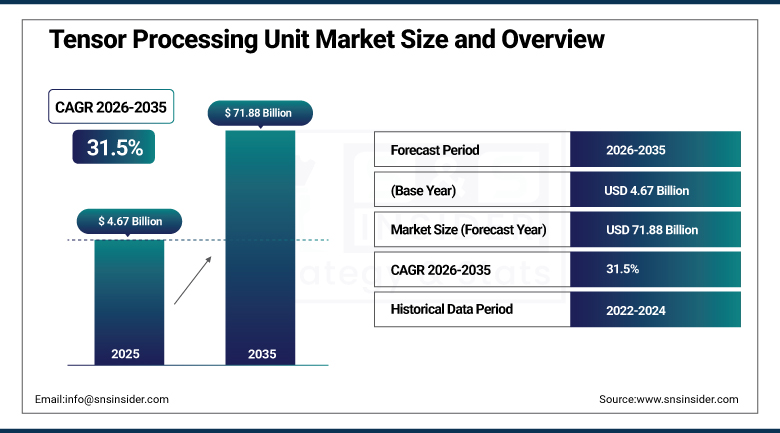
The Tensor Processing Unit Market was valued at USD 4.67 Billion in 2025 and is expected to reach USD 71.88 Billion by 2035, growing at a CAGR of 31.5% from 2026–2035.
The global tensor processing unit market is growing at an exceptional and transformative pace. Tensor processing units are application-specific integrated circuits originally developed by Google and subsequently by NVIDIA, Intel, AMD, AWS, and others to accelerate the matrix multiplication operations. The market is rapidly growing due to rising demand for AI acceleration in deep learning and machine learning, with TPUs optimized for neural network computations widely used in cloud computing, autonomous vehicles, healthcare, and finance. Tech giants including Google, NVIDIA, and Intel are continuously enhancing TPU efficiency, speed, and energy consumption, while cloud providers including Google Cloud TPU, AWS, and Microsoft Azure are integrating TPUs for faster processing and lower latency.
In 2024, Google launched TPU v5p, its most powerful Cloud TPU to date, delivering up to 459 teraflops of BFloat16 performance and designed specifically for large-scale foundation model training across Google’s AI research and commercial cloud infrastructure. The TPU v5p’s pod-scale connectivity architecture enables synchronous training across thousands of TPU chips whose aggregate performance creates the computational foundation for training frontier AI models including Gemini whose commercial and research significance sustains Google’s TPU development investment and cloud TPU revenue growth.
To Get more information On Tensor Processing Unit Market- Request Free Sample Report
Tensor Processing Unit Market Trends:
-
Generative AI foundation model training is driving TPU demand through large-scale, synchronized TPU pod infrastructure investments globally.
-
Hyperscale cloud providers are developing custom AI chips like TPU, Trainium, Inferentia, Maia, and MTIA to reduce GPU dependency.
-
Edge TPU adoption is expanding across smartphones, autonomous vehicles, IoT devices, and industrial robotics with massive deployment scale.
-
TPU-as-a-Service cloud models are increasing accessibility by enabling pay-per-use TPU compute without physical infrastructure ownership.
-
Next-generation neuromorphic computing research is integrating TPU-style tensor acceleration with in-memory and analog computing architectures.
U.S. Tensor Processing Unit Market Outlook:
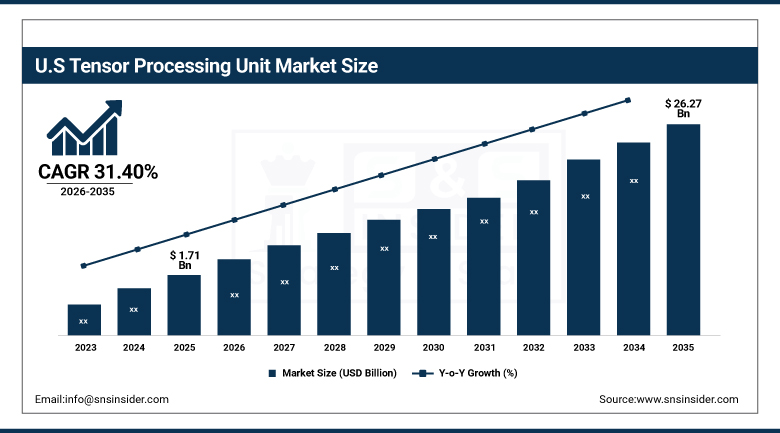
The U.S. Tensor Processing Unit Market was valued at approximately USD 1.71 Billion in 2025 and is expected to reach approximately USD 26.27 Billion by 2035, growing at a CAGR of approximately 31.40%.
The U.S. is the world’s most commercially significant TPU market within North America’s dominant revenue position. Google, NVIDIA, Intel, AMD, and AWS collectively define the global TPU technology frontier whose U.S. headquarters creates domestic commercial concentration. Google’s Cloud TPU service, AWS’ Trainium and Inferentia accelerator programme, and Microsoft’s Project Maia collectively create the most commercially sophisticated cloud TPU infrastructure of any national market. The U.S. AI research ecosystem’s extraordinary model development activity creates the world’s highest TPU training workload demand whose commercial scale sustains hyperscale TPU investment that creates competitive technological differentiation.
AWS launched Trainium2 in 2024, the second-generation custom machine learning accelerator chip providing up to 4x performance improvement over the original Trainium for large language model training workloads. Trainium2’s deployment in AWS’ UltraCluster configuration enables synchronous training across 100,000+ chips whose aggregate 65 exaflops of computational capacity creates training infrastructure competitive with Google’s TPU v5p pods for frontier AI model development, demonstrating the commercial commitment to custom AI accelerator investment that reduces AWS’ dependency on third-party GPU procurement.
Tensor Processing Unit Market Segment Analysis:
-
By Application, the artificial intelligence & machine learning segment dominated the tensor processing unit market with approximately 58% share in 2025, while the healthcare & medical imaging segment is the fastest growing.
-
By Deployment, the cloud segment dominated the tensor processing unit market with approximately 65% share in 2025, while the edge/on-device segment is the fastest growing.
-
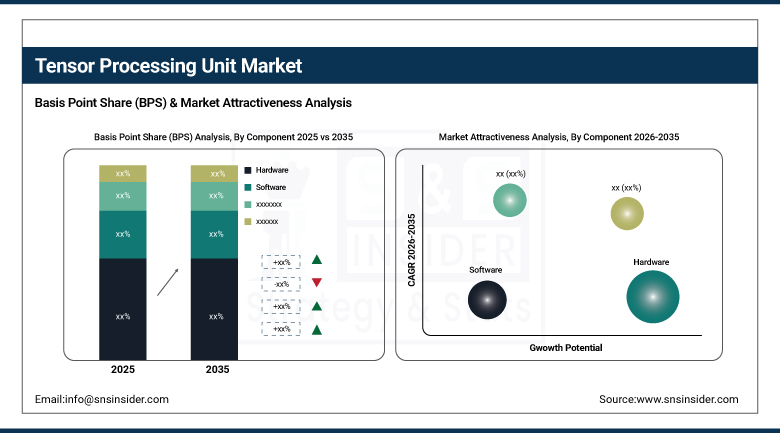
By Component, the hardware segment dominated the tensor processing unit market with approximately 72% share in 2025, while the software segment is the fastest growing.
-
By End User, the IT & cloud service providers segment dominated the tensor processing unit market with approximately 48% share in 2025, while the healthcare & life sciences segment is the fastest growing.
By Application, AI & ML dominates, healthcare grows fastest
AI and machine learning retained the dominant application position with approximately 58% of the TPU market in 2025. The AI application’s commercial primacy reflects the extraordinary and accelerating pace of large language model, multimodal foundation model, and generative AI development whose training and inference computational requirements create the most commercially urgent and highest-value TPU procurement. Each new frontier AI model that requires training on hundreds of billions of parameters creates TPU pod-scale infrastructure investment whose commercial scale compounds with the competitive AI race’s increasing model size and training compute demands.
Healthcare is the fastest-growing application because AI’s transformative potential in medical imaging diagnosis, drug discovery, clinical decision support, and genomic analysis is creating structured institutional procurement motivation whose measurable patient outcome improvement and research acceleration create sustained investment. Each radiology AI system that assists physician diagnosis creates hospital TPU inference deployment, and each pharmaceutical AI drug discovery programme that uses deep learning for protein structure prediction and molecular property estimation creates research TPU procurement.
By Deployment, cloud dominates, edge grows fastest
Cloud deployment retained the dominant position with approximately 65% of the TPU market in 2025. Cloud’s commercial primacy reflects the hyperscale infrastructure’s role as the primary environment for frontier model training whose computational scale requires synchronous parallelism across thousands of TPU chips that only pod-scale cloud infrastructure can provide. Google’s TPU v5p pod deployment at its data centres, AWS’ UltraCluster Trainium configuration, and Microsoft’s Maia deployment collectively create cloud TPU infrastructure whose commercial scale defines the market’s revenue character.
Edge and on-device TPU is the fastest-growing deployment because smartphone neural processing units, autonomous vehicle AI inference chips, and industrial edge AI deployment create volume TPU adoption whose unit count substantially exceeds data centre installations. Each new smartphone generation that integrates a dedicated neural processing unit for on-device AI inference creates consumer-scale TPU deployment. Apple’s Neural Engine, Qualcomm’s Hexagon NPU, and Google’s Edge TPU collectively demonstrate the commercial scale of on-device AI acceleration whose volume at billions of annual smartphone shipments creates commercial market scale that hyperscale cloud TPU cannot match by unit count.
By Component, hardware dominates, software grows fastest
Hardware retained the dominant component position with approximately 72% of the TPU market in 2025. TPU hardware’s commercial primacy reflects the physical chip and system procurement’s role as the primary commercial value in every TPU deployment. Each Google Cloud TPU v5p pod, each AWS Trainium2 UltraCluster, and each edge AI chip represents hardware investment whose per-unit commercial value at premium AI accelerator pricing creates the market’s revenue foundation. The extraordinary pace of TPU hardware generation advancement, whose each new generation improves performance per watt and computational efficiency by multiples over predecessors, creates upgrade procurement cycles that sustain hardware revenue growth above the already extraordinary market expansion rate.
Software is the fastest-growing component because AI framework optimization, TPU-specific compilation toolchains like XLA and TensorFlow, and the cloud AI service platform software that makes TPU computational capacity accessible through developer-friendly APIs create software procurement whose growth rate exceeds hardware as the installed TPU base creates increasing software service value. Each organisation that deploys TPU infrastructure creates software tooling procurement for model compilation, performance profiling, and distributed training orchestration whose value compounds with the infrastructure investment.
By End User, IT & cloud providers dominate, healthcare grows fastest
IT and cloud service providers retained the dominant end-user position with approximately 48% of the TPU market in 2025. Google, AWS, Microsoft Azure, and the enterprise cloud ecosystem’s AI infrastructure investment creates the most commercially concentrated TPU procurement category. Each hyperscale cloud provider’s AI infrastructure investment creates TPU deployment whose scale reflects the commercial AI service revenue whose magnitude justifies the extraordinary capital investment. Google’s reported multi-billion-dollar annual TPU chip procurement and AWS’s custom silicon investment programme collectively demonstrate the commercial commitment that sustains IT and cloud service providers’ dominant market position.
Healthcare and life sciences is the fastest-growing end user because the convergence of medical imaging AI, drug discovery AI, and clinical decision support creates multiple simultaneous above-average growth vectors within a single industry vertical. Each hospital radiology department that deploys AI-assisted diagnosis creates TPU inference procurement, and each pharmaceutical company that deploys AlphaFold-based or equivalent protein structure prediction creates research TPU procurement whose value compounds with drug discovery programme scale. The FDA’s growing approval pipeline for AI-enabled medical devices creates regulatory legitimization that sustains institutional healthcare AI investment.
Regional Analysis:
|
Region |
Major Country |
Share within Region, 2025 (%) |
|---|---|---|
|
North America |
United States |
87.4% |
|
Europe |
Germany |
22.3% |
|
Asia Pacific |
China |
44.8% |
|
Middle East & Africa |
UAE |
38.4% |
|
Latin America |
Brazil |
44.2% |
North America Tensor Processing Unit Market Insights
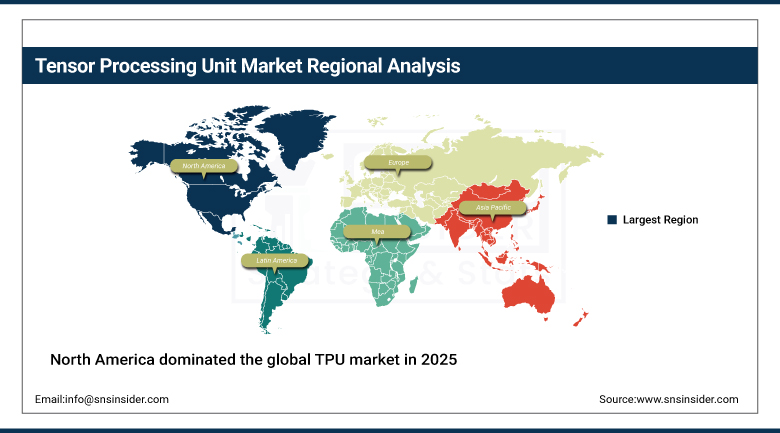
North America dominated the global TPU market in 2025 with the highest AI infrastructure investment and most commercially advanced AI research ecosystem. The United States accounts for approximately 87.4% of North American revenues through Google, NVIDIA, Intel, AMD, and AWS’ commercial dominance whose combined portfolio creates the global TPU technology standard. The extraordinary U.S. AI investment cycle, whose venture capital and corporate R&D creates the world’s highest concentration of frontier AI model development, sustains TPU procurement that compounds with model complexity growth.
Canada contributes approximately 12.6% of North American revenues through its growing AI research community, the technology sector’s cloud AI adoption, and international AI research institute networks whose compute infrastructure creates consistent TPU procurement.
Get Customized Report as per Your Business Requirement - Enquiry Now
Europe Tensor Processing Unit Market Insights
Europe is a technically sophisticated TPU market where European AI research excellence, GDPR’s data sovereignty creating on-premise AI infrastructure motivation, and the industrial sector’s AI adoption create structured institutional demand. Germany accounts for approximately 22.3% of European revenues through its automotive industry’s autonomous driving AI programme, the industrial manufacturing sector’s AI quality control adoption, and SAP and Siemens’ enterprise AI investment.
The United Kingdom, France, and the Netherlands are significant secondary markets where national AI research centers, financial services AI adoption, and the pharmaceutical industry’s drug discovery AI programme create consistent TPU procurement.
Asia Pacific Tensor Processing Unit Market Insights
Asia Pacific is the fastest-growing regional TPU market, driven by China’s extraordinary AI investment programme, Baidu’s, Alibaba’s, and Huawei’s domestic AI accelerator development, Japan’s industrial AI adoption, and South Korea’s Samsung and SK Hynix’s AI semiconductor investment. China accounts for approximately 44.8% of Asia Pacific revenues through its national AI strategy’s domestic accelerator development, the domestic cloud provider’s AI infrastructure investment, and the manufacturing sector’s industrial AI adoption creating edge TPU deployment.
South Korea’s Samsung and SK Hynix’s HBM memory for AI accelerators, Japan’s SoftBank’s ARM-based AI chip investment, and India’s rapidly growing technology sector’s cloud AI adoption create significant secondary markets whose combined procurement reinforces Asia Pacific’s fastest-growing regional status.
MEA & Latin America Tensor Processing Unit Market Insights
UAE leads MEA revenues at approximately 38.4% through its extraordinary AI infrastructure investment programme, G42’s AI research and deployment, and the government’s AI strategy creating structured public sector TPU procurement. Brazil leads Latin American revenues at approximately 44.2% through its technology sector’s cloud AI adoption, the financial services industry’s AI fraud detection, and the growing research community’s AI model development creating cloud TPU consumption.
Saudi Arabia’s NEOM and Vision 2030’s AI investment programme creates significant MEA secondary market procurement whose scale reflects the extraordinary government commitment to AI-driven economic transformation.
Market Dynamics:
Growth Drivers: Generative AI foundation model training demand and cloud AI service democratization
Generative AI’s extraordinary commercial adoption is the TPU market’s most commercially transformative growth driver. Each new frontier foundation model requiring training on trillions of tokens across hundreds of billions of parameters creates computational demand that only pod-scale TPU and GPU infrastructure can satisfy. The competitive AI race among Google, Anthropic, OpenAI, Meta, and emerging frontier model developers creates training compute demand that grows exponentially with each model generation’s scale increase. Goldman Sachs’ estimate that AI infrastructure investment will exceed USD 1 trillion by 2030 creates commercial motivation for TPU capacity investment whose scale sustains extraordinary market growth.
Cloud AI service democratization through API-based TPU consumption is creating commercial access for organisations whose AI workload requirements would not justify dedicated on-premise TPU capital investment. Each organization that accesses TPU-powered AI through Google Cloud, AWS, or Azure APIs creates cloud TPU consumption revenue whose aggregate across millions of API calls creates commercial scale. The AI-as-a-Service model’s progressive displacement of traditional software applications creates structural TPU consumption growth that compounds with digital transformation adoption.
Restraints: TPU supply chain concentration and energy consumption regulatory pressure
Advanced AI chip supply chain’s concentration at TSMC’s leading-edge semiconductor fabrication creates geopolitical procurement risk whose Taiwan concentration creates supply vulnerability. Each TSMC production disruption risk creates hyperscale cloud provider supply chain resilience investment motivation that sustains Intel Foundry Services and Samsung Foundry’s alternative production qualification despite higher cost, moderating the pace of TPU capacity expansion.
AI data center energy consumption’s extraordinary growth, creating grid-scale power demand that threatens power grid stability in major AI infrastructure regions, is creating regulatory scrutiny and sustainability pressure that moderates AI infrastructure investment pace. Each new data center power purchase agreement at gigawatt scale creates utility infrastructure investment requirement whose approval process creates deployment timeline extension that moderates TPU deployment velocity.
Opportunities: Custom silicon ecosystem and quantum-classical TPU hybrid architecture
Custom AI accelerator silicon development by verticals including automotive OEMs, healthcare technology companies, and financial services firms creates a new market segment beyond hyperscale cloud provider procurement. Each new custom TPU programme that an enterprise invests in creates silicon design, fabrication, and software toolchain procurement whose commercial scale grows with vertical AI capability development. Tesla’s Dojo AI training supercomputer, Apple’s Neural Engine, and ByteDance’s custom AI inference chip collectively demonstrate the commercial trajectory of vertical custom silicon.
Quantum-classical hybrid computing architecture integration represents the most commercially visionary TPU development direction whose quantum acceleration of specific tensor operations creates computational capability that purely classical TPU architecture cannot achieve. Each quantum computing advance that creates commercially viable quantum advantage in AI workload acceleration creates investment motivation that sustains long-term research procurement.
Recent Developments:
-
2024: Google launched TPU v5p in 2024, its most powerful Cloud TPU delivering up to 459 teraflops of BFloat16 performance, designed for large-scale foundation model training with pod-scale connectivity enabling synchronous training across thousands of chips for frontier AI model development.
-
2024: AWS launched Trainium2 in 2024, the second-generation custom machine learning accelerator providing up to 4x performance improvement over original Trainium for large language model training, deployable in UltraCluster configurations enabling 65 exaflops aggregate compute across 100,000+ chips.
-
2024: NVIDIA launched the Blackwell B200 GPU architecture in 2024 with enhanced tensor processing capability delivering up to 20 petaflops of AI performance per chip, establishing a new AI accelerator performance standard that TPU architecture must continuously compete against in cloud AI infrastructure procurement decisions.
Tensor Processing Unit Market Key Players:
-
Google LLC
-
NVIDIA Corporation
-
Intel Corporation
-
Advanced Micro Devices Inc.
-
Amazon Web Services Inc.
-
Microsoft Corporation
-
Qualcomm Technologies Inc.
-
Huawei Technologies Co., Ltd.
-
IBM Corporation
-
Arm Holdings PLC
-
Marvell Technology Inc.
-
Baidu Inc.
-
Alibaba Group
-
Synopsys Inc.
-
Micron Technology Inc.
-
Xilinx Inc./AMD
-
Samsung Electronics
-
Apple Inc.
-
Broadcom Inc.
-
Tesla, Inc.
Tensor Processing Unit Market Report Scope:
| Report Attributes | Details |
|---|---|
| Market Size in 2025 | USD 4.67 Billion |
| Market Size by 2035 | USD 71.88 Billion |
| CAGR | CAGR of 31.5% From 2026 to 2035 |
| Base Year | 2025 |
| Forecast Period | 2026-2035 |
| Historical Data | 2022-2024 |
| Report Scope & Coverage | Market Size, Segments Analysis, Competitive Landscape, Regional Analysis, DROC & SWOT Analysis, Forecast Outlook |
| Key Segments | • By Component (Hardware, Software, Services) • By Deployment (Cloud, Edge/On-Device, On-Premise) • By Application (Artificial Intelligence & Machine Learning, Natural Language Processing, Computer Vision, Autonomous Vehicles, Healthcare & Medical Imaging, Finance & Analytics, Others) • By End User (IT & Cloud Service Providers, Healthcare & Life Sciences, Automotive & Transportation, BFSI, Media & Entertainment, Retail & E-Commerce, Others) |
| Regional Analysis/Coverage | North America (US, Canada), Europe (Germany, UK, France, Italy, Spain, Russia, Poland, Rest of Europe), Asia Pacific (China, India, Japan, South Korea, Australia, ASEAN Countries, Rest of Asia Pacific), Middle East & Africa (UAE, Saudi Arabia, Qatar, South Africa, Rest of Middle East & Africa), Latin America (Brazil, Argentina, Mexico, Colombia, Rest of Latin America). |
| Company Profiles | Google LLC, NVIDIA Corporation, Intel Corporation, Advanced Micro Devices Inc., Amazon Web Services Inc., Microsoft Corporation, Qualcomm Technologies Inc., Huawei Technologies Co., Ltd., IBM Corporation, Arm Holdings PLC, Marvell Technology Inc., Baidu Inc., Alibaba Group, Synopsys Inc., Micron Technology Inc., Xilinx Inc./AMD, Samsung Electronics, Apple Inc., Broadcom Inc., Tesla, Inc. |
Frequently Asked Questions
The Tensor Processing Unit Market is expected to grow at a CAGR of 31.5% from 2026 to 2035.
The Tensor Processing Unit Market was valued at USD 4.67 Billion in 2025.
Rising demand for AI acceleration in deep learning and machine learning, with generative AI foundation model training creating extraordinary TPU procurement demand.
Artificial Intelligence & Machine Learning dominated the Tensor Processing Unit Market with approximately 58% share in 2025.
North America dominated the Tensor Processing Unit Market in 2025.
