
Terabit Optical Networking Market Report Scope & Overview:
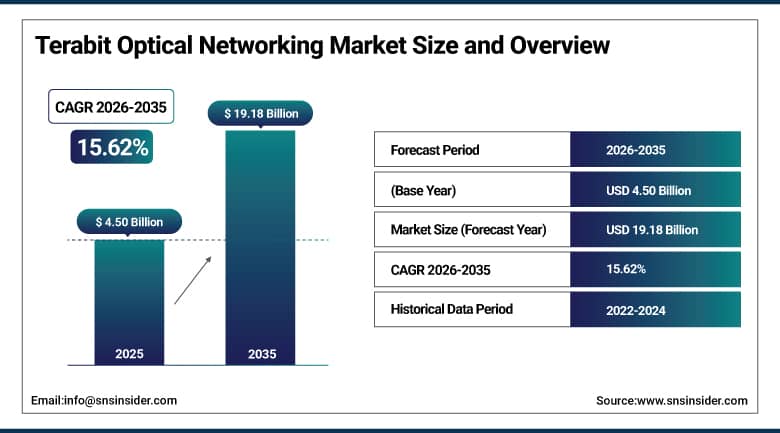
Terabit Optical Networking Market was valued at USD 4.50 Billion in 2025 and is expected to reach USD 19.18 Billion by 2035, growing at a CAGR of 15.62% from 2026–2035.
The terabit optical networking market is experiencing consistent growth due to increasing demand for ultra-high-capacity, low-latency, and reliable optical communication infrastructure. The expansion of cloud computing, hyperscale data centers, artificial intelligence, 5G networks, and high-performance computing is driving demand for terabit-scale network capacity. Investments in coherent optical systems, DWDM, OTN, coherent pluggable optics, and photonic integrated circuits are enhancing network capacity, efficiency, scalability, and power performance. Companies are focusing on higher data rates, transmission efficiency, network flexibility, and optical signal quality. Growing demand for high-bandwidth connectivity across data center interconnects, metro, regional, long-haul, and submarine networks is accelerating technological advancements. The adoption of 800G, 1.2T, 1.6T, and above-1.6T technologies, along with software-controlled and cloud-based architectures, is further supporting market growth.
In March 2026, OFC 2026 highlighted advances in 1.6T and 3.2T coherent transmission, optical I/O, co-packaged optics, and photonic integrated circuits to address the rapidly increasing bandwidth requirements of AI-era data centers and high-performance networks. The developments are expected to accelerate the deployment of next-generation terabit optical networking technologies globally by improving transmission capacity, network density, scalability, and energy efficiency.
To Get More Information On Terabit Optical Networking Market - Request Free Sample Report
Terabit Optical Networking Market Trends
-
Growing demand for high-capacity optical communication is driving the adoption of advanced terabit networking technologies to support increasing bandwidth requirements across modern networks.
-
Rising deployment of artificial intelligence, hyperscale data centers, cloud computing, and 5G infrastructure is increasing demand for high-speed optical connectivity and terabit-scale data transmission.
-
Increasing adoption of coherent optical technology, DWDM, OTN, coherent pluggable optics, and photonic integrated circuits is supporting the development of higher-capacity and more efficient optical networks.
-
Growing focus on improving transmission efficiency, network scalability, low latency, power efficiency, and optical signal quality is creating opportunities for terabit optical networking technology providers.
-
Advancements in optical components, coherent transmission, photonic integration, high-speed data rates, and software-controlled network architectures are improving network performance and supporting the adoption of terabit optical networking solutions.
The U.S. Terabit Optical Networking Market Outlook
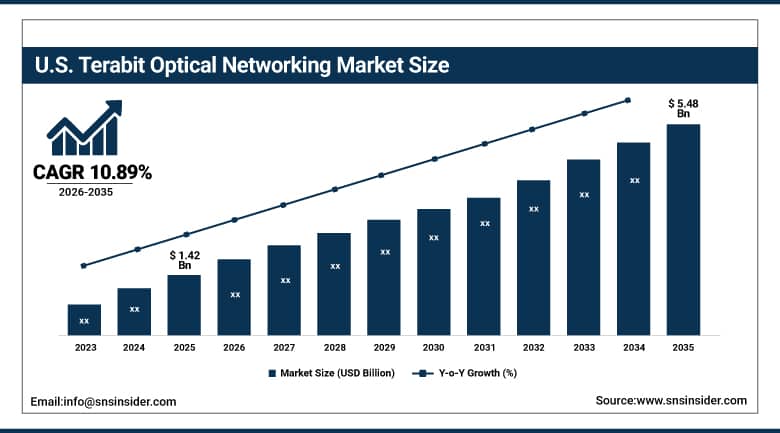
The U.S. Terabit Optical Networking Market was valued at USD 1.42 Billion in 2025 and is expected to reach around USD 5.48 Billion by 2035, growing at a CAGR of 10.89% from 2026–2035.
The U.S. terabit optical networking market is growing steadily due to rising demand for high-capacity, low-latency optical communication infrastructure. The expansion of artificial intelligence, hyperscale data centers, cloud computing, 5G networks, and high-performance computing is driving demand for terabit-scale data transmission. Investments in next-generation optical infrastructure and high-speed network upgrades are improving capacity, scalability, and efficiency. Growing hyperscale data centers, cloud services, telecom networks, and data center interconnect infrastructure are supporting market demand. Companies are focusing on coherent optical technology, DWDM, OTN, coherent pluggable optics, photonic integrated circuits, and higher data-rate solutions to enhance transmission efficiency and network flexibility. The adoption of 800G, 1.2T, 1.6T, and above-1.6T technologies is further supporting market growth in the U.S.
In March 2026, OFC 2026 in Los Angeles showcased next-generation optical networking technologies, including 800G and 1.6T validation platforms, 1.6T and 3.2T coherent transmission, optical I/O, and photonic integrated circuits for AI data centers. The developments are expected to support increasing U.S. demand for high-capacity optical connectivity as hyperscale data centers and AI infrastructure expand, strengthening adoption of terabit-scale networking solutions.
Terabit Optical Networking Market Segment Analysis
-
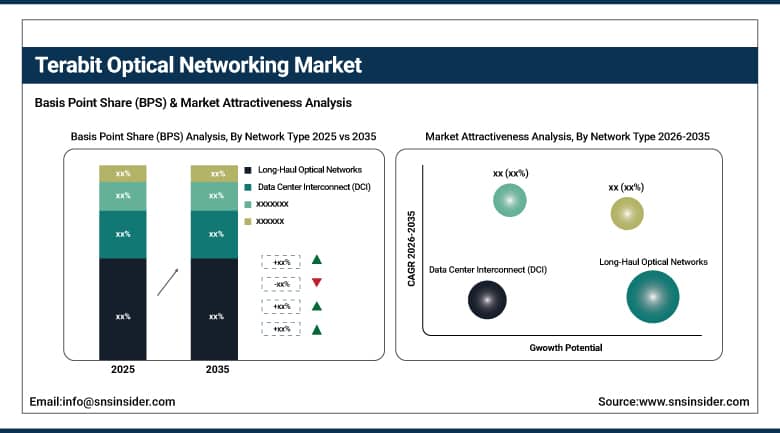
By Network type, long-haul optical networks dominated the terabit optical networking market with a 31.00% share in 2025, while data center interconnect (DCI) is projected to be the fastest-growing segment, registering a 22.28% CAGR during 2026–2035.
-
By technology, coherent optical technology dominated the terabit optical networking market with a 36.00% share in 2025, while coherent pluggable optics are projected to be the fastest-growing segment, registering a 21.70% CAGR during 2026–2035.
-
By Data Rate,800G dominated the terabit optical networking market with a 36.00% share in 2025, while above 1.6T is projected to be the fastest-growing segment, registering a 24.59% CAGR during 2026–2035.
-
By Component, optical transponders dominated the terabit optical networking market with a 30.00% share in 2025, while coherent pluggable modules are projected to be the fastest-growing segment, registering a 21.30% CAGR during 2026–2035.
-
By Application, telecom networks dominated the terabit optical networking market with a 32.00% share in 2025, while AI & high-performance computing infrastructure is projected to be the fastest-growing segment, registering a 22.82% CAGR during 2026–2035.
-
By Deployment, on-premises dominated the terabit optical networking market with a 48.00% share in 2025, while cloud-based is projected to be the fastest-growing segment, registering the highest growth during 2026–2035.
By Network Type, long-haul optical networks dominated the terabit optical networking market, while data center interconnect (DCI) is expected to grow fastest.
Long-haul optical networks accounted for the dominant share of the terabit optical networking market in 2025, driven by the increasing requirement for high-capacity and reliable transmission across geographically dispersed locations. Rising internet traffic, cloud services, 5G connectivity, and growing inter-regional data transmission are increasing the need for high-speed optical transport over long distances. Terabit-class optical technologies enable network operators to expand capacity while improving spectral efficiency and overall network performance.
Data Center Interconnect (DCI) is projected to exhibit the highest growth rate during 2026–2035. The rapid expansion of hyperscale and cloud data centers, increasing AI and machine learning workloads, and the development of distributed computing architectures are creating strong demand for high-bandwidth connections between data center facilities. The deployment of 800G, 1.6T, and emerging higher-speed optical technologies is expected to further strengthen DCI adoption and accelerate the transition toward terabit-class interconnectivity.
By Component, optical transponders dominated the terabit optical networking market, while coherent pluggable modules are expected to grow fastest.
Optical transponders held the leading position in the terabit optical networking market in 2025, supported by their critical role in converting and transmitting high-capacity optical signals across long-haul, metro, telecom, and data center networks. The increasing demand for higher transmission speeds, network capacity, and efficient optical transport is driving the deployment of advanced optical transponders. The transition toward 400G, 800G, and emerging terabit-class optical networking technologies is further supporting their adoption across modern communication infrastructure.
Coherent pluggable modules are anticipated to register the highest CAGR during the forecast period from 2026 to 2035. Their compact form factor, flexible deployment, lower power requirements, and ability to support high-speed coherent transmission are encouraging network operators and data center providers to adopt next-generation pluggable solutions. Growing AI workloads, hyperscale data center expansion, and increasing bandwidth requirements are expected to further accelerate demand for coherent pluggable modules.
By Application, telecom networks dominated the terabit optical networking market, while AI & high-performance computing infrastructure is expected to grow fastest.
Telecom networks held the dominant position in the terabit optical networking market in 2025, supported by the continuous expansion of broadband connectivity, 5G networks, cloud services, and high-capacity backbone infrastructure. Increasing data traffic and growing demand for faster, reliable, and scalable communication networks are driving telecom operators to upgrade optical infrastructure. The adoption of advanced coherent transmission, high-speed optical transport, and terabit-class networking technologies is further supporting market growth.
AI & High-Performance Computing Infrastructure is expected to register the highest CAGR during the forecast period from 2026 to 2035. The rapid growth of generative AI, machine learning, accelerated computing, and large-scale AI clusters is generating substantial demand for high-bandwidth, low-latency optical connectivity. Increasing deployment of AI data centers and high-performance computing systems is driving adoption of 800G, 1.6T, and higher-speed optical technologies, creating significant opportunities for terabit optical networking solutions.
Regional Analysis
|
Region |
Major Country |
Share within Region, 2025(%) |
|---|---|---|
|
North America |
United States |
81.75% |
|
Europe |
Germany |
34.30% |
|
Asia Pacific |
China |
48.54% |
|
Middle East & Africa |
Saudi Arabia |
23.50% |
|
Latin America |
Brazil |
23.00% |
North America terabit optical networking market insights
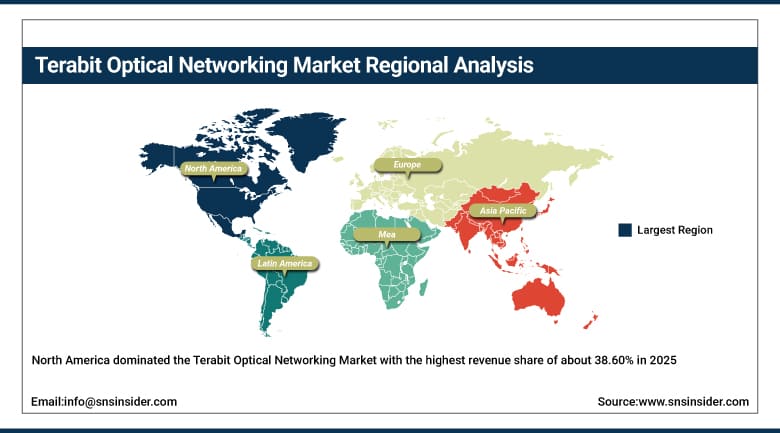
North America dominated the Terabit Optical Networking Market with the highest revenue share of about 38.60% in 2025, supported by its highly developed telecommunications infrastructure, extensive fiber-optic networks, and strong presence of hyperscale cloud and data center operators. The region has also been an early adopter of 5G, high-speed broadband, and advanced coherent optical technologies. Significant investments in artificial intelligence, cloud computing, data center interconnects, and high-performance computing are increasing requirements for high-capacity, low-latency optical connectivity. Furthermore, the presence of leading optical networking technology providers, strong research and development capabilities, and continuous network modernization by telecom operators are strengthening North America's market position.
Growing data traffic from streaming, enterprise applications, cloud services, and AI workloads is further encouraging operators to deploy 800G, 1.6T, and emerging terabit-class optical systems. These factors collectively support the region's leading revenue contribution and sustained demand for next-generation optical networking infrastructure.
Get Customized Report as Per Your Business Requirement - Enquiry Now
Europe terabit optical networking market insights
The terabit optical networking market in Europe is expected to witness steady growth over the forecast period, supported by the expansion of high-capacity fiber-optic networks, increasing cloud and data center connectivity, 5G deployment, and growing demand for faster and more reliable data transmission. Rising internet traffic, digital transformation, and investments in next-generation optical transport infrastructure are encouraging network operators to upgrade existing systems. Increasing adoption of 800G, 1.6T, and emerging terabit-class optical technologies is further supporting regional demand for advanced coherent transmission, optical transponders, and high-speed networking solutions
Germany is anticipated to remain one of the key national markets in Europe, driven by its strong telecommunications infrastructure, expanding data center ecosystem, industrial digitalization, and increasing demand for high-bandwidth connectivity. Investments in cloud computing, 5G infrastructure, enterprise networking, and AI-enabled computing are encouraging the deployment of advanced optical networking technologies. In addition, countries such as the UK, France, Italy, and the Netherlands are contributing to regional demand through investments in fiber networks, hyperscale data centers, cloud infrastructure, and high-capacity optical connectivity.
Asia Pacific terabit optical networking market insights
Asia Pacific is expected to grow at the fastest CAGR of about 18.56% from 2026–2035, driven by rapid digital transformation, expanding telecommunications infrastructure, and accelerating deployment of 5G and advanced broadband networks. Countries including China, Japan, South Korea, India, Singapore, and other Southeast Asian economies are investing substantially in hyperscale and edge data centers to accommodate rapidly increasing internet traffic and cloud-based services. The expansion of AI, machine learning, high-performance computing, and digital platforms is creating substantial demand for high-bandwidth and low-latency connectivity between data centers and network nodes. In addition, increasing smartphone penetration, e-commerce activity, video streaming, and enterprise cloud adoption are generating significant growth in regional data traffic. Governments and telecommunications companies are also investing in fiber-optic backbone networks and next-generation optical transport infrastructure to improve connectivity and network capacity.
The increasing adoption of 400G, 800G, 1.6T, and higher-speed optical technologies is expected to accelerate modernization across the region. Growing data center interconnect requirements and expanding cross-border digital infrastructure will further support Asia Pacific's rapid market growth through 2035.
Middle East & Africa and Latin America terabit optical networking market insights
The terabit optical networking market in the Middle East & Africa and Latin America is expected to witness consistent growth from 2026 to 2035, supported by expanding telecommunications infrastructure, increasing data traffic, 5G deployment, cloud adoption, and investments in high-capacity fiber-optic networks. Growing digital transformation initiatives and the development of data centers are creating demand for advanced optical transport, high-speed connectivity, and next-generation terabit networking technologies. Increasing investments in broadband infrastructure and modernization of existing communication networks are further supporting opportunities for coherent optical systems, optical transponders, and high-capacity network solutions.
Saudi Arabia is expected to remain an important market in the Middle East & Africa, supported by substantial investments in digital infrastructure, 5G networks, cloud computing, data centers, and national digital transformation initiatives. The country's economic diversification programs are also encouraging the development of advanced communication infrastructure and high-speed connectivity. In Latin America, Brazil is anticipated to remain a key country-level market due to its large telecommunications sector, expanding fiber-optic networks, growing cloud and data center infrastructure, and increasing demand for high-bandwidth connectivity. Other Latin American countries are also expected to contribute to regional growth through investments in broadband expansion, 5G deployment, cloud services, and modernization of optical communication networks.
Market Dynamics
Growth Driver: Increasing demand for high-capacity and low-latency optical connectivity is driving market growth
One of the key factors driving the growth of the global terabit optical networking market is the rapid increase in data traffic across telecom networks, cloud platforms, hyperscale data centers, and AI infrastructure. The expansion of generative AI, machine learning, cloud computing, 5G services, video streaming, and high-performance computing is creating substantial demand for faster and higher-capacity network connections. As conventional network infrastructure faces increasing bandwidth requirements, operators and data center providers are adopting advanced optical technologies capable of supporting 400G, 800G, 1.6T, and emerging terabit-class transmission speeds.
In addition, advancements in coherent optical technology, coherent pluggable modules, optical transponders, photonic integrated circuits, and optical line systems are improving transmission capacity, spectral efficiency, and network flexibility. Increasing investments in fiber-optic infrastructure, data center interconnects, and next-generation backbone networks are further encouraging the deployment of terabit optical networking solutions.
Restraint: High deployment costs and technological complexity can limit market adoption
The high cost and technical complexity associated with deploying terabit optical networking infrastructure can restrict market adoption, particularly among smaller network operators and enterprises. Advanced optical transponders, coherent pluggable modules, optical switches, amplifiers, and line systems require significant capital investment and specialized network infrastructure. Upgrading existing networks to support 800G, 1.6T, and higher transmission rates may also require substantial changes to optical equipment, fiber infrastructure, network management systems, and supporting technologies.
Moreover, managing high-speed optical networks requires specialized technical expertise and sophisticated monitoring and control capabilities. Compatibility challenges between equipment from different vendors, evolving standards, power consumption considerations, and the need for continuous network upgrades can further increase deployment complexity. These factors may delay modernization projects and limit adoption in cost-sensitive markets.
Opportunity: Rapid expansion of AI infrastructure and hyperscale data centers creates new market opportunities
The rapid expansion of AI and high-performance computing infrastructure presents significant opportunities for terabit optical networking solution providers. Increasing deployment of AI clusters, accelerated computing systems, and hyperscale data centers is generating substantial demand for high-bandwidth, low-latency connectivity within and between data center facilities. As AI workloads require faster movement of large datasets, advanced optical networking technologies are becoming increasingly important for supporting scalable computing architectures.
Furthermore, the growing adoption of 800G, 1.6T, and future higher-speed optical technologies creates opportunities for manufacturers of coherent pluggable modules, optical transponders, optical switches, and photonic integrated circuits. Expansion of cloud services, 5G networks, edge computing, and data center interconnect infrastructure is expected to further increase demand. Investments in next-generation fiber-optic networks and modernization of telecom backbones across emerging markets will also create additional opportunities for terabit optical networking technologies through 2035.
Recent Developments
-
2026: Ciena Corporation continued advancing high-capacity optical networking solutions, supporting 800G, 1.6T, and next-generation terabit connectivity for telecom networks, cloud platforms, and data centers.
-
2026: Nokia Corporation continued expanding its next-generation optical networking portfolio, including high-capacity coherent and pluggable optics, to support growing bandwidth requirements across telecom and data center networks.
-
2026: Huawei Technologies Co., Ltd. continued developing advanced optical transport and high-speed coherent networking solutions to address increasing bandwidth demand from cloud computing, 5G, and data center infrastructure.
-
2026: Cisco Systems, Inc. continued strengthening its high-speed optical networking portfolio, supporting data center interconnect, AI infrastructure, cloud networking, and next-generation network connectivity.
-
2026: Coherent Corp. continued advancing high-speed optical components and coherent optical technologies, supporting the development of 800G, 1.6T, and emerging higher-speed optical networking solutions.
Terabit Optical Networking Market key players are:
-
Ciena Corporation
-
Nokia Corporation
-
Cisco Systems, Inc.
-
Huawei Technologies Co., Ltd.
-
ZTE Corporation
-
Fujitsu Limited
-
Infinera Corporation
-
Coherent Corp.
-
Lumentum Holdings Inc.
-
Juniper Networks, Inc.
-
ADTRAN, Inc.
-
Ribbon Communications Inc.
-
NEC Corporation
-
Ericsson
-
Arista Networks, Inc.
-
Broadcom Inc.
-
Marvell Technology, Inc.
-
Corning Incorporated
-
Ekinops S.A.
-
FiberHome Technologies Group.
Terabit Optical Networking Market Report Scope:
| Report Attributes | Details |
|---|---|
| Market Size in 2025 | USD 4.50 Billion |
| Market Size by 2035 | USD 19.18 Billion |
| CAGR | CAGR of 15.62% From 2026 to 2035 |
| Base Year | 2025 |
| Forecast Period | 2026-2035 |
| Historical Data | 2022-2024 |
| Report Scope & Coverage | Market Size, Segments Analysis, Competitive Landscape, Regional Analysis, DROC & SWOT Analysis, Forecast Outlook |
| Key Segments | • By Technology (Coherent Optical Technology, Dense Wavelength Division Multiplexing (DWDM), Optical Transport Network (OTN), Coherent Pluggable Optics, Photonic Integrated Circuits, Other Technologies) • By Network Type (Data Center Interconnect (DCI), Metro Optical Networks, Regional Optical Networks, Long-Haul Optical Networks, Submarine Optical Networks, Other Networks) • By Data Rate (400G, 800G, 1.2T, 1.6T, Above 1.6T, Other Data Rates) • By Component (Optical Transponders, Coherent Pluggable Modules, Optical Switches, Optical Line Systems, Optical Amplifiers, Network Management & Control Software) • By Application (Telecom Networks, Cloud & Hyperscale Data Centers, Internet Service Provider Networks, Enterprise Networks, 5G Networks, AI & High-Performance Computing Infrastructure) • By Deployment (On-Premises, Cloud-Based, Hybrid) |
| Regional Analysis/Coverage | North America (US, Canada), Europe (Germany, UK, France, Italy, Spain, Russia, Poland, Rest of Europe), Asia Pacific (China, India, Japan, South Korea, Australia, ASEAN Countries, Rest of Asia Pacific), Middle East & Africa (UAE, Saudi Arabia, Qatar, South Africa, Rest of Middle East & Africa), Latin America (Brazil, Argentina, Mexico, Colombia, Rest of Latin America) |
| Company Profiles | Ciena Corporation, Nokia Corporation, Cisco Systems, Inc., Huawei Technologies Co., Ltd., ZTE Corporation, Fujitsu Limited, Infinera Corporation, Coherent Corp., Lumentum Holdings Inc., Juniper Networks, Inc., ADTRAN, Inc., Ribbon Communications Inc., NEC Corporation, Ericsson, Arista Networks, Inc., Broadcom Inc., Marvell Technology, Inc., Corning Incorporated, Ekinops S.A., FiberHome Technologies Group |

Frequently Asked Questions
Key players in the Terabit Optical Networking Market include Ciena Corporation, Nokia Corporation, Cisco Systems, Inc., Huawei Technologies Co., Ltd., ZTE Corporation, Coherent Corp., Lumentum Holdings Inc., and Infinera Corporation, among others.
Key opportunities in the Terabit Optical Networking Market include the expansion of AI and high-performance computing infrastructure, data center interconnects, cloud computing, 5G networks, and the adoption of 800G, 1.6T, and emerging higher-speed optical technologies.
The market is primarily driven by increasing data traffic, rapid cloud and hyperscale data center expansion, growing AI workloads, 5G deployment, and the rising need for high-capacity, low-latency optical connectivity.
The Coherent Optical Technology segment dominated the Terabit Optical Networking Market, accounting for approximately 36.00% market share in 2025, supported by its high transmission capacity, long-distance performance, and spectral efficiency.
The North America region dominated the Terabit Optical Networking Market in 2025 with a 38.60% share, driven by advanced fiber-optic infrastructure, strong telecommunications networks, extensive hyperscale data center deployment, and significant investments in AI, cloud computing, 5G, and high-performance computing infrastructure.
