
Optical AI Accelerator Market Report Scope & Overview:
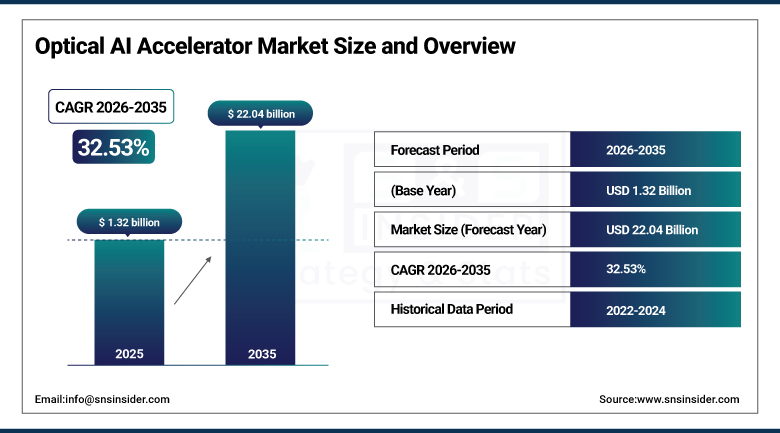
The Optical AI Accelerator Market was valued at USD 1.32 Billion in 2025 and is projected to reach USD 22.04 Billion by 2035, expanding at a CAGR of 32.53% during the forecast period 2026–2035.
The market for optical AI accelerator has witnessed a quick growth in commercial adoption because of the demand for an alternative to conventional electronic AI accelerators on account of limitations related to power consumption, temperature, and bandwidth. Optical AI accelerators make use of silicon photonics, photonic integrated circuit, and optical matrix computing technologies to perform AI computations with low latency and energy efficiency. The proliferation of large language models, multimodal AI, and trillion-parameter neural networks has intensified investments in photonic computing systems for the next generation of AI training and inference for cloud data centers and HPC applications.
Commercial adoption has been further aided by developments in co-packaged optics, photonic interconnects, optical neural processing, and heterogeneous AI accelerators. Investments made by hyperscaler, semiconductor firms, and photonics firms have accelerated the growth of the ecosystem, and innovations in packaging technologies, optical I/O, and AI software optimizations have enabled scalable commercialization. Light matter becomes a member of the NVIDIA's NVLink Fusion ecosystem in 2026 for faster deployment of photonic interconnects for AI infrastructure owing to increasing adoption of optical connectivity by hyperscaler.
To Get more information Optical AI Accelerator Market - Request Free Sample Report
Optical AI Accelerator Market Trends:
-
Increasing adoption of photonic computing for large-scale AI model training.
-
Growing deployment of co-packaged optics across hyperscale AI infrastructure.
-
Rising investment in optical interconnect technologies for AI clusters.
-
Expansion of silicon photonics-enabled accelerator architectures worldwide.
-
Increasing collaboration between semiconductor and photonic technology companies.
U.S. Optical AI Accelerator Market Size Outlook:
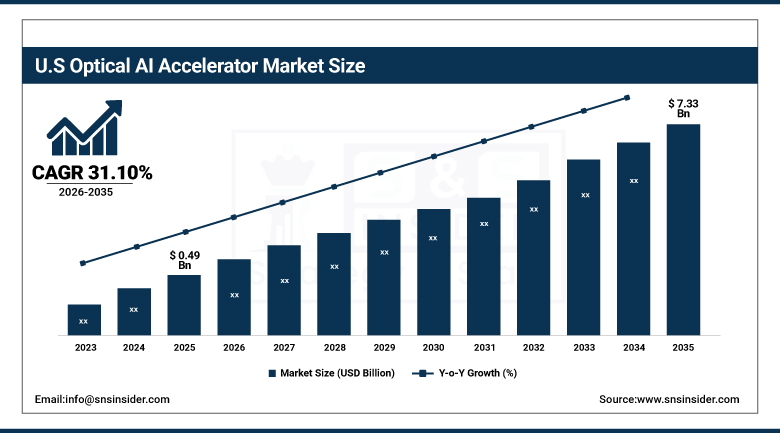
The U.S. Optical AI Accelerator Market was valued at USD 0.49 billion in 2025 and is expected to reach approximately USD 7.33 billion by 2035, expanding at a CAGR of 31.10% during 2026–2035.
The U.S. continues to be a key player in the optical AI accelerator market of North America owing to the availability of hyperscale cloud players, mature semiconductor industry, and investments in AI compute infrastructure. It is evident that technology companies are leveraging optical computing techniques in order to address issues of memory bandwidth limitation and power consumption of AI clusters. Investments in AI fabs, advanced packaging, silicon photonics, and optical interconnects have paved the way for commercial success of photonic AI accelerators in cloud, defense, and scientific computing applications.
The country's position is further augmented by collaboration between semiconductor manufacturers, photonic firms, foundries, and research centers developing optical computing technology of the future. Efforts to build domestic semiconductor industry and infrastructure are contributing towards the commercialization of optical accelerator technologies. Lightmatter joined the NVLink Fusion ecosystem of NVIDIA in June 2026 to offer co-packaged and near-packaged optical connectivity for the AI infrastructure of the future.
Optical AI Accelerator Market Segment Analysis:
-
By Component, photonic processor chips & accelerator ASICs dominated the market with 42.00% share in 2025, while optical interconnect & photonic fabric components are projected to witness the fastest growth with 34.70% CAGR during the forecast period.
-
By Architecture, optical matrix-multiplication accelerators dominated the market with 37.00% share in 2025, while photonic interconnect-centric accelerators are projected to witness the fastest growth with 36.39% CAGR during the forecast period.
-
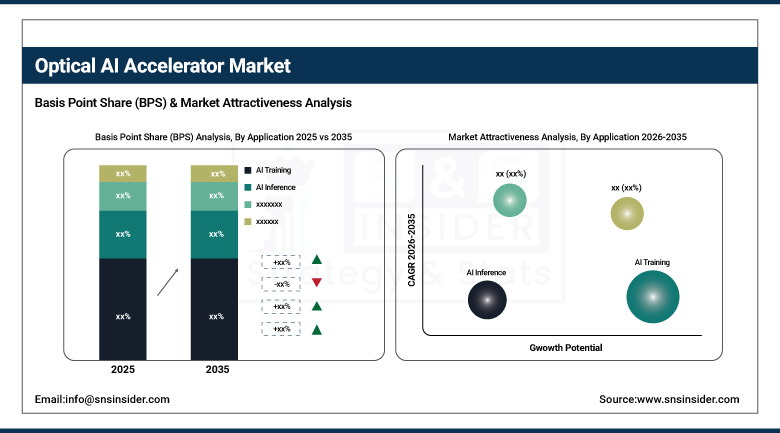
By Application, AI training dominated the market with 39.00% share in 2025, while high-performance & scientific computing is projected to witness the fastest growth with 35.36% CAGR during the forecast period.
-
By End User, hyperscalers & cloud service providers dominated the market with 43.00% share in 2025, while research institutions & supercomputing centers are projected to witness the fastest growth with 34.58% CAGR during the forecast period.
By Application, AI training dominated, while high-performance & scientific computing grows fastest.
The AI training application segment is expected to generate the highest revenue market share of 39.00%, based on factors like the rapid proliferation of foundation models, LLMs, multimodal AI, and generative AI. The AI training processes necessitate extremely high computational throughput capacity, memory bandwidth capability, and interconnectivity, thus making optical AI accelerators very appealing for hyperscale cloud providers. Photonic computing architectures have proven to help greatly lower latency and power consumption while also offering parallel matrix computing capabilities that are very useful for deep learning processes. The launch of NVIDIA Blackwell Ultra AI platform offering next-gen AI infrastructure in March 2026 will increase demand for advanced optical connectivity solutions.
The high-performance & scientific computing application is expected to witness the highest CAGR of 35.36% during 2026-2035. Scientific simulation, climate modeling, genomics, quantum research, defense analysis, and exascale computing increasingly demand energy-efficient architecture that will be capable of processing large amounts of data and consuming minimum power in the process. Optical AI accelerators offer major benefits in this regard due to their ability to provide fast matrix computation, scalable optical networking, and low latency distributed computing. Government investments in scientific computing infrastructure are further helping the cause. In 2025, several exascale computing projects supported by the U.S. Department of Energy have been utilizing advanced AI hardware and photonic networking.
By Component, photonic processor chips & accelerator ASICs dominated the market, while optical interconnect & photonic fabric components grows fastest.
Photonic processor chips & accelerator ASICs held the largest share of the optical ai accelerator market at 42.00% in 2025 and became one of the biggest revenue generating components within the industry. Their popularity is explained by the growing trend of employing silicon photonic processors capable of performing matrix multiplication and neural network computations using much less energy than traditional electronic processors. Cloud hyperscalers and artificial intelligence semiconductor suppliers continue to develop optical accelerators with the aim of optimizing computing density, minimizing thermal issues, and achieving better throughput within generative AI training clusters. The development of new photonic integration, wafer-scale manufacturing, and heterogeneous chip packaging solutions continues to increase commercial acceptance in AI infrastructure.
The fastest CAGR of 34.70% is estimated for optical interconnect & photonic fabric components over the period from 2026 to 2035. Large GPU clusters, AI supercomputing applications, and rack-scale computing architecture result in a growing need for ultra-high bandwidth optical communication technologies capable of replacing copper interconnects. Optical fabrics allow achieving lower latencies, better scalability, and increased energy efficiency, supporting distributed AI model training on thousands of processors. Ayar Labs was among the major market players which expanded commercialization of its optical I/O platform in 2025.
By Architecture, optical matrix-multiplication accelerators dominated, while photonic interconnect-centric accelerators grows fastest.
Optical matrix multiplication accelerators were the market leader, accounting for 37.00% of the total Optical AI Computing Hardware market share in 2025, attributed to their ability to carry out computationally complex linear algebraic calculations at the core of modern artificial intelligence algorithm designs. Matrix multiplication is the most computationally intensive task in any neural network training and inference, making the use of optical technology much more energy efficient compared to traditional electronics. Growing usage of transformers, foundation AI models, and large neural networks drives commercial adoption of photonic matrix computing platforms in hyperscale cloud computing and cutting-edge research facilities. Manufacturers are increasingly focusing on designing integrated photonic chips capable of carrying out highly efficient and fast analog optical calculations.
Photonic interconnect-centric accelerators are projected to have the highest growth rate of 36.39% during the forecast period. As distributed AI systems become more complex, industry attention has increasingly been on removing the communication bottleneck rather than just improving compute capabilities. Photonic interconnect-centric systems allow for ultra-low latency communication between GPUs, CPUs, memory, and accelerator clusters and also reduce the amount of energy consumed by the communication process within the system. These benefits are becoming even more significant as AI hyperscale clusters keep growing larger. In 2025, Broadcom launched new generation co-packaged optics technology for AI networking capacity and power efficiency purposes.
Regional Analysis:
|
Region |
Major Country |
Share within Region, 2025 (%) |
|---|---|---|
|
North America |
United States |
95.00% |
|
Europe |
Germany |
26.00% |
|
Asia Pacific |
China |
27.00% |
|
Middle East & Africa |
UAE |
4.00% |
|
Latin America |
Brazil |
4.00% |
North America Optical AI Accelerator Market Insights
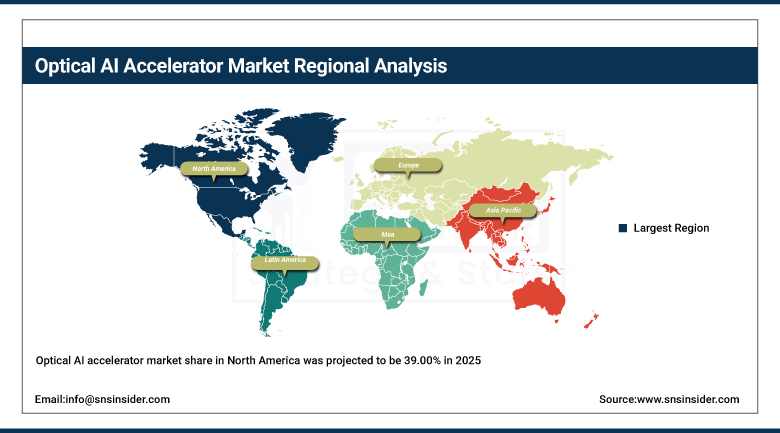
The optical AI accelerator market share in North America was projected to be 39.00% in 2025. The region continued its dominance owing to the presence of hyperscale cloud operators, advanced semiconductor companies, and substantial AI infrastructure investment. The region has established itself as the primary commercial center for the adoption of photonic computing technology as corporations look for an alternative approach to traditional electronic accelerators for large scale training and inference of AI models. Investments in silicon photonics, optical networking, advanced semiconductor packaging and AI supercomputing capabilities have led to a rapid deployment of optical AI accelerators in cloud computing, defense, scientific research, and enterprise AI.
The region is known for its established innovation ecosystem of leading chip makers, photonics firms, labs and semiconductor companies that are government sponsored. In June 2026, Light matter joined NVIDIA’s NVLink Fusion ecosystem to adopt photonic interconnect technologies in the next generation AI infrastructure, enabling high bandwidth and low power consumption in hyperscale data centers.
Get Customized Report as per Your Business Requirement - Enquiry Now
Europe Optical AI Accelerator Market Insights
The market for optical accelerators for AI remains a highly significant one for Europe on account of its extensive capabilities in semiconductors research and development, increasing spending on high-performance computing, and emphasis on digital sovereignty. Several countries, such as Germany, France, the UK, the Netherlands, and Switzerland, are spending heavily on developing the necessary infrastructure for AI, silicon photonics, and semiconductor innovation. The increased use of AI in areas like manufacturing, automotive engineering, health care, and science necessitates an energy-efficient architecture for computing with lowered operating costs. As part of its efforts in 2025 to implement the European Chips Act, the European Commission has been pushing forward on several fronts.
Asia Pacific Optical AI Accelerator Market Insights
The Asia-Pacific region is anticipated to witness the highest CAGR of 35.62% due to fast growth in AI infrastructure, semiconductor manufacturing, and hyperscale cloud deployment in China, Japan, South Korea, India, Taiwan, and Singapore. The governments and private players have been investing a lot of money into the manufacturing of semiconductors, AI computer centers, and photonics research in order to ensure competitiveness of the region. Growing popularity of generative AI, industrial automation, and intelligent manufacturing is driving high demands for optical AI accelerators that provide higher efficiency and lower power consumption. In 2025, Japan continued promoting next-generation photonics and AI semiconductors through its national technology initiatives to enhance its computing capabilities and reduce dependency on imported semiconductor technologies.
Middle East & Africa and Latin America Optical AI Accelerator Market Insights
Market expansion is seen in the Middle East and Africa due to increased government investments in artificial intelligence, smart cities, digital infrastructure, and national data center projects. Countries like the UAE, Saudi Arabia, and South Africa have been investing in cloud infrastructure and computing facilities powered by AI to diversify their digital economies. The increasing demand for AI sovereignty, research computing, and digital transformation is likely to provide long-term opportunities for optical AI accelerator adoption in the region. In addition, the region’s adoption will be boosted by the increasing partnerships between the region and global technology companies setting up hyperscale cloud regions and AI innovation centers in the region.
The market in Latin America continues growing steadily as a result of increasing cloud adoption, AI implementations, and data center investments in countries such as Brazil, Mexico, Chile, and Colombia. Companies are increasingly implementing AI-powered analytics, industrial automation, and cloud computing technologies that need advanced computing infrastructures. Digital transformation initiatives along with the increasing availability of hyperscale cloud services will lead to increased commercial adoption of optical AI accelerators in the region. In 2025, Microsoft increased its investments in AI and cloud computing infrastructure in Latin America.
Market Dynamics:
Growth Drivers: Accelerated development of hyperscale AI infrastructure and need for energy-efficient computing.
The accelerated deployment of generative AI, foundation models, and trillion parameter large language models has spurred the need for higher-performance computing architectures that can offer greater compute throughput with less energy consumption. Traditional electronic AI accelerators are becoming more and more limited in terms of memory bandwidth, thermal dissipation, and power efficiency, compelling hyperscale cloud operators to consider optical AI accelerators as a future-proof option. Continued growth in investments in AI factories, packaging, and photonic chip production will keep driving commercial adoption of such technologies. In June 2026, Lightmatter joined NVIDIA's NVLink Fusion platform, allowing for the implementation of advanced photonic interconnects in future AI infrastructure.
Restraints: Excessive commercialization costs and manufacturing complexity of photonic computing devices.
While there have been many advances in technology in recent years, the commercialization of optical computing accelerators is still restricted due to high cost of development, complex manufacturing processes and insufficient availability of advanced photonic manufacturing ecosystems. The manufacturing of integrated photonic circuits’ demands special semiconductor manufacturing facilities, advanced packaging techniques and optical assembly processes that are much more costly than electronic chip manufacturing. There are also issues with the integration of optics into electronic computing platform, supply chain issues with advanced photonic components and the lack of specific engineering expertise. In 2025, some of the major silicon photonics developers noted their intentions to invest in manufacturing and packaging advancements to enable better scaling and commercialization of optical computing devices.
Opportunities: Increasing use of optical interconnects and co-packaged optics within AI data centers.
Increasing adoption of hyperscale AI clusters has created significant business opportunities for optical AI accelerator manufacturers as conventional copper interconnects reach their bandwidth and power capacity limits. Optical interconnects, optical I/O, and photonic fabric have the capability of enabling significantly higher bandwidth with lower latency, energy requirements, and cooling needs. Growing demand for rack-scale computer systems, distributed AI computing, and exascale computer systems will fuel growing demand for optical accelerators within the forecast period. Further opportunities will be created through semiconductor industry programs, and collaboration between the semiconductor, cloud services, and photonics industries. As early as 2025, Broadcom came up with new co-packaged optics technology to facilitate the creation of AI networking infrastructures with greater bandwidth and energy efficiency.
Recent Developments:
-
2026: Lightmatter joined NVIDIA's NVLink Fusion ecosystem, enabling integration of photonic interconnect technologies into next-generation AI infrastructure to improve bandwidth efficiency, scalability, and energy performance for hyperscale AI data centers.
-
2026: NVIDIA introduced its Blackwell Ultra AI platform, featuring enhanced AI computing capabilities and next-generation networking technologies designed to support increasingly demanding AI training and inference workloads across hyperscale infrastructure.
-
2025: Ayar Labs expanded commercialization of its optical I/O technology through strategic collaborations aimed at improving chip-to-chip communication efficiency, reducing power consumption, and accelerating deployment of optical connectivity across AI and high-performance computing systems.
-
2025: Broadcom advanced its co-packaged optics portfolio to address increasing AI networking bandwidth requirements, supporting higher-performance optical connectivity and improved power efficiency for next-generation hyperscale AI data center infrastructure.
Optical AI Accelerator Market Key Players are:
-
NVIDIA Corporation
-
Lightmatter, Inc.
-
Celestial AI, Inc.
-
Ayar Labs, Inc.
-
Lightelligence Inc.
-
Intel Corporation
-
Lumentum Holdings Inc.
-
Coherent Corp.
-
Ranovus Inc.
-
HyperLight Corporation
-
OpenLight Photonics, Inc.
-
POET Technologies Inc.
-
TSMC
-
GlobalFoundries Inc.
-
Q.ANT GmbH
-
Salience Labs
-
Rockley Photonics Holdings Limited
-
Nokia Corporation
-
Xanadu Quantum Technologies Inc.
-
Lightium
Optical AI Accelerator Market Report Scope:
| Report Attributes | Details |
|---|---|
| Market Size in 2025 | USD 1.32 Billion |
| Market Size by 2035 | USD 22.04 Billion |
| CAGR | CAGR of 32.53% From 2026 to 2035 |
| Base Year | 2025 |
| Forecast Period | 2026-2035 |
| Historical Data | 2022-2024 |
| Report Scope & Coverage | Market Size, Segments Analysis, Competitive Landscape, Regional Analysis, DROC & SWOT Analysis, Forecast Outlook |
| Key Segments | • By Component (Photonic Processor Chips & Accelerator ASICs, Accelerator Cards, Servers & Integrated Systems, Optical Interconnect & Photonic Fabric Components, Software, Compilers, SDKs & Integration Services) • By Architecture (Optical Matrix-Multiplication Accelerators, Hybrid Optoelectronic Accelerators, Photonic Interconnect-Centric Accelerators, Optical Neural Processing Units, Others) • By Application (AI Training, AI Inference, High-Performance & Scientific Computing, Edge AI & Real-Time Analytics, Others) • By End User (Hyperscalers & Cloud Service Providers, Research Institutions & Supercomputing Centers, AI Semiconductor & System Companies, Enterprises & Industrial Users, Others) |
| Regional Analysis/Coverage | North America (US, Canada), Europe (Germany, UK, France, Italy, Spain, Russia, Poland, Rest of Europe), Asia Pacific (China, India, Japan, South Korea, Australia, ASEAN Countries, Rest of Asia Pacific), Middle East & Africa (UAE, Saudi Arabia, Qatar, South Africa, Rest of Middle East & Africa), Latin America (Brazil, Argentina, Mexico, Colombia, Rest of Latin America). |
| Company Profiles | NVIDIA Corporation, Lightmatter, Inc., Celestial AI, Inc., Ayar Labs, Inc., Lightelligence Inc., Intel Corporation, Lumentum Holdings Inc., Coherent Corp., Ranovus Inc., HyperLight Corporation, OpenLight Photonics, Inc., POET Technologies Inc., TSMC, GlobalFoundries Inc., Q.ANT GmbH, Salience Labs, Rockley Photonics Holdings Limited, Nokia Corporation, Xanadu Quantum Technologies Inc., Lightium |
Frequently Asked Questions
The Optical AI Accelerator Market was valued at USD 1.32 Billion in 2025.
The market is projected to reach USD 22.04 Billion by 2035.
The Optical AI Accelerator Market is anticipated to expand at a CAGR of 32.53% during the forecast period.
North America dominated the global Optical AI Accelerator Market in 2025, accounting for 39.00% of total market revenue.
Photonic Processor Chips & Accelerator ASICs accounted for the largest market share of 42.00% in 2025.
