
Optical Switches Market Report Scope & Overview:
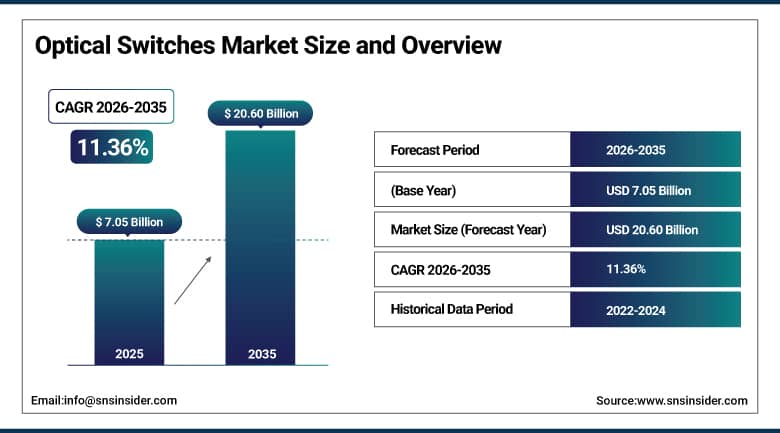
The global Optical Switches Market size was valued at USD 7.05 Billion in 2025 and is expected to reach USD 20.60 Billion by 2035, growing at a CAGR of 11.36% from 2026 to 2035.
The Optical Switches Market is witnessing growth due to the rapid adoption of high-speed optical communication networks along with increasing data traffic on the cloud computing platforms and growing demand for low latency data transmission solutions. Optical switches are becoming one of the essential building blocks for the next generation of telecom infrastructure, hyperscale data centres, 5G networks and optical transport systems. Moreover, the increasing adoption of software defined networking (SDN), network virtualization technologies, and fiber-optic communication systems are further driving the market. The long-term market is driven by increased investment in data centre modernisation, edge computing infrastructure, and advanced optical networking technologies.
iPronics Introduces ONE Series Solid-State Silicon Photonics Optical Circuit Switch Platform for Hyperscale Data Centres and AI-Driven Computing Infrastructure at OFC 2026 Enabling Faster Network Reconfiguration, Compact Deployment and Dynamic Layer-1 Topology Optimisation.
Market Size and Forecast
- Market Size in 2026E: USD 7.82 Billion
- Market Size by 2035: 20.60 Billion
- CAGR: 11.36% from 2026 to 2035
- Fastest Growing Region: Asia Pacific
- Largest Region: Asia Pacific
To Get More Information On Optical Switches Market - Request Free Sample Report
Optical Switches Market Trends
- Rising deployment of hyperscale data centers and AI infrastructure is increasing demand for optical switches that support high-speed, low-latency data transmission.
- Growing adoption of 5G networks and fiber-optic communication systems is accelerating the use of optical switching technologies for efficient traffic management.
- Increasing investments in data center modernization are driving integration of MEMS-based, electro-optic, and silicon photonics switching solutions.
- Expansion of edge computing and high-performance computing environments is creating strong demand for programmable and dynamically reconfigurable optical switches.
- Strategic collaborations among telecom operators, cloud providers, and networking vendors are supporting development of higher-capacity and energy-efficient optical switching platforms.
U.S. Optical Switches Market Size Outlook
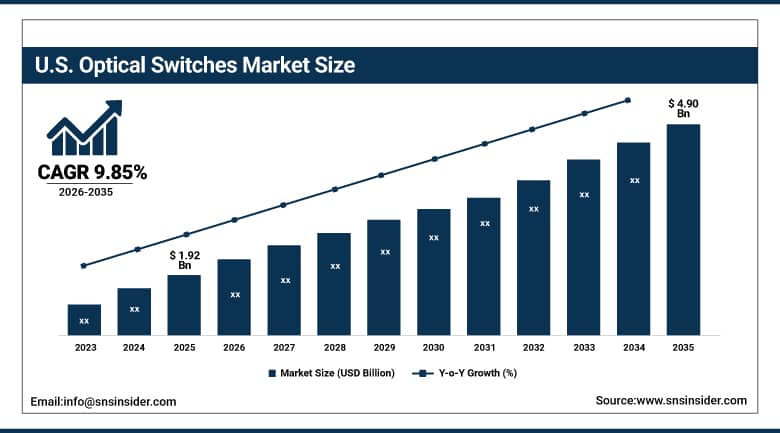
The U.S. Optical Switches Market was valued at USD 1.92 Billion in 2025 and is expected to reach USD 4.90 Billion by 2035, growing at a CAGR of 9.85% from 2026 to 2035.
The U.S. Optical Switches Market is expected to witness a strong growth due to the growing investments in hyperscale data centres, artificial intelligence infrastructure, cloud computing platforms and next generation telecommunications networks. It is well-endowed with a robust technology ecosystem, advanced semiconductor manufacturing capabilities and widespread deployment of high speed optical communications systems. The increasing need for low latency data transmission, software defined networking (SDN) and high performance computing environments is driving the adoption of optical switching technologies. Moreover, the U.S. market is witnessing an increase in the adoption of MEMS-based, electro-optic and silicon photonics optical switches due to the growth of 5G infrastructure, edge computing facilities and AI-driven networking architectures.
In 2026, NVIDIA announced its Quantum-X800 InfiniBand and Spectrum-X Ethernet photonics switches with co-packaged optics and silicon photonics ASICs, up to 409.6 Tbps bandwidth and significantly better power efficiency for AI data centres and enterprise networking infrastructure.
Optical Switches Market Segment Analysis
- By Switching Technology, MEMS-based Switching dominated the Optical Switches Market with a 32.80% share in 2025, while Electro-Optic Switching is the fastest-growing switching technology segment with a CAGR of 12.96% from 2026–2035.
- By Port Count, 1×4 dominated the Optical Switches Market with a 28.40% share in 2025, while 1×16 and Above is the fastest-growing port count segment with a CAGR of 14.47% from 2026–2035.
- By Application, Circuit Switching dominated the Optical Switches Market with a 26.40% share in 2025, while Cross-Connects is the fastest-growing application segment with a CAGR of 12.84% from 2026–2035.
- By End-User Industry, IT & Telecom dominated the Optical Switches Market with a 34.80% share in 2025, while Data Centers is the fastest-growing end-user industry segment with a CAGR of 14.43% from 2026–2035.
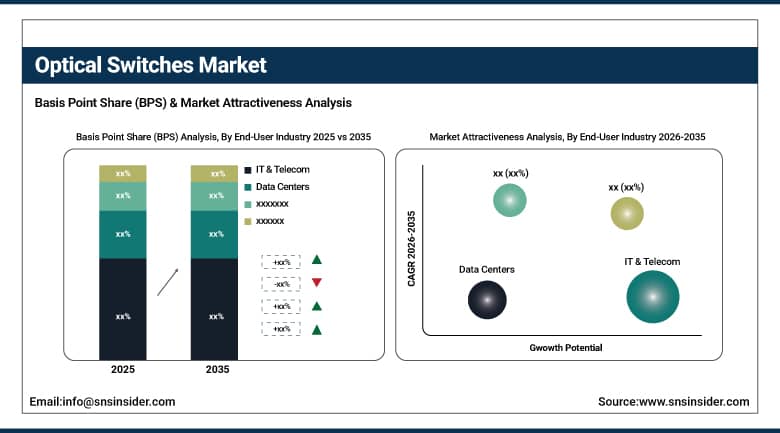
By End-User Industry, IT & Telecom dominated the Optical Switches Market, while Data Centers is expected to register the fastest CAGR during the forecast period 2026–2035.
The IT & Telecom segment dominated the Optical Switches Market with a revenue share of 34.80% in 2025. The growth of the segment can be attributed to the growing demand for high-speed communication networks, growing fiber-optic infrastructure, and rising internet traffic across the world. Optical switches are extensively used in telecom networks for signal routeing, network optimisation, protection switching and efficient bandwidth management. The growing adoption of 5G networks, broadband expansion and next-generation communication technologies is further supporting the deployment of optical switching solutions in the IT and telecom sector.
Data Centres segment is projected to grow at the fastest CAGR of 14.43% during the forecast period 2026-2035. The growth drivers are rising data generation, rapid adoption of cloud services, artificial intelligence applications and increasing demand for high-bandwidth data transmission. Optical switches provide better scalability and low latency for efficient network management in large scale data centre environments. Increasing investment in hyperscale data centres, edge computing infrastructure and AI-powered computing systems is expected to significantly boost the adoption of optical switching technologies.
By Switching Technology, MEMS-based Switching dominated the Optical Switches Market, while Electro-Optic Switching is expected to register the fastest CAGR during the forecast period 2026–2035.
The MEMS-based Switching segment dominated the Optical Switches Market with a revenue share of 32.80% in 2025. This section is dominant due to its high reliability, less power consumption, scalability and wide usage in the optical communication networks. MEMS-based optical switches offer low insertion loss and high switching accuracy for efficient signal routeing, and are suitable for telecommunications infrastructure, network monitoring systems and optical cross-connects. The increasing deployment of fiber-optic networks, rising bandwidth needs and the expansion of cloud-based services are pushing the adoption of MEMS optical switching technologies in the telecom and data communication environments.
Electro-Optic Switching segment is anticipated to register the fastest CAGR of 12.96% during 2026-2035 forecast period. The growth of this segment is driven by new demands for high-speed optical switching solutions, advances in photonic integrated circuits, and the increasing need for ultra-fast data transmission in next-generation networks. Fast electro-optic switches are compatible with advanced optical architectures, and for this reason they are being adopted in data centres, artificial intelligence infrastructure and high-performance computing applications.
By Port Count, 1×4 dominated the Optical Switches Market, while 1×16 and Above is expected to register the fastest CAGR during the forecast period 2026–2035.
The 1×4 segment dominated the Optical Switches Market with a revenue share of 28.40% in 2025. It continues to be the leader thanks to its balanced blend of performance, cost-effectiveness and its ability to adapt to different optical networking applications. 1x4 optical switches are widely used in telecommunications networks, fibre monitoring systems and optical signal management applications that require moderate switching capacity. The rising demand for reliable network connectivity and investments in fiber-optic infrastructure is driving the adoption of 1×4 configurations across a wide range of industries.
The 1×16 and Above segment is estimated to grow with the fastest CAGR of 14.47% during the forecast period 2026-2035. The fast growth is backed by increasing network complexity, growing data traffic and the increasing deployment of large-scale data centres. A greater number of ports in an optical switch allows for efficient handling of multiple optical channels and improves scalability and flexibility in advanced communication networks. The demand for high port count switching solutions is likely to accelerate due to cloud computing, AI workloads and the expansion of high capacity optical networks.
By Application, Circuit Switching dominated the Optical Switches Market, while Cross-Connects is expected to register the fastest CAGR during the forecast period 2026–2035.
The Circuit Switching segment dominated the Optical Switches Market with a revenue share of 26.40% in 2025. The segment’s prominence is attributed to the ongoing demand for efficient optical signal routeing and dependable communication infrastructure. Circuit switching applications allow dedicated optical paths for high-capacity networks that enable stable data transmission in telecom and enterprise environments. The adoption of circuit switching applications in communication systems is driven by increasing investments in optical network upgrades, growing fibre connectivity, and demand for improved network performance.
The Cross-Connects segment is expected to register the fastest CAGR of 12.84% during the forecast period 2026-2035. Growth is supported by growing demand for flexible optical network architectures, dynamic bandwidth allocation and automated network management. Optical cross-connect systems allow efficient switching of multiple optical channels, thus improving the scalability and operational efficiency of the network. The growth of cloud infrastructure, 5G networks and high-capacity data transmission systems is expected to create significant growth opportunities for optical switches used in cross-connect applications.
Regional Analysis
|
Region |
Major Country |
Share within Region, 2025 (%) |
|---|---|---|
|
North America |
United States |
84.12% |
|
Europe |
Germany |
28.40% |
|
Asia Pacific |
China |
36.90% |
|
Middle East & Africa |
UAE |
25.10% |
|
Latin America |
Brazil |
46.27% |
Asia Pacific Optical Switches Market Insights
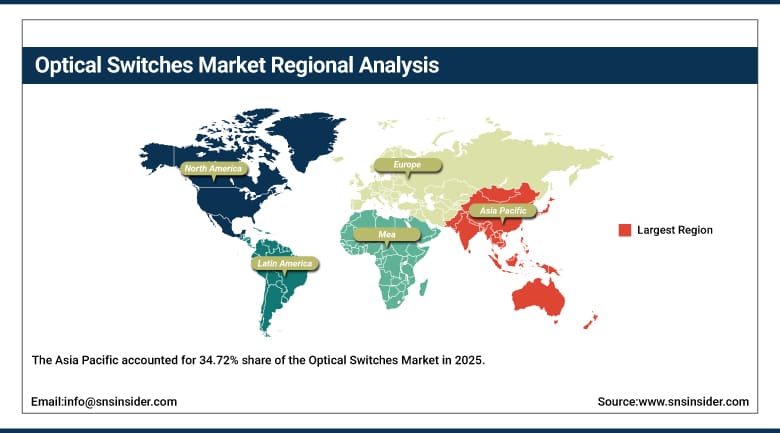
The Asia Pacific accounted for 34.72% share of the Optical Switches Market in 2025 and is projected to be the leading and fastest-growing regional market through the forecast period with a CAGR of 12.60%. Factors driving regional growth include the rapid pace of digitalization, rise in data centers, high internet penetration, and adoption of 5G technology, cloud computing, and artificial intelligence solutions. There is an active development of telecommunication infrastructure and fiber optics networks in various countries in the region in order to cope with increasing demand for data.
China is a major player within the Asia Pacific Optical Switches Market because of the country’s vast telecommunication infrastructure, developing data center infrastructure, and large investments in optical communication technologies. Rising deployment of optical switches in telecom networks, cloud infrastructure, and enterprises of China, Japan, South Korea, and India drives regional growth. The need for higher-capacity data transmission and effective optical signal processing is likely to boost regional growth further through the forecast period.
Get Customized Report as Per Your Business Requirement - Enquiry Now
North America Optical Switches Market Insights
The Optical Switches Market in North America experienced growth in 2025 due to the existence of well-developed telecommunication infrastructure, the widespread presence of hyperscale data centres, and the increasing investment in fast and optical communication systems. Early development and implementation of fibre optics technology, use of cloud computing platforms and growing need for fast and efficient data transmission networks have been fueling adoption of optical switches in North America. The use of optical switches in communications networks is driven by the need for low latency communications, the development of 5G networks and the increasing use of artificial intelligence and edge computing systems.
The US holds the highest share of the North American Optical Switches Market in 2025, which is 84.12% due to its large data centre network, established technology sector, and huge investment in optical communication systems. Increasing adoption of optical switching solutions in Canada is also attributed to growing digital infrastructure across the country.
Europe Optical Switches Market Insights
Europe held a significant share of the Optical Switches Market in 2025 owing to several digital transformation initiatives, increasing investments in communication infrastructure, and growing demand for improved network management solutions. There is increasing adoption of fibre optics network, cloud services and innovative connectivity solutions in the region. Increasing demand for data centres, increasing automation in different industry and need of scalable communication networks are driving the deployment of optical switches in the field of telecommunication, industry and enterprises.
Germany is one of the most important Optical Switches markets in Europe due to its strong industrial environment, strong IT infrastructure, and adoption of high-end networking solutions. Other countries like UK, France and Netherlands are also contributing significantly to market growth with investments in data centres and digital connectivity solutions. The European market is projected to witness a steady growth over the forecast period owing to the rising demand for fast communication networks, rising adoption of cloud services, and advancements in optical networking solutions.
Middle East & Africa and Latin America Optical Switches Market Insights
The Middle East & Africa and Latin America regions are seeing increasing popularity for optical switching technology due to rising investments in digital infrastructure, improvements in telecommunication systems, and a high demand for reliable connectivity solutions. The development of cloud computing solutions, the development of smart city projects and increased internet connectivity have created opportunities for the implementation of optical switches. However, relatively low level of development of digital infrastructure, and lack of large data centres are limiting the growth of the market in these regions.
Brazil continues to lead Latin America and is contributing majorly to the market, owing to the increased developments in telecom infrastructure and a high demand for high-speed networks. Countries in the Middle East & Africa region like UAE and Saudi Arabia are working towards digital transformation, construction of data centres, and improvement in communication networks. The uptake of optical switches will increase slowly but surely.
Market Dynamics
Growth Drivers: Rising demand for high-speed connectivity and expansion of data centers driving market growth
Some of the factors for the growth of the Optical Switches Market are increasing requirements for high-bandwidth communication networks, rapidly growing data centres and increasing usage of cloud computing, artificial intelligence and 5G technology. Optical switches are key components of the modern communication infrastructure, enabling efficient signal routeing and data transmission while ensuring network scalability. Sophisticated optical switches are increasingly becoming the preferred choice of telecom companies, businesses and data centre operators to meet the rising volumes of global data traffic, upsurge in fibre optics infrastructure and the requirement for low latency connectivity.
The efficiency and versatility of optical switches has been improved by technological advancements in the optical networking industry, such as photonic integrated circuits, automated network management and software-defined networking solutions. High-end optical switch solutions are required for next-generation communication systems, edge computing infrastructure and hyperscale data centres. Moreover, investments in 5G infrastructure, digital transformation, and smart connectivity solutions are providing very good growth opportunities to the optical switch market.
Restraints: High deployment costs and technological complexities limiting market expansion
High costs incurred during the installation of the optical networking systems pose as challenges for the Optical Switches Market. There are high initial costs for the purchase and implementation of an optical switching system, including maintenance and technical know-how. Also, the complexity arising from the integration of the optical switches into the network architecture and making sure that they are compatible with various communication systems poses a challenge.
In addition, there is always constant innovation that demands frequent updates of the optical networking systems in order to maintain its efficiency. Issues like standardization, manufacturing complexity and high research and development capacity might have an impact on the rate of adoption of the optical switch technologies. Moreover, competition posed by other network technologies and high costs incurred by the operators of the networks pose challenges to the growth of the optical switches market.
Opportunities: Expansion of AI-driven data centers and next-generation optical networks creating new growth avenues
The growing use of artificial intelligence, machine learning, cloud computing and high performance computing are expected to open up massive growth opportunities for the Optical Switches Market. The ever-increasing amount of data processed in data centres drives the demand for optical switches that are scalable, power efficient and high-capacity networking solutions. The growth in hyperscale data centres, edge computing, and AI computing facilities will continue to drive the deployment of optical switching solutions.
Emerging markets in Asia Pacific, Latin America and Middle East & Africa offer great potential as the digital infrastructure expands, the internet penetration rate increases and telecommunications infrastructure is invested in. The market is expected to be driven by the integration of optical switches with automated network management solutions, software defined networking platforms and next generation fibre network. The growing need for high-speed connectivity, AI-based data processing, and power-efficient communications infrastructure is anticipated to be a prime factor driving the adoption of advanced optical switching solutions across the globe during the forecast period.
Recent Developments:
-
2026: Marvell and Lumentum demonstrated an integrated rack-level Optical Circuit Switching (OCS) system at OFC 2026 for AI data center infrastructure. The platform reduces networking power consumption and enables ultra-low-latency connectivity by eliminating optical-electrical-optical conversions.
-
2025: Leading optical technology companies launched an Optical Circuit Switching (OCS) subproject under the Open Compute Project (OCP). The initiative focuses on standardizing OCS hardware and software interfaces to accelerate adoption across multi-vendor data center environments.
-
2026: Google introduced its Virgo Network AI Data Center Fabric with advanced MEMS-based Optical Circuit Switching infrastructure. The system dynamically routes optical connections between TPU clusters, reducing network power consumption by more than 60%.
-
2025: iPronics launched the ONE-32, a software-defined Optical Circuit Switch based on silicon photonics CMOS technology. The solution supports AI and cloud infrastructure with near-zero latency and up to 50% lower data center switching power consumption.
Optical Switches Companies are:
- Lumentum Holdings Inc.
- Cisco Systems, Inc.
- Juniper Networks, Inc.
- Huawei Technologies Co., Ltd.
- Nokia Corporation
- Ciena Corporation
- Broadcom Inc.
- Marvell Technology, Inc.
- Coherent Corp.
- II-VI Incorporated
- Molex LLC
- TE Connectivity Ltd.
- EXFO Inc.
- Santec Corporation
- NTT Electronics Corporation
- HUBER+SUHNER AG
- Thorlabs, Inc.
- Agilent Technologies, Inc.
- NEC Corporation
- Google LLC
Optical Switches Market Report Scope:
| Report Attributes | Details |
|---|---|
| Market Size in 2025 | USD 7.05 Billion |
| Market Size by 2035 | USD 20.60 Billion |
| CAGR | CAGR of 11.36% From 2026 to 2035 |
| Base Year | 2025 |
| Forecast Period | 2026-2035 |
| Historical Data | 2022-2024 |
| Report Scope & Coverage | Market Size, Segments Analysis, Competitive Landscape, Regional Analysis, DROC & SWOT Analysis, Forecast Outlook |
| Key Segments | • By Switching Technology (MEMS-based Switching, Electro-Optic Switching, Thermo-Optic Switching, Liquid-Crystal-Based Switching, Acousto-Optic Switching, and Others) • By Port Count (1×2, 1×4, 1×8, and 1×16 and Above) • By Application (Circuit Switching, Multiplexing, Cross-Connects, Signal Monitoring, Protection Switching, and Others) • By End-User Industry (IT & Telecom, Manufacturing, Healthcare, Aerospace & Defense, Data Centers, Energy & Utilities, and Others) |
| Regional Analysis/Coverage | North America (US, Canada), Europe (Germany, UK, France, Italy, Spain, Russia, Poland, Rest of Europe), Asia Pacific (China, India, Japan, South Korea, Australia, ASEAN Countries, Rest of Asia Pacific), Middle East & Africa (UAE, Saudi Arabia, Qatar, South Africa, Rest of Middle East & Africa), Latin America (Brazil, Argentina, Mexico, Colombia, Rest of Latin America). |
| Company Profiles | Lumentum Holdings Inc., Cisco Systems, Inc., Juniper Networks, Inc., Huawei Technologies Co., Ltd., Nokia Corporation, Ciena Corporation, Broadcom Inc., Marvell Technology, Inc., Coherent Corp., II-VI Incorporated, Molex LLC, TE Connectivity Ltd., EXFO Inc., Santec Corporation, NTT Electronics Corporation, HUBER+SUHNER AG, Thorlabs, Inc., Agilent Technologies, Inc., NEC Corporation, Google LLC |

Frequently Asked Questions
