
Optical Genome Mapping Market Report Scope & Overview:
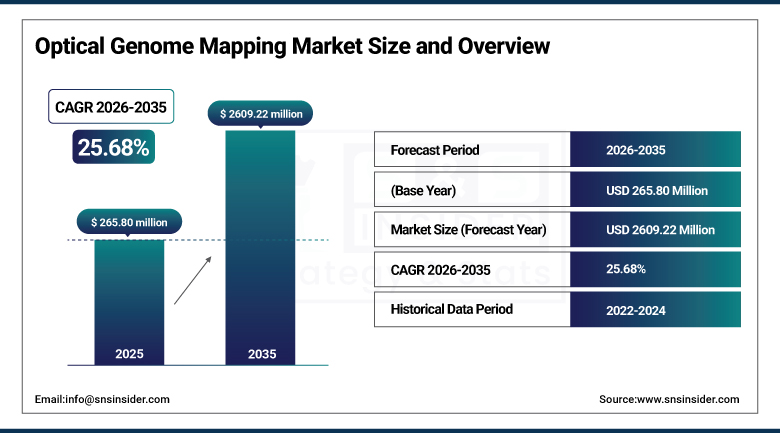
The Optical Genome Mapping Market was valued at USD 265.80 million in 2025 and is expected to reach USD 2609.22 million by 2035, growing at a CAGR of 25.68% from 2026–2035.
The optical genome mapping market is witnessing strong growth in the global market owing to increasing demand for high-resolution structural variant detection. Rising adoption in cancer and rare disease genomics is supporting market expansion. Expanding clinical genomics and precision medicine programs are driving technology adoption. Researchers are focusing on advanced genome mapping platforms for improved accuracy. Growing integration of bioinformatics and software analytics is improving workflow efficiency. Increasing emphasis on fast and cost-effective genomic analysis is further accelerating market adoption.
According to the U.S. National Human Genome Research Institute and National Institutes of Health 2025 genomics adoption data, over 6.4 million human genomes have been sequenced in clinical and research programs globally, with increasing integration of complementary structural variant detection technologies. As per NIH Genomic Data Sharing policy updates, more than 90% of federally funded large-scale genomics projects require open data deposition into controlled-access repositories. The European Bioinformatics Institute reports that structural variant analysis adoption in rare disease diagnostics exceeds 40% in advanced genomic laboratories, supporting rising clinical use of optical genome mapping in cytogenetics and cancer research applications.
To Get more information on Optical Genome Mapping Market - Request Free Sample Report
Optical Genome Mapping Market Trends
-
-
Greater use of optical genome mapping in precision medicine applications is revolutionizing genomics studies and diagnostics in clinical settings around the world.
-
More utilization of modern genomic technologies in oncology research is contributing to early detection and effective treatment planning of complex cancers.
-
Greater investments by pharmaceutical companies in their discovery pipelines are increasing the use of structural variant analysis in target identification and validation stages.
-
More collaborations between biotech companies and research organizations are facilitating the availability and usage of high-resolution genomic mapping technologies globally.
-
Progress in imaging systems and sample preparation approaches is making optical genome mapping technologies more accurate, efficient and scalable.
-
Greater use of genomic technologies in academic and translational research is fostering innovation in disease modeling and personalized medicine development.
-
U.S. Optical Genome Mapping Market Outlook.
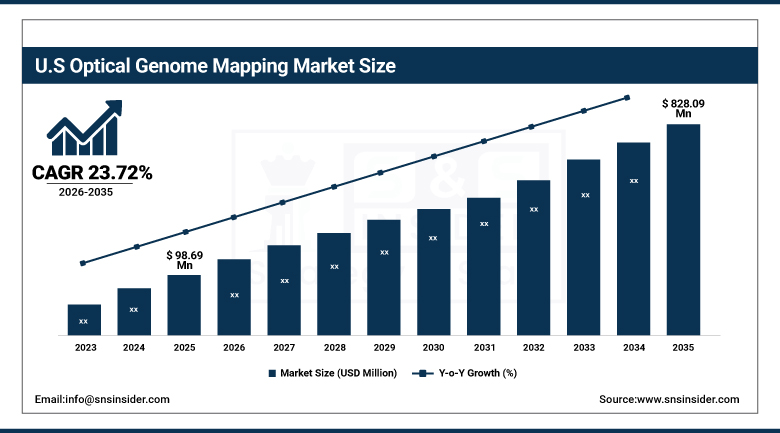
The U.S. Optical Genome Mapping Market was valued at USD 98.69 million in 2025 and is expected to reach around USD 828.09 million by 2035, growing at a CAGR of 23.72% from 2026–2035.
The U.S. Optical Genome Mapping Market is growing steadily owing to strong demand for advanced genomic analysis. Increasing adoption in cancer genomics and rare disease diagnostics is supporting market expansion. Rising investments in precision medicine and clinical research are driving consistent adoption. Biotechnology companies are focusing on high-resolution genome mapping platforms. Integration of AI-based bioinformatics tools is improving data interpretation efficiency. Growing need for accurate structural variant detection is further accelerating market adoption.
As per the genomic initiatives of the National Institutes of Health and National Human Genome Research Institute in the United States, there have been more than 7,000 rare diseases identified around the world with an increasing use of genomics technologies in clinical diagnosis.
As per the CMS 2025 coverage model for laboratory services, next generation sequencing and advanced cytogenetics technologies are covered in the diagnostic pathway for specific oncology and rare disease indications. The CDC in the United States has also indicated that the ability for genomic sequencing has increased in more than 70% of large academic medical centers worldwide.
Optical Genome Mapping Market Segment Analysis
-
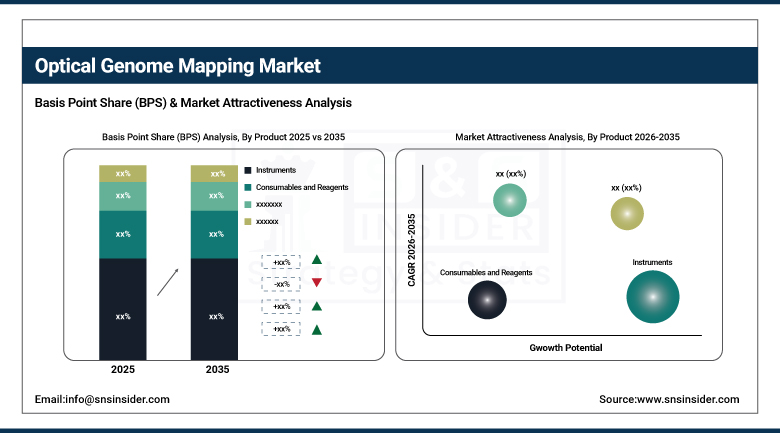
By Product, instruments dominated the market with 41.25% share in 2025; while consumables and reagents are the fastest growing segment with CAGR of 28.34% during 2026 to 2035.
-
By Application, structural variant detection dominated the market with 48.60% share in 2025; while genome assembly is the fastest growing segment with CAGR of 29.19% during 2026 to 2035.
-
By End-User, biotechnology and pharmaceutical companies dominated the market with 44.75% share in 2025; while clinical laboratories are the fastest growing segment with CAGR of 29.27% during 2026 to 2035.
By Product, instruments dominated the optical genome mapping market, while consumables and reagents are the fastest growing segment.
The instruments segment was the leader among other segments with dominated market share in terms of revenues in the optical genome mapping market in 2025. The instruments segment has been dominating the market due to their initial high installation value in the form of genome mapping systems which are very crucial to generate structural variant data of high resolution. The growing number of genome mapping procedures at research institutions and genomics clinical labs are adding more fuel to the demand for genome mapping instruments.
The consumables and reagents segment is projected to have the fastest CAGR from 2026 to 2035 due to its continuous use in every genome mapping process. More sample volumes in diagnostic and laboratory centers are driving up the need for consumables and reagents. Rising adoption of large-scale genomic studies and increasing preference for standardized kits and reagents for genome mapping process have been contributing towards segment growth.
By Application, structural variant detection dominated the optical genome mapping market, while genome assembly is the fastest growing segment.
Structural variant detection segment has taken a dominant position in the optical genome mapping market, generating the highest revenue share in 2025. This is attributed to the superior capability of detecting larger structural variations in the form of insertion, deletion, inversion, and translocation in an extremely efficient manner. This application finds wide usage in the field of oncology and research in rare diseases. The growing need for advanced genomics diagnostics along with superiority over conventional sequencing technologies further bolsters the market position of this application segment.
Genome Assembly Segment will have the fastest CAGR during 2026-2035, owing to increasing usage for de novo genome sequencing and advanced reference genome assembly. Growing need for comprehensive genomic databases along with advancements in the long-read mapping technology is expected to fuel the market growth. Additionally, increasing use in the field of agriculture, evolutionary biology, and personalized medicine is anticipated to speed up the growth in the coming years.
By End-User, biotechnology and pharmaceutical companies dominated the optical genome mapping market, while clinical laboratories are the fastest growing segment.
The biotechnology and pharmaceutical companies' segment are the leading segment of the optical genome mapping market. In 2025, biotechnology and pharmaceutical companies are the dominating segments owing to high revenue share on account of the extensive genomic research in drug discovery applications. The presence of advanced optical mapping technologies for the identification of structural variations in support of precision medicine workflows in R&D is another factor responsible for market leadership.
The clinical laboratories segment is anticipated to have the highest CAGR from 2026 to 2035. Rising usage of the technology in clinical laboratories is attributed to the increasing adoption of optical genome mapping in clinical diagnostics and rare disease testing. Improving efficiencies in workflow and accurate detection of genetic variants contribute significantly to the adoption by clinical diagnostic laboratories, especially the reference ones.
Regional Analysis
|
Region |
Major Country |
Share within Region, 2025(%) |
|---|---|---|
|
North America |
United States |
86.75% |
|
Europe |
Germany |
28.60% |
|
Asia Pacific |
China |
43.20% |
|
Middle East & Africa |
UAE |
17.80% |
|
Latin America |
Brazil |
46.70% |
North America Optical Genome Mapping Market Insights.
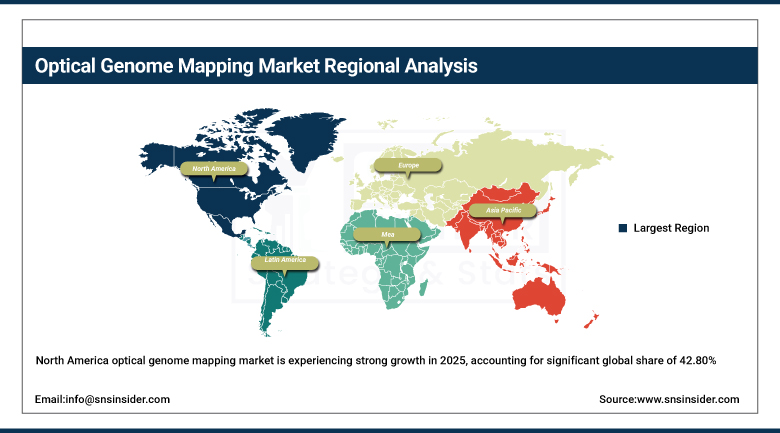
North America optical genome mapping market is experiencing strong growth in 2025, accounting for significant global share of 42.80%. Driven by advanced genomic research infrastructure and high adoption of precision medicine applications. Increasing demand for structural variant detection in oncology and rare disease research is supporting expansion. Strong presence of biotechnology companies and academic research institutes further accelerates technology adoption across region. Integration of high throughput sequencing platforms with optical mapping systems improves diagnostic accuracy and efficiency. Continued investment in genomics innovation and healthcare modernization is strengthening regional market leadership.
As stated in the U.S. National Human Genome Research Institute and National Institutes of Health 2025 genomics infrastructure data, there are more than 2,000 laboratories conducting genetic testing in North America, 90% of which utilize next generation sequencing as a fundamental technique in diagnosis. According to the U.S. Centers for Disease Control and Prevention genomics surveillance strategy, over 70% of public health laboratories currently use cutting-edge genomics technologies to track pathogens.
Get Customized Report as per Your Business Requirement - Enquiry Now
Europe Optical Genome Mapping Market Insights.
Europe optical genome mapping market is characterized by stable growth in 2025 driven by strong regulatory and research frameworks. Strict genomic data governance and emphasis on precision diagnostics are supporting technology adoption across major countries. Increasing use in rare disease identification and cancer genomics is expanding clinical applications. Strong academic collaborations and government funded research programs are enhancing innovation in structural variant analysis. Expansion of pharmaceutical research and personalized medicine initiatives is further driving demand. Circular healthcare and sustainability focused policies also support digital genomic technologies integration.
According to the European Commission’s Horizon Europe life science research program and Eurostat Research and Development statistics 2025, the continent makes up about 23% of all the world's biotechnology research production, with more than 2,800 ongoing genomics medicine and precision diagnostics projects financed in EU member countries. According to European Medicines Agency advanced therapy guidance, usage of next generation sequencing and genome sequencing has risen to above 60% in some of the leading hospitals in EU for clinical research. Eurostat estimates show that over 75% of EU healthcare establishments have interoperable electronic health records systems, enabling integration of high-resolution genomics technology such as optical genome mapping in clinical research processes.
Asia Pacific Optical Genome Mapping Market Insights.
Asia Pacific optical genome mapping market is the fastest growing region, registering a CAGR of 28.04% during the forecast period. Rapid expansion of genomic research infrastructure is driving strong market acceleration. Increasing investments in biotechnology and healthcare modernization across China, India, Japan, and South Korea are driving adoption. Rising prevalence of genetic disorders and cancer cases is increasing demand for advanced diagnostic tools. Expanding pharmaceutical manufacturing and contract research organizations are boosting application of genomic mapping. Growing government support for life sciences innovation is accelerating technology deployment. Expanding academic research networks and low-cost sequencing capabilities are further strengthening regional growth.
As per the WHO Global Genomic Medicine Surveillance Framework and UNESCO Bioethics and Genomics Policy Indicators, 70% of the Asia Pacific countries have national programs for genomic medicine or precision medicine, indicating growing utilization of sophisticated genomic tools. As reported by OECD Biotechnology Statistics and health systems of the region, over 50% of the tertiary care hospitals of high-income Asia Pacific economies have adopted next generation sequencing technology.
Middle East and Africa and Latin America Optical Genome Mapping Market Insights.
Middle East and Africa along with Latin America optical genome mapping market is witnessing gradual growth driven by healthcare modernization. Increasing focus on genetic disease screening and oncology research is supporting adoption of advanced genomic technologies. Rising investments in healthcare infrastructure and laboratory expansion are improving diagnostic capabilities. Growing pharmaceutical and biotechnology collaborations are enhancing research capacity across emerging economies. Expansion of private healthcare providers and diagnostic networks is further supporting market penetration. Increasing awareness of precision medicine is gradually boosting demand for genomic mapping solutions.
As per WHO Global Health Observatory Report 2025, it is estimated that the proportion of new cancer cases in Latin America & Caribbean region will be around 14% of the total cases worldwide, whereas the rate of increase of cancer burden in Africa is faster compared to the global rate, which is expected to rise up to 85% by the year 2040. According to the UNESCO and national genomic policies, less than 25% of African countries and less than 40% of Latin American countries have genomic medicine programs.
Market Dynamics
Growth Drivers: Growing demand for high accuracy structural variant detection in cancer and genetic disorder research applications
The rising incidence of cancer and complex genetic diseases is creating the need for more accurate analyses of structural variants. Optical genome mapping has an advantage over conventional sequencing techniques because of its higher resolution, thereby making the process more accurate. Increasing applications in oncological research and translational genomics have enabled earlier disease diagnosis and planning of treatment. Collaboration between biotech firms and research centers will make the technology even more accessible. Improved techniques in sample preparation and imaging are also contributing significantly to its adoption.
According to the National Institutes of Health and National Human Genome Research Institute genomic research, over 80% of rare diseases arise from genetic causes where structural variants are responsible for the bulk of undiagnosed patients. According to the data from the CDC, one in 33 babies in the US each year suffers from birth defects, which underscores the need for better genomic diagnoses. Programs funded by the NIH have noted that the next generation of cytogenomic tests like optical genome mapping can identify structural variants above 500 base pairs with more accuracy than traditional karyotyping.
Restraints: Limited availability of skilled genomic data interpretation experts and supporting bioinformatics infrastructure globally
Lack of skilled personnel in genomic data analysis affects efficient application of optical genome mapping technology. Data interpretation in this context needs bioinformatic skills that are not available in developing nations. Insufficient computational facilities in developing countries hinder efficient large-scale analysis of genomic data. Absence of standard training programs hinders application of this technology in clinical applications. Compatibility problems with current laboratory information systems affect efficient adoption of the technology. Challenges affect scalability of the technology despite increased demand for its application in research and precision medicine.
Opportunities: Increasing application of optical genome mapping in drug discovery and advanced genomic research pipelines globally
The increasing application of genomic technologies in drug discovery presents great potential for growth in the market. The optical genome mapping helps to conduct a thorough analysis of structural variations that aid in identifying and validating targets. The pharmaceutical organizations are increasingly incorporating genomic technologies in their research processes in the early stages. Growth in investments made by biopharmaceutical R&D organizations helps in utilizing the technologies effectively. Increasing applications of the technologies in academic and translational research organizations aid in innovations in disease modeling.
According to the U.S. National Human Genome Research Institute 2025 genomic data initiatives and National Institutes of Health sequencing program updates, over 70% of large-scale genomic research projects now integrate long-read or high-resolution structural variant detection methods alongside next-generation sequencing. As per NIH-funded Cancer Genome Atlas expansion datasets, structural variant analysis contributes to more than 30% of clinically relevant genomic alterations identified in cancer research pipelines.
Recent Developments
-
2026: Pacific Biosciences enhanced Revio platform with SPRQ-Nx chemistry improvements, reducing sequencing cost and expanding high-throughput genome analysis applications.
-
2025: Illumina introduced constellation mapped-read technology pilot programs and expanded spatial transcriptomics initiatives to improve complex genomic and cellular resolution analysis.
-
2025: Bionano Genomics expanded optical genome mapping clinical adoption through enhanced Saphyr workflow integration and cytogenetics laboratory partnerships globally.
-
2024: Thermo Fisher Scientific completed acquisition of Olink Holding AB, expanding proteomics capabilities and spatial biology integration across workflows.
Optical Genome Mapping Market Key Players are:
-
Bionano Genomics
-
Oxford Nanopore Technologies
-
Pacific Biosciences
-
Illumina
-
Thermo Fisher Scientific
-
Agilent Technologies
-
QIAGEN
-
F. Hoffmann-La Roche
-
Revvity
-
Danaher Corporation
-
Standard BioTools
-
Bio-Rad Laboratories
-
10x Genomics
-
Genedata
-
Nucleome Informatics
-
Saphetor
-
Golden Helix
-
Fabric Genomics
-
Genomenon
-
BGI Genomics
Optical Genome Mapping Market Report Scope:
| Report Attributes | Details |
|---|---|
| Market Size in 2025 | USD 265.80 Million |
| Market Size by 2035 | USD 2609.22 Million |
| CAGR | CAGR of 25.68% From 2026 to 2035 |
| Base Year | 2025 |
| Forecast Period | 2026-2035 |
| Historical Data | 2022-2024 |
| Report Scope & Coverage | Market Size, Segments Analysis, Competitive Landscape, Regional Analysis, DROC & SWOT Analysis, Forecast Outlook |
| Key Segments | • By Product (Instruments, Consumables and Reagents, Software, Services) • By Application (Structural Variant Detection, Genome Assembly, Microbial Strain Typing, Others) • By End-User (Biotechnology and Pharmaceutical Companies, Clinical Laboratories, Academic Research Institutes, Others) |
| Regional Analysis/Coverage | North America (US, Canada), Europe (Germany, UK, France, Italy, Spain, Russia, Poland, Rest of Europe), Asia Pacific (China, India, Japan, South Korea, Australia, ASEAN Countries, Rest of Asia Pacific), Middle East & Africa (UAE, Saudi Arabia, Qatar, South Africa, Rest of Middle East & Africa), Latin America (Brazil, Argentina, Mexico, Colombia, Rest of Latin America). |
| Company Profiles | Bionano Genomics, Oxford Nanopore Technologies, Pacific Biosciences, Illumina, Thermo Fisher Scientific, Agilent Technologies, QIAGEN, F. Hoffmann-La Roche, Revvity, Danaher Corporation, Standard BioTools, Bio-Rad Laboratories, 10x Genomics, Genedata, Nucleome Informatics, Saphetor, Golden Helix, Fabric Genomics, Genomenon, BGI Genomics |
Frequently Asked Questions
The Structural Variant Detection dominated in 2025 due to high accuracy in identifying insertions, deletions, inversions, translocations in oncology and rare diseases.
The optical genome mapping market is expected to grow at a CAGR of 25.68% from 2026 to 2035.
The Major growth factors include rising demand for high resolution structural variant detection, cancer and rare disease genomics, precision medicine expansion, bioinformatics integration, AI analytics, and drug discovery applications.
