
Quantum-Safe Networking Market Report Scope & Overview:
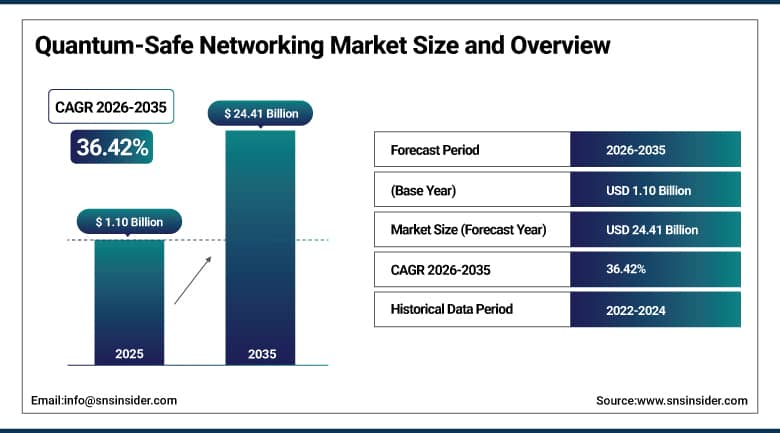
Quantum-Safe Networking Market was valued at USD 1.10 Billion in 2025 and is expected to reach USD 24.41 Billion by 2035, growing at a CAGR of 36.42% from 2026–2035.
The quantum-safe networking market is experiencing consistent growth due to the increasing need for secure communication and network protection against emerging quantum computing threats. The advancement of quantum computing capabilities and the growing adoption of digital infrastructure are increasing demand for quantum-resistant security solutions across enterprises, governments, financial institutions, and critical infrastructure.
Investments in post-quantum cryptography, quantum-safe network architectures, secure communication technologies, and cryptographic migration solutions are increasing as organizations prepare for potential quantum-enabled cyberattacks. Companies are focusing on integrating quantum-resistant algorithms, upgrading network security infrastructure, protecting sensitive data, and ensuring long-term cryptographic resilience. Growing concerns surrounding data security, compliance requirements, and the need to safeguard critical information are accelerating technological advancements. The integration of quantum-safe security into cloud environments, telecommunications networks, enterprise systems, and critical infrastructure is further supporting market growth.
March 2025, NIST selected HQC as an additional post-quantum encryption algorithm, providing a backup to ML-KEM and strengthening the foundation for quantum-safe protection of internet traffic and sensitive data.
To Get More Information On Quantum-Safe Networking Market - Request Free Sample Report
Quantum-Safe Networking Market Trends
-
Growing adoption of quantum-safe networking solutions is driving demand for post-quantum cryptographic technologies that protect communications and network infrastructure from emerging quantum computing threats.
-
Rising digitization of enterprises, governments, financial institutions, and critical infrastructure is increasing the need for secure networking solutions capable of protecting sensitive information against future quantum-enabled attacks.
-
Increasing adoption of post-quantum cryptography, quantum-resistant algorithms, and crypto-agile network architectures is supporting demand for quantum-safe security across cloud, telecommunications, enterprise, and government networks.
-
Growing focus on data confidentiality, regulatory compliance, cryptographic migration, and protection against harvest-now-decrypt-later attacks is creating opportunities for quantum-safe networking solution providers.
-
Advancements in post-quantum encryption, secure key management, quantum-safe VPNs, network security platforms, and crypto-agile infrastructure are improving protection capabilities and supporting market adoption.
The U.S. Quantum-Safe Networking Market Outlook
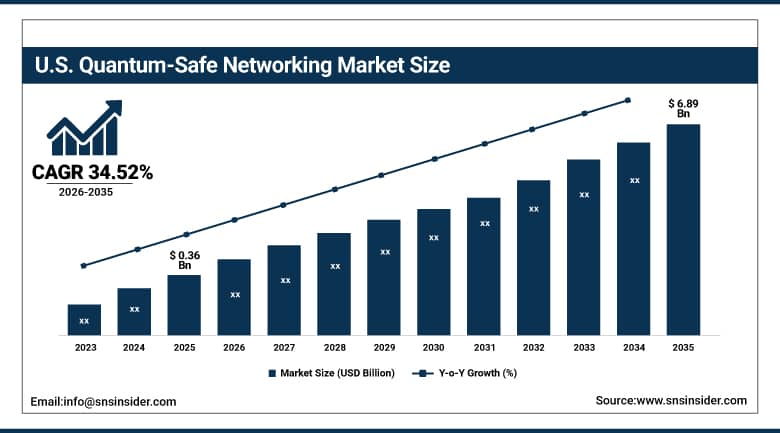
The U.S. Quantum-Safe Networking Market was valued at USD 0.36 Billion in 2025 and is expected to reach around USD 6.89 Billion by 2035, growing at a CAGR of 34.52% from 2026–2035.
The U.S. market for quantum-safe networking is growing steadily as organizations increase investments in network security, post-quantum cryptography, and protection against emerging quantum-enabled cyber threats. The rapid digitization of enterprises, financial institutions, government agencies, healthcare organizations, and critical infrastructure is increasing the need for secure communication networks capable of providing long-term cryptographic protection. Growing awareness of harvest-now-decrypt-later attacks is encouraging organizations to begin transitioning toward quantum-resistant security technologies. Investments in post-quantum cryptography, crypto-agile network architectures, quantum-safe VPNs, secure gateways, and encryption technologies are supporting market development. Network security providers are increasingly focusing on integrating quantum-resistant algorithms, automated cryptographic migration, secure key management, and compatibility with existing enterprise infrastructure. The expansion of cloud computing, telecommunications, and zero-trust networking is further increasing demand for quantum-safe network protection across the United States.
In August 2026, the U.S. Department of Commerce's Bureau of Industry and Security issued a temporary final rule requiring U.S. persons to allocate 100% of monthly sales of covered lithium-ion battery black mass and tungsten waste to U.S. persons, unless an adjustment or exception is granted. Effective August 27, 2026, the measure is intended to strengthen domestic critical-mineral supply chains and does not directly apply to the quantum-safe networking market; therefore, it should not be included as a market-specific development for quantum-safe networking.
Quantum-Safe Networking Market Segment Analysis
-
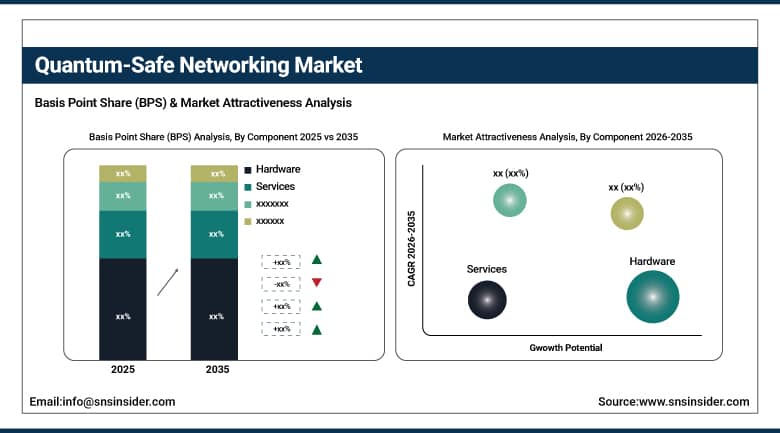
By Component, hardware dominated the quantum-safe networking market with a 52.37% share in 2025, while services are projected to be the fastest-growing segment, registering a 39.09% CAGR during 2026–2035.
-
By Technology, post-quantum cryptography (PQC) dominated the quantum-safe networking market with a 38.42% share in 2025, while quantum-safe SD-WAN is projected to be the fastest-growing segment, registering a 37.14% CAGR during 2026–2035.
-
By Deployment mode, on-premises dominated the quantum-safe networking market with a 54.63% share in 2025, while cloud-based is projected to be the fastest-growing segment, registering a 39.05% CAGR during 2026–2035.
-
By Organization size, large enterprises dominated the quantum-safe networking market with a 68.47% share in 2025, while small and medium enterprises are projected to be the fastest-growing segment, registering a 38.49% CAGR during 2026–2035.
-
By Application, secure communication dominated the quantum-safe networking market with a 29.84% share in 2025, while secure financial transactions are projected to be the fastest-growing segment, registering a 39.48% CAGR during 2026–2035.
-
By End-User, banking, financial services, and insurance (BFSI) dominated the quantum-safe networking market with a 28.62% share in 2025, while information technology (IT) and telecommunications are projected to be the fastest-growing segment, registering a 37.89% CAGR during 2026–2035.
By Component, hardware dominated the quantum-safe networking market, while services are expected to grow fastest.
Hardware held the dominant position in the market in 2025 due to the critical role of secure network appliances, encryption gateways, security modules, and quantum-resistant infrastructure in enabling quantum-safe communications. The increasing need to upgrade existing network infrastructure to support post-quantum cryptographic standards is driving demand for specialized hardware. Growing investments in secure communication infrastructure across enterprises, government organizations, financial institutions, and critical infrastructure are further supporting hardware adoption.
Services are anticipated to grow at the highest CAGR during the forecast period of 2026 to 2035. The increasing complexity of cryptographic migration, network assessment, implementation, consulting, and managed security requirements is encouraging organizations to rely on specialized quantum-safe networking services. Growing demand for crypto-agility, security assessments, migration planning, and continuous protection is expected to accelerate service adoption.
By Application, secure communication dominated the quantum-safe networking market, while secure financial transactions are expected to grow fastest.
Secure communication held the dominant position in the market in 2025 due to the increasing need to protect data transmitted across enterprise networks, telecommunications infrastructure, government systems, and other sensitive communication environments. The transition toward post-quantum cryptographic algorithms and increasing concerns regarding harvest-now-decrypt-later attacks are encouraging organizations to strengthen the protection of network communications.
Secure financial transactions are projected to exhibit the highest growth rate during the forecast period of 2026–2035. Financial institutions handle highly sensitive transactional and customer information, making long-term cryptographic protection increasingly important. Rising digital banking activity, increasing cybersecurity requirements, and investments in quantum-resistant encryption for payment and financial networks are expected to accelerate adoption.
By End-User, banking, financial services, and insurance (BFSI) dominated the quantum-safe networking market, while information technology (IT) and telecommunications are expected to grow fastest.
BFSI held the dominant position in the market in 2025 due to the sector's extensive reliance on secure digital transactions, confidential customer information, payment networks, and highly protected communications. Growing cybersecurity risks and the potential long-term impact of quantum computing on existing encryption are encouraging financial institutions to evaluate and deploy quantum-resistant security technologies.
Information technology (IT) and telecommunications are projected to register the highest growth rate during the forecast period of 2026–2035. The rapid expansion of cloud services, data centers, 5G and advanced telecommunications networks, and digital infrastructure is increasing the need for quantum-safe protection. Growing investments in network modernization and crypto-agile security architectures are expected to further support adoption across the IT and telecommunications sector.
Regional Analysis
|
Region |
Major Country |
Share within Region, 2025(%) |
|---|---|---|
|
North America |
United States |
83.74% |
|
Europe |
Germany |
34.30% |
|
Asia Pacific |
China |
48.54% |
|
Middle East & Africa |
Saudi Arabia |
23.50% |
|
Latin America |
Brazil |
23.00% |
North America quantum-safe networking market insights
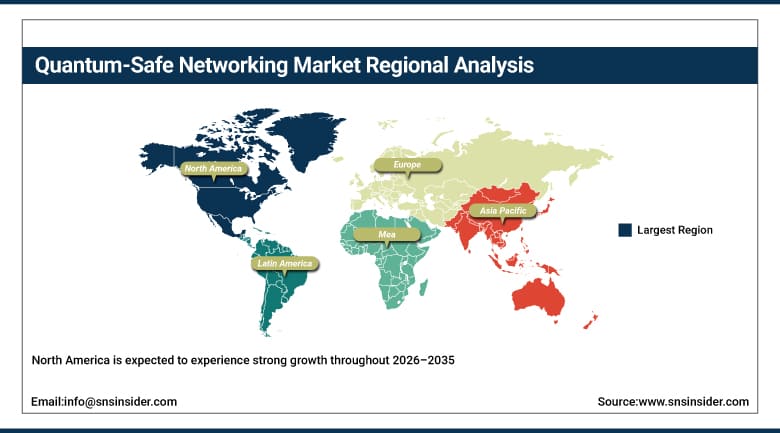
North America is expected to experience strong growth throughout 2026–2035, driven by increasing investments in post-quantum cryptography, cybersecurity modernization, secure communications, cloud infrastructure, and protection against emerging quantum-enabled cyber threats. North America accounted for majority share of 38.74% of the quantum-safe networking market in 2025, making it the dominant regional market. The region benefits from major technology companies, cybersecurity providers, telecommunications operators, government agencies, and financial institutions investing in quantum-resistant security solutions. Increasing awareness of harvest-now-decrypt-later attacks and the need for cryptographic agility are further encouraging organizations to upgrade network security infrastructure.
The United States is expected to dominate the North American market, accounting for 83.74% of the regional market share in 2025. The country's dominance is supported by strong cybersecurity investments, government initiatives promoting post-quantum cryptography, extensive enterprise and cloud infrastructure, and the presence of leading technology and network security providers. Canada is also expected to contribute to regional growth through investments in cybersecurity, digital infrastructure, telecommunications, and quantum technologies.
Get Customized Report as Per Your Business Requirement - Enquiry Now
Europe quantum-safe networking market insights
The quantum-safe networking market in Europe is expected to experience significant growth during the forecast period, supported by increasing cybersecurity requirements, regulatory initiatives, digital transformation, and investments in post-quantum cryptography. Growing awareness of quantum-related risks among governments, financial institutions, telecommunications operators, and enterprises is encouraging organizations to evaluate cryptographic migration and adopt quantum-resistant security architectures. Increasing emphasis on data sovereignty, secure communications, and protection of critical infrastructure is further supporting regional demand.
Germany is anticipated to remain a key national market in Europe, supported by its strong industrial base, advanced telecommunications infrastructure, cybersecurity investments, and increasing focus on protecting critical digital systems from emerging quantum threats. The United Kingdom, France, Italy, and other European countries are also contributing to regional demand through investments in post-quantum security, government cybersecurity programs, financial technology, cloud infrastructure, and secure enterprise networking.
Asia Pacific quantum-safe networking market insights
The Asia Pacific region is expected to be the fastest-growing regional market during 2026–2035, supported by rapid digital transformation, expanding telecommunications infrastructure, increasing cloud adoption, and growing investments in cybersecurity and quantum technologies. The region is expected to register a CAGR of approximately 39.59% during 2026–2035, supported by its expanding technology ecosystem, telecommunications infrastructure, financial services sector, government cybersecurity initiatives, and increasing deployment of advanced digital infrastructure.
China will remain a major market in Asia Pacific due to its extensive telecommunications infrastructure, strong technology ecosystem, government investment in quantum technologies, and growing emphasis on secure communications and cybersecurity. Japan and South Korea will also remain significant markets because of their advanced electronics, telecommunications, automotive, financial, and technology industries. India is expected to witness increasing demand as digital infrastructure, cloud services, financial technology, telecommunications networks, and government digitalization continue to expand.
Middle East & Africa and Latin America quantum-safe networking market insights
The quantum-safe networking markets in the Middle East & Africa and Latin America are expected to register steady growth during 2026–2035, driven by increasing digitalization, cloud adoption, cybersecurity investments, telecommunications modernization, and growing awareness of emerging quantum-related security risks. Governments, financial institutions, enterprises, and critical infrastructure operators are increasingly focusing on strengthening network resilience and protecting sensitive information against future quantum-enabled attacks. Expanding digital economies and investments in secure communications are creating opportunities for quantum-resistant networking technologies.
Saudi Arabia is expected to remain an important market in the Middle East & Africa, supported by digital transformation initiatives, cybersecurity investments, smart infrastructure development, cloud adoption, and modernization of critical information systems. In Latin America, Brazil is expected to remain an important country-level market due to its large financial services sector, expanding digital economy, telecommunications infrastructure, and growing cybersecurity requirements. Other countries across both regions are also expected to contribute to market growth through increasing adoption of cloud services, digital platforms, secure networking, and advanced cybersecurity solutions.
Market Dynamics
Growth Driver: Increasing demand for quantum-resistant network security is driving market growth
One of the key driving forces behind the growth of the global quantum-safe networking market is the increasing need to protect sensitive digital communications and network infrastructure against future quantum-enabled cyber threats. The rapid expansion of cloud computing, digital services, telecommunications, financial technology, and connected enterprise infrastructure is increasing the volume of sensitive information transmitted across networks. Organizations are increasingly recognizing the potential threat posed by sufficiently powerful quantum computers to conventional public-key cryptographic systems, encouraging early migration toward post-quantum security technologies.
In addition, growing adoption of post-quantum cryptography, crypto-agile architectures, quantum-resistant encryption, secure key management, and quantum-safe network security solutions is supporting market expansion. Government cybersecurity initiatives, increasing protection requirements for critical infrastructure, and growing awareness of harvest-now-decrypt-later attacks are further encouraging investments in quantum-safe networking technologies.
Restraint: Complex cryptographic migration and integration challenges can limit market adoption
The complexity of migrating existing network infrastructure from conventional cryptographic algorithms to quantum-resistant technologies represents a significant challenge for the quantum-safe networking market. Enterprises often operate heterogeneous IT environments containing legacy systems, proprietary applications, multiple encryption standards, and interconnected networks, making large-scale cryptographic migration technically complex and resource-intensive.
Moreover, organizations need to evaluate cryptographic dependencies, replace vulnerable algorithms, maintain interoperability, and minimize operational disruption during the transition. The shortage of specialized quantum-security expertise, integration requirements, implementation costs, and uncertainty surrounding the long-term selection of post-quantum algorithms can create additional barriers, particularly for small and medium-sized organizations. These factors may slow the adoption of comprehensive quantum-safe networking solutions in some markets.
Opportunity: Growing post-quantum migration and critical infrastructure protection creates new market opportunities
The increasing need to protect critical digital infrastructure presents substantial opportunities for quantum-safe networking solution providers. Financial institutions, government agencies, telecommunications operators, healthcare organizations, technology companies, and critical infrastructure providers are increasingly evaluating quantum-resistant security strategies to safeguard sensitive information and long-lived data.
Further, the expansion of cloud computing, 5G and advanced telecommunications, zero-trust architectures, and distributed enterprise networks creates opportunities for integrating quantum-safe encryption and secure networking capabilities into existing security platforms. Increasing investments in cryptographic agility, post-quantum VPNs, secure communication gateways, quantum-resistant key management, and managed security services are expected to create additional opportunities for technology providers. Government-led cybersecurity programs and growing requirements for long-term data protection are also expected to accelerate the adoption of quantum-safe networking solutions.
Recent Developments
-
2026: Cloudflare expanded its post-quantum cryptography capabilities across its security and networking services, supporting broader adoption of quantum-resistant protection for enterprise communications and Internet infrastructure.
-
2026: Cisco continued advancing post-quantum cryptography capabilities across its networking and security portfolio, supporting organizations in preparing network infrastructure for emerging quantum-related cybersecurity threats.
-
2026: IBM continued expanding its post-quantum cryptography and quantum-safe security initiatives, helping enterprises assess cryptographic vulnerabilities and develop migration strategies for quantum-resistant security.
-
2026: Microsoft continued integrating post-quantum cryptographic capabilities across its security ecosystem, supporting organizations in strengthening long-term protection for cloud services, applications, and network communications.
-
2026: Entrust continued advancing quantum-safe cryptography, digital certificates, and cryptographic agility solutions to help enterprises and government organizations prepare for the transition toward post-quantum security.
Quantum-Safe Networking Market key players are:
-
Cloudflare, Inc.
-
Cisco Systems, Inc.
-
IBM Corporation
-
Thales
-
Entrust Corporation
-
Palo Alto Networks
-
Fortinet
-
Amazon Web Services, Inc. (AWS)
-
Microsoft Corporation
-
Google LLC
-
DigiCert, Inc.
-
PQShield Ltd.
-
ISARA Corporation
-
CryptoNext Security
-
SandboxAQ
-
Keyfactor
-
QuSecure
-
Quantum Xchange
-
Utimaco
-
WOLFSSL
Quantum-Safe Networking Market Report Scope:
| Report Attributes | Details |
|---|---|
| Market Size in 2025 | USD 1.10 Billion |
| Market Size by 2035 | USD 24.41 Billion |
| CAGR | CAGR of 36.42% From 2026 to 2035 |
| Base Year | 2025 |
| Forecast Period | 2026-2035 |
| Historical Data | 2022-2024 |
| Report Scope & Coverage | Market Size, Segments Analysis, Competitive Landscape, Regional Analysis, DROC & SWOT Analysis, Forecast Outlook |
| Key Segments | • By Component (Hardware, Software, Services) • By Technology (Post-Quantum Cryptography, Quantum Key Distribution, Quantum Random Number Generation, Quantum-Safe VPN, Hybrid Cryptography, Others) • By Deployment Mode (On-Premises, Cloud-Based, Hybrid) • By Organization Size (Large Enterprises, Small and Medium Enterprises) • By Application (Secure Communication, Network Security, Data Protection, Secure Financial Transactions, Critical Infrastructure Protection, Others) • By End-User (Banking, Financial Services, and Insurance (BFSI), Government & Defense, Healthcare, Information Technology (IT) and Telecommunications, Energy, Other End Users) |
| Regional Analysis/Coverage | North America (US, Canada), Europe (Germany, UK, France, Italy, Spain, Russia, Poland, Rest of Europe), Asia Pacific (China, India, Japan, South Korea, Australia, ASEAN Countries, Rest of Asia Pacific), Middle East & Africa (UAE, Saudi Arabia, Qatar, South Africa, Rest of Middle East & Africa), Latin America (Brazil, Argentina, Mexico, Colombia, Rest of Latin America) |
| Company Profiles | Cloudflare, Inc., Cisco Systems, Inc., IBM Corporation, Thales, Entrust Corporation, Palo Alto Networks, Fortinet, Amazon Web Services, Inc. (AWS), Microsoft Corporation, Google LLC, DigiCert, Inc., PQShield Ltd., ISARA Corporation, CryptoNext Security, SandboxAQ, Keyfactor, QuSecure, Quantum Xchange, Utimaco, wolfSSL. |

Frequently Asked Questions
The market is primarily driven by increasing cybersecurity threats, growing adoption of post-quantum cryptography, rising awareness of harvest-now-decrypt-later attacks, digital infrastructure expansion, and increasing investments in quantum-resistant network security.
Hardware dominated the quantum-safe networking market in 2025, accounting for a 52.37% share.
