
UAV Battery Market Report Scope & Overview:
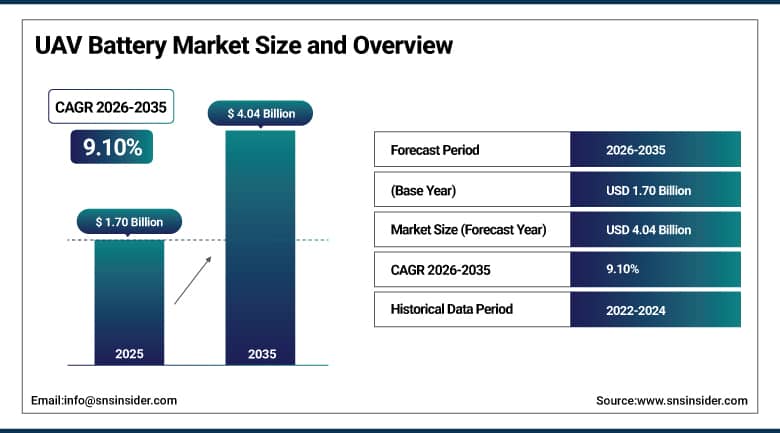
The UAV Battery Market was valued at USD 1.70 billion in 2025 and is expected to reach USD 4.04 billion by 2035, growing at a CAGR of 9.10% from 2026–2035.
The UAV battery market is witnessing strong growth because of the increasing deployment of drones in military, agricultural, logistics, surveillance, mapping, and industrial inspection uses around the world. The rising need for more flight time and energy-efficient battery systems along with faster charging energy sources is creating a strong demand for lithium-ion, lithium polymer, and fuel cell batteries. The increasing usage of drones in delivery services, smart agriculture, aerial monitoring, and military surveillance will continue to boost market growth during 2025-2026. In addition, increasing investment in the efficiency of batteries, hydrogen fuel cell, battery management systems with AI integration, and high energy density batteries is driving growth in the UAV battery market.
DJI introduced the FlyCart 100 cargo drone in 2025 featuring advanced high-capacity lithium battery systems capable of supporting payloads up to 80 kg and improving long-duration logistics operations. The company is increasingly focusing on high-energy-density battery technologies, intelligent battery management systems, and fast-charging solutions to support growing commercial drone delivery and industrial transportation applications worldwide.
To Get More Information On UAV Battery Market - Request Free Sample Report
UAV Battery Market Trends
-
Rising deployment of autonomous drones across military surveillance, logistics, agriculture, and industrial inspection applications is significantly accelerating demand for advanced UAV battery technologies globally.
-
Increasing adoption of lightweight, high-energy-density, and fast-charging lithium-ion and lithium polymer battery systems is improving drone flight endurance and operational efficiency.
-
Growing popularity of hydrogen fuel cell-powered drones is driving innovation in long-range UAV operations, industrial monitoring, and defence surveillance applications worldwide.
-
Expansion of AI-enabled battery management systems and next-generation solid-state battery technologies is enhancing UAV safety, thermal stability, and energy performance during complex aerial missions.
-
Rising investments in autonomous delivery drones, hybrid aerial vehicles, and emergency response UAV systems are significantly strengthening demand for advanced and long-endurance drone battery solutions during 2025–2026.
The U.S. UAV Battery Market Outlook
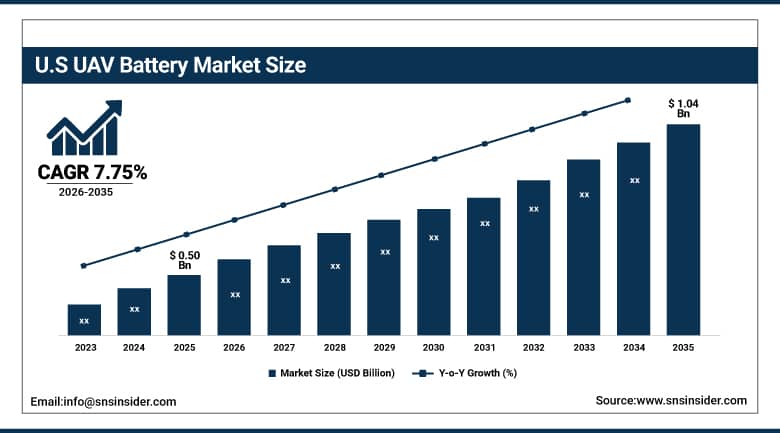
The U.S. UAV Battery Market was valued at USD 0.50 billion in 2025 and is expected to reach USD 1.04 billion by 2035 at a CAGR of 7.75%.
The UAV battery market systems are experiencing a rapid growth in the US on account of increased application of drone technology in multiple areas including military reconnaissance, logistics, agriculture, infrastructure inspection, disaster management, and delivery services. With the increase in demand for batteries with features like low weight, high energy density, and fast charging capabilities, there is a rapid adoption of extremely sophisticated batteries such as lithium ion, lithium polymer, solid state, and fuel cell batteries. Furthermore, the development of drone operations on an autonomous basis, modernization initiatives within defense, and increased usage in industries is driving growth in the industry. Increased spending on the manufacture of batteries in the country, implementation of artificial intelligence-based battery management systems, and long-range UAV technologies is further fueling industry growth.
U.S. companies are increasingly investing in solid-state battery technologies and AI-enabled battery management systems to improve charging speed, thermal stability, operational safety, and flight duration for commercial and military drones. Growing focus on domestic battery manufacturing and reduction of dependence on foreign drone battery supply chains is further strengthening industry expansion during 2025–2026.
UAV Battery Market Segment Analysis
-
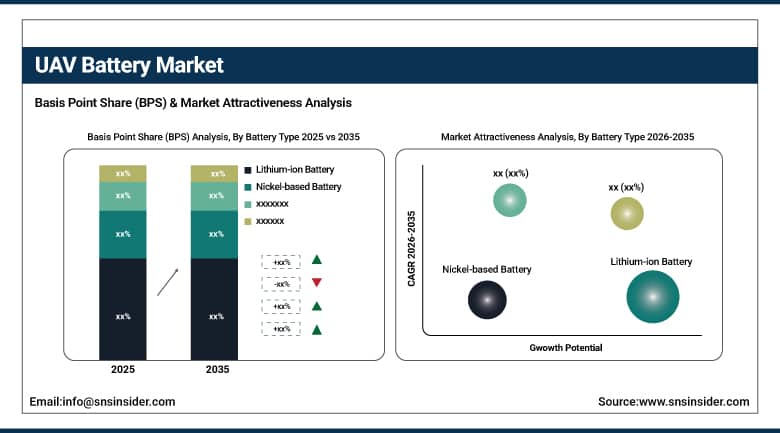
By Battery Type, Lithium-ion battery dominated with approximately 43.89% revenue share in 2025; Lithium polymer (Li-Po) is expected to be the fastest-growing Type segment at approximately 9.95% CAGR from 2026 to 2035.
-
By UAV Type, Fixed-wing UAV dominated with approximately 48.36% revenue share in 2025; Hybrid UAV are expected to be the fastest-growing Type segment at approximately 9.98% CAGR from 2026 to 2035.
-
By End User, Military & defense dominated with approximately 52.81% revenue share in 2025; Commercial is expected to be the fastest-growing Type segment at approximately 11.25% CAGR from 2026 to 2035.
-
By Application, Surveillance & monitoring dominated with approximately 30.18% revenue share in 2025; Logistics & delivery providers are expected to be the fastest-growing Type segment at approximately 11.94% CAGR from 2026 to 2035.
By Battery Type, Lithium-ion battery dominating while lithium polymer (Li-Po) battery
The Lithium ion battery segment accounted for about 43.89% of the market share in terms of revenue in 2025 because of high energy density, lightweight design, durability, and extensive use in the military, commercial, and industrial UAVs. The Lithium ion batteries were used in surveillance drones, mapping drones, and industrial inspection drones since the manufacturers preferred the steady power delivery, quick charging capability, and good flying abilities of Lithium ion batteries.
The lithium polymer (Li-Po) batteries are anticipated to grow at the highest CAGR of around 9.95% between 2026 and 2035 due to the growing demand for compact and lightweight batteries that provide high discharge rates required for advanced UAVs. The increasing utilization of high-speed drones, autonomous UAVs, and commercial UAV platforms is leading to rising demands for Li-Po batteries.
By UAV Type, Fixed-wing UAV dominating while hybrid UAV emerging as the fastest-growing
The fixed-wing UAV battery market segment held around 48.36% revenue share in 2025 due to increased endurance of flights, wide operation coverage, and improved efficiency in surveillance, border monitoring, agriculture mapping, and inspection applications by the drones. Defense organizations and commercial drone operators were more inclined towards using fixed-wing UAVs for long distance and efficient flying operations. The increasing use of fixed-wing drones in military and monitoring applications played a significant role in dominating the market segment during 2025.
The hybrid UAV battery market segment will record the highest growth rate with a CAGR of about 9.98% between 2026 and 2035 because of rising demand for drones with a capability to combine vertical takeoff capabilities along with range. Rapid use of hybrid drones for applications such as logistics, emergency services, surveillance, and industry is fueling technological advancements in the field.
By End User, Military & defense dominating while commercial emerging as the fastest-growing
The military & defense vertical generated around 52.81% revenue share in 2025 due to increasing use of UAVs for border patrol, espionage, reconnaissance, and defense missions by defense departments in several countries. Growing expenditure on modern warfare devices, real-time aerial surveillance technology, and endurance UAV missions fueled the adoption rate of UAV batteries in the military sector during 2025.
The commercial application segment is forecast to register the highest rate of growth with a CAGR of around 11.25%, during 2026-2035, as a result of growing deployment of drones in the areas of logistics, agriculture, infrastructure surveying, aerial photography, and industrial monitoring operations. Increasing preference for autonomous delivery solutions and commercial UAVs based on artificial intelligence (AI) is fueling global demand for UAV batteries.
By Application, Surveillance & monitoring dominating while logistics & delivery emerging as the fastest-growing
The segment of surveillance and monitoring had a revenue market share of about 30.18% due to the increasing use of UAVs for applications such as border security, infrastructure surveillance, disaster management, environmental monitoring, and industrial inspections. This was due to government bodies, military entities, and industries adopting drone systems that incorporate batteries with increased endurance capabilities.
It is forecasted that the segment of logistics and delivery will experience the highest growth rate, which is expected to be about 11.94% from 2026 to 2035 due to increased investment in drone delivery technology, medical supplies transport, and e-commerce logistics. The increase in the use of cargo drones and delivery UAVs has immensely contributed to the growth in battery technologies worldwide.
Regional Insights:
|
Region |
Major Country |
Share within Region,2025 (%) |
|---|---|---|
|
North America |
United States |
84% |
|
Europe |
Germany |
26% |
|
Asia Pacific |
China |
51% |
|
Middle East & Africa |
UAE |
24% |
|
Latin America |
Brazil |
41% |
North America UAV Battery Market Insights
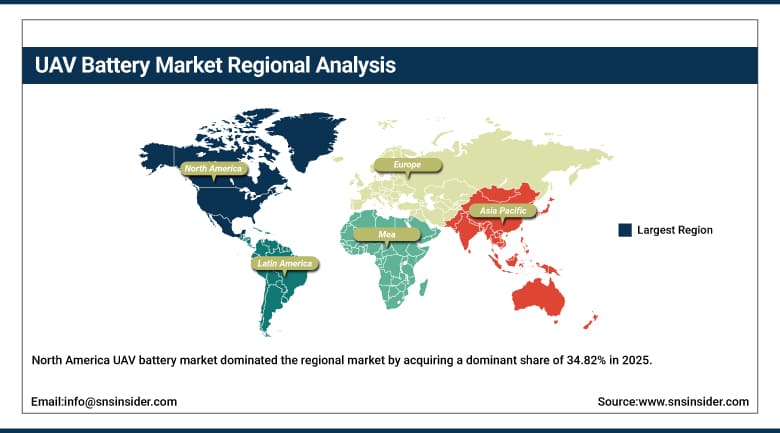
North America UAV battery market dominated the regional market by acquiring a dominant share of 34.82% in 2025, due to growing use of unmanned aerial vehicles in various military, logistics, agricultural, and industrial applications. The U.S. played an important role in driving the regional market growth through increasing capital investments in the development of autonomous UAVs, advanced drone technology, and Li-Ion batteries. Growing implementation of UAVs enabled with artificial intelligence, smart drone monitoring solutions, and commercial UAV delivery systems also fueled the demand for UAV batteries in 2025.
Get Customized Report as Per Your Business Requirement - Enquiry Now
Europe UAV Battery Market Insights
Europe is experiencing growth as a result of the growing use of drones in sectors like inspection, renewable energy monitoring, defense, and environment observation applications. Nations like Germany, France, and the UK are becoming more involved with the latest drone technologies, including autonomous drones and battery technologies to make UAVs more efficient and sustainable in terms of flight time. The growing use of drones for infrastructure inspection, smart cities, and agriculture observation purposes will drive the demand for high-tech LiPo and hybrid UAV batteries.
Asia Pacific UAV Battery Market Insights
The Asia Pacific UAV battery market is forecasted to record the highest CAGR of nearly 7.98% during the forecast period from 2026 to 2035 driven by increased production of drones, increased investments in the field of smart agriculture, and increase in the usage of drones in industries including China, India, Japan, and South Korea. With more utilization of UAVs in applications like logistics, aerial mapping, surveillance, and inspection, there will be a significant increase in demand for efficient batteries with lightweight and higher energy density.
Middle East & Africa and Latin America UAV Battery Market Insights
The Middle East & Africa region as well as Latin America witnessed continuous growth due to the growing use of drones for purposes including mining operations, oil & gas management, agriculture surveillance, and border security applications. Nations like the UAE and Brazil have been increasingly utilizing drone technology for purposes of industrial inspections, smart agriculture practices, and infrastructure monitoring. Growing investment in drone surveillance systems, commercial drone applications, and environmental monitoring by drones are anticipated to provide impetus to the need for advanced drone batteries in both these regions.
Market Dynamics:
Growth Drivers: Rising deployment of autonomous drones and demand for high-performance battery systems accelerating industry growth
UAV battery market will experience substantial growth due to the increased use of drones in various sectors including military surveillance, logistics, agricultural activities, infrastructure inspection, emergency response services, and industrial monitoring activities across the world. The growing need for lightweight, energy-dense, and rapid charge capabilities of battery technology is fueling the demand for modern battery systems like lithium-ion batteries, lithium polymer batteries, and fuel cells. Growth in the application of autonomous drone technology, smart agriculture projects, and drone delivery systems is expected to bolster market growth.
U.S.-based drone and battery technology companies are increasingly developing hydrogen fuel cell-powered UAVs capable of achieving significantly longer flight endurance compared to conventional lithium battery-powered drones. These next-generation drones are being deployed for infrastructure inspection, border surveillance, industrial monitoring, and emergency response operations where long-duration aerial missions and reduced downtime are critical operational requirements.
Restraints: Limited flight endurance and high battery replacement costs restricting industry expansion
Difficulties that the industry will face are those resulting from the limited flying time of drones powered by batteries, their expensive replacements caused by expensive battery technologies, as well as thermal problems related to their use in long flights. Degradation of drone performance owing to numerous battery charge cycles, poor weather, and energy requirements for heavy payload transportation may additionally be among the factors hampering effective drone operations. Furthermore, strict air safety regulations, restrictions in lithium battery transportation, and reliance on rare earth materials will restrict the use of new UAV battery technologies.
Opportunities: Expansion of hydrogen fuel cell drones and next-generation battery technologies creating new opportunities
There are a large number of opportunities being created within the UAV battery market, especially because of the rising popularity of hydrogen fuel cells in drones, AI-powered battery monitoring systems, and new generation solid-state batteries. The expansion within the sector of autonomous aerial vehicles, logistics drones, and industrial drones has been driving growth and adding to the demand for improved energy sources. The rising use of drones for delivery services, emergency purposes, and hybrid aerial vehicle models is further fueling development within the sector from 2025 to 2026.
Agricultural drone deployment is rapidly increasing across China, India, Japan, and the United States, where UAVs equipped with advanced lithium polymer battery systems are increasingly used for crop spraying, irrigation analysis, precision farming, and field mapping activities. Growing use of autonomous agricultural drones is significantly accelerating demand for lightweight, long-endurance, and fast-charging battery technologies capable of supporting continuous farming operations during peak agricultural seasons.
Recent Developments:
-
May, 2026: Amprius expanded its presence in South Korea’s drone and advanced mobility sector through collaboration initiatives focused on strengthening next-generation UAV battery adoption and commercial drone energy solutions across Asia Pacific markets.
-
2026: The company continued supplying advanced battery technologies for aerospace and unmanned systems while expanding focus on thermal management, lightweight battery architecture, and high-performance energy storage systems capable of supporting next-generation UAV and defense platforms.
-
June, 2025: Saft partnered with Safran to co-develop a high-voltage battery system for aviation electrification. The project focused on delivering higher power levels, improved energy storage capacity, and longer operational duration for advanced aerospace and unmanned aerial applications.
UAV Battery Market Key Players are:
-
Amprius Technologies, Inc.
-
EaglePicher Technologies
-
Saft Groupe S.A.
-
Panasonic Holdings Corporation
-
LG Energy Solution Ltd.
-
Samsung SDI Co., Ltd.
-
GS Yuasa Corporation
-
Kokam Co., Ltd.
-
Shenzhen Grepow Battery Co., Ltd.
-
MaxAmps Lithium Batteries
-
Denchi Group Ltd.
-
Intelligent Energy Holdings plc
-
Ballard Power Systems Inc.
-
Plug Power Inc.
-
HES Energy Systems
-
SolidEnergy Systems Corp.
-
Ultralife Corporation
-
EnerSys
-
Tadiran Batteries GmbH
-
Lithium Werks B.V.
UAV Battery Market Report Scope:
| Report Attributes | Details |
|---|---|
| Market Size in 2025 | USD 1.70 Billion |
| Market Size by 2035 | USD 4.04 Billion |
| CAGR | CAGR of 9.10% From 2026 to 2035 |
| Base Year | 2025 |
| Forecast Period | 2026-2035 |
| Historical Data | 2022-2024 |
| Report Scope & Coverage | Market Size, Segments Analysis, Competitive Landscape, Regional Analysis, DROC & SWOT Analysis, Forecast Outlook |
| Key Segments | • By Battery Type (Lithium-ion Battery, Lithium Polymer (Li-Po) Battery, Nickel-based Battery, Fuel Cell Battery) • By UAV Type (Fixed-wing UAV, Rotary-wing UAV, Hybrid UAV) • By End User (Military & Defense, Commercial, Consumer) • By Application (Surveillance & Monitoring, Mapping & Surveying, Agriculture, Logistics & Delivery, Photography & Videography, Inspection & Maintenance) |
| Regional Analysis/Coverage | North America (US, Canada), Europe (Germany, UK, France, Italy, Spain, Russia, Poland, Rest of Europe), Asia Pacific (China, India, Japan, South Korea, Australia, ASEAN Countries, Rest of Asia Pacific), Middle East & Africa (UAE, Saudi Arabia, Qatar, South Africa, Rest of Middle East & Africa), Latin America (Brazil, Argentina, Mexico, Colombia, Rest of Latin America). |
| Company Profiles | Amprius Technologies, Inc., EaglePicher Technologies, Saft Groupe S.A., Panasonic Holdings Corporation, LG Energy Solution Ltd., Samsung SDI Co., Ltd., GS Yuasa Corporation, Kokam Co., Ltd., Shenzhen Grepow Battery Co., Ltd., MaxAmps Lithium Batteries, Denchi Group Ltd., Intelligent Energy Holdings plc, Ballard Power Systems Inc., Plug Power Inc., HES Energy Systems, SolidEnergy Systems Corp., Ultralife Corporation, EnerSys, Tadiran Batteries GmbH, Lithium Werks B.V. |

Frequently Asked Questions
The UAV Battery Market is expected to grow at a CAGR of 9.10% from 2026 to 2035.
The UAV Battery Market was valued at USD 1.70 billion in 2025.
Fixed-wing UAV dominated the market in 2025 with approximately 48.36% of revenues.
Lithium-ion Battery dominated the market in 2025 with approximately 43.89% of revenues.
Asia Pacific dominated the UAV Battery Market in 2025 with approximately 29.47% of global revenues.
