
Grid Resilience Market Report Scope and Overview:
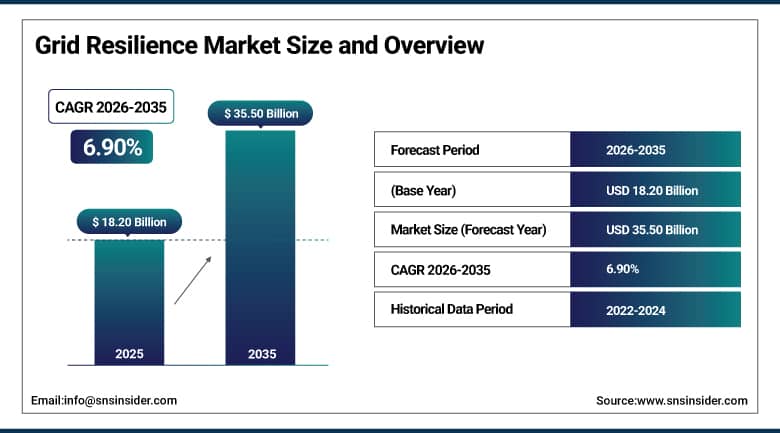
The Grid Resilience Market was valued at USD 18.20 Billion in 2025 and is projected to reach USD 35.50 Billion by 2035, registering a CAGR of 6.90% from 2026 to 2035.
The growth of the Grid Resilience Market is being driven by the increasing risks posed by climate-related disruptions, digital transformation in the energy industry, regulatory demands and funding initiatives favoring grid modernization, and varied applications in transmission, distribution, and generation systems around the world. The use of real-time monitoring solutions, collaboration between technology companies and utility providers, and growth of predictive analytics capability using AI have been made possible after huge investments by utilities, industrial organizations, and governments towards building resilient and adaptive grid systems.
Grid resilience solutions are used to help utility providers and grid systems cope, adjust to, and quickly recover from disturbances due to extreme weather conditions, cyber-attacks, and an increasing number of distributed energy resources. The solutions comprise hardware such as sensors, automatic switches, and circuit breakers, software based on big data and AI for predictive analytics, and service offerings including consulting, integration, and management.
To Get More Information On Grid Resilience Market - Request Free Sample Report
Grid Resilience Market Trends
-
Rising frequency of extreme weather events continues accelerating investment in self-healing grid networks.
-
Growing cyber threats targeting critical infrastructure continue driving demand for resilient security architectures.
-
Expanding distributed energy resource integration is broadening demand for advanced grid management platforms.
-
Increasing adoption of digital twins and simulation tools continues improving resilience strategy planning.
-
Growing regulatory mandates and government funding continue shaping utility grid modernization investment.
U.S. Grid Resilience Market Outlook
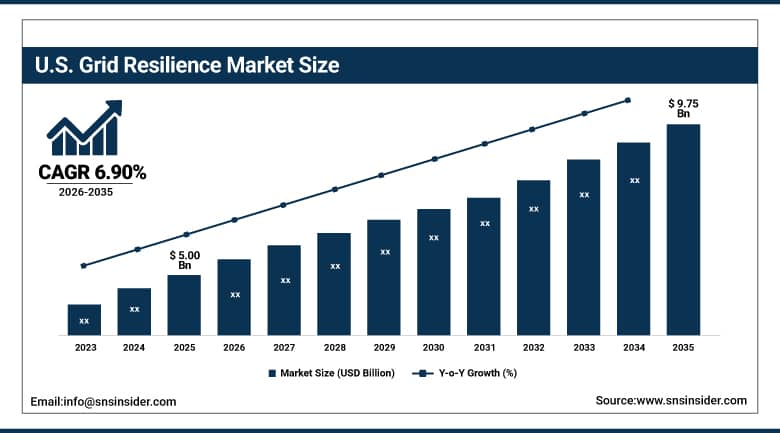
The U.S. Grid Resilience Market was valued at approximately USD 5.00 Billion in 2025 and is projected to reach approximately USD 9.75 Billion by 2035, registering a CAGR of approximately 6.90% from 2026 to 2035.
In the U.S., demand has been spurred by large investments in grid modernization programs, frequent occurrence of weather events, and an active regulatory landscape, facilitated by federal funding and state regulations. The nation is experiencing a fast pace of implementation of cutting-edge technology solutions, intended to boost grid reliability, integrate renewables, and cope with climate-induced disruptions in investor-owned and municipal utilities.
AI-based predictive analytics and automated fault detection software solutions were key to the consolidation of market leadership within the domain of grid resilience in the U.S. Moreover, growing installation of cybersecurity-enabled grid architecture by utilities controlling highly interconnected systems was also crucial for the demand growth for the product.
Grid Resilience Market Segment Analysis
-
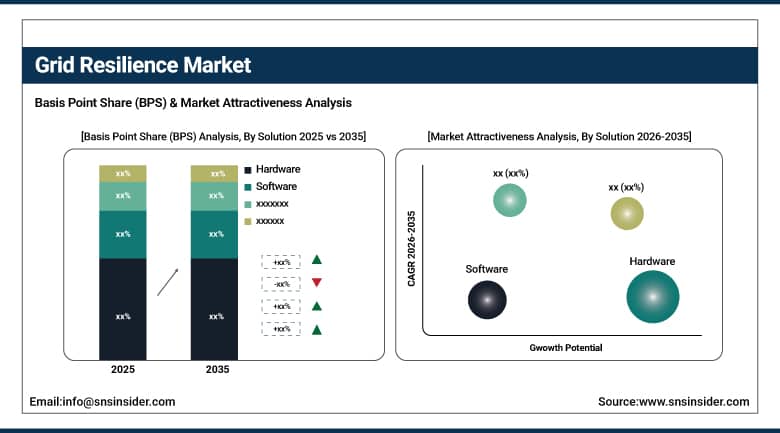
By Solution, Hardware segment dominated the Market in 2025 with 44.60% share; Software segment is the fastest growing segment, registering a CAGR of approximately 9.20%.
-
By Application, Distribution segment dominated the market in 2025 with 42.80% share; Transmission segment is the fastest growing segment, registering a CAGR of approximately 8.60%.
-
By End-User, Utilities segment dominated the market in 2025 with 48.60% share; Residential segment is the fastest growing segment, registering a CAGR of approximately 9.80%.
-
By Deployment Mode, On-Premises segment dominated the market in 2025 with 58.40% share; Cloud segment is the fastest growing segment, registering a CAGR of approximately 10.20%.
By Solution, Hardware Dominates the Grid Resilience Market While Software Grows Fastest
The hardware held the largest share of around 44.60% in the Grid Resilience Market in 2025, comprising of sophisticated sensors, automatic switches, circuit breakers, and energy storage devices which make up the resilient grid infrastructure. Increasing use of distributed energy resources and microgrids is fueling the need for efficient hardware that can help manage the decentralized power supply, especially in disaster-prone regions where quick segregation and recovery of the impacted grid portions is necessary.
Software is expected to grow at a CAGR of about 9.20%, which is the fastest among the Solution segments. This is due to the adoption of sophisticated software applications using big data, artificial intelligence, and machine learning technologies, helping utilities measure the efficiency of the grid, predict equipment failure, and balance the loads. Increasing adoption of digital twin technologies is adding more impetus to this growing trend.
By Application, Distribution Dominates the Grid Resilience Market While Transmission Grows Fastest
Application in distribution segment had maximum market share in 2025 accounting for around 42.80%, considering that the distribution networks are highly susceptible to disruptions due to weather conditions, failure of equipment, and cyberattacks because of their wide geographical coverage and decentralized nature. Automated reclosers, smart meters, and fault location, isolation, and service restoration system have been contributing significantly to the dominance of this segment within utilities with large distribution networks.
Transmission application is expected to grow with highest CAGR of around 8.60%, owing to increasing use of technologies such as high voltage direct current and dynamic line rating system that helps transmission networks withstand and recover from extreme conditions. Increasing cross border interconnection and penetration of renewable energy are adding further impetus to its rapid growth.
By End-User, Utilities Lead the Grid Resilience Market While Residential Grows Fastest
Utilities have come to dominate the end-user segment with a revenue share of around 48.60% for 2025 because of their direct involvement in the generation, transmission, and distribution of electricity, which makes them the main players in all grid resilience programs. With renewables and distributed energy resources gaining higher adoption levels, the need for more advanced grid resilience techniques increases.
Residential will be the most dynamic one, with a CAGR of around 9.80% owing to the increased use of rooftop solar, home energy storage, and smart homes, which can serve as emergency power sources. The trend towards self-generation and energy management makes Residential a valuable end-user segment that is likely to expand its revenues further.
By Deployment Mode, On-Premises Leads the Grid Resilience Market While Cloud Grows Fastest
In 2025, the On-Premises deployment segment was the largest market segment with a market share of around 58.40% as it was the most preferred option for utilities and other organizations owing to their security, compliance, and control needs. The On-Premises deployment solution is most preferred by companies in those regions that have strong regulations concerning critical infrastructure protection.
The Cloud deployment segment is expected to be the fastest growing segment with a CAGR of 10.20% during the forecast period owing to its scalability, flexibility, and cost-effectiveness that help utilities gain access to advanced analytics and monitoring tools without having to make heavy investments in infrastructure initially.
Regional Analysis:
|
Region |
Major Country |
Share within Region, 2025 (%) |
|---|---|---|
|
North America |
United States |
82.00% |
|
Europe |
Germany |
26.00% |
|
Asia Pacific |
China |
34.00% |
|
Middle East and Africa |
Saudi Arabia |
30.00% |
|
Latin America |
Brazil |
55.00% |
North America Grid Resilience Market Insights
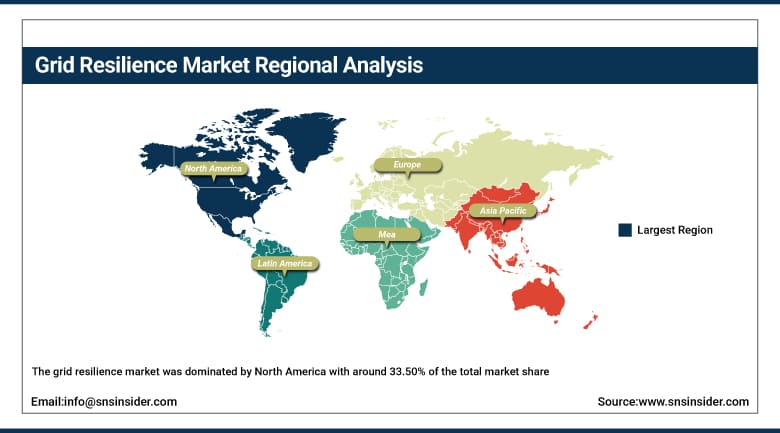
The grid resilience market was dominated by North America with around 33.50% of the total market share, driven by the extensive grid modernization efforts, occurrence of several extreme weather conditions, and favorable regulatory policies. The United States leads in the initiatives for grid resilience, owing to the financial support from the government, mandates by states, and collaboration between public and private sectors, while Canada remains committed to grid modernization and resilient systems.
In North America, the share of revenue generated by the United States stood at about 82.00%, owing to the fast adoption of hardware, software, and services for improved reliability of grids, renewable energy integration, and mitigation of climate change disruptions.
Get Customized Report as Per Your Business Requirement - Enquiry Now
Europe Grid Resilience Market Insights
The Europe region commanded a significant market share in the Grid Resilience Market owing to its promising growth opportunities that are facilitated through the Green Deal, renewable energy targets, and grid connections in the region. Some of the countries leading the adoption of advanced grid resilience technology in the Europe region include Germany, UK, and France due to the high amount of renewable energy generated.
The Germany region led the Europe market based on revenue share, holding around 26.00% of the regional share due to a collaborative effort towards grid modernization. On the other hand, UK and France remained important contributors to the Europe market as a result of investments made in the digitalization and cybersecurity sectors.
Asia Pacific Grid Resilience Market Insights
Asia Pacific is expected to be the fastest growing region with an estimated CAGR of 7.80% between 2026 to 2035. Rapid urbanization, rising energy consumption, and government measures to replace old infrastructures in China, India, Japan, South Korea, and South East Asia are the key driving factors behind this development. In particular, this holds true for regions prone to natural calamities.
China had a majority share in terms of revenue in the Asia Pacific region. The reason for this was its substantial investment in renewable energy, smart grid technologies, and disaster preparedness. Likewise, the growing need for energy availability and rural electrification in India, Japan, and South Korea drove the overall growth of the region.
MEA and Latin America Grid Resilience Market Insights
Both the Middle East & Africa and Latin America continued to register consistent growth, with the former and latter tackling issues associated with grid reliability, connectivity, and affordability, though at a relatively slower rate compared to other more matured regions. Increasing infrastructure investment in these regions by governments coupled with higher installations of renewables needing resilient solutions has made these regions key markets for grid resilience solutions for the coming decade.
For the Middle East & Africa, Saudi Arabia dominated the demand in the region with an approximate market share of 30.00%, attributable to investments in grid modernization associated with the energy diversification strategy in the country. For Latin America, Brazil retained its leadership position with an approximate market share of 55.00% owing to the country's vast power network.
Market Dynamics:
Growth Drivers: Increasing Frequency of Climate-Induced Disruptions
Market progress is propelled by the ever-growing number and intensity of natural disruptions, such as hurricanes, wildfires, floods, which cause unprecedented strain on the current grid system and lead to outages and major financial losses. There are substantial investments made into developing sophisticated grid resilience systems, which include monitoring and self-healing grids among others. Further supporting arguments include digital transformation in the energy industry through the use of smart grid technologies, IoT devices, and advanced analytics software. Another contributing factor to the growing momentum of the market throughout the forecast period is the rise of cybersecurity threats to the energy infrastructure.
Restraints: High Cost and Complexity of Implementation
The high costs and complexities of installing advanced resilient solutions continue to pose considerable challenges towards increasing adoption in the market as updating the existing infrastructure and installing new technologies involve huge capital investments. This problem especially exists in smaller utilities that have less budgets. The other major challenge is the issue of uncertainties in regulations and slow policy-making process. Such issues may act as a barrier to market growth by making the adoption of resilient solutions difficult. The issues of cybersecurity and increased vulnerabilities caused by higher digitalization need to be addressed to increase stakeholder confidence.
Opportunities: Advanced Analytics and Distributed Energy Management
There are significant opportunities within advanced analytics, artificial intelligence, and distributed energy management due to the digitization of the power grid infrastructure results in the collection of large volumes of data which can be used to improve efficiency and increase resilience of systems. Platforms offered by Siemens and Hitachi Energy which include AI-powered grid analytics together with automatic responses represent an example of how vendors take advantage of this expanding workflow in order to distinguish themselves in the market. Moreover, there is a rising focus on sustainability and decarbonization which results in a need for technologies capable of working with variable generation, supporting electrification and flexible operation of the grid.
Recent Developments:
-
2026: Quanta Services secured a large-scale grid hardening infrastructure contract supporting utility wildfire mitigation and storm resilience programs.
-
2026: Honeywell International expanded its grid analytics platform with new AI-driven anomaly detection capabilities for utility cybersecurity applications.
-
2025: ABB launched an enhanced ABB Ability grid resilience platform integrating real-time fault detection with automated self-healing network capabilities.
-
2025: Schneider Electric upgraded its EcoStruxure Grid platform with new resilience modules supporting predictive maintenance for utility-scale infrastructure.
-
2025: S&C Electric Company expanded its IntelliRupter self-healing grid technology line, enhancing automated fault isolation for distribution networks.
-
2025: Cisco Systems expanded its industrial networking portfolio with grid-hardened connectivity solutions supporting utility resilience initiatives.
Grid Resilience Market key players are:
-
ABB Ltd.
-
Siemens AG
-
Schneider Electric SE
-
GE Vernova Inc.
-
Eaton Corporation plc
-
Hitachi Energy Ltd.
-
Mitsubishi Electric Corporation
-
S&C Electric Company
-
Schweitzer Engineering Laboratories, Inc.
-
Cisco Systems, Inc.
-
Oracle Corporation
-
Honeywell International Inc.
-
Landis+Gyr Group AG
-
Itron Inc.
-
Nexans S.A.
-
Xylem Inc.
-
Siemens Energy AG
-
CG Power and Industrial Solutions Limited
-
Toshiba Energy Systems & Solutions Corporation
-
Quanta Services, Inc.
Grid Resilience Market Report Scope:
| Report Attributes | Details |
|---|---|
| Market Size in 2025 | USD 18.20 Billion |
| Market Size by 2035 | USD 35.50 Billion |
| CAGR | 6.90% from 2026 to 2035 |
| Base Year | 2025 |
| Forecast Period | 2026-2035 |
| Historical Data | 2022-2024 |
| Report Scope & Coverage | Market Size, Segments Analysis, Competitive Landscape, Regional Analysis, DROC & SWOT Analysis, Forecast Outlook |
| Key Segments | •Solution (Hardware, Software, Services) •Application (Transmission, Distribution, Generation) •End-User (Utilities, Industrial, Commercial, Residential) •Deployment Mode (On-Premises, Cloud) |
| Regional Analysis/Coverage | North America (US, Canada), Europe (Germany, UK, France, Italy, Spain, Russia, Poland, Rest of Europe), Asia Pacific (China, India, Japan, South Korea, Australia, ASEAN Countries, Rest of Asia Pacific), Middle East & Africa (UAE, Saudi Arabia, Qatar, South Africa, Rest of Middle East & Africa), Latin America (Brazil, Argentina, Mexico, Colombia, Rest of Latin America). |
| Company Profiles | ABB Ltd., Siemens AG, Schneider Electric SE, GE Vernova Inc., Eaton Corporation plc, Hitachi Energy Ltd., Mitsubishi Electric Corporation, S&C Electric Company, Schweitzer Engineering Laboratories, Inc., Cisco Systems, Inc., Oracle Corporation, Honeywell International Inc., Landis+Gyr Group AG, Itron Inc., Nexans S.A., Xylem Inc., Siemens Energy AG, CG Power and Industrial Solutions Limited, Toshiba Energy Systems & Solutions Corporation, Quanta Services, Inc. |

Frequently Asked Questions
Key players in the Grid Resilience Market include ABB Ltd., Siemens AG, Schneider Electric SE, GE Vernova Inc., and Eaton Corporation plc, among others.
Key opportunities in the Grid Resilience Market include advanced analytics, artificial intelligence, and distributed energy management, alongside growing emphasis on sustainability and decarbonization requiring resilient grid infrastructure.
The market is driven by the increasing frequency and severity of climate-induced disruptions, accelerating digital transformation within the energy sector, and the increasing incidence of cyber threats targeting critical energy infrastructure.
The Hardware segment dominated the Grid Resilience Market, accounting for approximately 44.60% market share.
The North America region dominated the Grid Resilience Market in 2025 with a 33.50% share, driven by substantial investments in grid modernization and a high incidence of extreme weather events.
