
Variant Interpretation Market Report Scope & Overview:
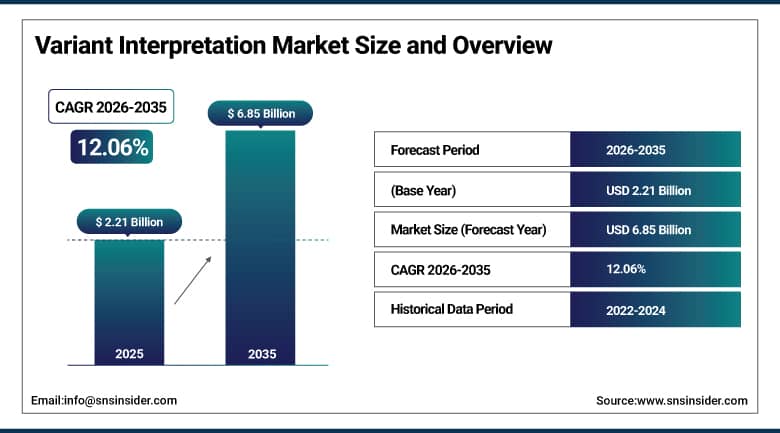
The Variant Interpretation Market was valued at USD 2.21 billion in 2025 and is expected to reach USD 6.85 billion by 2035, growing at a CAGR of 12.06% from 2026-2035.
The Variant Interpretation Market is witnessing strong growth Because of the rise in the use of next-generation sequencing (NGS), precision medicine, and genetic tests. The rising numbers of rare genetic diseases, hereditary diseases, and cancer are raising the need for variant interpretation solutions. Technological advancements in the form of artificial intelligence, machine learning, and bioinformatics on the cloud computing platform are helping in faster and accurate interpretation of genetic information. Moreover, technological advancement in genomic research studies, personalized medicine, and genomics testing are fueling the growth of the market.
According to the World Health Organization (WHO), around 20 million new cancer cases and 9.7 million cancer deaths were recorded globally in 2022, increasing demand for genomic testing and clinical variant interpretation in precision oncology.
To Get More Information On Variant Interpretation Market - Request Free Sample Report
Variant Interpretation Market Trends
-
The growing adoption of precision medicine and personalized healthcare services is substantially boosting the need for advanced variant interpretation software solutions.
-
The increasing use of next-generation sequencing technologies is contributing to the generation of massive volumes of genomic data, thereby escalating the need for variant interpretation software.
-
The increasing incidence of genetic disorders, rare diseases, and inherited cancers is augmenting the usage of clinical variant interpretation software in diagnostic labs across the world.
-
The development of artificial intelligence, machine learning, and bioinformatics technologies is increasing the accuracy of interpretation and lowering turnaround times.
-
The rising investment in genomic research, population sequencing programs, and precision oncology activities is providing substantial growth opportunities for market players across the globe.
U.S. Variant Interpretation Market Outlook
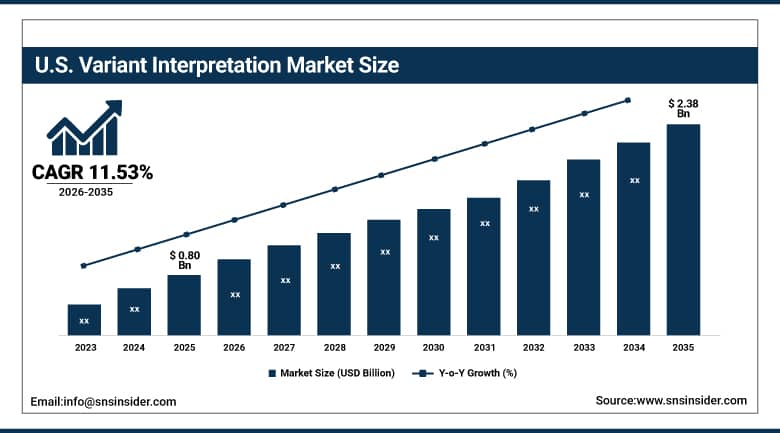
U.S. Variant Interpretation Market was valued at USD 0.80 billion in 2025 and is expected to reach USD 2.38 billion by 2035, growing at a CAGR of 11.53% from 2026-2035.
The U.S. Variant Interpretation Market is experiencing strong growth owing to the genomic research infrastructure of the nation, extensive utilization of next-generation sequencing methods, and precision medicine. The rise in the prevalence of cancer and genetic disorders has increased the demand for accurate genetic variant interpretation within diagnostic laboratories and hospitals. High investment in genomics research coupled with effective government support, together with the presence of biotechnology firms and bioinformatics companies, is fueling market growth. In addition, advancements in AI-based interpretation solutions and adoption of genomic testing by patients are driving market growth.
In FY2025, the National Cancer Institute (NCI) received US$7.2 billion in funding to strengthen cancer research initiatives. The investment supports cancer genomics, precision oncology, clinical sequencing, and data-driven research, accelerating advances in genomic medicine and improving clinical variant interpretation capabilities.
Variant Interpretation Market Segment Analysis
-
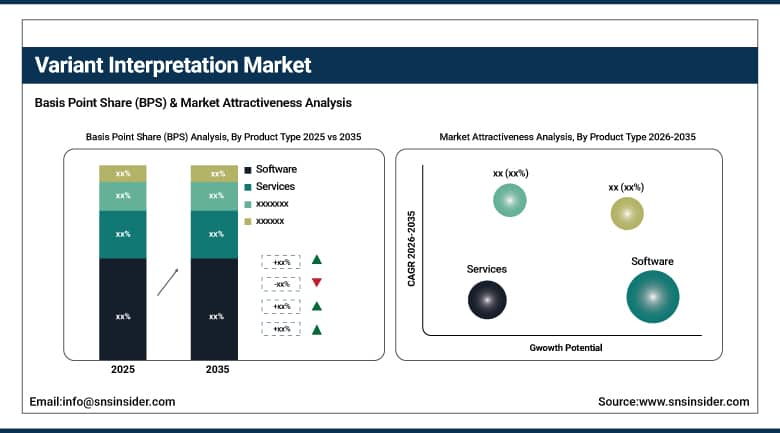
By Product Type, Software dominated the variant interpretation market with 68% share in 2025; Software is expected to grow at the fastest CAGR of 12.70% from 2026–2035.
-
By Application, Clinical Diagnostics dominated the variant interpretation market with 43% share in 2025; Drug Development is expected to grow at the fastest CAGR of 16.52% from 2026–2035.
-
By End User, Hospitals and Clinics dominated the Variant Interpretation Market with 39% share in 2025; Pharmaceutical and Biotechnology Companies is expected to grow at the fastest CAGR of 14.24% from 2026–2035.
By Product Type, Software dominates the variant interpretation market, Software grow fastest.
Software segment dominated the variant interpretation market with the largest share of 68% in 2025, owing to the rising utilization of interpretation platform based on AI, automated tools for variant classification, and cloud genomics solutions. Increase in the volume of genomic data and the need for a speedy and standard interpretation procedure, along with easy integration with laboratory information system and software advancements, are some of the factors that lead to this.
By Application, Clinical Diagnostics dominates the variant interpretation market, Personalized Medicine grows fastest
Clinical Diagnostics segment dominated the variant interpretation market will have the largest market share of 43%, thanks to the rising popularity of genomic testing for identifying rare diseases, hereditary conditions, and cancers. Increased adoption of precision medicine, rising access to next-generation sequencing solutions, and increasing need for precise genetic variant classification in hospitals and diagnostic labs has been major factors behind the growth of this segment. Continuous advances in clinical decision support solutions and interpretation guidelines have played an important role in making it a dominant player in the market.
The Personalized Medicine segment is estimated to witness the fastest CAGR of 16.5% between 2026 and 2035 due to increasing demand for personalized treatment methods based on patients' genetics. Growing integration of genomic information in treatment decisions, rising use of companion diagnostics, rising investments in precision medicine, and advanced artificial intelligence-based variant interpretation platforms have accelerated the adoption of this method. Increasing incidence of chronic and genetic diseases, along with the growing genomic research, is another factor behind the rapid growth of this segment.
By End User, Hospitals and Clinics dominate the variant interpretation market, Pharmaceutical and Biotechnology Companies grow fastest.
Hospitals and Clinics segment dominated the variant interpretation market holding the largest market share in revenue of approximately 39% in 2025 due to the increasing use of genomic tests in the clinical setting for the diagnosis of cancers, rare diseases, and inherited disorders. Increased patient volume, growth in precision medicine initiatives, advancements in diagnostic infrastructure, and higher adoption of next-generation sequencing technology have considerably boosted the demand for precise interpretation of variants in healthcare organizations.
The Pharmaceuticals and Biotechnology Companies segment is anticipated to witness the fastest CAGR of 14.24 % from 2026 to 2035 on account of increased funding for precision medicine, targeted drugs, and genomics biomarkers. Rising application of variant interpretation in clinical trials, patient selection, development of companion diagnostics, and target discovery, and AI-enabled genomics analytics, has propelled its adoption among pharmaceutical and biotechnology companies.
Regional Analysis
|
Region |
Major Country |
Share within Region, 2025 (%) |
|---|---|---|
|
North America |
United States |
84.34% |
|
Europe |
Germany |
22.8% |
|
Asia Pacific |
China |
38.6% |
|
Middle East & Africa |
UAE |
24.7% |
|
Latin America |
Brazil |
46.2% |
North America Variant Interpretation Market Insights
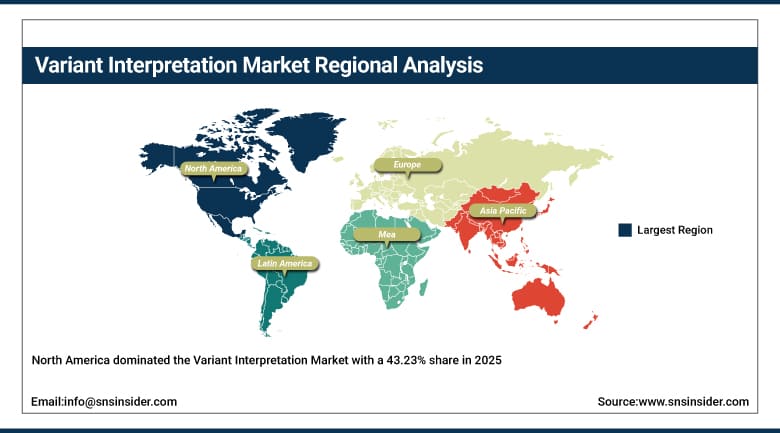
North America dominated the Variant Interpretation Market with a 43.23% share in 2025, Backed by its superior genomic healthcare ecosystem, advanced use of next generation sequencing (NGS) and presence of top players in biotechnology and molecular diagnostic space. The region enjoys huge investments in precision medicine, clinical genomics, and variant interpretation platforms based on artificial intelligence. Good reimbursement policies, regulatory framework, and robust research grants have made genome testing an important part of regular clinical practice.
The United States forms the major portion of the North American Variant Interpretation Market, owing to its superior genomic infrastructure, adoption of next generation sequencing (NGS), advances in precision medicine and presence of prominent biotechnology companies, growing at a CAGR of 84.34%. Canada too plays a role in making North America dominate the market.
Get Customized Report as Per Your Business Requirement - Enquiry Now
Europe Variant Interpretation Market Insights
Europe's Variant Interpretation Market is witnessing strong growth due to increasing adoption of genomic sequencing in clinical diagnostics, rising prevalence of rare and inherited diseases, and expanding precision medicine initiatives. The countries that include Germany, the UK, France, and the Netherlands are spending a lot on their genomic research, bioinformatics facilities, and artificial intelligence-based interpretation platform. More cooperation is seen among the research centers, healthcare organizations, and biotech companies in the region which is leading to increased innovations. Regulatory frameworks, increasing need for personalized treatments, and continuous developments in next-generation sequencing technologies are contributing towards market expansion in the region.
Germany constitutes a large portion of the Europe Variant Interpretation Market, owing to the availability of highly developed healthcare facility, well-structured genomic research and growing usage of precision medicine solutions in the region. Germany is experiencing growth, due to increased investment in next generation sequencing, clinical diagnosis and bioinformatics platform. Due to increased genetic testing usage, innovation in healthcare with government support, and availability of top-notch research institutions, Germany is forecasted to experience growth with a CAGR of 22.8%.
Asia Pacific Variant Interpretation Market Insights
The Asia Pacific region will see a high growth rate at a CAGR of 13.79% during the forecast period because of the increased use of next-generation sequencing technologies, increased funding for genome studies, and increased focus on precision medicine in countries such as China, Japan, and India. The growing prevalence of genetic disorders, cancers, and rare diseases is fueling the need for more effective variant interpretation solutions. Government backing for genomics initiatives, developing healthcare infrastructure, and growing collaborations among biotech companies and research organizations are further driving market growth.
China is anticipated to witness a CAGR of 38.6% during the forecast period, owing to the growing use of genomics testing and precision medicine, and the presence of advanced healthcare research facilities in the region. China is rapidly growing due to initiatives by the government to back genetic research, prevalence of rare diseases, and technological developments in next-generation sequencing technologies. Growing collaborations among biotech companies, research institutions, and healthcare providers, along with growing adoption of artificial intelligence-based variant interpretation solutions are helping China emerge as an important player in the Asia Pacific Variant Interpretation Market.
Middle East & Africa and Latin America Variant Interpretation Market Insights
The Middle East & Africa and Latin America Variant Interpretation Market is witnessing continuous growth because of rising adoption of genomic tests, increasing developments in precision medicines and improving healthcare infrastructure. Some countries such as UAE, Saudi Arabia, South Africa, Brazil, Mexico and Argentina have invested in molecular diagnostics, clinical genomics, and bioinformatics services. Collaboration between research institutes, healthcare organizations and biotech companies, as well as awareness about hereditary diseases and AI-based variant interpretation solutions are helping in market adoption and future market development of the region.
UAE is estimated to witness a CAGR of 24.7% during the forecast period due to increasing investment in genomics, precision medicines and improved healthcare infrastructure.
Market Dynamics
Growth Drivers: Increasing Adoption of Precision Medicine and Genomic Testing Accelerates Demand for Accurate Variant Interpretation Solutions
Growing adoption of precision medicine approaches is leading to an increased need for advanced variant interpretation techniques within healthcare and research fields. Increased use of next-generation sequencing technology has led to the generation of massive amounts of genomic data that require interpretation in order to discover disease-related mutations. The growing incidences of cancer, rare genetic diseases, and hereditary conditions have been prompting doctors to include genome testing in their diagnostic and treatment procedures. In addition, the pharmaceutical industry is increasingly making use of genomics in the development of drugs and conducting clinical trials.
Restraints: Data Privacy Concerns and Regulatory Challenges Restrict Widespread Use of Genomic Interpretation Technologies Globally
Growing concerns regarding genomic data privacy, security, and regulatory compliance are These are some of the obstacles that might hinder the widespread adoption of technology for interpreting variants. Information in the genome is very private and hence requires tight security measures. The increasing number of data protection regulations in various locations makes it hard for firms that are operating in more than one market. There is also the problem of inconsistency in regulatory requirements for genomic tests and interpretation of results. In addition, there are concerns from the patients on the sharing of genetic information that might affect the use of genomics testing services.
Opportunities: Expanding integration of artificial intelligence with genomic analytics creates stronger clinical interpretation capabilities and efficiency
Expanding integration of artificial intelligence into genomic analytics offers many opportunities for growth in the field of variant interpretation. AI-based technology can quickly analyze millions of genetic variants, link up with the scientific literature, consider clinical data, and produce very accurate interpretation reports. With each publication, clinical outcome, and database update, machine learning systems constantly learn and develop their abilities.
All of these developments minimize the effort required to conduct manual reviews while increasing the speed and accuracy of the interpretation process. Many health care providers look for automated solutions that will allow them to diagnose patients more quickly and accurately. There is also a need for pharmaceutical companies in AI technology to find biomarkers and develop targeted drugs.
Recent Developments:
-
2025: Illumina introduced Connected Insights v5.2 with enhanced interpretation accuracy, visualization features, and broader assay compatibility for precision oncology and genomic variant analysis.
-
2025 Bionano upgraded VIA and Solve software platforms using AI-based workflows to automate variant calling, annotation, and interpretation across OGM, microarray, and NGS data.
-
2025: QIAGEN Clinical Insight Interpret One was selected for Royal Marsden’s liquid biopsy service, enabling AI-supported variant interpretation for ESR1 mutation testing in breast cancer.
Variant Interpretation Market key players are:
-
Illumina, Inc.
-
Thermo Fisher Scientific, Inc.
-
QIAGEN N.V.
-
Agilent Technologies, Inc.
-
F. Hoffmann-La Roche Ltd.
-
Invitae Corporation
-
Fabric Genomics, Inc.
-
GeneDx (a subsidiary of Sema4)
-
PierianDx, Inc.
-
Sophia Genetics SA
-
Centogene N.V.
-
BC Platforms AG
-
Golden Helix, Inc.
-
Congenica Ltd.
-
DNAnexus, Inc.
-
WuXi NextCODE
-
Strand Life Sciences Pvt. Ltd.
-
GENALICE B.V.
-
Saphetor SA
-
Paragon Genomics, Inc.
Variant Interpretation Market Report Scope:
| Report Attributes | Details |
|---|---|
| Market Size in 2025 | USD 2.21 Billion |
| Market Size by 2035 | USD 6.85 Billion |
| CAGR | CAGR of 12.06% From 2026 to 2035 |
| Base Year | 2025 |
| Forecast Period | 2026-2035 |
| Historical Data | 2022-2024 |
| Report Scope & Coverage | Market Size, Segments Analysis, Competitive Landscape, Regional Analysis, DROC & SWOT Analysis, Forecast Outlook |
| Key Segments | By Product Type (Software, Services) By Application (Clinical Diagnostics, Research, Personalized Medicine, Drug Development, Others) By End-User (Hospitals and Clinics, Research Laboratories, Pharmaceutical and Biotechnology Companies, Others) |
| Regional Analysis/Coverage | North America (US, Canada), Europe (Germany, UK, France, Italy, Spain, Russia, Poland, Rest of Europe), Asia Pacific (China, India, Japan, South Korea, Australia, ASEAN Countries, Rest of Asia Pacific), Middle East & Africa (UAE, Saudi Arabia, Qatar, South Africa, Rest of Middle East & Africa), Latin America (Brazil, Argentina, Mexico, Colombia, Rest of Latin America). |
| Company Profiles | Illumina, Inc., Thermo Fisher Scientific, Inc., QIAGEN N.V., Agilent Technologies, Inc., F. Hoffmann-La Roche Ltd., Invitae Corporation, Fabric Genomics, Inc., GeneDx (a subsidiary of Sema4), PierianDx, Inc., Sophia Genetics SA, Centogene N.V., BC Platforms AG, Golden Helix, Inc., Congenica Ltd., DNAnexus, Inc., WuXi NextCODE (now part of WuXi AppTec), Strand Life Sciences Pvt. Ltd., GENALICE B.V., Saphetor SA, and Paragon Genomics, Inc. |
Frequently Asked Questions
The Variant Interpretation Market is expected to grow at a CAGR of 12.06 from 2026 to 2035.
The major growth factor driving the Variant Interpretation Market is the rising adoption of next-generation sequencing (NGS) and precision medicine, increasing the need for accurate genomic data analysis.
The Software segment dominated the Variant Interpretation Market in 2025.
