
VLSI Semiconductors Market Report Scope and Overview:
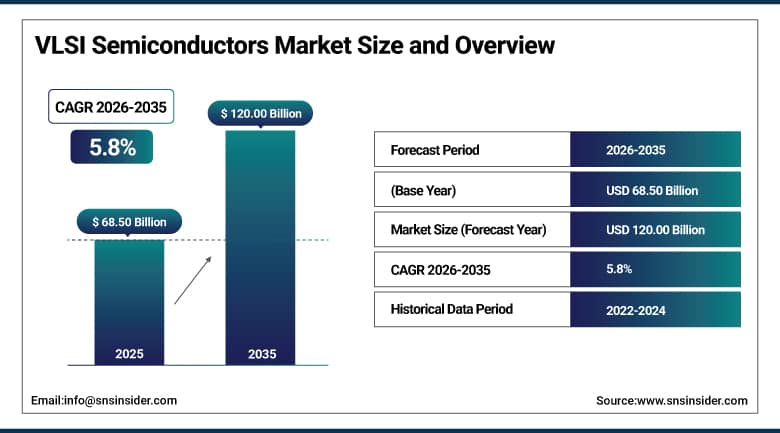
The VLSI Semiconductors Market size was valued at USD 68.50 Billion in 2025 and is projected to reach USD 120.00 Billion by 2035, registering a CAGR of 5.8% from 2026 to 2035.
The VLSI Semiconductors Market will help to continue with the miniaturization and improvement of modern electronics with the help of integrating millions to billions of transistors into single integrated circuits. The VLSI Semiconductors Market consists of increasing integration of AI/ML into chip design process, increasing usage of FinFET and next generation gate all around transistor architecture, and increasing use of 3D IC and heterogeneous integration packaging technology. There is an increase in the demand for VLSI semiconductors in 5G telecommunication equipment, electric vehicles, and automation industry, since the semiconductor players and the government both are putting money in manufacturing and chip design technologies that can continue to improve performance.
TSMC began constructing its third semiconductor manufacturing plant in Arizona during 2025, which will be one of the biggest investments for creating 2 nanometer high performance computing chips in the U.S., totaling $100 billion.
To Get More Information On VLSI Semiconductors Market - Request Free Sample Report
VLSI Semiconductors Market Trends
-
Growing integration of artificial intelligence and machine learning into chip design workflows continues accelerating design cycles and reducing costs.
-
Rising adoption of FinFET and emerging gate-all-around transistor architectures continues supporting sustained performance scaling at advanced process nodes.
-
Increasing deployment of 3D IC and heterogeneous integration packaging techniques continues enabling higher transistor density within compact form factors.
-
Expanding 5G telecommunications infrastructure rollout continues driving demand for advanced chipsets across base stations and network equipment.
-
Growing government investment in domestic semiconductor manufacturing capability continues reshaping the geography of VLSI chip production worldwide.
U.S. VLSI Semiconductors Market Size Outlook
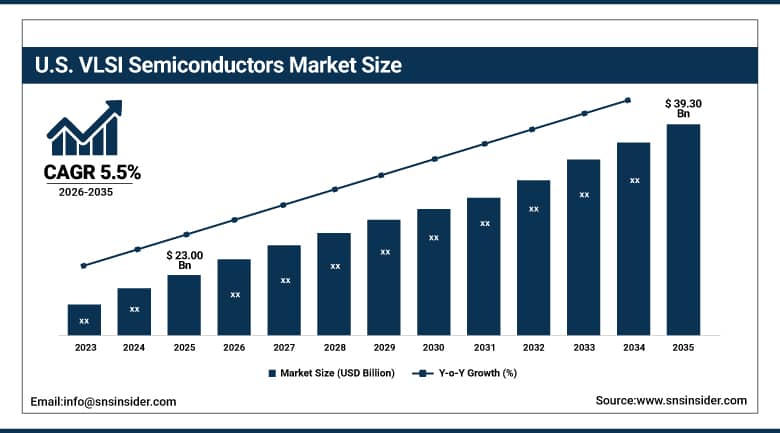
The U.S. VLSI Semiconductors Market was valued at approximately USD 23.00 Billion in 2025 and is projected to reach approximately USD 39.30 Billion by 2035, registering a CAGR of approximately 5.5% from 2026 to 2035.
Demand across the United States continued to be shaped by a deep concentration of leading VLSI chip designers, electronic design automation software providers, and foundries, alongside substantial investment in research and development and advanced manufacturing processes such as FinFET and gate-all-around technologies. Rising deployment of domestically fabricated logic and memory devices by leading fabless companies continued reinforcing the country's position as both the largest and most innovation-driven market tracked in this report. Growing adoption across data centers, automotive electronics, and defense computing applications added further layers of sustained domestic demand well beyond the technology's traditional personal computing use case.
Intel Corporation expanded its Core Ultra Series 2 portfolio throughout 2025 with the launch of new 200U, 200H, 200HX, and 200S series processors, strengthening its position in the AI PC commercial market.
VLSI Semiconductors Market Segment Analysis
-
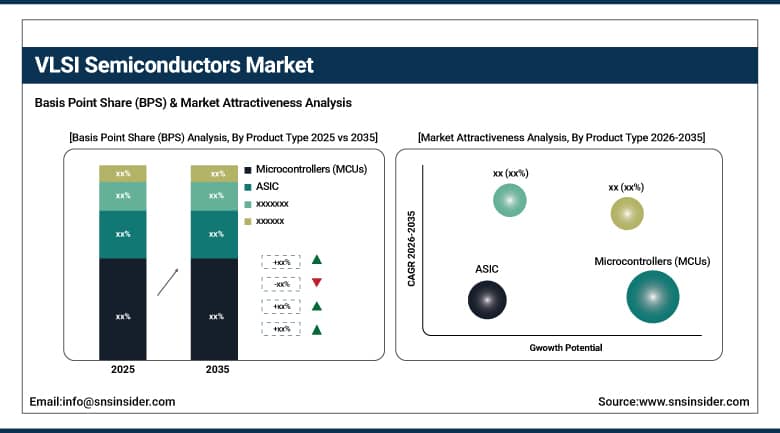
By Product Type, Microcontrollers (MCUs) segment dominated the VLSI Semiconductors Market in 2025 with 34% share; ASIC segment is the fastest growing segment.
-
By Technology, FinFET segment dominated the market in 2025 with 46% share; GAA (Gate-All-Around) segment is the fastest growing segment.
-
By Application, Consumer Electronics segment dominated the market in 2025 with 39% share; Telecommunications & 5G Infrastructure segment is the fastest growing segment.
-
By Manufacturing Type, Foundry segment dominated the market in 2025 with 58% share; OSAT segment is the fastest growing segment.
By Product Type, MCUs Lead While ASIC Grows Fastest
In 2025, the Microcontrollers (MCU) segment ruled the VLSI Semiconductors Market because of the wide range of applications that make use of them, such as consumer electronics, automotive electronics, industrial automation, and medical electronics, which include highly economical, small-sized, and power-efficient processors combining processing unit, memory unit, and I/O units on one chip. Continued growth in electric vehicle and IoT-enabled device adoption has kept MCUs the largest single revenue contributor within the product type landscape tracked in this report.
The ASIC segment is the fastest growing in the VLSI Semiconductors Market owing to rising demand for custom-designed silicon optimized for specific AI accelerator, networking, and 5G infrastructure workloads that merchant chips cannot efficiently address. Hyperscalers and telecom equipment manufacturers increasingly favor ASIC development to differentiate performance and reduce dependency on general-purpose processors. Growing investment in custom silicon design continues accelerating demand for ASIC development across the industry.
By Technology, FinFET Dominates While GAA Records Fastest Growth
The FinFET segment dominated the VLSI Semiconductors Market in 2025 due to its established position as the mainstream transistor architecture across the majority of leading-edge and mid-range process nodes currently in volume production. Foundries and fabless companies continue relying on FinFET for its proven manufacturability and broad process node coverage. Sustained volume production across established process nodes has kept FinFET the largest overall contributor to market revenue.
The GAA (Gate-All-Around) segment is the fastest growing in the VLSI Semiconductors Market owing to accelerating foundry transition toward gate-all-around architectures at 3-nanometer and below nodes to sustain continued performance and power efficiency scaling beyond FinFET limitations. Leading foundries are ramping GAA capacity to capture premium-priced customer commitments from AI accelerator and premium smartphone chip designers. Growing demand for next-generation compute efficiency continues accelerating adoption of GAA technology across leading foundry operators.
By Application, Consumer Electronics Leads While Telecom & 5G Grows Fastest
The Consumer Electronics segment dominated the VLSI Semiconductors Market in 2025 due to sustained global demand for smartphones, tablets, laptops, and wearable devices requiring increasingly sophisticated, energy-efficient chip designs. Chip designers continue prioritizing consumer electronics given the segment’s scale and recurring device replacement cycles. Sustained global consumer electronics shipment volumes have kept this application the largest overall revenue contributor across the market.
The Telecommunications & 5G Infrastructure segment is the fastest growing in the VLSI Semiconductors Market owing to the global rollout of 5G networks and increasing demand for high-speed, low-latency connectivity requiring advanced semiconductors for base stations, small cells, and edge computing equipment. Telecom operators and infrastructure providers continue investing heavily in next-generation network equipment requiring sophisticated chipsets. Accelerating 5G deployment across Asia-Pacific, North America, and Europe continues driving sustained growth in this application segment.
By Manufacturing Type, Foundry Leads While OSAT Grows Fastest
The Foundry segment dominated the VLSI Semiconductors Market in 2025 due to the continued dominance of the fabless business model across smartphone, computing, and AI chip design, which relies on third-party foundry capacity for manufacturing. Foundries have built the deepest process expertise and the largest customer bases among fabless chip designers globally. Sustained fabless industry growth has kept the foundry segment the largest overall contributor to market revenue.
The OSAT segment is the fastest growing in the VLSI Semiconductors Market owing to rising demand for advanced packaging services supporting 3D IC and heterogeneous integration architectures that combine multiple dies into single packages. Chip designers increasingly rely on outsourced assembly and test providers to implement increasingly sophisticated chiplet-based packaging solutions. Growing adoption of advanced packaging technology continues accelerating growth in the OSAT segment across the industry.
Regional Analysis
|
Region |
Major Country |
Share within Region, 2025 (%) |
|---|---|---|
|
North America |
United States |
82.00% |
|
Europe |
Germany |
23.00% |
|
Asia Pacific |
China |
38.00% |
|
Middle East and Africa |
UAE |
27.00% |
|
Latin America |
Brazil |
30.00% |
North America VLSI Semiconductors Market Insights
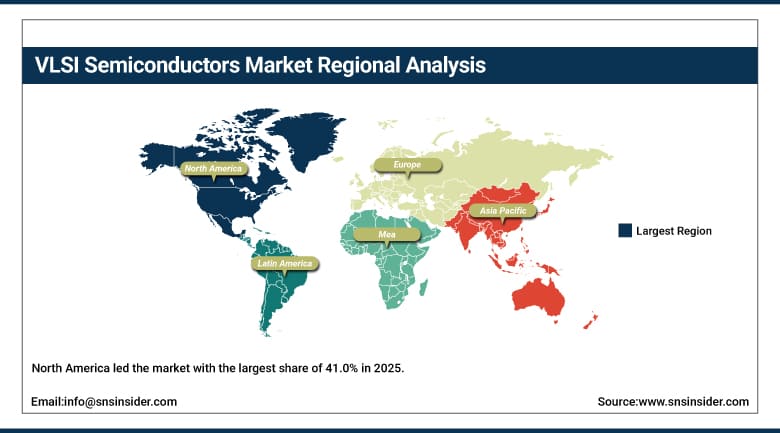
North America led the market with the largest share of 41.0% in 2025. The presence of leading VLSI chip designers, electronic design automation software providers, and foundries, alongside substantial investment in research and development and advanced manufacturing processes such as FinFET and GAA technologies, continued reinforcing the region’s dominant position. Strong government support, including initiatives to enhance domestic chip manufacturing and secure the supply chain, further strengthened North America’s standing as both the largest and one of the most innovation-driven markets tracked in this report, with continued CHIPS Act-backed investment expected to sustain regional demand through the forecast period.
The United States accounted for roughly 82.00% of regional revenue, anchored by its concentration of leading chip designers including Intel, NVIDIA, Qualcomm, and AMD, alongside a robust intellectual property framework encouraging innovation. Canada and Mexico added further regional demand through growing electronics manufacturing and assembly activity, and that combined strength kept the continent the largest addressable market for VLSI semiconductor vendors through the forecast period.
Get Customized Report as Per Your Business Requirement - Enquiry Now
Europe VLSI Semiconductors Market Insights
Europe held a meaningful share of global revenue, supported by strong automotive and industrial automation demand and continued expansion of domestic chip design capability across the region’s major economies. Regulatory momentum around the European Chips Act-backed semiconductor investment continued shaping regional development priorities without meaningfully slowing commercialization across the continent, while sustained automotive electrification investment kept the region among the more resilient VLSI semiconductor markets tracked in this report.
Germany led demand at roughly 23.00% of European revenue, supported by its substantial automotive sector and advanced industrial automation adoption. The UK and France contributed additional demand, and continued European investment in automotive electrification and industrial automation should keep regional demand for VLSI semiconductor technology climbing steadily through the forecast period.
Asia Pacific VLSI Semiconductors Market Insights
Asia Pacific held a substantial share of the VLSI Semiconductors Market in 2025, registering a CAGR of 5.9% from 2026 to 2035, supported by a strong manufacturing base, concentrated electronics and semiconductor hubs, and favorable government initiatives across the region’s largest economies. The high use of integrated VLSI chips across mobile and consumer electronics, automobiles, medical equipment, and computing devices has increased requirements for packaging and assembly equipment, while the presence of many major players in the region continued reinforcing its substantial position tracked in this report.
China led the pack, contributing the largest portion of regional revenue, supported by increasing demand for consumer electronics and automotive electronics integrated circuits. Japan and South Korea contributed meaningful additional demand, with Taiwan’s continued progress in sub-5-nanometer technology nodes expected to sustain revenue growth over the coming decade even amid cyclical fluctuations across the region.
MEA and Latin America VLSI Semiconductors Market Insights
The Middle East and Africa and Latin America both showed steady growth, driven by expanding electronics manufacturing investment, growing government focus on technology sector diversification, and rising demand for domestic assembly and chip design capability across both regions. As these markets continued building out modern electronics manufacturing infrastructure, VLSI semiconductor technology proved a genuinely valuable enabler of increasingly capable, locally assembled consumer and industrial electronics.
The UAE led Middle East and Africa demand, supported by the country’s growing electronics manufacturing investment and diversification initiatives. Saudi Arabia contributed further demand through its own industrial diversification programs. In Latin America, Brazil accounted for the largest share of regional revenue, with growing electronics assembly and manufacturing investment continuing to anchor regional demand for VLSI semiconductor technology.
Market Dynamics
Growth Drivers: Rising Demand for High-Tech Electronics and AI Integration
The industry is driven by rising need for high-tech electronic equipment across consumer electronics, automotive, healthcare, and communication sectors, growing integration of artificial intelligence and machine learning in chip design, expanding proliferation of IoT devices and data centers requiring high-performance computing capability, and increasing government reforms promoting domestic semiconductor manufacturing. As customer preferences evolve and smart functions integrate into ordinary devices, the need for advanced VLSI chip capability continues driving sustained investment across the industry.
Rising demand for AI and machine learning applications across self-driving cars, robotics, health diagnosis systems, and natural language processing continues reinforcing this driver, requiring increasingly powerful yet energy-efficient VLSI chips. Growing government investment in domestic semiconductor manufacturing across the United States, South Korea, and China continues defining a further layer of sustained demand, and that combination of AI application growth and supply chain localization is exactly what keeps overall demand climbing at such a steady, sustained pace.
Restraints: High Manufacturing Complexity and Reliability Requirements
The complicated nature and high expenses tied to semiconductor manufacturing continue posing a genuine restraint on faster market-wide expansion, as chip designs become more complex and feature sizes shrink, making development and production increasingly expensive. That cost profile has kept advanced VLSI chip development concentrated among a comparatively small number of well-resourced semiconductor companies.
Ongoing dependability and quality requirements for VLSI chips continue posing a further restraint, as manufacturers work to match strict performance standards while reducing defects across increasingly complex designs. Cyclical demand patterns and macroeconomic fluctuations, including economic recessions, geopolitical issues, and trade disagreements, further disrupt supply chains and delay investment decisions across the industry.
Opportunities: Advanced Manufacturing Technologies and Emerging Application Expansion
Advances made in the area of advanced manufacturing techniques, including extreme ultra-violet lithography and 3D integration, are certainly one of the real opportunities that can be utilized for improvements in terms of chip density, capability, and power savings. Firms that have established themselves early enough in the areas of advanced manufacturing techniques can capture market share through their capabilities as they continue growing.
Increased use of edge computing, virtual reality, augmented reality, and 5G communications provide another major opportunity for VLSI semiconductor manufacturers by opening up more markets. Manufacturers with energy-saving semiconductor devices have an excellent chance of securing a sizeable share as more importance is given to energy efficiency and durability in increasing demand for VLSI semiconductors with zero harm to the environment.
Recent Developments:
-
2025: TSMC broke ground on its third chip fabrication facility in Arizona, part of a $100 billion investment strategy to expand 2-nanometer high-performance computing chip production within the United States.
-
2025: Intel Corporation expanded its Core Ultra Series 2 portfolio with the launch of new 200U, 200H, 200HX, and 200S series processors, strengthening its position in the AI PC commercial market.
-
2026: Samsung Electronics announced it would begin delivering HBM4 memory products with 11.7 Gbps performance, aiming to reclaim leadership in the AI infrastructure and high-end memory markets.
VLSI Semiconductors Companies are:
-
Samsung Electronics Co., Ltd.
-
Taiwan Semiconductor Manufacturing Company (TSMC)
-
Broadcom Inc.
-
Qualcomm Technologies, Inc.
-
NVIDIA Corporation
-
Texas Instruments Incorporated
-
Advanced Micro Devices, Inc. (AMD)
-
Sony Semiconductor Solutions Corporation
-
Infineon Technologies AG
-
Renesas Electronics Corporation
-
GlobalFoundries Inc.
-
STMicroelectronics N.V.
-
MediaTek Inc.
-
NXP Semiconductors N.V.
-
Marvell Technology, Inc.
-
Analog Devices, Inc. (ADI)
-
onsemi (ON Semiconductor Corporation)
-
SK Hynix Inc.
VLSI Semiconductors Market Report Scope:
| Report Attributes | Details |
|---|---|
| Market Size in 2025 | USD 68.50 Billion |
| Market Size by 2035 | USD 120.00 Billion |
| CAGR | CAGR of 5.8% From 2026 to 2035 |
| Base Year | 2025 |
| Forecast Period | 2026-2035 |
| Historical Data | 2022-2024 |
| Report Scope & Coverage | Market Size, Segments Analysis, Competitive Landscape, Regional Analysis, DROC & SWOT Analysis, Forecast Outlook |
| Key Segments | • By Product Type (Microcontrollers (MCUs), Microprocessors (MPUs), ASIC, FPGA, MEMS, Analog ICs, Digital ICs, Mixed-Signal ICs) • By Technology (FinFET, Planar CMOS, GAA (Gate-All-Around), 3D IC & Heterogeneous Integration, SoC) • By Application (Consumer Electronics, Telecommunications & 5G Infrastructure, Automotive Electronics, Industrial Automation, Healthcare & Medical Devices, Others) • By Manufacturing Type (IDM, Foundry, OSAT) |
| Regional Analysis/Coverage | North America (US, Canada), Europe (Germany, UK, France, Italy, Spain, Russia, Poland, Rest of Europe), Asia Pacific (China, India, Japan, South Korea, Australia, ASEAN Countries, Rest of Asia Pacific), Middle East & Africa (UAE, Saudi Arabia, Qatar, South Africa, Rest of Middle East & Africa), Latin America (Brazil, Argentina, Mexico, Colombia, Rest of Latin America). |
| Company Profiles | Intel Corporation, Samsung Electronics Co., Ltd., Taiwan Semiconductor Manufacturing Company (TSMC), Broadcom Inc., Qualcomm Technologies, Inc., NVIDIA Corporation, Texas Instruments Incorporated, Micron Technology, Inc., Advanced Micro Devices, Inc. (AMD), Sony Semiconductor Solutions Corporation, Infineon Technologies AG, Renesas Electronics Corporation, GlobalFoundries Inc., STMicroelectronics N.V., MediaTek Inc., NXP Semiconductors N.V., Marvell Technology, Inc., Analog Devices, Inc. (ADI), onsemi (ON Semiconductor Corporation), SK Hynix Inc. |

Frequently Asked Questions
Key players in the VLSI Semiconductors Market include Intel Corporation, Samsung Electronics Co., Ltd., Taiwan Semiconductor Manufacturing Company (TSMC), Broadcom Inc., and Qualcomm Technologies, Inc., among others.
Key opportunities in the VLSI Semiconductors Market include advancements in advanced manufacturing technologies such as EUV lithography and 3D integration, along with expansion into edge computing, VR, AR, and 5G applications.
The market is driven by rising demand for high-tech electronics, increasing AI and machine learning integration, expanding IoT and data center applications, and government support for domestic semiconductor manufacturing.
The Microcontrollers (MCUs) segment dominated the VLSI Semiconductors Market, accounting for approximately 34% market share.
The North America region dominated the VLSI Semiconductors Market in 2025 with a 41.0% share, driven by leading semiconductor design capabilities, advanced manufacturing investments, and government support for domestic chip production.
