
Semiconductor Wet Chemicals Market Report Scope & Overview:
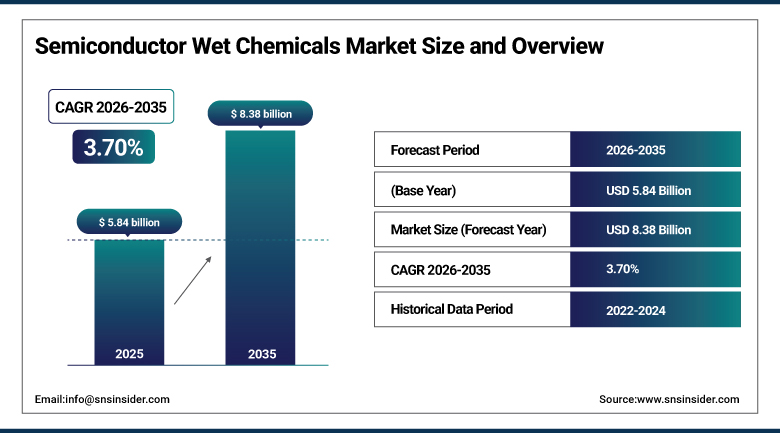
The Semiconductor Wet Chemicals Market was valued at USD 5.84 Billion in 2025 and is expected to reach USD 8.38 Billion by 2035, growing at a CAGR of 3.70% from 2026–2035.
The market for Semiconductors Wet Chemicals is witnessing continuous growth due to the expansion of semiconductor manufacturing capabilities, growing need for improved electronics products and complex wafer fabrication operations. Wet chemicals play an important role during crucial stages of semiconductor production like cleaning, etching, stripping, surface treatments, and wafer processing which require extremely high purity chemicals in order to avoid contamination and ensure the quality of devices. The growing presence of advanced nodes, 3D NAND, DRAM, advanced packaging, and artificial intelligence semiconductor applications is creating increased demand for chemicals that have strict purity standards. Moreover, governments' support for semiconductor production programs and building of new fabs is stimulating the production and supply of high purity wet chemicals.
In June 2026, ZEON Corporation expanded its battery materials development initiatives, focusing on advanced binder technologies and electrode materials to support the growing commercialization of next-generation batteries, including sodium-ion battery applications.
To Get more information Semiconductor Wet Chemicals Market - Request Free Sample Report
Semiconductor Wet Chemicals Market Trends
-
Growing semiconductor manufacturing and wafer fabrication activities are driving demand for high-purity wet chemicals.
-
Increasing adoption of advanced semiconductor nodes is accelerating the use of specialized chemicals for wafer cleaning and etching.
-
Expanding production of integrated circuits, memory devices, and advanced logic chips is strengthening market demand.
-
Rising investments in semiconductor fabrication facilities and advanced packaging are supporting consumption of high-purity wet chemicals.
-
Increasing development of ultra-high-purity chemical formulations is improving contamination control and process efficiency in semiconductor manufacturing.
U.S. Semiconductor Wet Chemicals Market Outlook
The U.S. Semiconductor Wet Chemicals Market was valued at USD 1.31 Billion in 2025 and is expected to reach around USD 1.87 Billion by 2035, growing at a CAGR of 3.63% from 2026–2035.
The increasing need for semiconductor manufacturing in the U.S. is likely to drive the U.S. semiconductor wet chemicals market through the forecast period. There have been more investments by semiconductor manufacturers in advanced fabrication plants due to the increasing demand for integrated circuits, memory chips, processors, and other semiconductors. Wet chemicals like hydrogen peroxide, sulfuric acid, hydrochloric acid, ammonium hydroxide, nitric acid, and phosphoric acid are being used extensively in wafer cleaning, etching, wafer surface preparation, and photoresist stripping operations.
Furthermore, the rising use of advanced semiconductor nodes is leading to the increasing need for ultra-high purity chemicals along with effective contamination control and consistent chemical performance. The development in the domestic semiconductor manufacturing, which includes investments in new fabrication plants and advanced packaging facilities, is also boosting the demand from this market. Moreover, the technological innovations in wafer processing and chemical purification processes are contributing to process efficiencies and improved yield. Increased investments in semiconductor manufacturing chain localization and next generation chip manufacturing is likely to drive the demand for high purity wet chemicals in the U.S. during the forecast period.
In 2026, Brewer Science completed its acquisition of Heraeus Epurio’s semiconductor chemicals business, bringing ultrapure electronic chemical formulation and manufacturing capabilities in-house. The transaction strengthens Brewer Science’s domestic semiconductor materials portfolio and supports tighter control over purity and consistency requirements for advanced-node manufacturing.
Semiconductor Wet Chemicals Market Segment Analysis
-
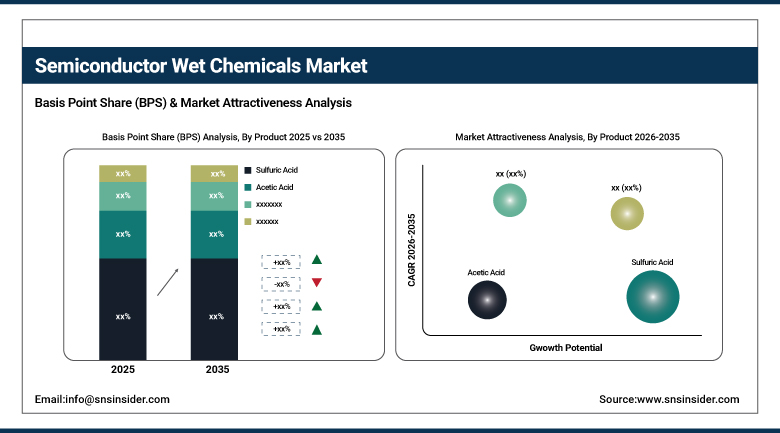
By Product, sulfuric acid dominated the semiconductor wet chemicals market with a 20.43% share in 2025, while hydrogen peroxide is projected to be the fastest-growing segment, increasing its market share from 6.05% CAGR by 2035.
-
By Application, cleaning dominated the semiconductor wet chemicals market with a 44.72% share in 2025, while etching is projected to be the fastest-growing segment, increasing its market share from 5.75% CAGR by 2035.
By Product, sulfuric acid dominated the semiconductor wet chemicals market, while hydrogen peroxide is expected to grow fastest
Sulfuric acid was the largest product segment in the global semiconductor wet chemicals market in 2025. Its dominance is attributed to its extensive use in wafer cleaning, photoresist stripping, and removal of organic contaminants during semiconductor fabrication. Sulfuric acid is particularly important in high-volume semiconductor manufacturing because of its strong oxidizing properties, effectiveness in removing photoresist residues, and compatibility with advanced cleaning formulations. The growing production of semiconductor wafers, increasing adoption of advanced process nodes, and stringent requirements for wafer cleanliness are supporting continued demand for high-purity sulfuric acid. In addition, its use in combination with hydrogen peroxide for advanced cleaning processes further strengthens its position among semiconductor wet chemicals.
Hydrogen peroxide is expected to be the fastest-growing product segment during the forecast period. The growth is supported by its extensive use in wafer cleaning and surface treatment, particularly in formulations designed to remove organic residues and particulate contamination. Hydrogen peroxide is widely incorporated into advanced cleaning processes because of its strong oxidizing properties and effectiveness in maintaining high wafer-surface purity. The increasing complexity of semiconductor devices, growing adoption of advanced nodes, expansion of semiconductor fabrication capacity, and rising demand for ultra-high-purity chemicals are expected to further increase its consumption. Its role in cleaner and more controlled semiconductor manufacturing processes is also supporting its growing adoption.
By Application, cleaning dominated the semiconductor wet chemicals market, while etching is expected to grow fastest
Cleaning was the largest application segment in the global semiconductor wet chemicals market in 2025. The segment's dominance is primarily attributed to the critical role of wet chemical cleaning in removing particles, organic residues, metallic contaminants, and other impurities from wafer surfaces throughout semiconductor manufacturing. As semiconductor geometries become smaller and device architectures become more complex, even minor contamination can affect wafer yield, device performance, and manufacturing reliability. Consequently, semiconductor manufacturers are increasing their use of high-purity cleaning chemicals and advanced cleaning formulations. The expansion of semiconductor fabrication facilities, increasing wafer production, and growing demand for high-performance chips for artificial intelligence, automotive electronics, consumer electronics, and data centers are further supporting the demand for wet chemical cleaning solutions.
Etching is expected to be the fastest-growing application segment. The growth is driven by the increasing adoption of advanced semiconductor nodes and the need for highly precise material removal during wafer fabrication. Wet etching enables selective removal of specific materials while minimizing damage to underlying layers, making it valuable for specialized semiconductor manufacturing processes. The increasing complexity of multilayer structures, shrinking feature sizes, advanced memory architectures, and growing adoption of sophisticated semiconductor fabrication technologies are expected to increase demand for high-performance etching chemicals. Furthermore, continued investment in new semiconductor fabs and the expansion of advanced chip manufacturing capacity are likely to create additional opportunities for specialized wet chemical etching solutions.
Regional Analysis
|
Region |
Major Country |
Share within Region, 2025(%) |
|---|---|---|
|
North America |
United States |
78.46% |
|
Europe |
Germany |
28.74% |
|
Asia Pacific |
China |
46.32% |
|
Middle East & Africa |
Saudi Arabia |
32.18% |
|
Latin America |
Brazil |
45.27% |
North America Semiconductor Wet Chemicals Market Insights
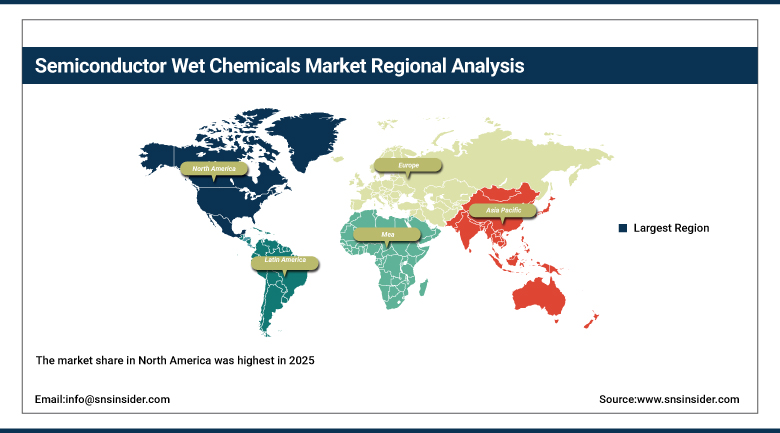
North America accounted for approximately 28.5% of the global Semiconductor Wet Chemicals Market in 2025, due to the presence of existing semiconductor fabrication industry, increased investment in advanced fabrication and the rising demand for high purity chemicals for wafer fabrication.
The U.S. had the largest market share in the regional market in 2025 due to the presence of large semiconductor manufacturers, fabs and chemical suppliers. Increasing investment in the semiconductor production, advanced logic and memory semiconductors and localization of the semiconductor supply chain is driving the growth of wet chemicals. Increase in the semiconductor fabrication capacity and advanced process nodes is further boosting the demand for high purity chemicals for cleaning, etching, surface preparation and photoresist stripping processes.
Get Customized Report as per Your Business Requirement - Enquiry Now
Europe Semiconductor Wet Chemicals Market Insights
The European semiconductor wet chemicals market is predicted to grow continuously due to the rise in investment towards semiconductor manufacturing and advanced electronics along with the development of semiconductor supply chain infrastructure within Europe. The growing development in semiconductor fabrication and research is leading to an increase in demand for high-purity chemicals that can be utilized in wafer cleaning and wafer surface preparation.
Semiconductor manufacturers within Europe are now concentrating on developing manufacturing abilities for power semiconductors, automotive semiconductors, sensors, and various advanced electronic components. Germany had been the major market in the European semiconductor wet chemicals market as per 2025 owing to its extensive automotive and industrial semiconductor industry and semiconductor manufacturing infrastructure.
Asia Pacific Semiconductor Wet Chemicals Market Insights
Asia Pacific is anticipated to witness the highest CAGR in the semiconductor wet chemicals market owing to rapid growth in semiconductor manufacturing capacity, increasing investment in state-of-the-art chip manufacturing, and rising demand for integrated circuits and memory chips. Countries like China, Taiwan, South Korea, Japan, and India are developing semiconductor manufacturing facilities and infrastructure, generating substantial demand for high purity wet chemicals.
In 2025, China held the largest market share in Asia Pacific, backed by growing infrastructure development in semiconductor manufacturing, domestic chip production plans, and investments in wafer fabrication and advanced electronic components. The increasing use of advanced manufacturing processes along with regional semiconductor capacity would help drive the demand for wet chemicals.
Middle East & Africa and Latin America Semiconductor Wet Chemicals Market Insights
The market for semiconductor wet chemicals in the Middle East & Africa region is anticipated to register steady growth with rising investments by nations in electronics manufacturing, technology infrastructure, and semiconductor manufacturing. Increasing efforts to diversify their economies away from their traditional energy sectors into other advanced industries are providing chances for semiconductor-related value chains. Saudi Arabia held the maximum market share in the Middle East & Africa region in 2025 owing to their efforts to diversify their economy, invest in technology, and develop their capabilities in the field of semiconductors and electronics.
There are rising chances for the semiconductor wet chemicals market in the Latin American region owing to growing electronics manufacturing, automation of industrial operations, and investment in technology infrastructure. Increased production of semiconductors, assembly operations, testing of semiconductors, and electronic components is driving the requirement for higher purity processing chemicals. Brazil held the maximum market share in the Latin American region in 2025 owing to its large industrial and electronics markets and increased investments in advanced manufacturing.
Market Dynamic
Growth Driver: Rising semiconductor fabrication capacity is driving semiconductor wet chemicals market growth
The growth of semiconductor wet chemicals market can be attributed to the rising investments in semiconductor fabrication facilities across the globe. There has been a growing need for integrated circuits, memory chips, processors, power semiconductors, and advanced electronic components that have led to investments in wafer fabrication plants. Hydrogen peroxide, sulfuric acid, hydrochloric acid, ammonium hydroxide, nitric acid, and phosphoric acid are required for wafer cleaning, wafer etching, surface treatment, and photoresist stripping.
Moreover, there is an increased demand for advanced semiconductor nodes which necessitates the use of high purity chemicals to control the contamination level and improve yield of wafers. Government policies favoring domestic production of semiconductors and localizing of their supply chain are also contributing to increased investment in fabrication plants.
Restraints: Stringent purity requirements and chemical handling challenges may restrict semiconductor wet chemicals market growth
The semiconductor wet chemicals industry, despite enjoying excellent growth prospects, could be hindered by high purity standards and complicated handling specifications. Modern production of semiconductors calls for highly pure chemicals with extremely low content of metal contamination, particles, and any other contaminants. The process of controlling chemical purity at all stages from production to delivery is likely to raise production and quality control expenses.
Moreover, most wet chemicals are often highly corrosive, reactive, and dangerous, and therefore necessitate dedicated storage facilities, sophisticated transport network, and special disposal procedures. Growing restrictions on the release of chemicals into the environment, as well as their treatment before disposal, will impose additional costs on producers and semiconductor fabricators. Disruptions within the chain of supply of chemical raw materials could be another problem for this industry.
Opportunities: Expansion of advanced semiconductor manufacturing is creating new growth opportunities
Rapid growth in the manufacture of advanced semiconductor is likely to provide ample opportunities for the global semiconductor wet chemicals market. Growing manufacturing of advanced logic chips, memory components, power semiconductors, and other advanced components has created the demand for better purity level and consistency in processes for wet chemicals.
Smaller process node technology along with increased complexity of wafer has added the requirement of better cleaning, etching, and surface treatment process. Moreover, advancements in advanced packaging techniques, three-dimensional semiconductor structure, and wafer processing technology have widened the scope for wet chemicals in semiconductor manufacturing process. Increased investments in the region specific semiconductor fab facilities, especially in the Asia Pacific and North American regions, are driving the chemical manufacturers to set up their manufacturing facilities and develop advanced ultra-high purity chemicals.
Recent Developments
-
2026: FUJIFILM Corporation signed an MoU with Gujarat in June 2026 to explore semiconductor materials manufacturing and strengthen India’s supply chain.
-
2026: FUJIFILM Corporation completed a GBP 5 billion Rapidus investment in February 2026 to support advanced semiconductor development and manufacturing.
-
2026: FUJIFILM Corporation showcased advanced semiconductor materials, including fluorine-free negative ArF immersion resist, at the Semiconductor of the Year 2026.
-
2026: Kanto Chemical Co., Inc. expanded high-purity electronic chemicals, cleaning solutions, etchants, and resist strippers for advanced semiconductor manufacturing.
-
2026: BASF SE advanced wet-processing chemistries for copper interconnects, through-silicon vias, and selective copper capping, supporting advanced fabrication processes.
Semiconductor Wet Chemicals Market Key Players are:
-
BASF SE
-
FUJIFILM Corporation
-
Merck KGaA
-
Entegris, Inc.
-
Honeywell International Inc.
-
Kanto Chemical Co., Inc.
-
Mitsubishi Chemical Corporation
-
Solvay S.A.
-
Eastman Chemical Company
-
Dow Inc.
-
DuPont de Nemours, Inc.
-
Linde plc
-
Air Liquide S.A.
-
Avantor, Inc.
-
Tokyo Ohka Kogyo Co., Ltd.
-
JSR Corporation
-
Shin-Etsu Chemical Co., Ltd.
-
Sumitomo Chemical Co., Ltd.
-
Stella Chemifa Corporation
-
Technic Inc.
Semiconductor Wet Chemicals Market Report Scope:
| Report Attributes | Details |
|---|---|
| Market Size in 2025 | USD 5.84 Billion |
| Market Size by 2035 | USD 8.38 Billion |
| CAGR | CAGR of 3.70% From 2026 to 2035 |
| Base Year | 2025 |
| Forecast Period | 2026-2035 |
| Historical Data | 2022-2024 |
| Report Scope & Coverage | Market Size, Segments Analysis, Competitive Landscape, Regional Analysis, DROC & SWOT Analysis, Forecast Outlook |
| Key Segments | • By Product (Acetic Acid, Hydrogen Peroxide, Hydrochloric Acid, Ammonium Hydroxide, Nitric Acid, Sulfuric Acid, Phosphoric Acid, Others) • By Application (Cleaning, Etching, Photoresist Stripping, Surface Preparation, Integrated Circuit Manufacturing, Others) |
| Regional Analysis/Coverage | North America (US, Canada), Europe (Germany, UK, France, Italy, Spain, Russia, Poland, Rest of Europe), Asia Pacific (China, India, Japan, South Korea, Australia, ASEAN Countries, Rest of Asia Pacific), Middle East & Africa (UAE, Saudi Arabia, Qatar, South Africa, Rest of Middle East & Africa), Latin America (Brazil, Argentina, Mexico, Colombia, Rest of Latin America) |
| Company Profiles | BASF SE, FUJIFILM Corporation, Merck KGaA, Entegris, Inc., Honeywell International Inc., Kanto Chemical Co., Inc., Mitsubishi Chemical Corporation, Solvay S.A., Eastman Chemical Company, Dow Inc., DuPont de Nemours, Inc., Linde plc, Air Liquide S.A., Avantor, Inc., Tokyo Ohka Kogyo Co., Ltd., JSR Corporation, Shin-Etsu Chemical Co., Ltd., Sumitomo Chemical Co., Ltd., Stella Chemifa Corporation, Technic Inc. |
Frequently Asked Questions
The market is driven by expanding semiconductor fabrication capacity, increasing production of advanced integrated circuits and memory devices, and rising demand for high-purity chemicals in wafer cleaning, etching, and surface preparation processes.
Sulfuric acid dominated the semiconductor wet chemicals market in 2025 with a 20.43% share, based on the provided market segmentation data.
North America dominated the semiconductor wet chemicals market in 2025, based on the regional market structure provided.
