
Wearable Technology In Healthcare Market Report Scope & Overview:
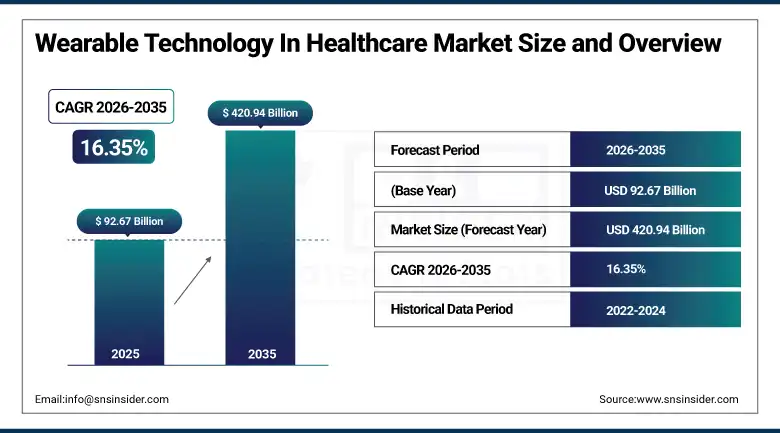
The Wearable Technology In Healthcare Market was valued at USD 92.67 Billion in 2025 and is projected to reach USD 420.94 Billion by 2035, expanding at a CAGR of 16.35% during the forecast period 2026–2035.
The global market for wearable technology in healthcare is rapidly commercializing, driven by the increasing adoption of remote patient monitoring systems, AI-powered health tracking platforms, and connected digital healthcare ecosystems in hospitals and consumer healthcare environments. Wearable biosensors, continuous monitoring systems, cloud-connected smart devices, and predictive health analytics platforms are increasingly being adopted by healthcare providers and technology companies to improve chronic disease management, preventive healthcare delivery and patient engagement. The increasing adoption of AI-driven diagnostics, live biometric monitoring, and smart healthcare infrastructure is offering significant backing to long-term market growth across both developed and developing healthcare economies.
In 2025–2026, several healthcare technology providers extended commercialization of AI-enabled wearable monitoring platforms integrated with predictive analytics, cloud-based patient monitoring systems and remote diagnostic capabilities.
To Get more information On Wearable Technology In Healthcare Market - Request Free Sample Report
Wearable Technology In Healthcare Market Trends
-
Increasing adoption of AI-enabled wearable health monitoring platforms globally.
-
Rising deployment of remote patient monitoring systems across healthcare infrastructure.
-
Growing commercialization of cloud-connected wearable diagnostic ecosystems.
-
Expansion of smart hospital infrastructure integrated with wearable biosensor technologies.
-
Increasing integration of predictive analytics and real-time biometric monitoring capabilities.
The U.S. Wearable Technology In Healthcare Market Size Outlook
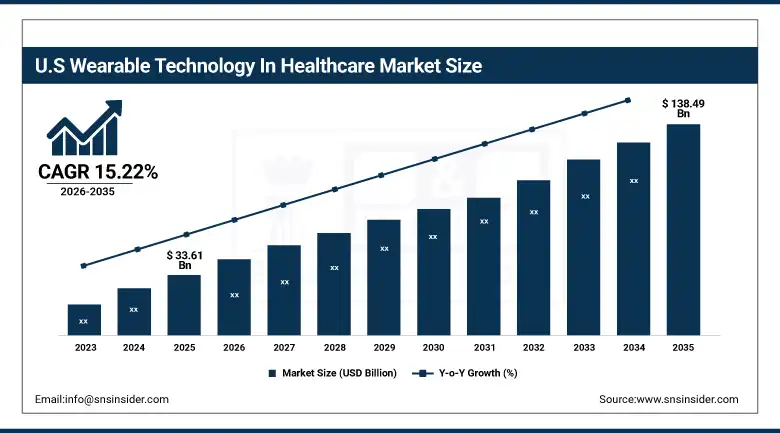
The U.S. Wearable Technology In Healthcare Market was valued at USD 33.61 billion in 2025 and is expected to reach approximately USD 138.49 billion by 2035, expanding at a CAGR of 15.22 % during 2026–2035.
The U.S. continues to hold a dominant position in the wearable healthcare technology market driven by robust digital healthcare infrastructure, increasing deployment of AI-powered remote patient monitoring systems, and high consumer uptake of connected healthcare devices. Hospitals, healthcare providers and digital health companies are investing more in wearable biosensors, predictive health analytics systems, cloud-enabled monitoring platforms and AI-assisted chronic disease management solutions to improve patient outcomes and operational efficiency. The reimbursement support for remote monitoring services is increasing and the investments in preventive healthcare technologies are rising, supporting the long-term growth of the market across the country.
Several healthcare technology companies based in the U.S. accelerated the deployment of AI-enabled wearable monitoring platforms that integrate predictive cardiovascular analytics and cloud-connected patient engagement systems in 2026.
Wearable Technology In Healthcare Market Segment Analysis
-
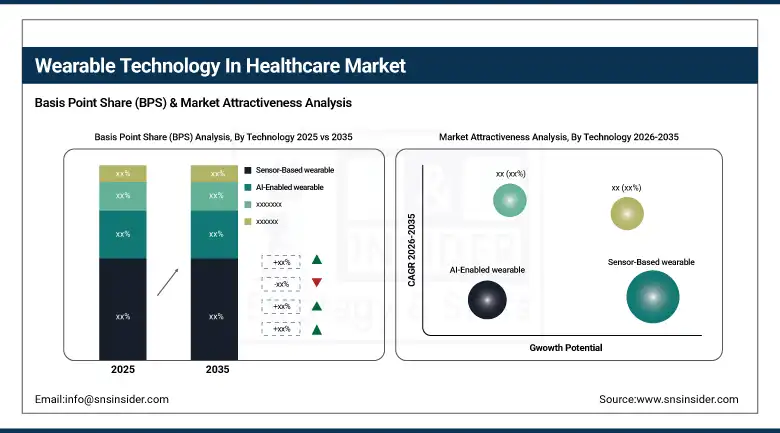
By Product Type, smartwatches & wrist-worn devices dominated the market with 48.00% share in 2025, while continuous monitoring devices (CGM, ECG, BP Monitoring) are projected to witness the fastest growth with 18.36% CAGR during the forecast period.
-
By Technology, sensor-based wearables dominated the market with 52.00% share in 2025, while AI-enabled wearables are projected to witness the fastest growth with 20.98% CAGR during the forecast period.
-
By Application, remote patient monitoring (RPM) dominated the market with 38.00% share in 2025, while fitness, wellness & preventive healthcare is projected to witness the fastest growth with 16.10% CAGR during the forecast period.
-
By End User, healthcare providers (hospitals & clinics) dominated the market with 45.00% share in 2025, while patients & consumers are projected to witness the fastest growth with 19.12% CAGR during the forecast period.
By Product Type, smart watches & wrist-worn devices dominated, while continuous monitoring devices are fastest-growing.
The smart watches & wrist-worn devices segment accounted for the largest revenue share of 48.00% in 2025 due to the growing adoption of connected fitness monitoring devices, heart-rate tracking systems, and AI-enabled wellness management applications by consumers. Healthcare providers and digital health companies are increasingly integrating wrist-based monitoring systems with cloud-connected healthcare ecosystems to improve the delivery of preventive healthcare and patient engagement. The increasing access to multifunctional wearable devices that include ECG, SpO2, sleep tracking, and activity monitoring capabilities is significantly boosting commercial adoption across healthcare and consumer wellness sectors around the world.
The continuous monitoring devices (CGM, ECG, BP Monitoring) segment is expected to grow at the fastest CAGR of 18.36% during the forecast period owing to increasing prevalence of chronic diseases, increasing demand for real-time patient monitoring, and increasing commercialization of clinical-grade wearable monitoring technologies. Healthcare providers are increasingly deploying wearable CGM systems, remote ECG monitoring devices, and cloud-connected blood pressure monitoring platforms for continuous patient surveillance and early disease intervention. In the 2025–2026 period, several medical technology companies launched wearable cardiac monitoring systems powered by AI, integrated with predictive analytics and remote healthcare management capabilities.
By Technology, sensor-based wearable dominated, while AI-enabled wearable are fastest-growing.
The sensor-based wearables segment held the largest market share of 52.00% in 2025, owing to the high integration of biosensors, motion tracking systems, gyroscopes, glucose sensors, and physiological monitoring components in wearable healthcare devices. A growing number of healthcare technology providers are rolling out wearable platforms with integrated sensors to support constant biometric monitoring, preventive health tracking, and clinical-grade physiological data capture. The long-term market expansion worldwide is being helped by the commercial acceptance of advanced biosensor technologies in hospitals, fitness monitoring systems, and remote healthcare infrastructure.
The AI-enabled wearables are expected to grow with the fastest CAGR of 20.98% during the forecast period owing to the increasing integration of predictive health analytics, generative AI-assisted diagnostics, and intelligent patient monitoring algorithms within the wearable healthcare ecosystem. More and more, tech companies and health systems are commercializing AI-enabled wearables that can detect abnormal cardiac activity, predict disease risk, and offer personalized health recommendations based on real-time analytics. In 2026, multiple vendors of wearable technology launched AI-enabled smart healthcare devices that support predictive health scoring, remote diagnostics, and automated patient engagement systems.
Regional Analysis
|
Region |
Major Country |
Share within Region, 2025 (%) |
|---|---|---|
|
North America |
United States |
93.00% |
|
Europe |
Germany |
27.00% |
|
Asia Pacific |
China |
25.00% |
|
Middle East & Africa |
UAE |
5.00% |
|
Latin America |
Brazil |
4.00% |
North America Wearable Technology In Healthcare Market Insights
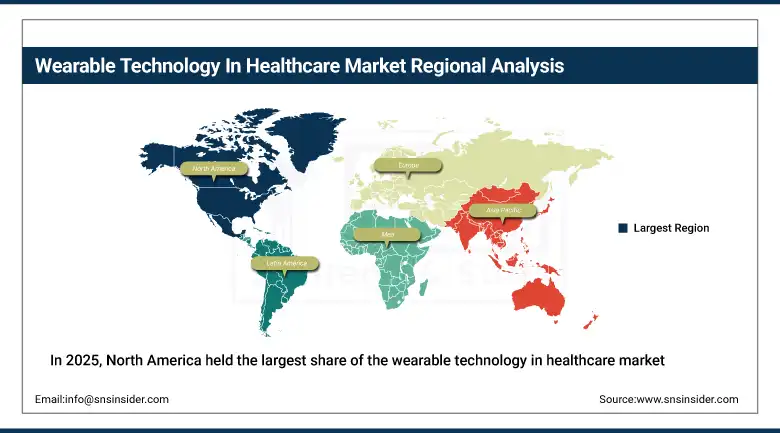
In 2025, North America held the largest share of the wearable technology in healthcare market, accounting for about 39.00% of the revenue share. The growth is attributed to the presence of advanced healthcare infrastructure, rapid digital health transformation, and rising commercialization of AI-enabled wearable healthcare technologies in the United States and Canada. Hospitals, healthcare systems and technology companies are investing more and more into remote patient monitoring systems, cloud-connected wearable ecosystems, predictive health analytics platforms and AI-powered diagnostic wearable in a bid to improve healthcare efficiency and patient outcomes. Increased adoption of preventive healthcare and increasing investments in connected healthcare infrastructure are some of the major factors propelling the growth of the region.
Several North American healthcare technology companies in 2026 saw commercialization expansion for AI-assisted wearable monitoring platforms that integrated predictive cardiovascular analytics along with cloud-enabled patient engagement systems.
Get Customized Report as per Your Business Requirement - Enquiry Now
Europe Wearable Technology In Healthcare Market Insights
Market share of Europe was nearly 27.00% in 2025 driven by rising healthcare digitalization initiatives, increasing adoption of wearable patient monitoring systems, and growing investments towards preventive healthcare technologies in Germany, the U.K., France, Italy, and other prominent healthcare markets of Europe. Healthcare providers across the region are deploying AI-assisted wearable biosensors, remote monitoring systems, and connected healthcare analytics platforms to support better management of chronic diseases, care of the elderly, and operational efficiencies across hospitals and outpatient settings. The rising incidence of cardiovascular diseases, diabetes and respiratory disorders is driving demand for wearable healthcare technologies that can facilitate continuous patient monitoring and predictive diagnostics.
During 2025–2026, several European healthcare providers expanded their implementation of AI-integrated wearable monitoring systems that enable predictive diagnostics, cloud-based patient analytics and real-time patient tracking capabilities across connected healthcare environments.
Asia Pacific Wearable Technology In Healthcare Market Insights
Asia Pacific is likely to observe the fastest CAGR of 19.62% during the forecast period owing to increasing healthcare digitalization, rapid smartphone penetration, increasing healthcare expenditure, and growing adoption of connected wearable health devices across China, Japan, South Korea, India, and South-east Asia. Across the region, healthcare providers, technology companies and digital health startups are increasingly rolling out AI-powered wearable monitoring systems, integrated with cloud-connected healthcare ecosystems, to enhance healthcare accessibility, preventive care delivery and chronic disease management. The increasing incidence of lifestyle-related disorders, ageing demographics, and heightened awareness about personalized healthcare management are substantially driving demand for wearable medical technologies across the region.
number of Asia Pacific healthcare technology companies commercialized AI-enabled wearable monitoring platforms integrated with predictive health analytics, automated clinical alerts and remote patient management systems to improve healthcare delivery efficiency and personalized care outcomes in 2026.
Middle East & Africa and Latin America Wearable Technology In Healthcare Market Insights
The Middle East & Africa market is witnessing stable growth, fueled by escalating investments in smart healthcare infrastructure, expanding deployment of wearable patient monitoring systems, and escalating adoption of AI-enabled healthcare technologies across UAE, Saudi Arabia, South Africa and other regional healthcare markets. Healthcare providers are spending more on cloud-enabled wearable healthcare ecosystems, predictive monitoring solutions and remote diagnostic technologies to increase operational efficiency, patient engagement and the management of chronic diseases. Government-led healthcare modernization initiatives, digital health transformation programmers, and growing investments in connected healthcare infrastructure further support commercialization opportunities across the region.
Latin America accounted for nearly 5.00% market share in 2025 propelled by rising consumer adoption of connected healthcare devices, growth of digital healthcare infrastructure and growing commercialization of wearable monitoring systems in Brazil, Mexico, Argentina and Chile. Healthcare providers and digital health companies are increasingly adopting AI-based wearable platforms, health analytics systems integrated with cloud computing, and patient remote monitoring technologies across the region to improve healthcare accessibility and optimize chronic disease management. Increasing penetration of smartphones, growing awareness related to health, and rising investments in telehealth ecosystems are also contributing significantly to the regional market growth.
Market Dynamics
Growth Drivers: Uptake of remote patient monitoring and AI-enabled healthcare wearables.
The growing acceptance of remote patient monitoring systems and AI-powered wearable healthcare technologies is driving major growth in the market globally. Healthcare providers, insurers and digital health companies are increasingly using wearable biosensors, cloud-connected monitoring devices and predictive healthcare analytics platforms to improve chronic disease management, reduce hospital readmissions and improve preventive healthcare delivery in clinical and homecare settings. AI-powered diagnostics, ongoing biometric monitoring and predictive health analytics integrated into wearable ecosystems. Growing demand for remote healthcare delivery and value-based care programmers have led healthcare organizations to increasingly adopt wearable ECG monitors, smart glucose monitoring solutions, fitness biosensors, and AI-enabled cardiac monitoring devices.
During 2025–2026, several wearable healthcare technology providers commercialized advanced AI-enabled patient monitoring ecosystems integrated with predictive analytics, automated clinical alerts, cloud-connected healthcare management capabilities, and intelligent remote care coordination technologies.
Restraints: Privacy concerns around data and integration costs for healthcare systems.
Although technology is advancing rapidly, healthcare data privacy concerns, compliance with cyber security, device interoperability, and high costs of implementation continue to limit the commercialization of wearable healthcare technologies in healthcare settings globally. Enterprise-grade wearable monitoring ecosystems often require substantial investments in cloud infrastructure, healthcare IT integration. The integration of wearable monitoring systems into legacy healthcare infrastructure and existing electronic health record environments is often accompanied by operational and financial barriers for smaller healthcare providers, independent clinics, and emerging healthcare facilities.
Healthcare’s regulatory organizations in 2026 rolled out updated guidelines for cyber security, digital health governance, interoperability and compliance for wearable healthcare technologies and connected patient monitoring platforms that operate across enterprise healthcare ecosystems.
Opportunities: Growth in cloud-connected healthcare ecosystems and predictive analytics platforms.
The long-term opportunities for global wearable healthcare technology vendors are enormous, with the rapid expansion of cloud-connected healthcare infrastructure and AI-powered predictive health analytics platforms. Healthcare organizations are investing more and more in enterprise wearable ecosystems, connected remote monitoring platforms, AI-assisted diagnostic tools and predictive healthcare analytics technologies to improve healthcare accessibility, patient engagement, operational scalability and chronic disease management efficiency. Cloud-based wearable ecosystems allow healthcare providers to access real-time patient information, predictive clinical insights, centralized monitoring systems, and automated health alerts across distributed healthcare environments thus improving care coordination and clinical workflow efficiency. As telehealth services, remote patient management programmers, and home-based healthcare delivery models gain traction, the global commercialization of connected wearable technologies is speeding up.
In 2025, with integrated AI-enabled clinical decision support systems, cloud-based patient monitoring infrastructure, intelligent healthcare automation technologies, and real-time remote care management capabilities to improve healthcare efficiency and personalized patient outcomes.
Recent Developments
-
2026: Apple expanded deployment of AI-enabled health monitoring capabilities integrated with predictive wellness analytics across wearable healthcare devices.
-
2026: Samsung Electronics introduced upgraded Galaxy wearable platforms supporting AI-powered cardiovascular monitoring and personalized health analytics.
-
2025: Fitbit expanded commercialization of cloud-connected wearable monitoring ecosystems integrated with remote patient management capabilities.
-
2025: Garmin introduced advanced wearable health tracking systems integrated with predictive biometric analytics and AI-assisted wellness monitoring technologies.
Wearable Technology In Healthcare Market Key Players are:
-
Apple Inc.
-
Samsung Electronics Co., Ltd.
-
Fitbit LLC
-
Garmin Ltd.
-
Xiaomi Corporation
-
Huawei Technologies Co., Ltd.
-
Medtronic plc
-
Dexcom Inc.
-
Abbott Laboratories
-
Koninklijke Philips N.V.
-
Omron Healthcare Inc.
-
Polar Electro Oy
-
Withings SA
-
AliveCor Inc.
-
BioTelemetry Inc.
-
Sotera Wireless Inc.
-
Masimo Corporation
-
Whoop Inc.
-
Empatica Inc.
-
VitalConnect Inc
Wearable Technology In Healthcare Market Report Scope:
| Report Attributes | Details |
|---|---|
| Market Size in 2025 | USD 92.67 Billion |
| Market Size by 2035 | USD 420.94 Billion |
| CAGR | CAGR of 16.35% From 2026 to 2035 |
| Base Year | 2025 |
| Forecast Period | 2026-2035 |
| Historical Data | 2022-2024 |
| Report Scope & Coverage | Market Size Analysis, Revenue Forecasting, Segment Analysis, Competitive Landscape, Regional Analysis, Retail Automation Assessment, Smart Checkout Technology Trends, AI-Enabled Retail Infrastructure Analysis, DROC & SWOT Analysis, Investment Trends, Supply Chain Evaluation, Consumer Transaction Technology Assessment, and Future Market Opportunity EvaluationChain Evaluation, Industrial Packaging Demand Analysis, Sustainability Assessment, DROC & SWOT Analysis, Regulatory Framework Analysis, Innovation Benchmarking, and Future Market Opportunity Evaluation |
| Key Segments | • By Product Type (Smartwatches & Wrist-Worn Devices, Continuous Monitoring Devices (CGM, ECG, BP Monitors), Wearable Patches & Therapeutic Devices) • By Technology (Sensor-Based Wearables, AI-Enabled Wearables, Connected IoT Wearables) • By Application (Remote Patient Monitoring (RPM), Chronic Disease Management, Fitness, Wellness & Preventive Healthcare) • By End User (Healthcare Providers (Hospitals & Clinics), Patients & Consumers, Research & Healthcare Institutions) |
| Regional Analysis/Coverage | North America (US, Canada), Europe (Germany, UK, France, Italy, Spain, Russia, Poland, Rest of Europe), Asia Pacific (China, India, Japan, South Korea, Australia, ASEAN Countries, Rest of Asia Pacific), Middle East & Africa (UAE, Saudi Arabia, Qatar, South Africa, Rest of Middle East & Africa), Latin America (Brazil, Argentina, Mexico, Colombia, Rest of Latin America). |
| Company Profiles | Apple Inc., Samsung Electronics Co., Ltd., Fitbit LLC, Garmin Ltd., Xiaomi Corporation, Huawei Technologies Co., Ltd., Medtronic plc, Dexcom Inc., Abbott Laboratories, Koninklijke Philips N.V., Omron Healthcare Inc., Polar Electro Oy, Withings SA, AliveCor Inc., BioTelemetry Inc., Sotera Wireless Inc., Masimo Corporation, Whoop Inc., Empatica Inc., VitalConnect Inc. |
Frequently Asked Questions
The Wearable Technology in Healthcare Market was valued at USD 92.67 billion in 2025.
The market is projected to reach USD 420.94 billion by 2035.
The market is expected to expand at a CAGR of 16.35% during the forecast period.
North America dominated the global market owing to strong digital healthcare infrastructure and rapid commercialization of AI-enabled wearable monitoring technologies.
Smart watches & Wrist-Worn Devices accounted for the largest revenue share of 48.00% in 2025.
